
Pole barn · GA
Pole Barns in Georgia
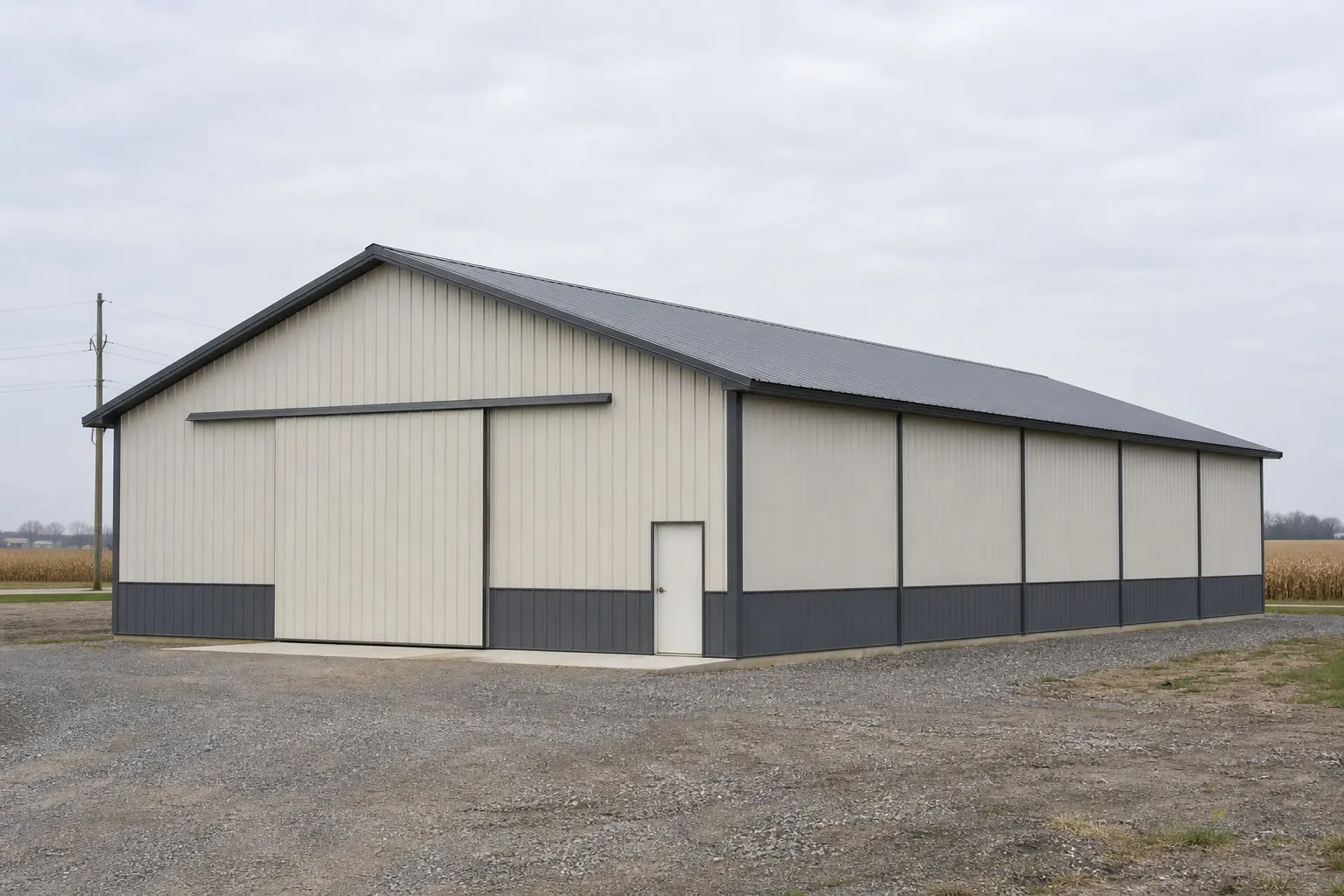
Georgia's post-frame demand traces directly back to its land: 39,264 farms covering 9,939,313 acres, at an average size of 253 acres, need efficient equipment and feed storage. But the state's five physiographic provinces mean the same pole barn design faces very different ground conditions depending on where it sits — from the sandy flats of the Coastal Plain to the red clay of the Piedmont to the sloped terrain of the Blue Ridge in the north. Planning a Georgia pole barn starts with identifying which province the site falls in, then matching the post foundation and ventilation strategy to that terrain and to Georgia's sustained annual rainfall.
Provincial Specs
What changes by Georgia province
Post-frame foundation and design priorities shift across Georgia's five physiographic provinces.
| Province | Typical Soil/Terrain | Design Priority |
|---|---|---|
| Coastal Plain | Sandy, flat | Drainage and wind-uplift anchoring |
| Piedmont | Red clay, rolling hills | Deep, stabilized post footings |
| Blue Ridge / Valley and Ridge | Sloped, rocky in places | Site grading and slope management |
Coastal Plain
- Typical Soil/Terrain
- Sandy, flat
- Design Priority
- Drainage and wind-uplift anchoring
Piedmont
- Typical Soil/Terrain
- Red clay, rolling hills
- Design Priority
- Deep, stabilized post footings
Blue Ridge / Valley and Ridge
- Typical Soil/Terrain
- Sloped, rocky in places
- Design Priority
- Site grading and slope management
Construction Strategy
The post-frame advantage across Georgia's terrain
Post-frame construction adapts well to Georgia's varied ground, but the foundation approach needs to match the province.
In the Piedmont, which includes the metro Atlanta corridor, builders work primarily with red clay soil. This soil compacts into a strong base but is prone to seasonal swelling and shrinking. A pole barn's deeply embedded posts generally handle this movement better than a rigid slab-on-grade alternative, provided the posts are set below typical frost depth and properly anchored against heave.
On the Coastal Plain, which covers the largest share of Georgia's 57,513.5 square miles, the sandy soil drains well but offers less lateral resistance to wind uplift. Pole barns here typically need larger concrete pads at the base of each post to prevent settling or lifting during severe thunderstorm winds. Farther north, in the Blue Ridge and Valley and Ridge provinces, the terrain itself becomes the main site-prep cost: grading a level pad on sloped ground, and in sections like the Lookout Mountain District, working around rock outcrop close to the surface.
Across all three regions, Georgia's sustained rainfall is the constant design factor. With an Atlanta-area annual normal near 50.4 inches, a pole barn storing hay, feed, or equipment needs ridge and eave ventilation as a functional requirement, not an upgrade — trapped humidity can spoil stored feed or corrode equipment well before it visibly damages the structure itself.
Dimensions
Sizes that fit Georgia farms
With an average farm size of 253 acres, Georgia pole barns often lean toward footprints that can house multiple pieces of heavy equipment.
30′ × 50′
1,500 sq ft
Common for smaller operations or as an auxiliary building alongside an existing barn.
40′ × 60′
2,400 sq ft
A versatile standard size for Piedmont and Coastal Plain farms needing hay and equipment storage together.
40′ × 80′
3,200 sq ft
Frequently chosen for larger-scale storage on Georgia's bigger farm tracts.
Example Configuration — for planning purposes only.
Because Georgia's farm count fell while average acreage grew between 2017 and 2022, many owners consolidating operations size up by one bay to accommodate future equipment growth rather than adding a second building later.
Get your Georgia pole barn quote
Connect with local post-frame builders who understand Georgia's provincial soil and climate conditions.
Environmental Resilience
Preparing for Georgia's regional hazards
Georgia's hazard exposure varies enough by county that FEMA's National Risk Index, not a statewide assumption, is the right reference point.
Coastal Plain
Southern Georgia counties can see tropical-system remnants bring heavy rain and wind; confirming your specific county's FEMA NRI exposure helps set uplift-anchoring expectations before framing begins.
Piedmont
Severe thunderstorms and occasional tornado activity are the main seasonal concern; hurricane-tie connections between trusses and posts are a common upgrade even away from the coast.
North Georgia mountains
Cooler winters and steeper terrain shift the focus toward site drainage and grading; standing water on a sloped pad undermines post stability faster than in flatter provinces.
Site Access
Getting materials to a rural Georgia site
A pole barn's post-frame components arrive on long trailers, and Georgia's mix of provinces means the delivery route deserves as much planning as the foundation.
On a Coastal Plain farm, long, straight approach roads generally make delivery straightforward, but a wet spring can turn a sandy access lane soft enough to bog down a loaded trailer; graveling or grading the final approach before delivery day avoids a costly delay. In the Piedmont, red clay access roads become slick and rutted after Georgia's sustained rainfall, so scheduling delivery around a dry stretch, or hardening the lane with base material, keeps the project on schedule.
North Georgia's Blue Ridge and Valley and Ridge terrain adds a third variable: switchback driveways and tighter turning radii on hillside properties can rule out the longest post and truss deliveries unless the access route is confirmed with the supplier in advance. Walking the delivery path with your builder before ordering, not after the trailer is loaded, is the cheapest way to avoid a re-routed or split delivery.
Storm-Season Readiness
Protecting equipment and stored feed year-round
An open or semi-enclosed pole barn holding equipment, hay, or livestock feed benefits from a seasonal checklist tailored to Georgia's regional weather split.
Step 1
Check FEMA NRI exposure for your county
Georgia's hazard exposure varies by county and tract across 18 hazard types tracked by FEMA's National Risk Index; use it to set expectations for wind, flood, and severe-storm risk before finalizing anchoring specs.
Step 2
Inspect truss-to-post connections each spring
Regardless of province, hurricane ties and adequate fastener counts at the truss-to-post connection carry the uplift load during severe thunderstorm season.
Step 3
Plan drainage around the pad
With an Atlanta-area annual precipitation normal near 50.4 inches, graded swales that direct water away from the building pad protect post stability over time.
Step 4
Ventilate stored feed and hay proactively
Ridge vents and eave baffles prevent trapped humidity from spoiling stored feed, a risk that shows up well before visible rust or rot appears on the structure.
Questions
Georgia Pole Barn FAQ
Common questions about agricultural post-frame buildings in Georgia.
Some Georgia counties offer exemptions or streamlined permitting for bona fide agricultural buildings on active farmland, but this varies by county. Always confirm with your local building official before starting construction.
Piedmont clay generally needs deeper, stabilized post footings, Coastal Plain sand needs larger anchor pads for wind uplift resistance, and North Georgia's sloped terrain requires more site grading. A local soil check is the best way to confirm which applies to your lot.
Ridge vents, vented soffits, and keeping large doors open during the day all help. Many Georgia owners also apply a drip-stop membrane under the roof panels to catch and dissipate condensation before it drips onto stored equipment.
Both are common. Pressure-treated wood posts remain the traditional choice, but some Georgia buyers choose perma-columns or all-steel posts to reduce the risk of rot in the state's humid climate.
Yes. Coastal Plain sites generally prioritize wind-uplift anchoring and drainage, while North Georgia mountain sites prioritize site grading and slope stability. Confirm your county's specific hazard profile with FEMA's National Risk Index before finalizing plans.
Sources for the Georgia facts on this page
This page states no code requirement, wind speed, snow load, permit rule, price or supplier claim. The state-specific facts it does use are listed with their publisher below.
Georgia had 39,264 farms in 2022, down 7% from 2017, covering 9,939,313 acres of land in farms with an average farm size of 253 acres (up 8% since 2017).
USDA National Agricultural Statistics Service (NASS) · 2022 · Tier 1
https://www.nass.usda.gov/Publications/AgCensus/2022/Online_Resources/County_Profiles/Georgia/cp99013.pdfGeorgia had 39,264 farms in 2022, down 7% from 2017, covering 9,939,313 acres of land in farms with an average farm size of 253 acres (up 8% since 2017).
USDA National Agricultural Statistics Service (NASS) · 2022 · Tier 1
https://www.nass.usda.gov/Publications/AgCensus/2022/Online_Resources/County_Profiles/Georgia/cp99013.pdfThe New Georgia Encyclopedia (citing University of Georgia geography scholarship) describes Georgia as encompassing parts of five distinct physiographic provinces: the Appalachian Plateau, the Valley and Ridge, the Blue Ridge, the Piedmont, and the Coastal Plain.
New Georgia Encyclopedia (University of Georgia Press / Georgia Humanities) · Reference overview · Tier 2
https://www.georgiaencyclopedia.org/articles/geography-environment/geographic-regions-of-georgia-overview/The Georgia Environmental Protection Division / Georgia Geologic Survey publishes a detailed physiographic map and regional descriptions of Georgia, including named sections such as the Lookout Mountain District of the Appalachian Plateau province in the state's northwest corner.
Georgia Environmental Protection Division, Georgia Geologic Survey · 1988 (state reference map) · Tier 2
https://epd.georgia.gov/document/publication/sm-4-physiographic-map-georgia-12000000-1988/downloadAtlanta's (Hartsfield-Jackson) 1991-2020 annual climate normal precipitation is about 50.4 inches with roughly 2.2 inches of annual snowfall.
NOAA National Centers for Environmental Information (NCEI) · 1991-2020 · Tier 1
https://www.ncei.noaa.gov/access/services/data/v1?dataset=normals-monthly-1991-2020&dataTypes=MLY-PRCP-NORMAL,MLY-SNOW-NORMAL&format=csv&stations=USW00013874FEMA's National Risk Index platform (hazards.fema.gov) is the authoritative county/tract-level source for Georgia natural hazard exposure scores across 18 hazard types.
Federal Emergency Management Agency (FEMA) · Current NRI dataset · Tier 1
https://www.fema.gov/flood-maps/products-tools/national-risk-index