
Aircraft hangar · MI
Aircraft Hangars in Michigan
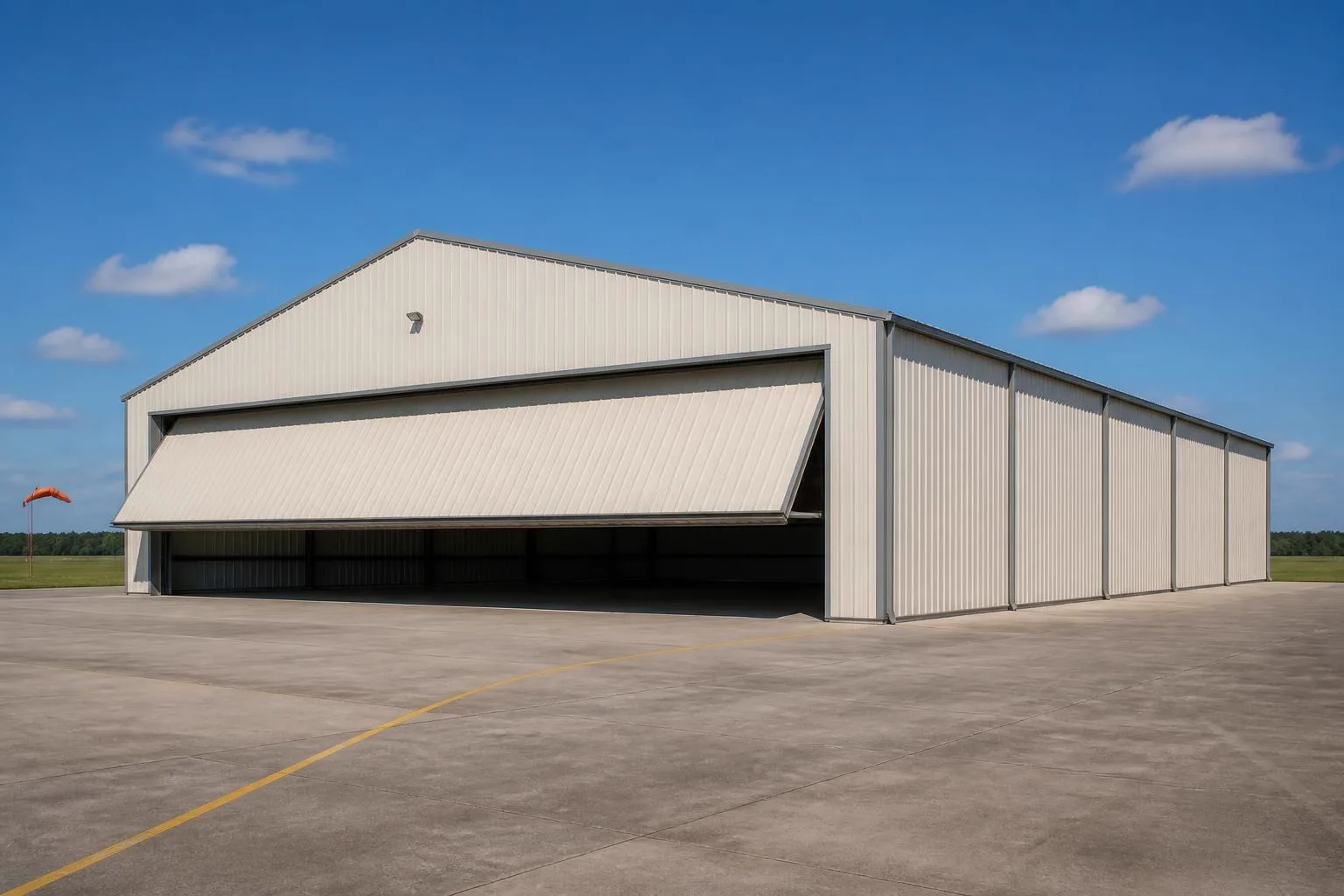
A hangar is the hardest steel building to get right in a northern state, because it combines the widest clear span with the largest moving opening on the property. In Michigan both of those are tested every winter: NWS Detroit/Pontiac references 1991-2020 normals that put the Detroit Metro Airport station near 34-35 inches of annual precipitation with mean January and February snowfall around 12-14 inches each, and FEMA's National Risk Index scores winter weather, ice storm and severe/strong wind among the 18 hazard types across the state's 83 counties. Add USGS's description of Michigan as two peninsulas separated by the Straits of Mackinac and you have a state where a hangar at a southern metro field and a hangar at a northern field are genuinely different projects.
Wide Roof, Big Opening, Northern Winter
Every hangar decision is a trade between clear width and everything else, and in Michigan that trade is priced by winter. The state's published benchmark normals come from Detroit Metro Airport — roughly 34-35 inches of annual precipitation and mean January and February snowfall near 12-14 inches each — and that is the mild end of the state. FEMA's National Risk Index, the federal tool covering Michigan's 83 counties, scores winter weather, ice storm and severe/strong wind among its 18 hazard types. A hangar has to hold a wide unsupported roof under that loading and still open a door the full width of the building on the coldest morning of the year.
Operability
In Michigan the Door Is the Building
Choose the hangar door for winter operation first and aesthetics second. In Michigan the failure mode is not structural — it is a door that will not open, or an apron you cannot clear.
Bifold, hydraulic and sliding doors all behave differently in ice. The important Michigan question to put to a supplier is not which door is strongest but what happens to each mechanism after a freezing-rain event, how the bottom seal behaves when it freezes to the apron, and what maintenance the drive needs at low temperature. Ice storm exposure is explicitly among the hazards FEMA scores across this state, so the question is routine rather than pessimistic.
The apron is the other half of the answer, and it is where Michigan hangar owners most often regret a decision made on paper. A full-width door needs its full width cleared to be useful, which means the snow has to go somewhere that is not in front of the door and not where roof snow will shed onto it. On a leased row of T-hangars the space available for that is often decided by the lease line, not by you. Work out the clearing plan — where the plough windrow ends up, where roof shed lands, who does the clearing — before the site plan is fixed.
Roof geometry follows from the same reasoning. A profile that sheds cleanly is an advantage until you consider what it sheds onto; on a hangar the shed line and the door approach are frequently the same ground. Getting this right is a free decision at layout stage and an annual problem afterwards.
Site Context
Michigan Field Contexts
USGS describes Michigan as two peninsulas separated by the Straits of Mackinac, and hangar projects behave differently on each side of that line.
Southern Lower Peninsula metro fields
Closest to fabrication and freight, longest practical construction window, and the most active general-aviation demand. The binding constraints here are usually the airport sponsor's minimum standards, available lease lots and matching the finish and roofline of an existing hangar row — not the availability of contractors or materials.
Northern Lower Peninsula and lake-effect fields
Seasonal-use aircraft and heavier snow management dominate. Owners here are more likely to want a hangar that tolerates being unattended for weeks — which pushes toward simpler door mechanisms, a roof that does not rely on someone raking it, and drainage that works during a mid-winter thaw.
Upper Peninsula fields
Freight distance from southern-Michigan and northern-Indiana fabrication is a real budget item, and the build season is genuinely short: a slab poured late can push occupancy a full year. UP projects also carry the greatest gap between local design values and the Detroit-area normals, so nothing should be specified before the local numbers arrive.
Get hangar quotes for your Michigan field
Tell suppliers the field, the aircraft envelope and the local design values from your building department. Hangar quotes without those three inputs are not comparable.
Order of Operations
The Michigan Hangar Sequence
Hangar projects in Michigan fail on sequence more than on specification. Lease and design values come before any building decision.
Step 1
Read the ground lease and minimum standards first
The airport sponsor sets footprint, setbacks, finishes, door face, utilities and sometimes roof colour. We hold no sourced statewide summary of Michigan field standards, so this document is the authority — and it can invalidate a building you have already configured.
Step 2
Get the local snow, wind and frost values in writing
Enforcement is local across Michigan's 83 counties. A hangar's span makes it more sensitive to these values than almost any other building type, so obtain them before you choose a width.
Step 3
Fix the aircraft envelope, not just the aircraft
Tail height, wingspan with any future upgrade, and how the aircraft is manoeuvred in and out on a frozen apron determine the door clear opening. Michigan adds the practical point that towing on ice needs more room than towing on dry concrete.
Step 4
Commission a site investigation before the slab detail
USGS mapped hydrologic provinces across both peninsulas with the Michigan DNR; groundwater and soil behaviour vary enough that a standard slab detail is a gamble. This also governs frost-protected perimeter design.
Step 5
Plan heat and condensation deliberately
A part-heated hangar in a Michigan winter condenses on the underside of the roof and onto the aircraft. Decide whether the hangar is heated, tempered or cold, and specify insulation and ventilation to match that decision rather than retrofitting.
Step 6
Schedule construction against the season, not the calendar
With 21,750 privately-owned housing units authorised statewide in 2024, Michigan contractors and concrete crews are competing for the same short pour window. Book the foundation slot early or accept a later occupancy.
Footprints
Common Hangar Footprints
Clear span drives everything else, so start from the widest aircraft you expect to keep and work outward.
60′ × 100′
6,000 sq ft
A general-aviation single or twin with room to work around the aircraft on a day when the apron is unusable.
80′ × 80′
6,400 sq ft
A square footprint that maximises door width relative to span — useful where the lease lot is wide but shallow and snow storage is limited.
Example Configuration — for planning purposes only.
Span and door width should be settled with the airport sponsor's standards and your local design values in hand; the footprint pages carry the dimensional detail.
Evidence Position
What We Do Not Assert About Michigan Hangars
No snow load, wind speed, code edition, lease rule or price appears on this page. Those come from your airport sponsor and your local building department.
The Michigan facts used here are limited to sourced federal material: NOAA 1991-2020 normals as referenced by NWS Detroit/Pontiac, FEMA's National Risk Index as the federal hazard tool for the state's counties, USGS descriptions of the peninsulas and of the mapped hydrologic provinces, and Census building-permit authorisations for 2024. Everything else on this page is planning reasoning, labelled as such.
Hangars are the building type where borrowed numbers do the most damage, because a wide clear span concentrates the consequence of an under-estimate. If a supplier quotes you a Michigan hangar without asking which field it is at and what the local design values are, that is a signal about the quote rather than about the state.
Questions
Michigan Hangar Questions
What Michigan hangar owners actually need answered before they configure a building.
We do not publish one, and you should be wary of anyone who does without knowing your field. Michigan spans two peninsulas with very different winters and code enforcement is local across 83 counties. Ask the department with jurisdiction over the airport parcel for the design values, and give them to your supplier before you pick a span.
There is no single answer, but the selection criteria are specific here: how the mechanism behaves after freezing rain, whether the bottom seal frees itself from an icy apron, and what maintenance the drive needs in cold weather. Ice storm exposure is one of the hazards FEMA scores for Michigan counties, so treat it as a normal operating condition.
That is a zoning and airspace question rather than a building question, and it is answered locally. This page does not carry Michigan zoning or airspace rules; ask your local department and the field or aviation authority relevant to the site.
Yes. Freight from southern-Michigan and northern-Indiana fabrication is longer, the construction season is shorter, and local design values diverge furthest from the Detroit-area normals. Plan a UP hangar as its own project with the foundation slot booked well ahead.
Decide explicitly, because a partially heated hangar is the worst case: warm, moist air against a cold roof deck condenses onto the aircraft. Choose heated, tempered or cold, then specify insulation and ventilation for that decision.
Pricing is delegated to the cost silo. Michigan-specific cost drivers include freight distance to the field, the short pour window, and any finish requirements the airport sponsor imposes through the ground lease.
Sources for the Michigan facts on this page
This page states no code requirement, wind speed, snow load, permit rule, price or supplier claim. The state-specific facts it does use are listed with their publisher below.
Detroit Metro Airport's NOAA 1991-2020 climate normals show total annual precipitation of roughly 34-35 inches, with January and February mean snowfall near 12-14 inches each.
NOAA National Centers for Environmental Information (NCEI) · 1991-2020 · Tier 1
https://www.ncei.noaa.gov/access/services/data/v1?dataset=normals-monthly-1991-2020&format=pdf&stations=USW00094847FEMA's National Risk Index is the federal tool for county- and state-level natural hazard exposure data for Michigan's 83 counties, covering 18 hazard types including winter weather, ice storm, and severe/strong wind.
Federal Emergency Management Agency (FEMA) · Current NRI release · Tier 1
https://www.fema.gov/flood-maps/products-tools/national-risk-indexUSGS describes Michigan as consisting of two peninsulas -- the Upper Peninsula and Lower Peninsula, separated by the Straits of Mackinac -- and notes it is the only U.S. state touching four of the five Great Lakes, giving it the longest freshwater coastline in the country.
U.S. Geological Survey · 2021 · Tier 1
https://pubs.usgs.gov/publication/fs20213047USGS Water-Resources Investigations Report 91-4120 delineates named hydrologic provinces across Michigan's Upper and Lower Peninsulas, prepared in cooperation with the Michigan DNR Geological Survey Division.
U.S. Geological Survey, in cooperation with Michigan Dept. of Natural Resources · 1991 · Tier 1
https://pubs.usgs.gov/wri/1991/4120/report.pdfBuilders in Michigan were authorized to construct 21,750 new privately-owned housing units in 2024, of which 15,045 were single-unit structures.
U.S. Census Bureau · 2024 (final annual estimates) · Tier 1
https://www.census.gov/construction/bps/stateannual.html