
Aircraft Hangar · MA
Aircraft Hangars in Massachusetts
A Massachusetts aircraft hangar project starts from a different baseline than one in a wide-open Plains state. Land here is scarce and expensive to assemble at any scale — the state's average farm parcel runs just 66 acres, among the smallest averages in the country — so most hangar sites are airport-adjacent leaseholds or small privately held parcels rather than open acreage. Add Boston Logan's roughly 49-inch average annual snowfall and a terrain split between western crystalline uplands and southeastern Coastal Plain ground, and the planning conversation quickly becomes about door orientation, apron drainage and snow management rather than raw footprint.
The intersection
What a Massachusetts site actually changes about a hangar
The building type does not change. What changes is how scarce the land is, which terrain it sits on, and how much winter weather the daily operation has to absorb.
USDA's 2022 Census of Agriculture put Massachusetts's average farm at 66 acres, among the smallest averages in the country and down from an already modest 7,241 farms in 2017 to 7,083. That figure is about agricultural land, not aviation land specifically, but it is a useful proxy for how little open, buildable acreage exists at any given price point statewide. A hangar buyer used to shopping for a private strip on a large rural parcel will find that Massachusetts simply does not have much of that inventory; most hangar projects here are planned on airport-leased ground or a tightly bounded private parcel, which shifts the early planning questions toward lease terms, utility access and shared taxiway logic rather than raw acreage.
The second change is terrain. USGS's Geomorphology of New England describes Massachusetts as split between crystalline upland terrain in the west — including the Berkshires — and Coastal Plain sediment along the southeast. A hangar apron on hilly upland ground needs different grading and drainage planning than one on flat coastal sediment, and general-aviation fields exist on both sides of that divide. Describing your specific field's terrain to a builder, rather than assuming either condition, avoids a foundation surprise mid-project.
The third change is winter operations. Boston Logan's NOAA normals show roughly 49 inches of average annual snowfall, with January and February each averaging close to 14 inches. Nothing here states a design snow load — that is an engineering and code question for your local building department — but the operational reality is that a hangar door has to open reliably in winter, apron drainage has to move meltwater away from the threshold, and there has to be somewhere to stack plowed snow that does not block the taxiway.
Site context
How Massachusetts terrain changes hangar siting
The USGS-documented upland/coastal split is the clearest way to anticipate site conditions before requesting a quote.
Western crystalline uplands (Berkshires and hill country)
Rolling to steep terrain shaped by glacial activity, with more variable grading and occasional shallow bedrock. Fields on this side benefit from an early site visit before apron layout is finalized.
Central till plains and river valleys
Mixed terrain between the uplands and the coast. Grading needs are typically moderate, with soil drainage and existing tree lines the practical siting variables.
Southeastern Coastal Plain
Flatter, sandier ground described by USGS as Coastal Plain sediment. Grading is often easier, but water table depth and apron drainage away from the hangar threshold are worth confirming near the coast.
Exposure
Roughly 49 inches of annual snow shapes door and apron planning
A hangar that has to open reliably through a Massachusetts winter is planned differently from one in a milder or drier climate.
NOAA's 1991-2020 climate normals for Boston Logan show about 43.6 inches of annual precipitation and roughly 49 inches of average annual snowfall, with January and February each averaging near 14 inches. This is a station normal, not a design value; your engineer and local building department own the actual load and code conversation. As an operational planning prompt, though, it means door threshold height, apron slope toward drainage, and dedicated snow-storage space near — but not blocking — the taxiway approach are worth resolving before the plan is finalized.
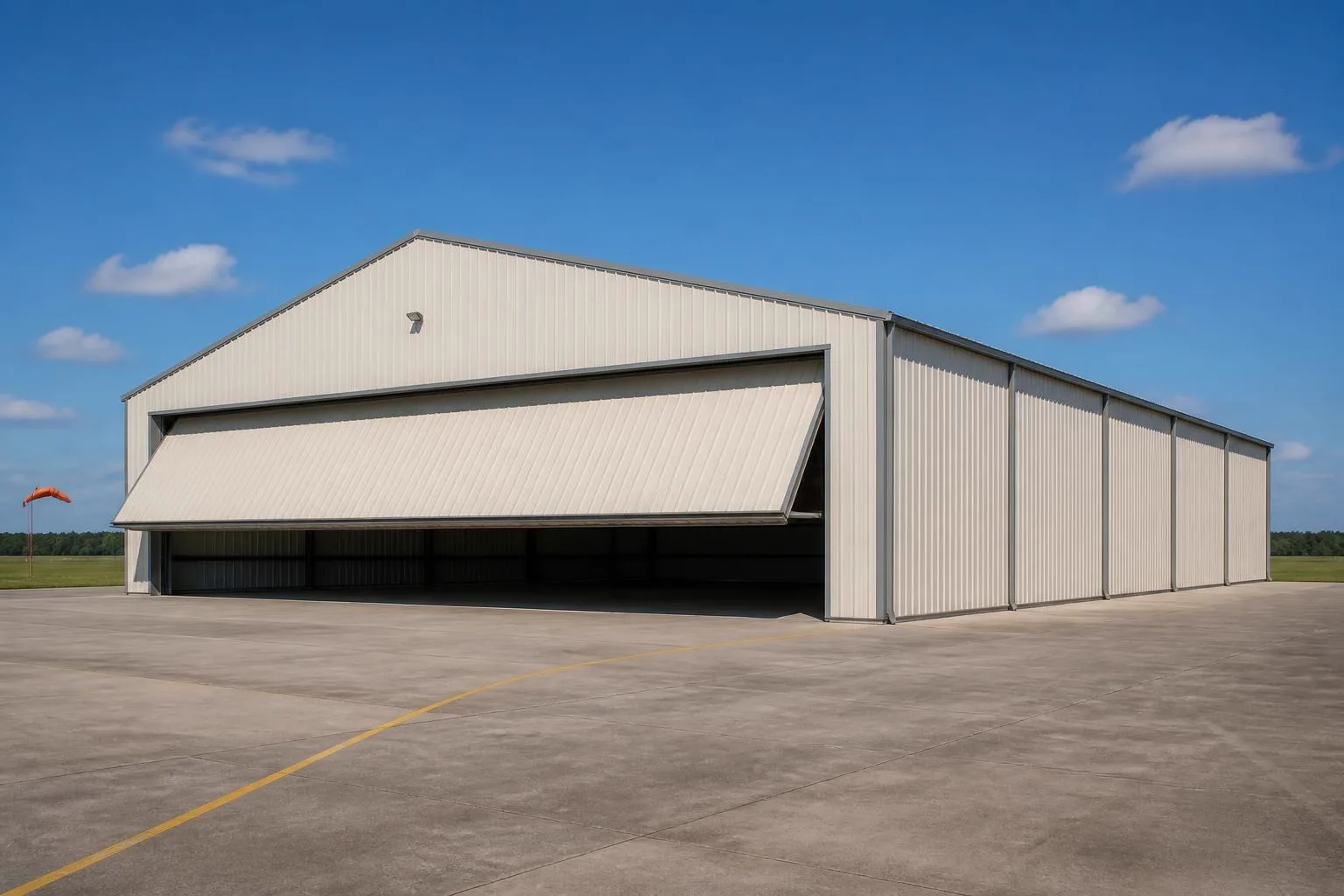
Clear-span bifold or sliding doors are common on hangars precisely because they avoid a center post that would complicate wing clearance, and in a snow climate the door's bottom seal and threshold detailing matter as much as its span. Massachusetts hangar owners who skip this at the planning stage tend to revisit door hardware and apron grading after the first heavy winter.
- Door threshold height
- Coordinate with apron grading so meltwater and plowed snow do not pond against the door seal.
- Snow storage adjacent to the apron
- Reserve space that does not encroach on taxiway clearance or wingtip swing radius.
- Interior heating and condensation control
- Worth discussing with your builder if the hangar will be occupied or used for maintenance work through the winter.
Get Massachusetts aircraft hangar quotes
Tell us your airframe size, whether your field sits inland or coastal, and your door preference. We route it with the Massachusetts and hangar context already attached.
Configuration
How Massachusetts hangar programs typically split
Given how scarce open acreage is statewide, the configuration question is usually about maximizing a constrained footprint rather than choosing among abundant land options.
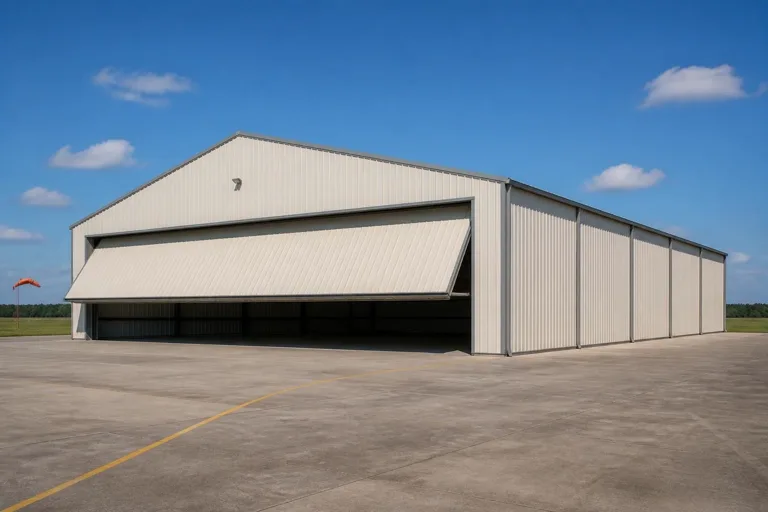 Single-aircraft private hangarA compact clear-span footprint sized to one airframe plus modest storage, typical of a leased airport row space.Multi-bay hangar with shared apronSeveral bays under one roofline sharing a single apron and taxiway connection, common where land is leased jointly among owners.Hangar with attached workshop or officeA dedicated maintenance or office bay attached to the hangar proper, useful where the parcel cannot support a second structure.
Example Configuration — for planning purposes only.
Footprint
Sizes that suit a constrained Massachusetts leasehold
Because open acreage is scarce statewide and most hangar sites are airport-leased or tightly bounded, footprints tend to be sized precisely to the airframe rather than built with generous surplus room.
50′ × 50′
2,500 sq ft
A single-engine private aircraft footprint with modest storage margin.
60′ × 60′
3,600 sq ft
Room for a larger single aircraft or a small multi-bay split.
80′ × 100′
8,000 sq ft
A multi-bay configuration where the leasehold or parcel supports shared apron access.
100′ × 150′
15,000 sq ft
Where the site genuinely supports a larger hangar row or maintenance-scale operation.
Example Configuration — for planning purposes only.
Footprint pages carry the room-by-room layout detail; this page only explains why the Massachusetts brief tends to land in this range.
Preparation
Before you request a Massachusetts hangar quote
These items address frequent source of re-quoting on a hangar project here.
Step 1
Confirm your lease or parcel boundary with the airport authority
Airport-leased sites have setback and taxiway-clearance rules the authority controls; confirm them before finalizing footprint.
Step 2
Describe your terrain, not just your town
Whether your field sits in the western uplands or on Coastal Plain ground changes grading and apron drainage planning.
Step 3
Decide door type and threshold height early
This single decision drives apron grading and winter operations more than any other variable.
Step 4
Plan snow storage and apron drainage up front
Cheaper to resolve now than to retrofit grading after the apron is poured.
Questions
Massachusetts aircraft hangar questions
Honest state-level answers, with anything jurisdiction- or airport-specific routed to the office that actually owns it.
That depends on your parcel's zoning, any airport-authority requirements if it connects to a public field, and local building rules — all set locally rather than by a single statewide answer. Your local building department and, if relevant, the airport authority are the right first calls.
There is no official minimum, but Massachusetts's 66-acre average farm size, among the smallest in the country, signals that open acreage is scarce statewide, so most projects here fit a leased or tightly bounded parcel rather than a large private strip.
We do not state design loads on this page — that is an engineering and code question for your local building department. What we can say is that Boston Logan's climate normals show roughly 49 inches of average annual snowfall, which is a useful prompt for door threshold and apron drainage planning, not a specification.
That is a personal and operational decision, not one this page can make. USGS does document genuinely different terrain — crystalline uplands in the west versus Coastal Plain sediment in the southeast — so grading and drainage conversations will differ by location.
We do not publish state-level prices, because a credible number depends on span, door type, site work and current material costs. Our cost pages explain what drives the number; a quote reflects your specific project.
Sources for the Massachusetts facts on this page
This page states no code requirement, wind speed, snow load, permit rule, price or supplier claim. The state-specific facts it does use are listed with their publisher below.
Massachusetts had 464,451 acres of land in farms in 2022, an average farm size of 66 acres -- among the smallest average farm sizes in the country.
USDA NASS · 2022 · Tier 1
https://www.nass.usda.gov/Publications/AgCensus/2022/Full_Report/Volume_1,_Chapter_1_State_Level/Massachusetts/st25_1_001_001.pdfMassachusetts had 7,083 farms in 2022, down from 7,241 in 2017.
USDA National Agricultural Statistics Service (NASS) · 2022 (with 2017 comparison) · Tier 1
https://www.nass.usda.gov/Publications/AgCensus/2022/Full_Report/Volume_1,_Chapter_1_State_Level/Massachusetts/st25_1_001_001.pdfUSGS Geomorphology of New England (Professional Paper 1208) describes Massachusetts as spanning crystalline upland terrain (including the Berkshires in the west) and Coastal Plain sediments along the southeast, reflecting a mix of glacially shaped hill country and low coastal terrain.
U.S. Geological Survey · 1982 · Tier 1
https://pubs.usgs.gov/pp/1208/report.pdfBoston Logan Airport's NOAA 1991-2020 climate normals show total annual precipitation of about 43.6 inches and average annual snowfall of about 49 inches.
NOAA National Centers for Environmental Information (NCEI) · 1991-2020 · Tier 1
https://www.ncei.noaa.gov/access/services/data/v1?dataset=normals-monthly-1991-2020&format=pdf&stations=USW00014739The Boston Logan NOAA 1991-2020 normals show winter monthly snowfall means around 14 inches in both January and February.
NOAA National Centers for Environmental Information (NCEI) · 1991-2020 · Tier 1
https://www.ncei.noaa.gov/access/services/data/v1?dataset=normals-monthly-1991-2020&format=pdf&stations=USW00014739