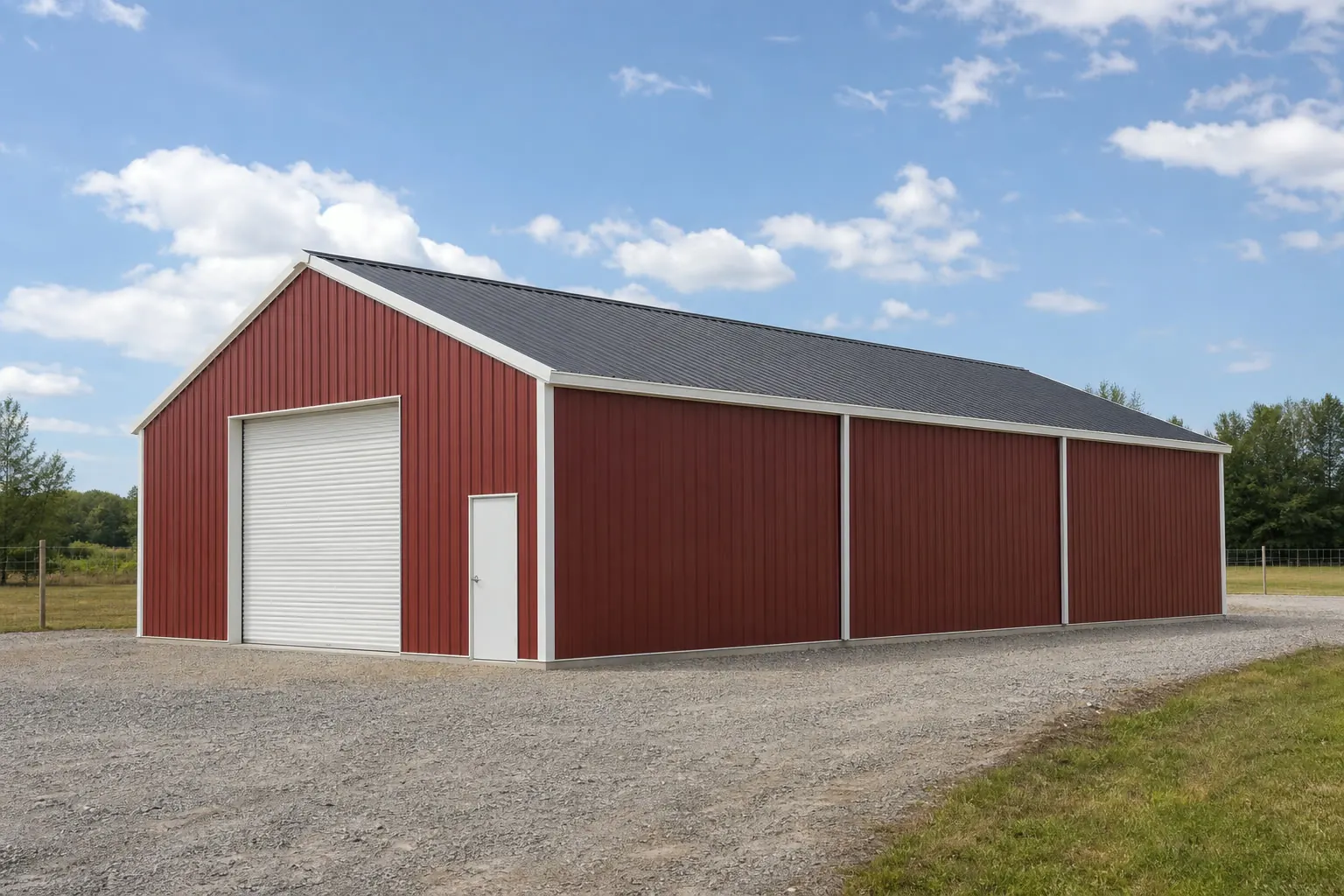
Storage building · NC
Storage Buildings in North Carolina
A storage building in North Carolina has to answer a question a generic spec sheet can't: which of the state's three landscapes is it sitting on? USGS research groups North Carolina into the Coastal Plain, Piedmont and Blue Ridge physiographic provinces, and each one hands a storage-building project a different foundation, drainage and access problem before a single wall panel goes up. Add a farm economy of 42,817 farms averaging 190 acres and a hurricane season NOAA calls highly variable year to year, and the useful planning approach is regional, not statewide.
Terrain
Three provinces, three storage-building briefs
The same steel shell needs a different site plan depending on which North Carolina province it lands in.
Coastal Plain
Sandy, flatter ground with a shallower water table; grading to move water away from the slab matters more here than soil compaction strength.
Piedmont
Expansive clay soils shift with moisture, so slab jointing and a properly compacted base reduce the risk of cracking over time.
Blue Ridge / Mountains
Slope is the dominant siting constraint; a cut-and-fill pad or retaining work is often needed before foundation work can begin, and access road grade affects delivery logistics.
Agricultural Use
Sizing storage for North Carolina's working land
North Carolina's farm base shapes how big — and how accessible — a storage building needs to be.
USDA counted 42,817 farms in North Carolina in 2022, averaging 190 acres across 8,128,136 acres of farmland statewide. That scale of operation drives a specific storage requirement: bulk seed, fertilizer, or harvested crop storage that needs wide clear-span interiors and door openings sized for a loaded trailer, not a passenger vehicle.
Farm counts were down 8% from 2017, a trend worth noting for anyone assuming steady statewide agricultural expansion; storage-building demand on any individual property should be sized to that specific operation's plans rather than a general growth assumption. On smaller acreage or in suburban counties, the same steel shell more often serves personal or small-business overflow storage, where security and interior organization matter more than clear-span width.
Footprints
Matching footprint to intended load
North Carolina storage-building sizing tends to follow what's being stored, not a fixed default.
30′ × 40′
1,200 sq ft
Common for personal overflow or small-business inventory storage.
40′ × 60′
2,400 sq ft
Sized for farm equipment and bulk agricultural inputs on larger parcels.
50′ × 100′
5,000 sq ft
A commercial-scale footprint suited to warehousing or distribution use.
Example Configuration — for planning purposes only.
Confirm truck or trailer turning radius on-site before finalizing door placement, especially on graded mountain-county pads.
Storm & Water
Planning around a variable hurricane season
North Carolina's hurricane exposure isn't a fixed annual quantity, and that changes how a storage building should be specified.
NOAA's state climate summary describes landfalling hurricane counts in North Carolina as highly variable from year to year, with storm intensity and rainfall rates projected to increase. For a storage building holding inventory, equipment or crops, that means anchoring and roof drainage should be specified against a demanding storm year, not an average one, since the next active season is not predictable from the last quiet one.
FEMA's National Risk Index remains the correct authoritative tool for pulling county-specific hazard ratings; a storage building sited in a coastal county and one sited in a Piedmont county can face meaningfully different documented exposure, and only a county-level lookup gives an accurate answer, so treat any general statewide hurricane statement as background context rather than a substitute for that lookup.
- Grade for a wet year
- Design roof and site drainage against heavier rainfall rates, not typical-year averages.
- Pull your county's FEMA NRI rating
- Statewide claims can't substitute for a county-specific hazard lookup.
- Elevate high-value inventory racking
- A modest elevation above slab level protects goods if water intrudes during a storm event, particularly on coastal-plain or low-lying Piedmont sites.
Plan your North Carolina storage building
Share your county and intended use, and we'll connect you with builders who understand your local terrain and drainage conditions.
Growth & Climate Reference
Rising Construction Activity and a Piedmont-Only Climate Reference
North Carolina's building-permit growth points to steady non-farm storage demand, while its most detailed public climate data covers only the Piedmont's Triangle area.
The Census Bureau's Building Permits Survey shows North Carolina's statewide total of privately-owned housing units authorized rising year over year, a signal of continued residential and small-business growth across the state. That growth supports a second, non-farm source of storage-building demand — homeowners and small businesses in expanding Piedmont and coastal metro counties needing overflow, contractor, or inventory storage separate from the state's agricultural storage market.
On the climate side, the National Weather Service's Raleigh-Durham office publishes detailed 1991-2020 daily and monthly normals for the RDU station, covering precipitation and snowfall for the Triangle area specifically. That level of station detail doesn't extend to the Coastal Plain's humidity patterns or the Blue Ridge's mountain precipitation, so a storage building buyer outside the Triangle should treat the RDU normals as general background rather than a stand-in for local conditions. Your county building department and your engineer set the structural design criteria for this site — confirm them before you finalize the frame.
Use Cases
How North Carolina storage buildings get used
The same basic steel shell gets configured differently depending on the property and business behind it.
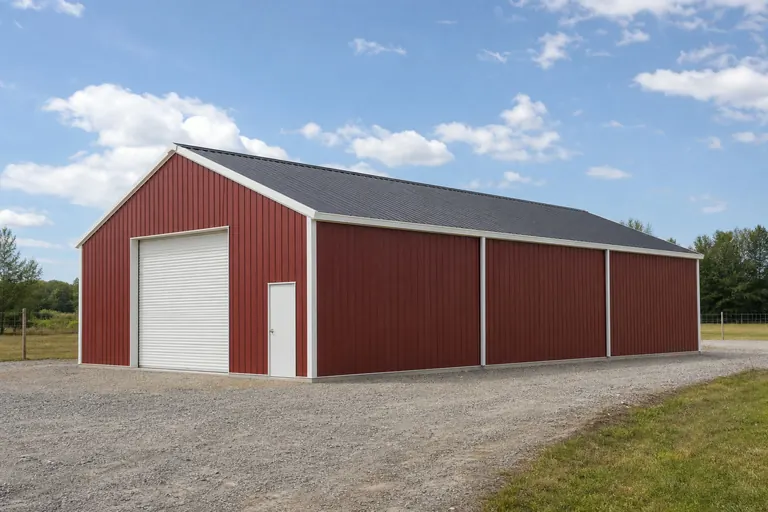 Bulk Ag StorageWide clear-span buildings for seed, feed or equipment on working North Carolina farms.Small Business OverflowSecure, organized storage for inventory in growing Piedmont metro counties.Mountain-Property StorageBuilt on a graded pad to fit the available flat ground in Blue Ridge foothill counties.
Example Configuration — for planning purposes only.
Before You Order
Getting a North Carolina storage building ready to permit
Because permitting, soil conditions and hazard exposure are decided locally in North Carolina, the prep work before ordering looks different than a one-size-fits-all national checklist.
- Pull your county's soil and floodplain mapsCoastal Plain, Piedmont and Blue Ridge counties file different soil survey and floodplain data; ask your county planning office which maps apply to your parcel before finalizing a foundation plan.
- Confirm your county's FEMA NRI hazard ratingFEMA's National Risk Index scores each North Carolina county individually across 18 hazard types, so a general statewide hazard statement should never substitute for your specific county's report.
- Ask about agricultural exemptions on farmlandWith 42,817 working farms statewide, many North Carolina counties offer a distinct review path for bona fide agricultural storage; confirm eligibility before assuming standard commercial permitting applies.
- Size door openings to your largest vehicle or implementTrailer and truck access is a common source of re-quoting after the fact; measure your largest piece of equipment before locking in a footprint.
- Check well and septic setback distancesIn the Piedmont and Blue Ridge provinces, where groundwater is a major drinking-water source, your county environmental health office can confirm the setback distance a storage building's runoff and any stored materials need to maintain.
Questions
North Carolina Storage Building Questions
What buyers commonly ask before committing to a North Carolina storage building site.
Costs and site prep needs vary by soil and slope, but exact figures depend on your specific site and contractor. Coastal sand, Piedmont clay and mountain slope conditions each call for different prep work; confirm scope with a local builder.
No. NOAA describes landfalling hurricane frequency as highly variable year to year, and county-level exposure differs. Check FEMA's National Risk Index for your specific county before finalizing anchoring specs.
It depends on your operation. With the average North Carolina farm at 190 acres, many owners size clear-span width and door openings to their largest implement or trailer rather than a fixed standard footprint.
In the Piedmont and Blue Ridge provinces, where more than half the population relies on groundwater according to NC State Extension, it's worth checking local water-table depth before excavation, especially if you plan a below-grade footing, since a high water table in those regions can complicate excavation and long-term slab stability.
Permit requirements are set locally, so confirm exact thresholds, inspections and setback rules with your county or municipal building department before ordering a building.
No. The National Weather Service's Raleigh-Durham normals describe the Triangle area specifically. Coastal Plain humidity and Blue Ridge mountain precipitation differ, so treat RDU's figures as general background and confirm structural design criteria for your own site with your county building department and engineer.
Sources for the North Carolina facts on this page
This page states no code requirement, wind speed, snow load, permit rule, price or supplier claim. The state-specific facts it does use are listed with their publisher below.
USGS-affiliated research (e.g., Scientific Investigations Report 2009-5149) characterizes North Carolina's Piedmont and Blue Ridge physiographic provinces, distinct from the state's Atlantic Coastal Plain province, based on differing regional geologic settings.
U.S. Geological Survey (USGS) · 2009 USGS report · Tier 1
https://pubs.usgs.gov/sir/2009/5149/North Carolina had 42,817 farms in 2022, down 8% since 2017.
USDA National Agricultural Statistics Service (NASS) · 2022 · Tier 1
https://www.nass.usda.gov/Publications/AgCensus/2022/Online_Resources/County_Profiles/North_Carolina/cp99037.pdfNorth Carolina had 8,128,136 acres of land in farms in 2022, an average farm size of 190 acres.
USDA NASS · 2022 · Tier 1
https://www.nass.usda.gov/Publications/AgCensus/2022/Online_Resources/County_Profiles/North_Carolina/cp99037.pdfNOAA's State Climate Summaries note that the number of landfalling hurricanes in North Carolina is highly variable year to year, and hurricane-associated storm intensity and rainfall rates are projected to increase.
NOAA National Centers for Environmental Information (NCEI) · 2022 summary · Tier 1
https://statesummaries.ncics.org/downloads/NorthCarolina-StateClimateSummary2022.pdfFEMA's National Risk Index is the authoritative source for county- and state-level natural hazard exposure ratings across 18 hazard types, viewable via FEMA's own interactive report tool.
Federal Emergency Management Agency (FEMA) · Current NRI release · Tier 1
https://www.fema.gov/flood-maps/products-tools/national-risk-indexNC State Extension publishes reference material describing groundwater conditions across the state's Piedmont and Blue Ridge provinces, noting over half of North Carolina's population depends on groundwater for drinking water.
NC State University Extension · NC State Extension reference publication · Tier 2
https://content.ces.ncsu.edu/ground-water-in-the-piedmont-and-blue-ridge-provinces-of-north-carolinaNWS Raleigh-Durham (KRDU) publishes 1991-2020 daily and monthly climate normals for the Raleigh-Durham station, including daily normal precipitation and snowfall values.
National Weather Service (NOAA), Raleigh NC office · 1991-2020 · Tier 1
https://www.weather.gov/media/rah/climate/RDU_DailyClimateNormals.pdfNorth Carolina's statewide total of privately-owned housing units authorized by building permits rose from 94,118 in 2022 to 98,853 in 2023, a 5.0% increase.
U.S. Census Bureau · 2023 (with 2022 comparison) · Tier 1
https://www.census.gov/construction/bps/pdf/2023annualhighlights.pdf