
Steel home · MO
Steel Homes in Missouri
A steel home is a primary residence, so it faces the full weight of local permitting review — and in Missouri, that review does not start at a state building-code office. Missouri Revised Statutes section 64.170 gives individual county commissions their own statutory authority to control construction and issue building permits, while the Missouri Division of Fire Safety, established within the Department of Public Safety, is limited by statute to fire-safety rulemaking rather than general residential construction review. That structure means a Missouri steel home project begins with a call to the county, not an assumption about a uniform state code. On top of that, NOAA describes Missouri's climate as continental — cold winters, hot and humid summers — and the Missouri Geological Survey puts roughly 33,000 of the state's 50,000 square miles south of the Missouri River inside the rugged Ozark Plateau, so foundation and siting decisions look different depending on whether a homesite sits in that terrain or on flatter ground elsewhere in the state.
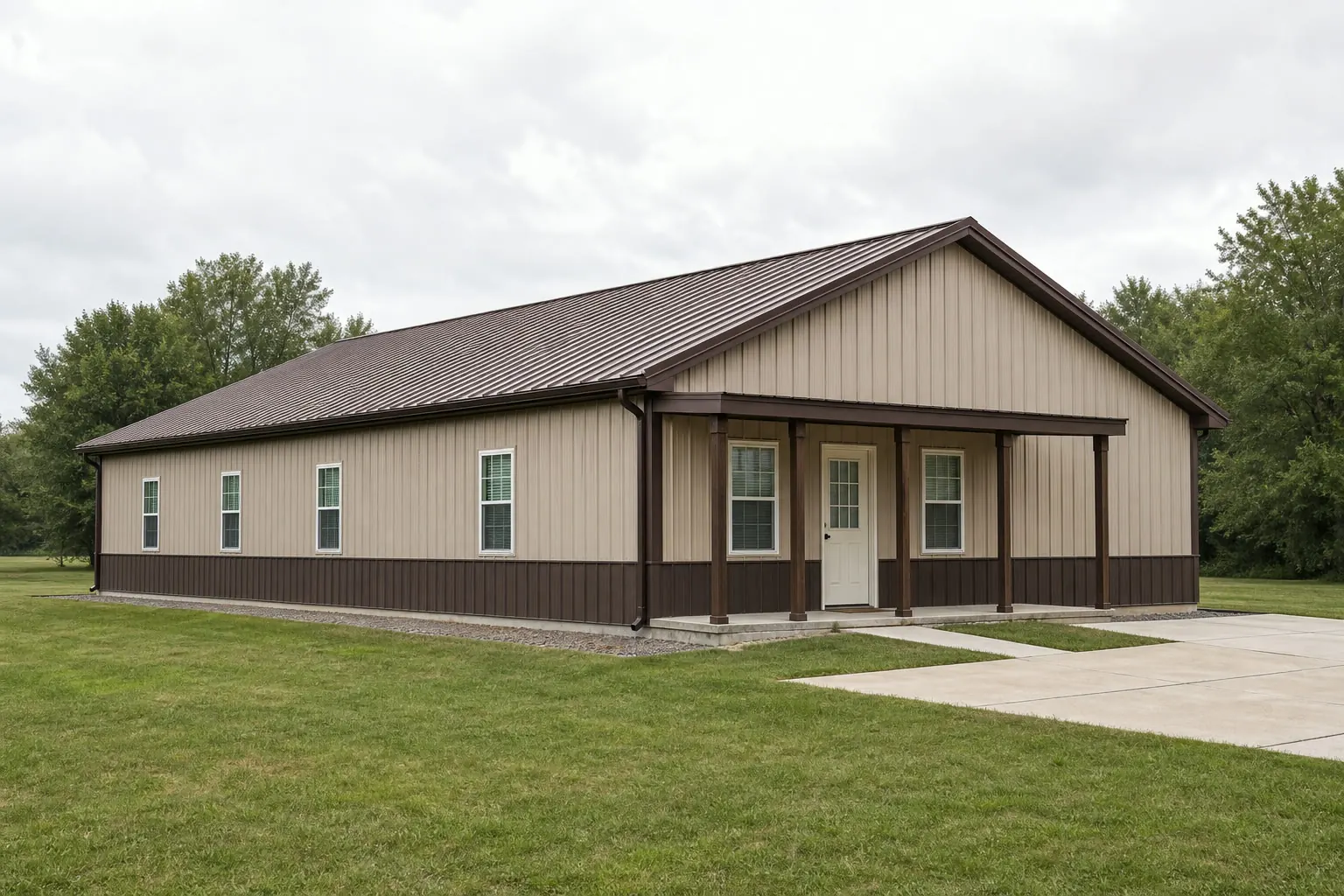
Your County Runs the Review, Not a State Code Office
Missouri does not operate a single mandatory statewide residential building code. RSMo 64.170 gives county commissions their own statutory power to control construction and issue building permits, while the Missouri Division of Fire Safety's authority, set out by statute within the Department of Public Safety, is scoped to fire safety, not general residential plan review. For a steel home, that means the county where the lot sits — not a state office — decides which energy code, if any, applies, what inspections are required, and what your occupancy timeline looks like. The first productive call on a Missouri steel-home project is to that county's building department.
Siting
Ozark Terrain Versus the Rest of the State
Roughly two-thirds of the land south of the Missouri River sits inside the rugged Ozark Plateau; the north is comparatively different ground.
| Region | Ground condition | What it means for the home |
|---|---|---|
| Ozark Plateau (south of Missouri River) | Rugged, per Missouri Geological Survey: lofty hills, deep valleys, clear springs and streams across ~33,000 of the state's ~50,000 square miles | Budget for engineered grading and possibly a stepped or pier foundation to keep the structure level. |
| Ground outside the Ozark footprint | Comparatively level to rolling terrain north of the river | Site prep is typically more straightforward, though drainage away from the foundation still needs planning. |
Ozark Plateau (south of Missouri River)
- Ground condition
- Rugged, per Missouri Geological Survey: lofty hills, deep valleys, clear springs and streams across ~33,000 of the state's ~50,000 square miles
- What it means for the home
- Budget for engineered grading and possibly a stepped or pier foundation to keep the structure level.
Ground outside the Ozark footprint
- Ground condition
- Comparatively level to rolling terrain north of the river
- What it means for the home
- Site prep is typically more straightforward, though drainage away from the foundation still needs planning.
Climate
Designing the Envelope for Missouri's Swings
NOAA describes Missouri's climate as continental, with cold winters and hot, humid summers, which shapes how a steel frame's thermal envelope should be built.
Steel conducts heat efficiently, so a continental climate with genuinely cold winters and genuinely hot, humid summers — the pattern NOAA NCEI's narrative description of Missouri's climate lays out — puts thermal bridging squarely in the design conversation from day one. A continuous layer of exterior insulation, or high-performance spray foam detailed carefully around steel studs and framing members, keeps heat from tracking through the frame in either direction across that seasonal swing.
Humidity adds a second layer to the same problem. Missouri's hot, humid summer half of the year means moisture management inside the wall assembly matters as much as R-value on paper. A properly detailed vapor barrier, positioned correctly for a heating-dominated winter and a cooling-dominated summer, helps prevent condensation from forming inside the wall cavity and damaging interior finishes over time.
None of this is a single specification a buyer can copy from a neighboring state's project, since exposure varies by county and by microclimate within Missouri itself; a local engineer or builder should confirm the wall assembly and vapor-barrier detailing against your specific site conditions before construction begins.
Start your Missouri steel home
Tell us your county, whether your site is in Ozark terrain, and your target footprint, and we route it with that context already attached.
Preparation
What to Confirm Before Building a Missouri Steel Home
These checks head off delays once the county's specific requirements and site conditions become clear.
Step 1
Contact your county's building department first
Since RSMo 64.170 places construction and permit authority at the county level, confirm which energy code and inspection sequence your specific county applies to a steel-frame residence.
Step 2
Identify whether your lot sits in Ozark terrain
South-of-the-river lots within the roughly 33,000-square-mile Ozark Plateau footprint should budget for engineered grading; northern lots may not need as much.
Step 3
Plan thermal-bridging mitigation at the design stage
Address continuous exterior insulation or high-performance cavity fill before framing begins, given Missouri's continental cold-winter, hot-summer swing.
Step 4
Confirm well and septic feasibility for rural sites
With an average Missouri farm at 308 acres, many steel-home sites are rural and will need a standalone well and a county health department-approved septic system.
Step 5
Ask your lender about comparable-sales availability early
Steel-frame residences remain uncommon in many Missouri counties, so raise appraisal expectations with your lender before finalizing plans.
Geography
Siting Context Across Missouri
Missouri's 68,746.3 square miles of land area offers meaningfully different site conditions depending on where a homesite falls.
Ozark Plateau (south)
Rugged hills and deep valleys per the Missouri Geological Survey; expect more foundation engineering and site grading before a level pad is achievable.
North and west of the Ozark footprint
Comparatively level to rolling ground; site prep is generally simpler, though drainage planning around the foundation still applies.
Rural acreage statewide
With an average farm size of 308 acres per USDA's 2022 Census of Agriculture, many rural Missouri homesites have room for a standalone well, septic system and generous setbacks from the road.
Questions
Missouri Steel Home Questions, Answered Honestly
County-permitting, climate and siting answers, with cost and financing questions routed to whoever actually owns them.
No single mandatory statewide code governs residential construction. RSMo 64.170 gives county commissions their own authority to regulate construction and issue permits, so your applicable code and inspection process depend on your county.
No. Its statutory authority within the Department of Public Safety is scoped to fire-safety rulemaking, not general residential construction review. Your county building department is the correct first contact for plan review.
Yes. The Missouri Geological Survey describes the Ozark Plateau, covering roughly 33,000 of the state's 50,000 square miles south of the Missouri River, as rugged terrain with hills and deep valleys, which typically means more foundation engineering than a flatter northern site.
NOAA describes Missouri's climate as continental, with cold winters and hot, humid summers. That swing makes thermal-bridging mitigation and careful vapor-barrier detailing important design considerations for a steel frame.
Many will, but because steel-frame residences remain uncommon in most Missouri counties, comparable sales can be limited. Raise this with your lender early and consider an appraiser experienced with non-traditional residential construction.
We do not publish state-level prices, since cost depends on size, specification, foundation engineering and site work, including any Ozark grading your terrain requires. Our cost pages explain what drives the number; a builder quote covers your specific project.
Sources for the Missouri facts on this page
This page states no code requirement, wind speed, snow load, permit rule, price or supplier claim. The state-specific facts it does use are listed with their publisher below.
Missouri has no single statewide mandatory building code; the Missouri Division of Fire Safety administers state fire-safety-related rules while county commissions are separately empowered by statute to control construction and issue building permits.
Missouri General Assembly / Justia (statute text) · 2025 Missouri Revised Statutes · Tier 2
https://law.justia.com/codes/missouri/title-vi/chapter-64/section-64-170/Missouri has no single statewide mandatory building code; the Missouri Division of Fire Safety administers state fire-safety-related rules while county commissions are separately empowered by statute to control construction and issue building permits.
Missouri General Assembly / Justia (statute text) · 2025 Missouri Revised Statutes · Tier 2
https://law.justia.com/codes/missouri/title-vi/chapter-64/section-64-170/NOAA NCEI publishes a narrative 'Climate of Missouri' describing the state's continental climate with cold winters and hot, humid summers.
NOAA National Centers for Environmental Information (NCEI) · Historical narrative (NCEI climate normals series) · Tier 1
https://www.ncei.noaa.gov/data/climate-normals-deprecated/access/clim60/states/Clim_MO_01.pdfThe Missouri Geological Survey (part of Missouri DNR) describes the Ozarks region — covering about 33,000 of the region's 50,000 square miles within Missouri — as rugged, with lofty hills, deep valleys, and cold clear springs and streams south of the Missouri River.
Missouri Geological Survey, Missouri Department of Natural Resources · Fact sheet, rev. 2016 (orig. 2002) · Tier 2
https://dnr.mo.gov/print/document-search/pub0655Missouri had 27,026,243 acres of land in farms in 2022, an average farm size of 308 acres.
USDA NASS · 2022 · Tier 1
https://www.nass.usda.gov/Publications/AgCensus/2022/Online_Resources/County_Profiles/Missouri/cp99029.pdf