
Steel home · MI
Steel Homes in Michigan
Planning a steel home in Michigan means building at the intersection of two distinct peninsulas and the longest freshwater coastline in the United States. Search demand for 'steel home michigan' is modest, but the structural implications are massive. You aren't just choosing a floor plan; you are designing for a state where winter snowfall can range from manageable to extreme, and where 9.4 million acres of agricultural land are increasingly being re-envisioned for modern residential use. This guide avoids the generic 'steel is strong' narrative to focus on how Michigan's geography and climate normals genuinely change your build requirements.
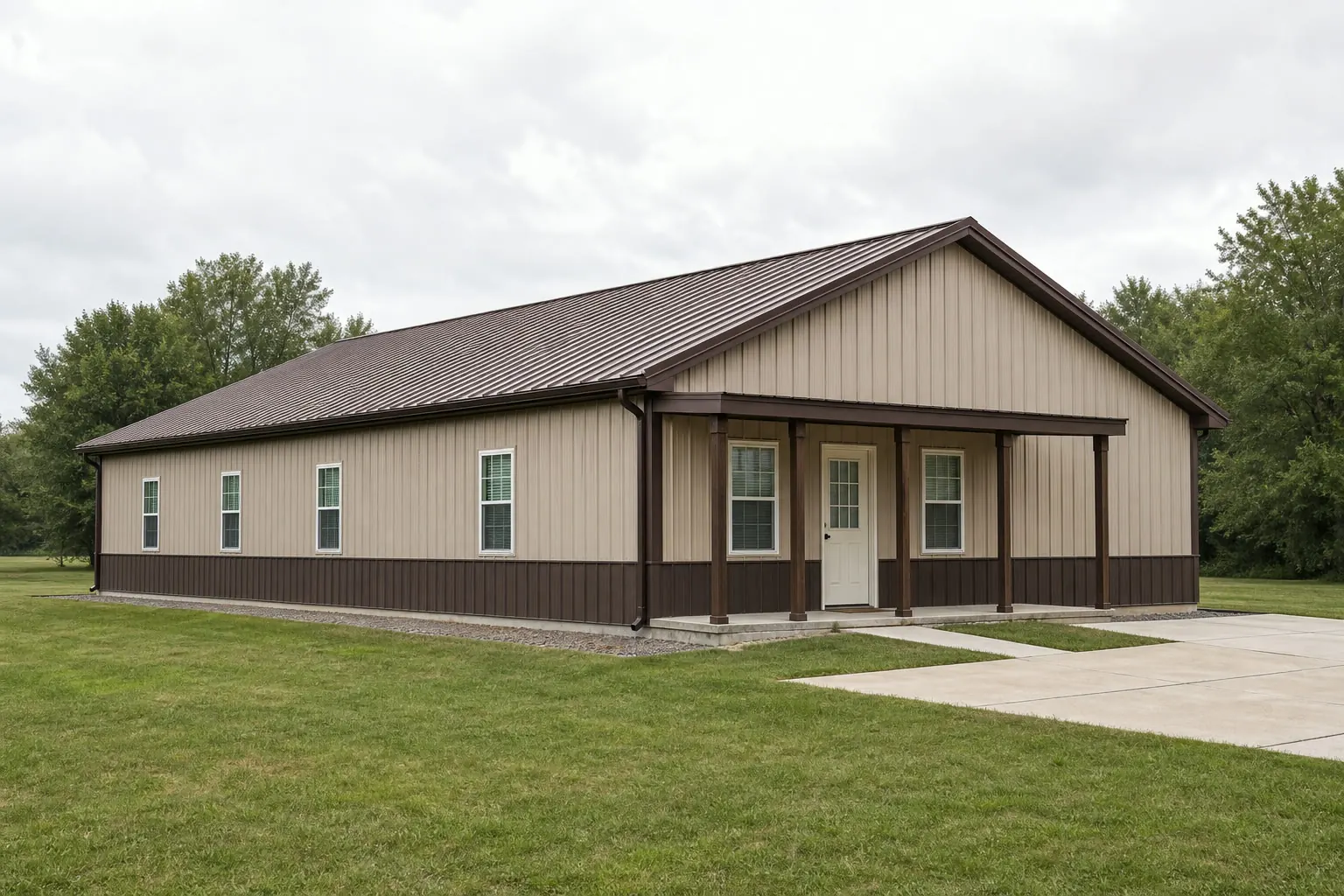
Building for a State of Two Worlds
Michigan is a state defined by water and wood, but the rise of steel residential construction is changing the skyline of both its urban corridors and its rural landscapes. When you plan a steel home here, you aren't just selecting a durable material; you are choosing a system that can withstand the unique pressures of the Great Lakes basin. From the heavy snow loads of the Upper Peninsula to the wind-swept plains of the central Lower Peninsula, the Michigan steel home is a study in adaptability. We don't pretend there is a single 'Michigan standard'—instead, we look at how the state's 9.4 million acres of farmland and its 3,288 miles of freshwater coastline dictate the rules of your build.
Geographic Planning
The Peninsula Divide: Planning for Two Different Michigans
The Straits of Mackinac represent more than a bridge; they are the boundary between two distinct engineering environments for steel residential builds.
In the Lower Peninsula, steel home buyers are often looking at parcels that were once part of Michigan's vast agricultural network. With 45,581 farms remaining, the transition of large acreage into residential plots is a primary driver for steel construction. Steel's ability to clear-span large distances without interior support columns makes it ideal for the open-concept 'modern farmhouse' style that is popular in Southern Michigan. However, sites in the Lower Peninsula must still contend with the humidity of the Great Lakes basin. While Detroit Metro Airport records roughly 35 inches of annual precipitation, the proximity to Lake Michigan or Lake Huron can increase the localized moisture levels, requiring high-specification protective coatings for the steel frame and siding to prevent long-term oxidation.
Crossing the bridge into the Upper Peninsula (UP) changes the brief entirely. The UP is a land of extreme snow and rugged terrain. USGS describes the state as two peninsulas for a reason; the climatic delta is massive. In the UP, a steel home must be engineered for lake-effect snow loads that can exceed the design capacity of standard residential kits sold in the Midwest. Steel is actually an advantage here, as the strength-to-weight ratio allows for steeper roof pitches that shed snow more effectively than traditional wood framing. The logistical challenge in the UP is delivery and construction timing. The 'build season' is shorter, and because most steel manufacturing is centered in the southern part of the state or neighboring Indiana and Ohio, transportation costs to a remote UP site must be factored into the initial budget.
Regardless of which peninsula you choose, the site's hydrologic province matters. USGS and the Michigan DNR map these provinces because they dictate how water moves through the soil. Steel homes are heavy, and their foundations are typically slab-on-grade or thickened-edge rafts. If your site is in a province with high clay content or a high water table—common near the Great Lakes coastlines—the cost of site preparation can rival the cost of the steel kit itself. We don't have verified frost-depth numbers for every Michigan soil type in our evidence base, which is why we insist on a local geotechnical report before you sign a contract. Assuming a 42-inch frost line statewide is a mistake that can lead to foundation heaving in the harsher northern regions.
Site Context
Coastal vs. Inland Steel Design
Michigan's 3,288 miles of freshwater coastline create micro-climates that demand different responses from a steel home.
The Great Lakes Coastal Zone
Touching four of the five Great Lakes, Michigan has a massive coastal exposure area. Steel homes built within 5 miles of the shore face higher wind speeds and sustained humidity. While freshwater is less corrosive than saltwater, the constant moisture requires meticulous attention to flashing and sealants at every penetration point in the steel envelope.
The Central Agricultural Plains
With 9.4 million acres in farms, central Michigan offers flat, open sites. These locations are prone to 'straight-line winds' during summer storm seasons. A steel home’s rigid frame is exceptionally well-suited for these high-wind events, providing a level of structural integrity that traditional stick-built homes struggle to match without expensive reinforcement.
The Lake-Effect Snowbelts
Primarily along the western edge of the Lower Peninsula and most of the Upper Peninsula, these zones receive intense, localized snowfall. Steel home roofs in these areas should be designed with minimal valleys and high-performance snow guards to prevent 'roof avalanches' that can damage lower structures or vehicles.
Start Your Michigan Steel Home Project
Ready to design a home that handles everything the Great Lakes can throw at it? We'll help you reconcile your vision with Michigan's geographic and climatic realities.
Data Points
Michigan Building Context by the Numbers
These figures represent the environment in which your Michigan steel home will be built, sourced from federal and state datasets.
| Measure | Figure | Source |
|---|---|---|
| Active Farms (2022) | 45,581 | USDA NASS |
| Land in Farms | 9.47 Million Acres | USDA NASS |
| Average Farm Size | 208 Acres | USDA NASS |
| Single-Unit Permits (2024) | 15,045 | U.S. Census Bureau |
| Annual Precipitation (Detroit) | ~35 Inches | NOAA NCEI |
| Great Lakes Touched | 4 of 5 | USGS |
Active Farms (2022)
- Figure
- 45,581
- Source
- USDA NASS
Land in Farms
- Figure
- 9.47 Million Acres
- Source
- USDA NASS
Average Farm Size
- Figure
- 208 Acres
- Source
- USDA NASS
Single-Unit Permits (2024)
- Figure
- 15,045
- Source
- U.S. Census Bureau
Annual Precipitation (Detroit)
- Figure
- ~35 Inches
- Source
- NOAA NCEI
Great Lakes Touched
- Figure
- 4 of 5
- Source
- USGS
Land Use
Transitioning Agricultural Land to Residential Steel
Michigan's 9.4 million acres of farmland are undergoing a shift that makes steel residential builds increasingly practical.
As the number of farms in Michigan has decreased from 47,641 in 2017 to 45,581 in 2022, more large-acreage parcels are hitting the market for residential development. For a buyer looking to build a 'barndominium' or a large-scale steel home, these parcels are ideal. They often come with existing cleared areas and access roads. However, agricultural soil is often highly productive because it holds moisture—a trait that is the enemy of a residential foundation. When building a heavy steel structure on former farmland, the 'fill' used to level the site must be engineered to prevent settling.
The advantage of steel in these rural Michigan settings is speed. Because a residential steel frame is manufactured off-site and bolted together on the pad, the 'dried-in' time is significantly faster than wood. In a state where the construction window is dictated by the first frost, getting a roof over the project quickly is the difference between a one-season build and a two-season headache. Furthermore, steel's resistance to pests—common in rural agricultural areas—reduces the long-term maintenance burden for Michigan homeowners.
- Verify Soil Stability
- Former agricultural land may require soil compaction tests to ensure the heavy steel frame does not settle unevenly.
- Respect Drainage Patterns
- USGS hydrologic provinces show varied water movement; ensuring your steel home doesn't sit in a natural runoff path is critical.
- Plan for Large-Vehicle Access
- Steel delivery trucks require wider turn radii and firmer ground than standard lumber delivery; check your rural driveway specs.
Clarifications
Michigan Steel Home FAQ
Honest answers regarding the realities of building residential steel in the Great Lakes State.
The measured demand is modest, with 'steel home michigan' seeing about 40 searches a month. However, the interest in 'barndominiums' and metal-sided homes is part of a larger cluster of 380 monthly searches, indicating a growing preference for durable, low-maintenance residential steel over traditional siding.
It fundamentally changes the roof load requirements. A steel home in Grand Haven or Marquette needs a significantly higher pounds-per-square-foot (PSF) snow load rating than one in Detroit. Your structural engineer will use local historical data to set this value.
Michigan has 83 counties, each with its own zoning and building department. While the Michigan Building Code provides a statewide framework, local 'zoning' may have aesthetic requirements regarding metal siding. Always check with your local planning commission before purchasing a kit.
Yes, and it is a common use for the state's 9.4 million acres of farm land. You must ensure the soil is properly tested for load-bearing capacity, as agricultural soils are often softer than the compact clay or gravel found in other regions.
There is no single 'typical' size. However, given the average Michigan farm size of 208 acres, many buyers opt for larger footprints (2,400+ sq. ft.) that allow for integrated garage or workshop space under the same steel roof.
Preparation
Michigan Steel Home Readiness Checklist
Steps to take before ordering your steel home kit in the Great Lakes State.
- Identify Your Hydrologic ProvinceConsult USGS/DNR maps to understand your site's drainage and water table characteristics before designing your foundation.
- Confirm County-Specific Snow LoadsCheck with your local building department for the design snow figure it uses for your parcel before finalizing the roof design; a figure drawn from statewide averages is not a substitute for the local value.
- Evaluate Delivery AccessEnsure your site can accommodate a semi-truck delivery, especially for remote UP or wooded Lower Peninsula parcels.
- Review Local Zoning on SidingSome Michigan municipalities have restrictions on exposed metal siding; verify if you need a specific finish to meet local code.
Sources for the Michigan facts on this page
This page states no code requirement, wind speed, snow load, permit rule, price or supplier claim. The state-specific facts it does use are listed with their publisher below.
Detroit Metro Airport's NOAA 1991-2020 climate normals show total annual precipitation of roughly 34-35 inches, with January and February mean snowfall near 12-14 inches each.
NOAA National Centers for Environmental Information (NCEI) · 1991-2020 · Tier 1
https://www.ncei.noaa.gov/access/services/data/v1?dataset=normals-monthly-1991-2020&format=pdf&stations=USW00094847USGS describes Michigan as consisting of two peninsulas -- the Upper Peninsula and Lower Peninsula, separated by the Straits of Mackinac -- and notes it is the only U.S. state touching four of the five Great Lakes, giving it the longest freshwater coastline in the country.
U.S. Geological Survey · 2021 · Tier 1
https://pubs.usgs.gov/publication/fs20213047USGS describes Michigan as consisting of two peninsulas -- the Upper Peninsula and Lower Peninsula, separated by the Straits of Mackinac -- and notes it is the only U.S. state touching four of the five Great Lakes, giving it the longest freshwater coastline in the country.
U.S. Geological Survey · 2021 · Tier 1
https://pubs.usgs.gov/publication/fs20213047Michigan had 45,581 farms in 2022, down from 47,641 in 2017.
USDA National Agricultural Statistics Service (NASS) · 2022 (with 2017 comparison) · Tier 1
https://www.nass.usda.gov/Publications/AgCensus/2022/Full_Report/Volume_1,_Chapter_1_State_Level/Michigan/st26_1_001_001.pdfMichigan had 9,472,069 acres of land in farms in 2022, an average farm size of 208 acres.
USDA NASS · 2022 · Tier 1
https://www.nass.usda.gov/Publications/AgCensus/2022/Full_Report/Volume_1,_Chapter_1_State_Level/Michigan/st26_1_001_001.pdfBuilders in Michigan were authorized to construct 21,750 new privately-owned housing units in 2024, of which 15,045 were single-unit structures.
U.S. Census Bureau · 2024 (final annual estimates) · Tier 1
https://www.census.gov/construction/bps/stateannual.htmlFEMA's National Risk Index is the federal tool for county- and state-level natural hazard exposure data for Michigan's 83 counties, covering 18 hazard types including winter weather, ice storm, and severe/strong wind.
Federal Emergency Management Agency (FEMA) · Current NRI release · Tier 1
https://www.fema.gov/flood-maps/products-tools/national-risk-index