
Horse barn · MI
Horse Barns in Michigan
Planning a horse barn in Michigan is an exercise in balancing ventilation with winter protection. Search demand for 'horse barn michigan' is steady at 40 monthly searches, reflecting a specialized audience that understands the state's environmental challenges. With 9.47 million acres of farmland and a climate that moves from humid summers to heavy lake-effect winters, your barn must be more than a shelter—it must be a climate-controlled management hub. This guide looks at how Michigan's two-peninsula geography and its freshwater coastline dictate your stall layout, ventilation path, and foundation drainage.
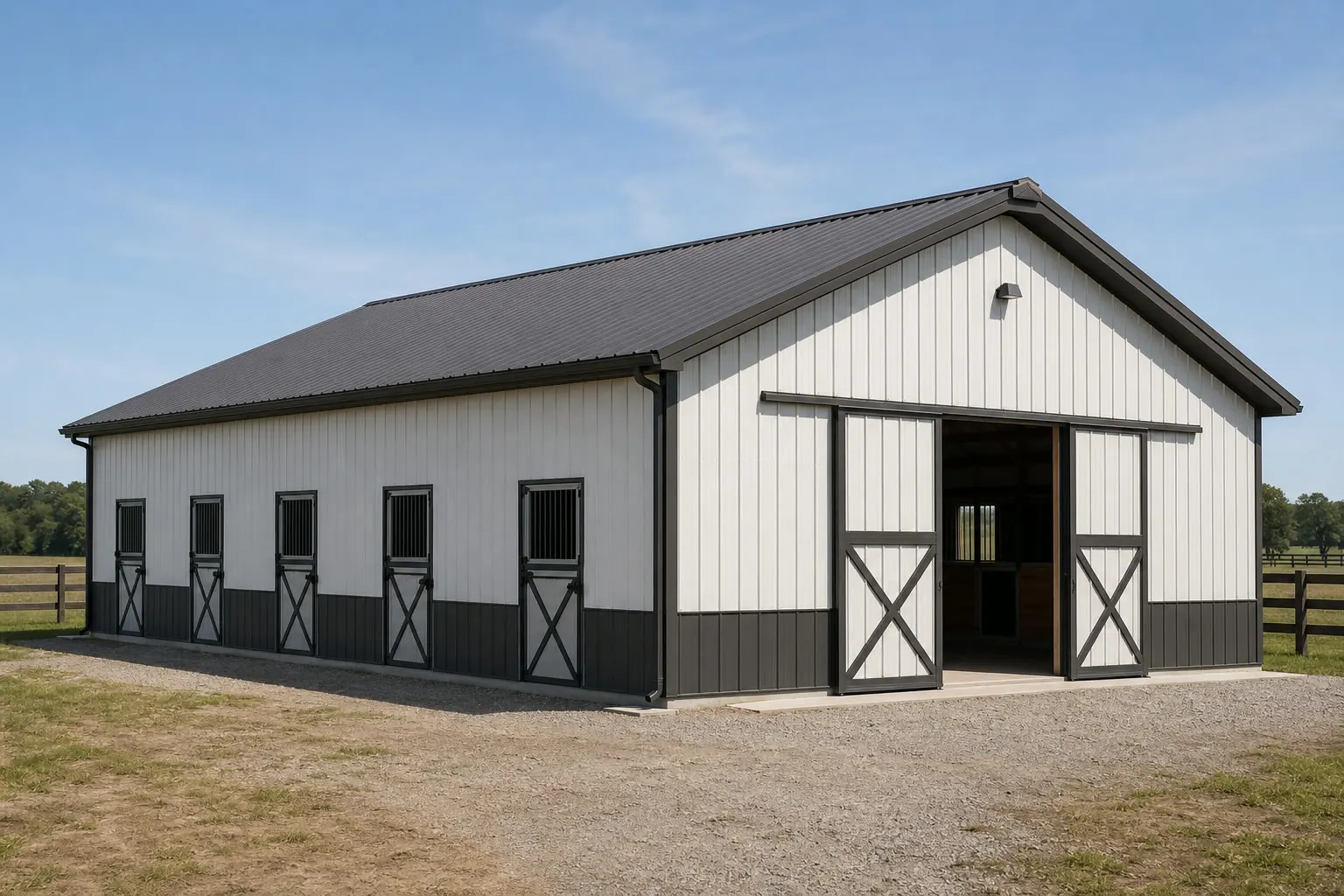
Managing the Michigan Horse Year
In Michigan, a horse barn is not just a building; it is the primary defense against a climate that can swing from humid 90-degree summers to sub-zero winters with double-digit snowfall. With 45,581 farms across the state, the tradition of equine care is deeply rooted in the soil of both the Upper and Lower Peninsulas. However, building a barn here requires an honest look at the weather. With annual precipitation averaging 35 inches and significant winter storms being a regular occurrence, the Michigan horse barn must solve two problems simultaneously: keeping the moisture out and keeping the air moving. We focus on how the state's unique geography—from its two-peninsula divide to its 9.47 million acres of farmland—shapes the way you build for your horses.
Seasonal Planning
The Great Lakes Winter: Building for Ventilation and Snow
The greatest threat to a Michigan horse in winter is not the cold, but the moisture trapped inside a poorly ventilated barn.
Michigan’s climate normals for the Detroit area show January and February mean snowfall near 12 to 14 inches each, but this is a conservative baseline. In the lake-effect snowbelts that hug the coastlines of Lake Michigan and Lake Superior, these numbers can triple. For a horse barn, this creates a structural challenge. The roof must not only support the weight of the snow but also provide continuous ventilation. When a barn is sealed tight to keep out the cold, ammonia from urine and moisture from the horses' breath build up, leading to respiratory issues. A Michigan-specific barn design utilizes 'over-sized' ridge vents and protected eave vents that won't be blocked by accumulating snow, ensuring a constant exchange of fresh air even during a blizzard.
The choice of steel for these structures is driven by the state's high precipitation. With 35 inches of annual rainfall, wood-frame barns in Michigan are prone to rot and moisture-wicking at the base of the posts. Steel columns, especially when paired with a concrete frost-wall or a properly engineered slab, offer a level of durability that handles the Michigan thaw-freeze cycle more effectively. Furthermore, the 83 counties in Michigan each have their own approach to building codes, but the fundamental need for a 'clear-span' interior remains universal. By eliminating interior support posts, you create a safer environment for horses and humans, allowing for wider aisles that are easier to navigate when the weather forces your daily routine indoors.
Reference
Michigan Agricultural & Climate Context
These sourced figures provide the planning environment for your Michigan horse barn project.
| Factor | Figure | Source |
|---|---|---|
| Total Farms (2022) | 45,581 | USDA NASS |
| Land in Farms | 9,472,069 Acres | USDA NASS |
| Avg Farm Size | 208 Acres | USDA NASS |
| Annual Precip (SE Michigan) | 34-35 Inches | NOAA NCEI |
| Avg Jan/Feb Snowfall (Detroit) | 12-14 Inches | NOAA NCEI |
| Number of Counties | 83 | FEMA NRI |
Total Farms (2022)
- Figure
- 45,581
- Source
- USDA NASS
Land in Farms
- Figure
- 9,472,069 Acres
- Source
- USDA NASS
Avg Farm Size
- Figure
- 208 Acres
- Source
- USDA NASS
Annual Precip (SE Michigan)
- Figure
- 34-35 Inches
- Source
- NOAA NCEI
Avg Jan/Feb Snowfall (Detroit)
- Figure
- 12-14 Inches
- Source
- NOAA NCEI
Number of Counties
- Figure
- 83
- Source
- FEMA NRI
Get a Michigan-Ready Barn Quote
Ready to build a barn that handles Michigan's snow, mud, and wind? Tell us your county and horse count, and we'll route you to the right planning resources.
Construction
Drainage and the Michigan Hydrologic Province
Where you build in Michigan matters as much as what you build, particularly when it comes to managing mud.
The USGS maps named hydrologic provinces across Michigan for a reason: the way water moves through the ground varies wildly between the sandy soils of the northern Lower Peninsula and the heavy clays of the southeast. For a horse barn, 'poor drainage' is the shortest path to a mud-choked paddock and foot health issues for your horses. Before finalizing a site plan, you must identify your province and soil type. In many parts of Michigan, a simple gravel pad is not enough. You may need a tiered drainage system that moves roof runoff (which is significant given the 35-inch annual precip) far away from the building and paddock areas.
On an average 208-acre Michigan farm, you often have the luxury of choosing the 'high ground.' However, 'high' is relative in Michigan's often flat landscape. Integrated gutter systems on your steel barn are not an optional luxury here; they are a necessity for moisture management. Furthermore, the frost depth—while not numerically verified in our current evidence set—is a critical local variable. A foundation that doesn't reach below the local frost line will heave during the Michigan spring thaw, misaligning stall doors and potentially compromising the structural integrity of the steel frame. Always consult local building officials in your specific county to confirm the required footer depth.
- Prioritize Site Elevation
- Select the highest point on your parcel to minimize the impact of Michigan's high water table and heavy precipitation.
- Plan for Snow Shedding
- Orient the barn so that roof snow sheds away from high-traffic doors and paddock gates.
- Install Heavy-Duty Gutters
- Manage the 35 inches of annual rain by routing it into a dedicated drainage field or storage pond.
Configuration
Michigan Horse Barn Layout Patterns
Given the seasonal constraints and farm sizes in Michigan, these are the configurations buyers gravitate toward.
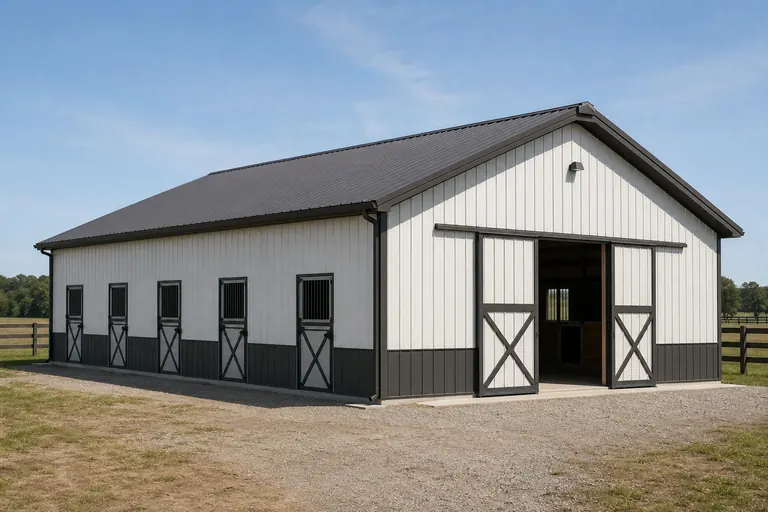 The Winter Management StableDesigned with an extra-wide center aisle to allow for indoor grooming and exercise during the months when snowfall exceeds 12 inches.The Integrated Ag-BarnCommon on Michigan's 208-acre average farms, this layout combines horse stalls with a large hay-loft or equipment storage bay under one steel roof.The Coastal Run-InFor hardier breeds in the coastal provinces, an open-sided steel shed provides shelter from the wind while maintaining maximum natural ventilation.
Example Configuration — for planning purposes only.
Common Questions
Michigan Horse Barn FAQ
Direct answers to the questions Michigan buyers ask most often about building stables in the Great Lakes State.
Most Michigan experts prioritize ventilation over insulation. While insulation can prevent condensation on the underside of a steel roof, a horse's natural coat is designed for Michigan winters. The key is keeping them dry and out of the wind, not necessarily 'warm.'
We do not have a verified state-level inventory count for horses in our current evidence. However, the average farm size of 208 acres allows for significant grazing and multiple-stall configurations.
A concrete frost-wall or thickened-edge slab is standard for handling the Michigan freeze-thaw cycle. The specific depth depends on your county's frost line requirements.
If you are in a lake-effect snowbelt, your quote will reflect the higher cost of the heavier steel required to meet the increased roof-load specifications for your specific zip code.
The spring freeze-thaw cycle across Michigan's clay and till soils turns unmanaged paddock areas into standing mud almost overnight. A dedicated manure-management pad with its own drainage, sited downhill and away from the barn's frost-wall footing, keeps thaw-season moisture from undermining the structure and keeps hooves out of standing water during the muddiest weeks of the year.
Sources for the Michigan facts on this page
This page states no code requirement, wind speed, snow load, permit rule, price or supplier claim. The state-specific facts it does use are listed with their publisher below.
Detroit Metro Airport's NOAA 1991-2020 climate normals show total annual precipitation of roughly 34-35 inches, with January and February mean snowfall near 12-14 inches each.
NOAA National Centers for Environmental Information (NCEI) · 1991-2020 · Tier 1
https://www.ncei.noaa.gov/access/services/data/v1?dataset=normals-monthly-1991-2020&format=pdf&stations=USW00094847USGS describes Michigan as consisting of two peninsulas -- the Upper Peninsula and Lower Peninsula, separated by the Straits of Mackinac -- and notes it is the only U.S. state touching four of the five Great Lakes, giving it the longest freshwater coastline in the country.
U.S. Geological Survey · 2021 · Tier 1
https://pubs.usgs.gov/publication/fs20213047Michigan had 45,581 farms in 2022, down from 47,641 in 2017.
USDA National Agricultural Statistics Service (NASS) · 2022 (with 2017 comparison) · Tier 1
https://www.nass.usda.gov/Publications/AgCensus/2022/Full_Report/Volume_1,_Chapter_1_State_Level/Michigan/st26_1_001_001.pdfMichigan had 9,472,069 acres of land in farms in 2022, an average farm size of 208 acres.
USDA NASS · 2022 · Tier 1
https://www.nass.usda.gov/Publications/AgCensus/2022/Full_Report/Volume_1,_Chapter_1_State_Level/Michigan/st26_1_001_001.pdfFEMA's National Risk Index is the federal tool for county- and state-level natural hazard exposure data for Michigan's 83 counties, covering 18 hazard types including winter weather, ice storm, and severe/strong wind.
Federal Emergency Management Agency (FEMA) · Current NRI release · Tier 1
https://www.fema.gov/flood-maps/products-tools/national-risk-indexUSGS Water-Resources Investigations Report 91-4120 delineates named hydrologic provinces across Michigan's Upper and Lower Peninsulas, prepared in cooperation with the Michigan DNR Geological Survey Division.
U.S. Geological Survey, in cooperation with Michigan Dept. of Natural Resources · 1991 · Tier 1
https://pubs.usgs.gov/wri/1991/4120/report.pdf