
Steel Home · MN
Steel Homes in Minnesota
A Minnesota steel home is a full-time, fully conditioned residence, and the state fact that should shape it most is not a single winter number but a real geographic divide. The Minneapolis-St. Paul station's 1991-2020 normal is 31.62 inches of precipitation and 51.2 inches of snowfall, while the National Weather Service's Duluth office documents International Falls as routinely among the coldest reporting stations in the entire contiguous United States, with records back to 1895. FEMA's National Risk Index scores Minnesota's 87 counties with a mean composite risk of 42.4 out of 100, and the state's building departments authorized 25,667 new housing units in 2023. None of those figures tells a buyer what their specific parcel needs — but together they tell you the questions to bring to your local building department before a floor plan is drawn.
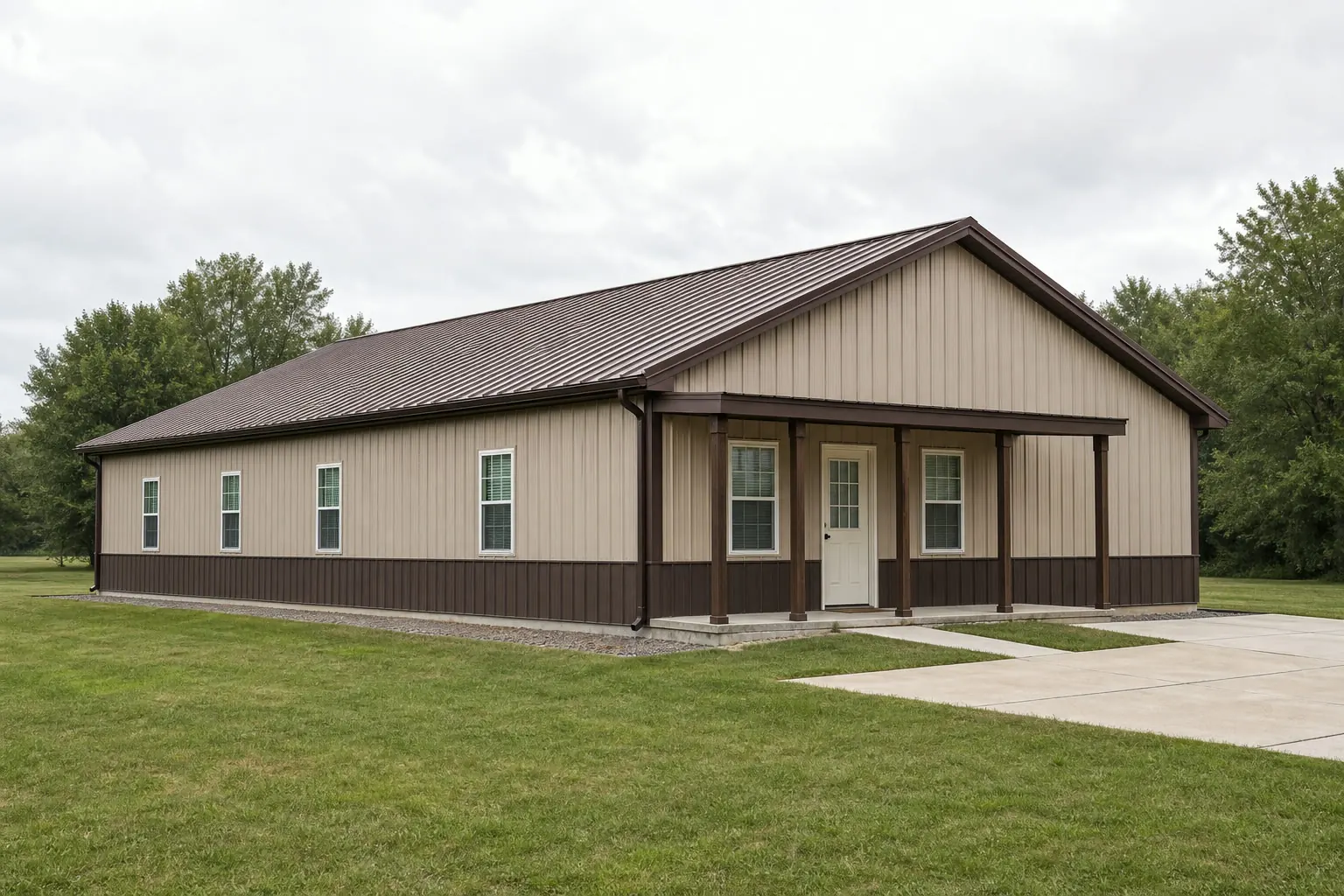
The intersection
What a Minnesota site actually changes about a steel home
Minnesota's winter conditions are not one statewide figure; the gap between the Twin Cities and the state's northern border is real and should shape the envelope brief.
A Minnesota steel home cannot be designed against a single statewide winter number, because the state does not have one. The Minneapolis-St. Paul station's 1991-2020 normal — 31.62 inches of annual precipitation and 51.2 inches of snow — is a reasonable reference for the Twin Cities region, but the National Weather Service's Duluth office separately documents International Falls as routinely recording some of the coldest January temperatures anywhere in the contiguous 48 states, with a period of record back to 1895. A steel home designed against a metro-area assumption and sited near the state's northern border is being under-specified before construction even begins.
The right first step is not accepting a generic 'Minnesota winter' brief from a builder, but asking which station's normals they are designing to and whether that matches your parcel's actual latitude and exposure. A full-time, fully conditioned residence lives with that envelope decision for decades, so getting the reference station right at the outset is worth the extra question.
None of this substitutes for your local building department, who determines what your specific parcel and occupancy require. What this page adds is the honest planning frame: in Minnesota, 'statewide' rarely describes either climate or hazard well, and a steel home benefits from getting that right before the envelope is designed.
Risk & Process
County-level hazard context and an active permit market
FEMA scores Minnesota's counties individually, and the state's building departments processed over 25,000 new housing units in a single recent year, both of which matter for how a steel-home project actually moves.
FEMA's National Risk Index reports a mean composite risk score of 42.4 out of 100 across Minnesota's 87 counties, using the agency's v1.20 release. A mean is, by definition, an average across counties with genuinely different exposure profiles, so a buyer's own county's specific NRI record is a far more useful reference than the statewide mean quoted here. Pull your county's figures directly from FEMA's official tool before making siting or insurance decisions.
On the process side, Minnesota's building permit offices authorized 25,667 new privately-owned housing units in 2023, including 12,770 single-family buildings alongside multi-unit structures. That volume signals a residential construction market with active, functioning local permitting infrastructure — not a rural exemption pathway some buyers may assume applies to a steel-frame residence. Confirm your specific occupancy classification and permit requirements with your local building department before finalizing a floor plan.
- Pull your county's NRI record
- Check FEMA's National Risk Index for your specific county rather than relying on the statewide mean composite score.
- Confirm permit process locally
- With over 25,000 housing units authorized statewide in a recent year, expect an active, code-enforced permitting process rather than an informal exemption.
- Ask which station's normals set your envelope spec
- Confirm whether your builder is designing to a Twin Cities-area normal or a colder northern-station reference that matches your actual site.
Site context
How climate and landscape context differ across Minnesota
Because Minnesota's climate normals and landscape classification both vary by region, where your steel home sits changes what you should be checking.
Twin Cities metro and southern Minnesota
The Minneapolis-St. Paul station's 1991-2020 normal of 31.62 inches of precipitation and 51.2 inches of snow is a reasonable regional reference here, and the area's higher permit volume typically means more established local builder and inspector familiarity with residential steel construction.
Northern Minnesota (Duluth NWS coverage, International Falls)
NWS Duluth documents this region, particularly International Falls, as routinely among the coldest in the contiguous 48 states. A steel home here should be designed against colder normals than a Twin Cities-area assumption would suggest.
North Central Glaciated Plains Section
The Minnesota DNR names this section among the state's ecological classification units. Its glacially shaped terrain is a reminder to confirm local soil and grading conditions with your builder rather than assuming a single statewide foundation approach.
Any county, before siting
FEMA's National Risk Index scores all 87 Minnesota counties individually; the statewide mean of 42.4 out of 100 is a starting reference only, not a substitute for pulling your own county's record.
Get Minnesota steel-home quotes
Tell us your county, your reference climate station and your bedroom program. We route it with the Minnesota and steel-home context already attached.
Configuration
What Minnesota steel-home buyers are usually building
Because a steel home carries no working-bay expectation, the brief is driven by residential program rather than farm or shop adjacency.
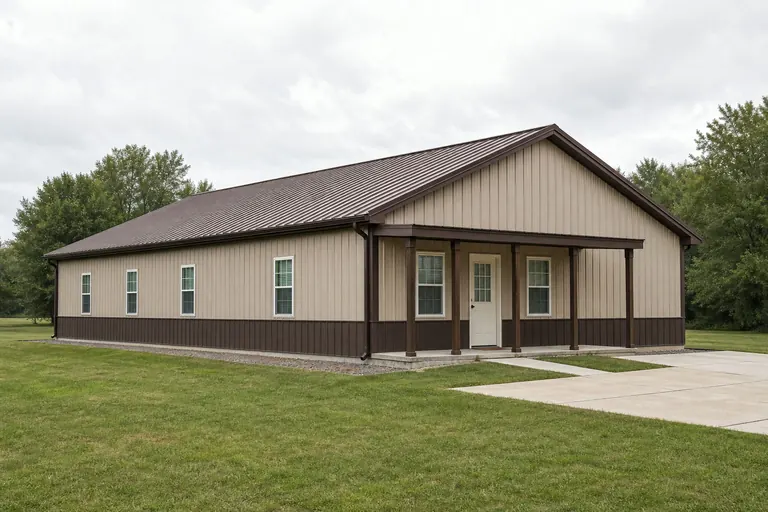 Primary single-level residenceA full-time home with no attached shop or equipment bay, sized to bedroom count and single-level living preference.Multi-level family residenceA larger steel-frame home with a second level, suited to buyers who want conventional residential square footage on a steel structure.Cold-climate rebuildA steel home replacing an older residence in Minnesota's colder northern reaches, prioritizing envelope continuity against a northern-station climate reference rather than a metro-area assumption.
Example Configuration — for planning purposes only.
Preparation
Before you request a Minnesota steel-home quote
Resolving these in advance keeps quotes comparable and avoids a costly re-quote later.
- Contact your local building department earlyOccupancy classification, permit thresholds and code requirements for a residential structure are set locally; ask before finalizing dimensions or floor plan.
- Name your reference climate station to your builderState clearly whether your envelope spec is being designed to a Twin Cities-area normal or a colder northern reference matching your actual site.
- Pull your county's NRI recordCheck FEMA's National Risk Index for your specific county rather than assuming the statewide mean composite score applies to your site.
- Confirm current builder and inspector lead timesWith over 25,000 housing units authorized statewide in a recent year, confirm current scheduling directly with local builders rather than assuming a fixed timeline.
Questions
Minnesota steel-home questions
Questions we can answer honestly at the state level, with the rest routed to whoever actually owns them.
Zoning, occupancy classification and permitting for a residential structure are decided locally. Your local building department is the only reliable source on whether and how a steel home is permitted on your specific site.
No. The Twin Cities station normal (31.62 in. precipitation, 51.2 in. snow) and the Duluth NWS office's documentation of International Falls as one of the coldest stations in the lower 48 show real regional variation. We do not convert these into a design value here; confirm with your engineer.
FEMA's National Risk Index scores all 87 Minnesota counties individually; the statewide mean composite score of 42.4 out of 100 is only a starting reference. Pull your own county's figures from the official NRI tool.
We do not generalize permit difficulty. Minnesota authorized 25,667 new housing units in 2023, indicating an active statewide permitting environment, but requirements and timelines are set locally — confirm with your building department.
There is no official typical size. Single-purpose residential briefs without a working bay tend to run smaller than a barndominium or shouse, but your footprint should be set by your actual program, not a statewide norm.
Sources for the Minnesota facts on this page
This page states no code requirement, wind speed, snow load, permit rule, price or supplier claim. The state-specific facts it does use are listed with their publisher below.
Minneapolis-St. Paul's 1991-2020 annual normal precipitation is 31.62 inches with 51.2 inches of annual snowfall.
NOAA National Centers for Environmental Information (NCEI) · 1991-2020 · Tier 1
https://www.ncei.noaa.gov/access/services/data/v1?dataset=normals-annualseasonal-1991-2020&stations=USW00014922&format=json&dataTypes=ANN-PRCP-NORMAL,ANN-SNOW-NORMALThe NWS Duluth office's climate reports show International Falls, MN routinely records some of the coldest January temperatures in the contiguous 48 states, based on the 1991-2020 climate normal period and a period of record back to 1895.
National Weather Service (NOAA), Duluth MN office · Period of record 1895-present; normals 1991-2020 · Tier 1
https://www.weather.gov/dlh/threadexFEMA's National Risk Index reports Minnesota's 87 counties with a mean composite NRI risk score of 42.4 on FEMA's 0-100 relative scale (v1.20 release).
Federal Emergency Management Agency (FEMA) · NRI v1.20 dataset · Tier 1
https://www.fema.gov/flood-maps/products-tools/national-risk-indexBuilding permit offices in Minnesota authorized construction of 25,667 new privately-owned housing units in 2023 (12,770 single-family buildings plus multi-unit structures).
U.S. Census Bureau · 2023 (final annual) · Tier 1
https://www2.census.gov/econ/bps/State/st2023a.txtThe Minnesota DNR's Ecological Classification System divides the state into named provinces and sections such as the Eastern Broadleaf Forest Province, the North Central Glaciated Plains Section, and the Blufflands Subsection in the southeast.
Minnesota Department of Natural Resources (DNR) · DNR reference material · Tier 2
https://www.dnr.state.mn.us/ecs/index.html