
Steel Home · WI
Steel Homes in Wisconsin
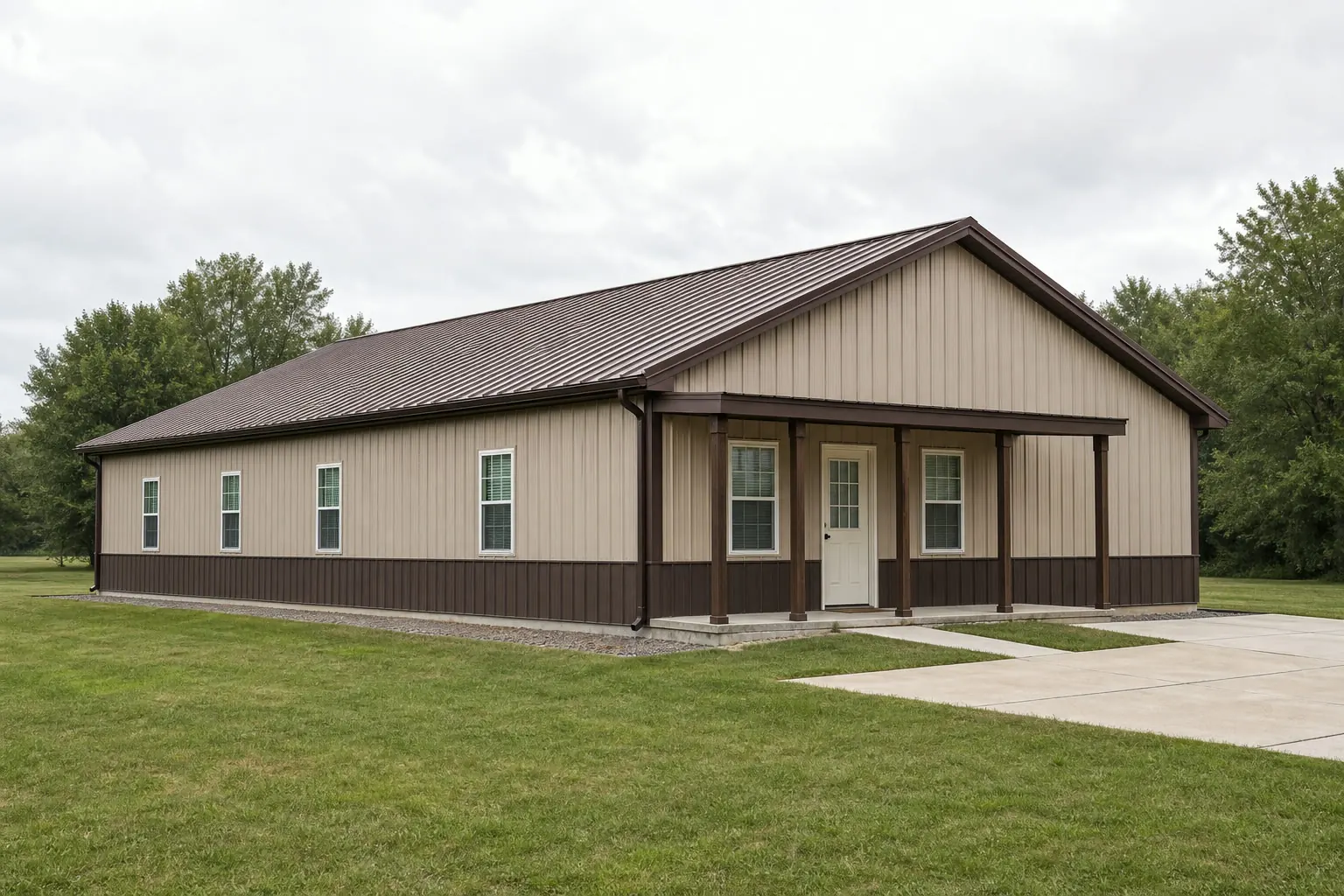
A Wisconsin steel home is a full-time, fully-conditioned residence built on a steel frame rather than wood, and the state context that matters most is not farmland or floor plan — it's climate structure and hazard breadth. The Wisconsin State Climatology Office does not publish one statewide design condition; it divides the state into distinct climate divisions with separate temperature, precipitation and snowfall normals, and FEMA's National Risk Index scores 18 separate hazard types across all 72 counties rather than one statewide figure. That means a steel-home buyer here is making envelope and siting decisions county by county, not off a single 'Wisconsin' number, and this page walks through what that actually means before a floor plan is drawn.
The intersection
What a Wisconsin site actually changes about a steel home
A Wisconsin steel home is judged county by county and climate division by climate division, not against one statewide standard.
Most states publish a single set of statewide climate normals that a builder can treat as a reasonable planning shorthand. Wisconsin's State Climatology Office does something different: it divides the state into distinct climate divisions, each with its own temperature, precipitation and snowfall normals, because the north-south span and Great Lakes influence produce genuinely different winters within the same state. For a steel home — a year-round, fully-conditioned residence — that division-level structure is the single most useful fact a buyer can hand their insulation contractor, because it tells them to ask 'which division's normals are you designing to' instead of accepting a generic statewide answer.
The same logic applies to hazard exposure. FEMA's National Risk Index does not publish one Wisconsin hazard score; it scores 18 distinct hazard types — including winter weather, severe wind, hail, tornado, flooding and drought — separately for each of the state's 72 counties. A steel home's siting decisions, from roof pitch to window placement to where mechanical equipment sits, are more sensibly informed by pulling your own county's NRI record than by any statewide narrative, including this one.
None of this substitutes for your local building department, who determines what your specific parcel and occupancy require. What this page adds is the honest planning frame: in Wisconsin, 'statewide' is rarely the right unit of analysis for either climate or hazard, and a steel home benefits from getting that right before the envelope is designed.
Exposure
Designing a residential envelope for divisional winters
Statewide normals put Wisconsin at roughly 34.9 inches of annual precipitation and about 51 inches of snowfall, but a steel home's envelope should be planned against its own division's normals, not the state average.
A steel-frame residence needs continuous insulation and careful vapor management at the thermal envelope regardless of location, but the intensity of that requirement shifts across Wisconsin's divisions. NOAA's U.S. Climate Normals program compiles the underlying 1991-2020 30-year station data that the state climatology office uses to build its divisional figures, and that dataset is the legitimate reference to bring to a builder conversation — not a design value this page assigns for you.
Practically, that means asking two questions before finishes are chosen: which climate division does the parcel actually sit in, and is the insulation and mechanical spec being quoted against that division's normals or a generic statewide assumption? A steel home in a colder northern division typically carries a heavier insulation and longer-heating-season conversation than the same footprint near the Lake Michigan shoreline, even though both sit inside the same state.
- Identify your climate division
- Ask your builder which of the state's published climate divisions your parcel falls in before finalizing envelope specs.
- Reference the underlying normals dataset
- NOAA's 1991-2020 U.S. Climate Normals program is the citable source behind divisional figures; bring it to your insulation contractor rather than a single statewide number.
- Plan drainage for real precipitation totals
- Roughly 34.9 inches of annual precipitation and 51 inches of snow statewide is a meaningful moisture load; confirm grading and downspout routing before the foundation is poured.
Site context
How hazard and climate context differ across Wisconsin
Because both climate normals and hazard scores are published below the state level, where your steel home sits changes what you should actually be checking.
Southeastern metro fringe (Racine, Sheboygan, Kenosha corridors)
Census data shows Racine (+221.5%) and Sheboygan (+283.6%) among the state's fastest-growing metro areas for housing units authorized year-over-year. A steel home permitted near these corridors is entering a fast-moving construction market; confirming current builder and inspector lead times locally is worth doing before fixing a schedule.
Lake Michigan shoreline counties
The state climatology office's divisional data shows lake-effect moderation shaping this region's normals differently from the interior. A steel home here should be designed against its own division's figures rather than an inland assumption.
Northern interior counties
Divisional normals run colder and snowier in the state's north, which typically means a heavier insulation and longer-heating-season brief for a full-time steel residence than the same footprint further south.
Any county, before siting
FEMA's National Risk Index scores all 72 Wisconsin counties across 18 hazard types individually. Pulling your own county's record from the official NRI tool is a more useful first step than reading a statewide hazard summary.
Get Wisconsin steel-home quotes
Tell us your county, your climate division and your bedroom program. We route it with the Wisconsin and steel-home context already attached.
Configuration
What Wisconsin steel-home buyers are usually building
Because a steel home carries no working-bay expectation, the brief is driven by residential program rather than farm or shop adjacency.
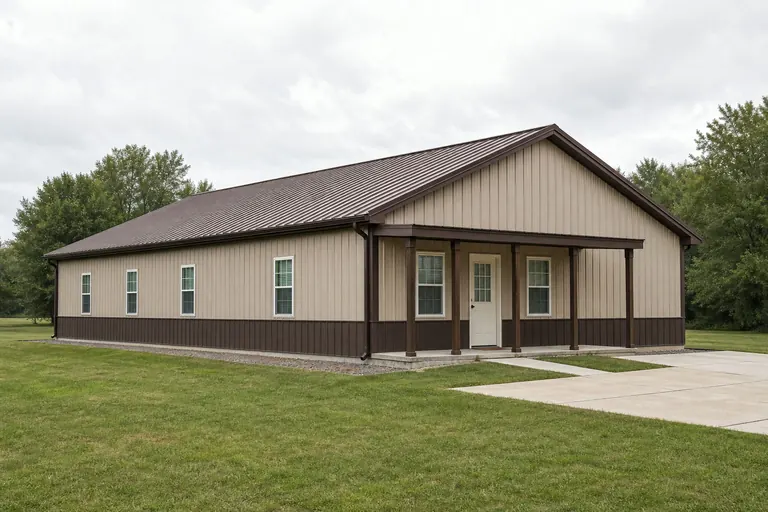 Primary single-level residenceA full-time home with no attached shop or equipment bay, sized to bedroom count and single-level living preference.Multi-level family residenceA larger steel-frame home with a second level, suited to buyers who want conventional-feeling residential square footage on a steel structure.Energy-focused rebuild or replacementA steel home replacing an older wood-frame residence on the same parcel, often prioritizing envelope continuity and a tighter thermal design against the local climate division's normals.
Example Configuration — for planning purposes only.
Footprint
Sizes that suit a Wisconsin steel-home brief
Single-purpose residential briefs in Wisconsin tend to be sized to bedroom count rather than to a working bay, which keeps typical footprints tighter than a barndominium or shouse.
30′ × 40′
1,200 sq ft
A compact single-level footprint suited to a smaller household or a downsizing build.
40′ × 50′
2,000 sq ft
A common mid-size residential footprint with room for a full bedroom and living layout.
40′ × 60′
2,400 sq ft
A larger single-level or modest two-story footprint for a full-time family residence.
Example Configuration — for planning purposes only.
Footprint pages carry layout and room-count detail for each of these; this page explains only why Wisconsin residential briefs tend to land in this range.
Preparation
Before you request a Wisconsin steel-home quote
Resolving these in advance keeps quotes comparable and avoids a costly re-quote later.
Step 1
Contact your local building department early
Occupancy classification, permit thresholds and code requirements for a residential structure are set locally; ask before finalizing dimensions or floor plan.
Step 2
Name your climate division to your builder
State clearly which of the published climate divisions your parcel falls in, so insulation and mechanical specs are quoted against the right normals.
Step 3
Pull your county's NRI record
Check FEMA's National Risk Index for your specific county rather than assuming a statewide hazard picture applies to your site.
Step 4
Confirm builder lead times near fast-growing metros
If your parcel is near a metro with recent permit-volume growth, confirm current scheduling directly rather than assuming standard lead times.
Questions
Wisconsin steel-home questions
Questions we can answer honestly at the state level, with the rest routed to whoever actually owns them.
Zoning, occupancy classification and permitting for a residential structure are decided locally, parcel by parcel. Your local building department is the only reliable source on whether and how a steel home is permitted on your specific site.
No. The Wisconsin State Climatology Office publishes separate normals by climate division rather than a single statewide figure, so envelope and insulation planning should reference your specific division. We do not convert these into design values here.
FEMA's National Risk Index scores 18 hazard types at the county level for all 72 Wisconsin counties. Pull your county's specific figures from the official NRI tool rather than relying on a statewide hazard narrative.
We do not publish state or metro-level prices, since fast-moving permit and construction markets like the ones Census data shows in Racine and Sheboygan can affect contractor availability and lead times. Confirm current conditions with local builders and your building department rather than relying on a statewide cost figure.
There is no official typical size. Single-purpose residential briefs without a working bay tend to land smaller than a barndominium or shouse, but your footprint should be set by your actual program, not a statewide norm.
Sources for the Wisconsin facts on this page
This page states no code requirement, wind speed, snow load, permit rule, price or supplier claim. The state-specific facts it does use are listed with their publisher below.
Wisconsin's statewide 1991-2020 annual normal precipitation is about 34.9 inches with roughly 51 inches of annual snowfall, per the Wisconsin State Climatology Office's statewide averages.
Wisconsin State Climatology Office (UW-Madison) · 1991-2020 · Tier 2
https://climatology.nelson.wisc.edu/wisconsin-historic-climate-data/statewide-climate-normals/The Wisconsin State Climatology Office divides the state into distinct climate divisions and publishes divisional (regional) climate normals for temperature, precipitation and snowfall separately from statewide figures, reflecting the state's north-south and lake-effect climate variation.
Wisconsin State Climatology Office (UW-Madison) · 1991-2020 · Tier 2
https://climatology.nelson.wisc.edu/wisconsin-climate-divisions/climate-normals/NOAA NCEI's U.S. Climate Normals program compiles 1991-2020 30-year station averages for temperature, precipitation and snowfall used to characterize Wisconsin's freeze-thaw and snow-load-relevant winter climate.
NOAA National Centers for Environmental Information (NCEI) · 1991-2020 · Tier 1
https://www.ncei.noaa.gov/products/land-based-station/us-climate-normalsFEMA's National Risk Index dataset defines and scores 18 natural hazard types (avalanche, coastal flooding, cold wave, drought, earthquake, hail, heat wave, hurricane, ice storm, inland flooding, landslide, lightning, strong wind, tornado, tsunami, volcanic activity, wildfire, winter weather) at the county level nationwide, including all 72 Wisconsin counties.
Federal Emergency Management Agency (FEMA) · Current NRI release · Tier 1
https://www.fema.gov/about/openfema/data-sets/national-risk-index-dataFEMA's National Risk Index (NRI) is an interactive county/tract-level tool scoring 18 natural hazards, including hazards relevant to Wisconsin such as winter weather, severe/strong wind, hail, tornado, riverine flooding and drought; official state-level summary figures should be pulled directly from the FEMA NRI tool rather than third-party aggregators.
Federal Emergency Management Agency (FEMA) · Current NRI release · Tier 1
https://www.fema.gov/flood-maps/products-tools/national-risk-indexWisconsin's total land area was measured at 54,157.8 square miles as of the 2010 Census, ranking 25th among states.
U.S. Census Bureau · 2010 Census · Tier 1
https://www.census.gov/geographies/reference-files/2010/geo/state-local-geo-guides-2010/wisconsin.htmlThe Census Bureau's 2023 Annual Building Permits highlights report tracks year-over-year percent change in total housing units authorized by state, with Wisconsin metro areas Sheboygan (+283.6%) and Racine (+221.5%) among the report's largest percentage gainers from 2022 to 2023.
U.S. Census Bureau · 2022-2023 · Tier 1
https://www.census.gov/construction/bps/pdf/2023annualhighlights.pdf