
RV carport · OR
RV Carports in Oregon
An RV carport is an open-sided structure built taller and longer than a standard vehicle cover, sized to clear a motorhome or travel trailer's roofline. In Oregon, two things change how that structure is sited more than in a climatically uniform state: NOAA's own narrative of a Cascade-divided climate, backed by Portland's 1991-2020 station normal of 36.91 inches of annual water-year precipitation, and DOGAMI's statewide landslide database, which is worth checking before setting tall posts into sloped or previously disturbed ground. With Oregon's average farm size at 430 acres per the 2022 Census of Agriculture, a meaningful number of Oregon RV carports also sit on rural acreage rather than a suburban driveway, which changes the access and grading conversation as much as the climate does.
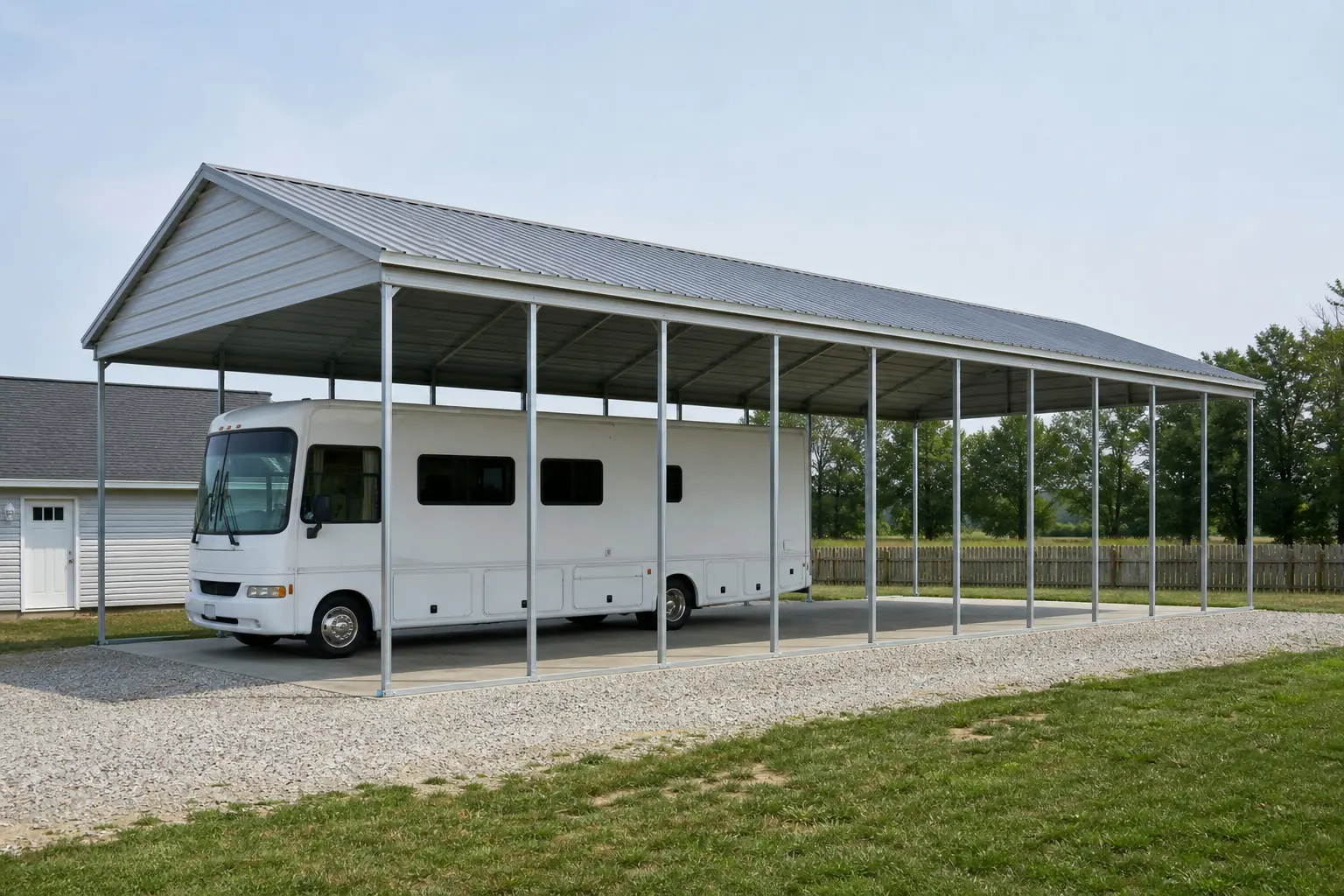
The intersection
Cascade climate and RV clearance are the two starting variables
An RV carport's height and length are set by the vehicle, but which side of the Cascades it sits on decides what the roof is actually fighting.
NOAA's 'Climate of Oregon' narrative credits the Pacific Ocean and the Cascade Range with splitting the state into a wetter western half and a drier eastern half. For an RV carport, tall enough to clear a motorhome's roofline and often open on both ends for drive-through access, that split decides the roof's job: on the wetter side, represented by Portland's 36.91-inch normal water-year precipitation total, the cover is shedding sustained rain across most months of the year, which makes gutter placement and end-wall wind-driven-rain exposure worth a real conversation. On the drier eastern side, the same tall open structure is instead managing sun exposure across a long dry season, with UV protection for the RV's finish and roof seals a bigger day-to-day concern than drainage.
None of this changes the RV carport's basic footprint math, which is set by the vehicle's height and length, but it does change what buyers should ask their builder about — roof-water routing on the wet side, sun and dust exposure on the dry side.
Site diligence
Tall posts and rural ground deserve a ground check first
A taller structure concentrates more load at fewer footings, and a lot of Oregon's RV carports sit on rural, sloped, or previously disturbed acreage.
Because an RV carport is taller than a standard vehicle cover, its posts and footings carry proportionally more overturning force from wind at the same footprint. That is an engineering question for a licensed professional, not something this page assigns a number to, but it is exactly the kind of structure where checking DOGAMI's statewide SLIDO landslide database before excavation is a reasonable step on sloped or previously disturbed rural ground, rather than an optional extra.
With Oregon's average farm size at 430 acres, many Oregon RV carport sites are rural rather than suburban, which raises a second question this page treats honestly: access. A motorhome or long travel trailer needs a turning radius and approach grade that a gravel farm lane may not currently offer, and that access conversation is worth having with a site contractor before a concrete pad location is finalized, independent of anything climate-related.
In the Portland metro four-county area — Clackamas, Columbia, Multnomah and Washington counties — DOGAMI has gone a step further than its statewide SLIDO screening and published coseismic landslide, liquefaction and soil-amplification maps for use in FEMA's HAZUS loss-estimation methodology. A tall RV carport's footing depth is exactly the kind of decision that benefits from checking those maps first if the site falls inside those four counties, since the concentrated post loading has less margin for soft or liquefaction-prone soil than a low, wide footprint would.
- SLIDO check
- Look up DOGAMI's statewide landslide database for sloped or previously disturbed rural sites before excavation.
- Access and turning radius
- Confirm the approach road and turning space suit your RV's actual length, not just the pad footprint.
- Post footing engineering
- A taller structure's footing design is a question for your builder's engineer, not a statewide assumption.
Configuration
Common Oregon RV carport configurations
Configuration follows the vehicle first, then which side of the Cascades and what kind of parcel the site is.
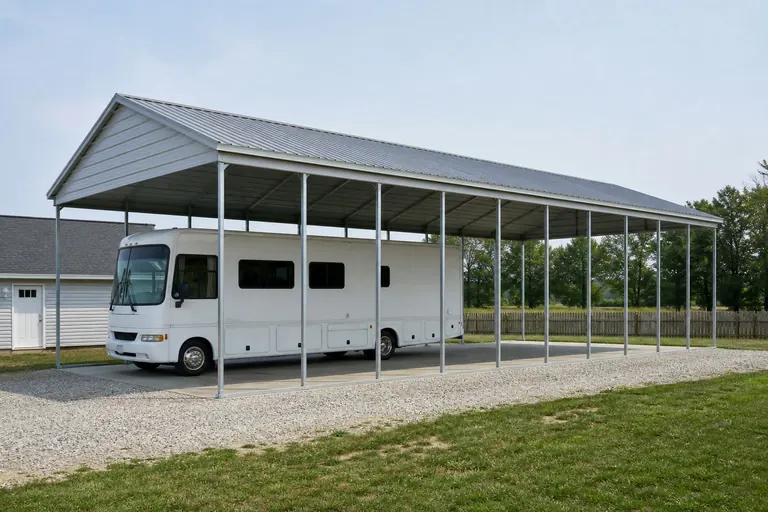 Single RV bay, suburban lotA drive-through bay sized to one motorhome or trailer, where west-side roof-water routing or east-side sun exposure is the main climate variable.
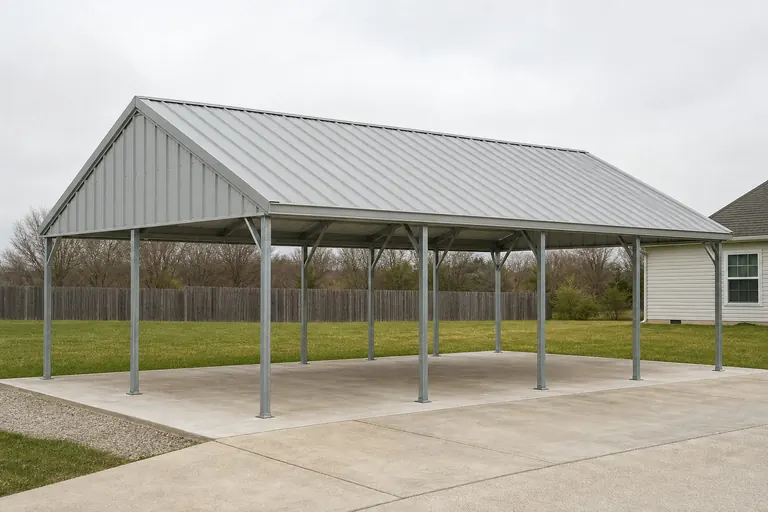 RV plus equipment bay, rural acreageA combined structure covering an RV alongside farm equipment, common on Oregon's larger rural parcels where a single access lane serves both.
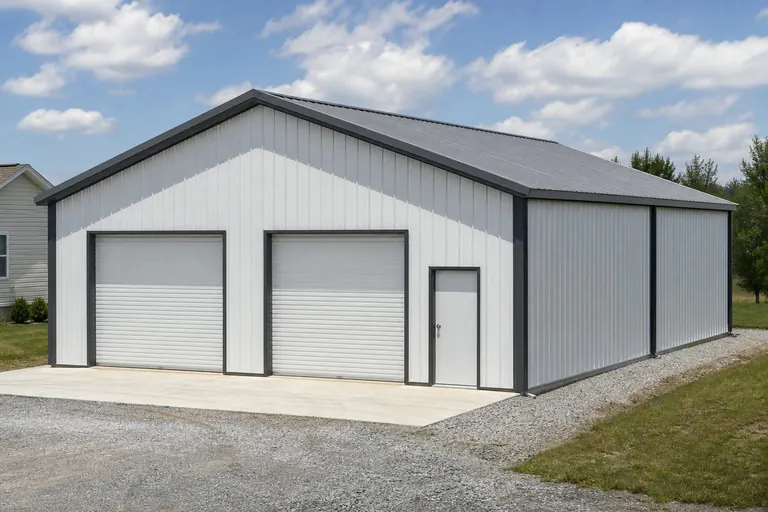 Partially enclosed RV coverAdded end or side panels for extra protection on exposed or wind-prone sites, keeping a drive-through opening for the vehicle.
Example Configuration — for planning purposes only.
Get Oregon RV carport quotes
Tell us your RV height, which side of the Cascades you're on and whether the site is rural. We route it with the Oregon and RV carport context already attached.
Footprint
Sizes that suit an Oregon RV carport
Vehicle length and height set the footprint; Cascade side changes exposure, not the size math.
14′ × 36′
504 sq ft
A single-bay footprint sized for one motorhome or long travel trailer.
14′ × 40′
560 sq ft
Added length for a longer Class A motorhome or a trailer with a full-length awning.
24′ × 40′
960 sq ft
A two-bay footprint for an RV alongside a second vehicle or equipment.
Example Configuration — for planning purposes only.
Footprint pages carry post spacing and clearance detail for each size; this page explains only the Oregon siting context.
Preparation
Before you request an Oregon RV carport quote
Confirming these details up front avoids a second round of quoting.
- State which side of the Cascades your site is onWest-side and east-side RV carports face different weather priorities.
- Check DOGAMI's SLIDO map for sloped or rural groundWorthwhile before setting tall posts into sloped or previously disturbed land.
- Measure your RV's full height including roof-mounted equipmentClearance needs to account for AC units, antennas and vents, not just body height.
- Confirm access and turning radius on rural lanesA gravel farm approach may need grading before a long RV can reach the pad.
- Check with your local building departmentPermit and setback questions are jurisdiction-specific; we do not state them here.
Questions
Oregon RV carport questions
Honest state-level answers, with jurisdiction-specific and site-specific items routed to whoever actually owns them.
The structure is the same, but the priority differs. Western Oregon, backed by Portland's 36.91-inch water-year precipitation normal, favors stronger roof-water routing; eastern Oregon leans toward sun and dust management.
It's worth checking, particularly on sloped or rural ground, since a taller structure's posts carry more concentrated load than a standard low carport. DOGAMI's statewide SLIDO database is the resource to start with.
Permit requirements depend on your city or county jurisdiction and the structure's size and placement. Your local building department is the only reliable source for that answer.
We do not publish state-level prices; cost depends on size, height, specification and site work. Our cost pages explain what drives the number.
Yes. An RV carport is taller and often longer to clear a motorhome or trailer's roofline, including roof-mounted equipment, which changes clearance and access needs compared with a standard vehicle carport.
It can. On larger rural parcels, common given Oregon's 430-acre average farm size, access road grading and turning radius for a long RV often matter as much as the structure's own clearance height.
Sources for the Oregon facts on this page
This page states no code requirement, wind speed, snow load, permit rule, price or supplier claim. The state-specific facts it does use are listed with their publisher below.
NOAA NCEI publishes a narrative 'Climate of Oregon' noting the Pacific Ocean's dominant influence on the state's mild, varied climate and the Cascade Range's role in dividing wet western Oregon from drier eastern Oregon.
NOAA National Centers for Environmental Information (NCEI) · Historical narrative (NCEI climate normals series) · Tier 1
https://www.ncei.noaa.gov/data/climate-normals-deprecated/access/clim60/states/Clim_OR_01.pdfNWS Portland's climate book reports Portland's 1991-2020 normal water-year (Oct 1-Sept 30) total precipitation at 36.91 inches.
National Weather Service (NOAA), Portland OR office · 1991-2020 normal (record from 1872-73) · Tier 1
https://www.weather.gov/media/pqr/climate/ClimateBookPortland/pg96.pdfThe Oregon Department of Geology and Mineral Industries (DOGAMI) maintains the Statewide Landslide Information Database for Oregon (SLIDO), a state geologic-hazard mapping resource covering landslide susceptibility statewide.
Oregon Department of Geology and Mineral Industries (DOGAMI) · SLIDO-4.5 released April 12, 2024 · Tier 2
https://www.oregon.gov/dogami/slido/Pages/data.aspxOregon had 15,295,779 acres of land in farms in 2022, an average farm size of 430 acres.
USDA NASS · 2022 · Tier 1
https://www.nass.usda.gov/Publications/AgCensus/2022/Online_Resources/County_Profiles/Oregon/cp99041.pdfDOGAMI has published coseismic landslide susceptibility, liquefaction susceptibility, and soil amplification class maps for Oregon's Clackamas, Columbia, Multnomah, and Washington counties, for use in FEMA's HAZUS loss-estimation methodology.
Oregon Department of Geology and Mineral Industries (DOGAMI) · 2019 · Tier 2
https://pubs.oregon.gov/dogami/ofr/O-19-09/O-19-09_report.pdf