
RV carport · CA
RV Carports in California
An RV carport in California is an open-sided cover sized for a tall, long vehicle, and where it sits changes the planning conversation more than in most states. CAL FIRE, under the Office of the State Fire Marshal, is required by law to classify land into Fire Hazard Severity Zones based on fuel loading, slope, fire weather and wind — a program worth checking for any parcel near wildland vegetation, since it is described here only as a mapping program, not a specific zone assignment for your site. California's 11 recognized geomorphic provinces, from the fog-prone Coast Ranges to the Mojave and Colorado deserts to the Central Valley, mean the same open structure faces very different corrosion, UV and wind exposure depending on where the parcel sits. The California Building Standards Commission administers Title 24 as the state's building standards framework, but the practical permit conversation for an RV carport still runs through your local building department.
The intersection
In California, fire-zone awareness and terrain define the RV carport brief
An open-sided RV carport is planned around vehicle clearance everywhere, but in California two additional questions — proximity to a mapped fire hazard zone and which of the state's geomorphic provinces the parcel sits in — shape the project from the start.
CAL FIRE, operating under the Office of the State Fire Marshal, is required by law to classify land into Fire Hazard Severity Zones using fuel loading, slope, fire weather and wind. That program exists statewide, but it does not assign one outcome to every California parcel — a lot near dense wildland vegetation and a lot in a dense urban tract can fall into very different categories. Before siting an open, unenclosed RV cover near brush or trees, it is worth checking your parcel against the current local FHSZ map and asking the local fire authority what, if anything, applies to an accessory structure like this. This page does not state a zone for any location; that is a lookup, not a generalization.
Terrain is the second variable, and California's scale makes it a real one. The California Geological Survey divides the state into 11 recognized geomorphic provinces — Coast Ranges, Central Valley, Sierra Nevada, Basin and Range, Mojave Desert, Colorado Desert, Transverse Ranges, Peninsular Ranges, Klamath Mountains, Cascade Range and Modoc Plateau. An open RV carport near the coast contends with salt-laden fog and humidity that favor corrosion-resistant fasteners and coatings; the same structure in the Mojave or Colorado Desert provinces faces intense summer UV and dust rather than moisture; a Central Valley site sits on flatter ground with its own agricultural dust and wind pattern. None of that is a single statewide answer, which is exactly the point.
Administration runs through Title 24, the California Building Standards Code administered by the California Building Standards Commission, but for a project like an RV carport the practical first call is still your city or county building department, which applies the adopted code locally and sets its own permit and setback requirements for accessory structures.
Comparison
How California region changes an RV carport's exposure
The open structure is the same; the conditions it has to withstand are not.
| Region type | Primary exposure | Practical consideration |
|---|---|---|
| Coastal (Coast Ranges, near-shore) | Salt-laden fog and humidity | Corrosion-resistant fasteners and coatings are worth discussing with your builder |
| Central Valley | Agricultural dust, seasonal heat, flat open wind | Site orientation relative to prevailing wind and dust source |
| Desert provinces (Mojave, Colorado Desert) | Intense summer UV, low humidity, blowing sand | Vehicle finish protection and dust ingress at open sides |
| Wildland-adjacent parcels (any province) | Potential Fire Hazard Severity Zone overlay | Check the current local FHSZ map before siting near vegetation |
Coastal (Coast Ranges, near-shore)
- Primary exposure
- Salt-laden fog and humidity
- Practical consideration
- Corrosion-resistant fasteners and coatings are worth discussing with your builder
Central Valley
- Primary exposure
- Agricultural dust, seasonal heat, flat open wind
- Practical consideration
- Site orientation relative to prevailing wind and dust source
Desert provinces (Mojave, Colorado Desert)
- Primary exposure
- Intense summer UV, low humidity, blowing sand
- Practical consideration
- Vehicle finish protection and dust ingress at open sides
Wildland-adjacent parcels (any province)
- Primary exposure
- Potential Fire Hazard Severity Zone overlay
- Practical consideration
- Check the current local FHSZ map before siting near vegetation
Configuration
Common California RV carport configurations
Configuration depends mostly on the vehicle and how much weather protection the site's exposure warrants.
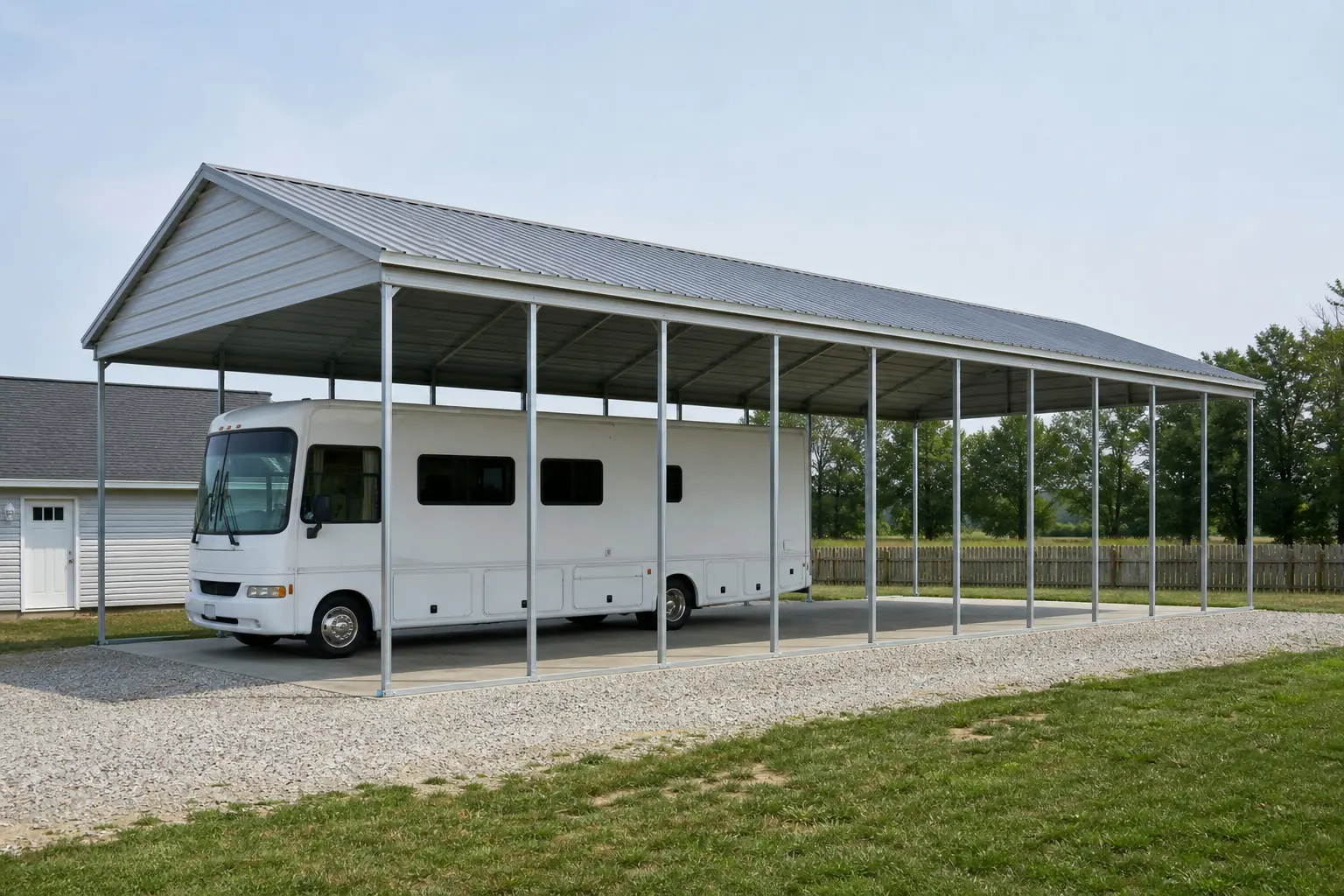
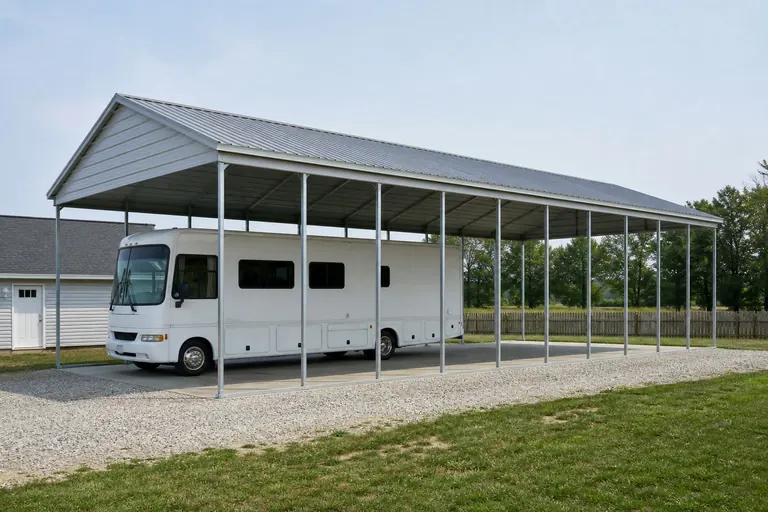 Single RV bayAn open bay sized to one motorhome or travel trailer, common on suburban and rural lots alike.
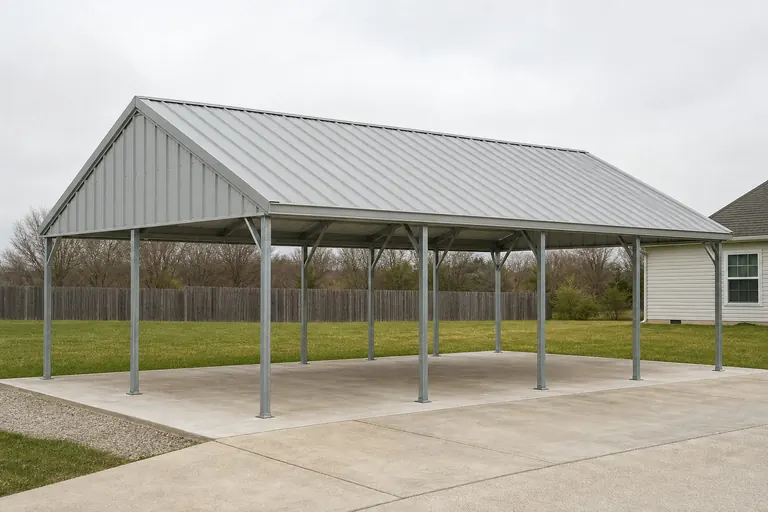 RV plus equipment bayA combined structure covering an RV alongside farm or recreational equipment, more common on Central Valley acreage.
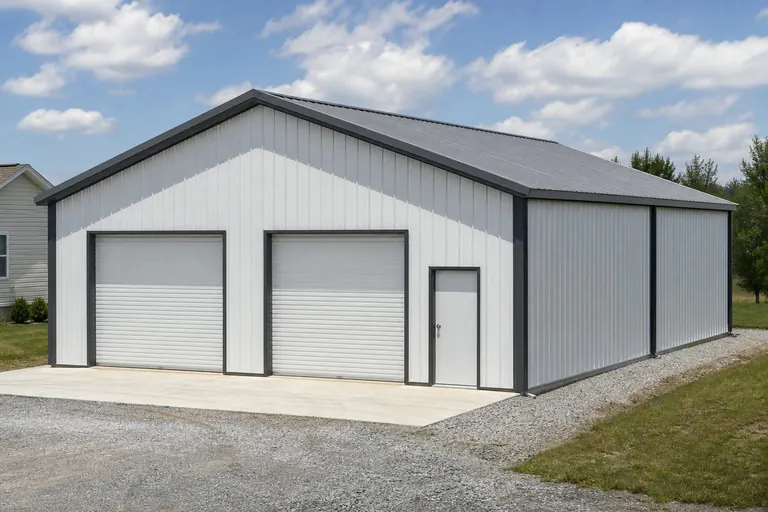 Partially enclosed RV coverSide panels added for extra protection against coastal fog or desert dust while keeping a drive-through end open.
Example Configuration — for planning purposes only.
Get California RV carport quotes
Tell us your RV height, region and whether the parcel is near mapped wildland vegetation, and we route it with the California context already attached.
Site context
Geomorphic provinces and RV carport siting
California's terrain diversity is the reason a single statewide siting answer does not exist for an open structure.
Coast Ranges
Fog and salt air favor corrosion-aware hardware selection for an unwalled steel cover.
Central Valley
Flat farmland where an RV carport often shares a parcel with agricultural buildings and equipment.
Mojave and Colorado Desert
Sustained UV and dust make finish protection and door/side-panel choices worth a closer look.
Sierra Nevada and Cascade Range
Higher elevation and terrain relief change access and site grading more than the structure itself.
Footprint
Sizes that suit a California RV carport
Vehicle clearance and length set the footprint; region changes exposure, not the size math.
14′ × 36′
504 sq ft
A single-bay footprint sized for one motorhome or long travel trailer.
14′ × 40′
560 sq ft
Added length for a longer Class A motorhome or a trailer with a full-length awning.
24′ × 40′
960 sq ft
A two-bay footprint for an RV alongside a second vehicle or equipment.
Example Configuration — for planning purposes only.
Footprint pages carry post spacing and clearance detail for each size; this page explains only the California siting context.
Preparation
Before you request a California RV carport quote
Confirming these details up front avoids a second round of quoting on an RV cover project.
Step 1
Check the current local Fire Hazard Severity Zone map
If the parcel sits near wildland vegetation, ask the local fire authority what, if anything, applies to an accessory structure.
Step 2
Identify which geomorphic province your parcel sits in
Coastal, desert and valley sites each favor different hardware and finish choices for an open steel structure.
Step 3
Confirm setback and permit rules with your local building department
Title 24 sets the statewide framework, but local departments administer it and set their own accessory-structure rules.
Step 4
Measure your RV's full height including roof-mounted equipment
Clearance needs to account for AC units, antennas and vents, not just the body height.
Step 5
Ask about anchoring appropriate to your site and region
Coastal, valley and desert exposure differ, and your builder can advise on hardware suited to your conditions.
Questions
California RV carport questions
Honest answers at the state level, with zone lookups and permitting questions routed to whoever actually owns them.
Permit requirements are set by your local building department, which administers Title 24 locally. Check with your city or county before finalizing dimensions or siting.
It can, if your parcel is near wildland vegetation. CAL FIRE's statutory FHSZ mapping program classifies land based on fuel loading, slope, fire weather and wind; check the current local map and ask your fire authority what applies to your specific site.
The state's 11 geomorphic provinces mean coastal, desert and valley sites face different corrosion, UV and dust conditions for an open structure. Your builder can recommend hardware and finish choices suited to your region.
We do not publish state-level prices, since cost depends on size, height, specification and site work. Our cost pages explain what drives the number; a builder quote covers your specific project.
Yes. An RV carport is taller and often longer to clear a motorhome or trailer's height, including roof-mounted equipment, which changes clearance and siting needs compared with a standard vehicle carport.
This page does not assert a specific rating or requirement. Title 24 is administered locally, and any structural or fire-related requirement for your accessory structure is a question for your local building department and engineer.
Sources for the California facts on this page
This page states no code requirement, wind speed, snow load, permit rule, price or supplier claim. The state-specific facts it does use are listed with their publisher below.
CAL FIRE, under the state Office of the State Fire Marshal, is required by law (Public Resources Code 4202 / Government Code 51178) to classify lands into Fire Hazard Severity Zones based on fuel loading, slope, fire weather, and wind, without this evidence assigning any specific zone.
California Department of Forestry and Fire Protection (CAL FIRE) / Office of the State Fire Marshal · current program; 2024 FHSZ maps referenced · Tier 2
https://osfm.fire.ca.gov/what-we-do/community-wildfire-preparedness-and-mitigation/fire-hazard-severity-zonesThe California Geological Survey (state geological survey) divides the state into 11 recognized geomorphic provinces, including the Coast Ranges, Central Valley, Sierra Nevada, Basin and Range, Mojave Desert, Colorado Desert, Transverse Ranges, Peninsular Ranges, Klamath Mountains, Cascade Range, and Modoc Plateau.
California Department of Conservation, California Geological Survey · 2002 (revised) · Tier 2
https://www.conservation.ca.gov/cgs/documents/publications/cgs-notes/CGS-Note-36.pdfThe California Building Standards Commission (CBSC) administers the California Building Standards Code, Title 24 of the California Code of Regulations, as the state's building standards framework.
California Department of General Services, Building Standards Commission (CBSC) · 2025 Triennial Edition, effective Jan 1, 2026 · Tier 2
https://www.dgs.ca.gov/bsc/The California State Climatologist describes California as having a Mediterranean climate overall, with precipitation concentrated October through April and dry conditions May through September, strongly modulated by mountains and the Pacific Ocean, with north coast areas averaging over 100 inches of annual precipitation and southeastern deserts under 5 inches.
California Department of Water Resources / Office of the State Climatologist (republished via CoCoRaHS) · n/a (narrative climatology) · Tier 2
https://media.cocorahs.org/docs/ClimateSum_CA.pdfThe average farm size in California was 383 acres in 2022.
USDA NASS · 2022 · Tier 1
https://www.nass.usda.gov/Publications/AgCensus/2022/Full_Report/Volume_1,_Chapter_1_State_Level/California/