
Metal garage · OR
Metal Garages in Oregon
A metal garage is a bigger commitment than a shed, and in Oregon the first real siting question is which side of the Cascades the parcel sits on. NOAA NCEI's narrative Climate of Oregon summary leads with the Cascade Range dividing a wetter western Oregon from a drier eastern Oregon, and Portland's 1991-2020 water-year normal of 36.91 inches of precipitation is representative of only the wet side. Layer on the Oregon Department of Geology and Mineral Industries' statewide SLIDO landslide database and its county-level seismic soil maps for the Portland metro counties, and a garage buyer here has genuine terrain homework to do before slab and drainage decisions are finalized.
The intersection
A garage answers to whichever side of the Cascades it sits on
NCEI's own narrative for Oregon frames the state's climate as two halves, and a garage — larger and more permanent than a shed — feels that split more directly.
NOAA's National Centers for Environmental Information publish a narrative 'Climate of Oregon' summary noting the Pacific Ocean's dominant influence on the state's mild, varied climate and the Cascade Range's role in dividing wet western Oregon from drier eastern Oregon. A garage buyer west of the mountains is planning for sustained moisture; a buyer east of them is planning for a drier, more temperature-variable environment. Neither spec transfers cleanly to the other side.
Portland International Airport's 1991-2020 water-year normal precipitation of 36.91 inches, tracked by the National Weather Service's Portland office, is representative of the wetter west side only. This page does not have a matching single statewide precipitation figure to offer, because Oregon's rainfall varies too widely between coastal valleys and the high desert for one number to describe both halves honestly.
Design
Drainage and ventilation follow the climate divide
A metal garage's biggest state-specific design questions in Oregon are moisture management on one side and heat/dryness management on the other.
On the wetter side, Portland's normal high temperatures — 47.5°F in January climbing to roughly 82.3°F in August, per NWS Portland's published normals — describe a mild range where humidity, not heat, drives the ventilation conversation. A garage there benefits from slab drainage planning and vented soffits to manage a long damp season rather than extreme temperature swings.
East of the Cascades, where NCEI's narrative describes a drier climate, the concern shifts toward dust infiltration and larger day-to-night temperature swings. A garage sited there is better served by attention to door sealing against dust and interior ventilation for heat buildup during the day.
Site check
Terrain and hazard resources for an Oregon garage slab
Oregon publishes county- and region-specific hazard data rather than one statewide rating, and a garage slab is a large enough pour to justify checking it.
| Resource | Coverage | Why it matters for a garage |
|---|---|---|
| DOGAMI SLIDO | Statewide landslide susceptibility mapping, SLIDO-4.5 released April 2024 | A garage slab is a heavier, more permanent pour than a shed pad, so slope stability is worth checking before it goes in. |
| DOGAMI Open-File Report O-19-09 | Coseismic landslide, liquefaction and soil amplification maps for Clackamas, Columbia, Multnomah and Washington counties | Relevant specifically to garage sites in the Portland metro four-county area. |
| FEMA National Risk Index | County-level scoring across 18 hazard types for all 36 Oregon counties | Pull your specific county's report rather than assuming a generic statewide hazard picture. |
DOGAMI SLIDO
- Coverage
- Statewide landslide susceptibility mapping, SLIDO-4.5 released April 2024
- Why it matters for a garage
- A garage slab is a heavier, more permanent pour than a shed pad, so slope stability is worth checking before it goes in.
DOGAMI Open-File Report O-19-09
- Coverage
- Coseismic landslide, liquefaction and soil amplification maps for Clackamas, Columbia, Multnomah and Washington counties
- Why it matters for a garage
- Relevant specifically to garage sites in the Portland metro four-county area.
FEMA National Risk Index
- Coverage
- County-level scoring across 18 hazard types for all 36 Oregon counties
- Why it matters for a garage
- Pull your specific county's report rather than assuming a generic statewide hazard picture.
Get Oregon metal garage quotes
Tell us which side of the Cascades your site sits on and your county, and we route it with the Oregon terrain and climate context attached.
Configuration
How an Oregon metal garage brief differs by property
A garage on a Portland-metro lot and a garage east of the Cascades are answering different questions before layout is even discussed.
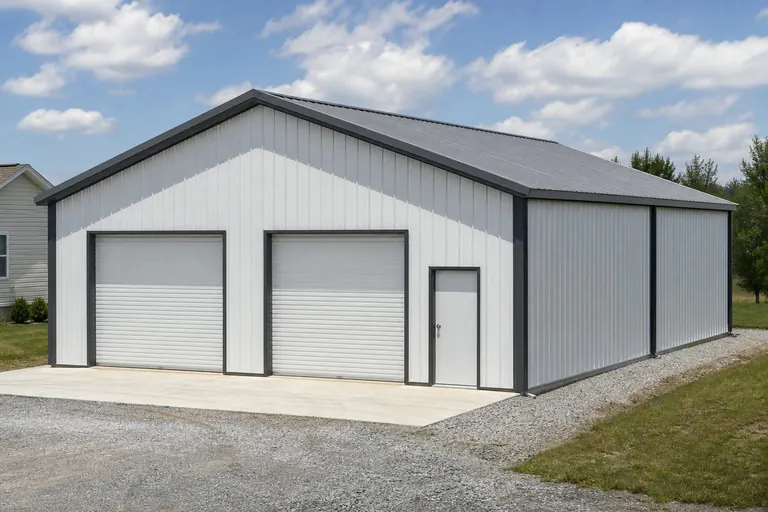 West-side residential garageSlab drainage and vented soffits to manage sustained damp conditions implied by Portland's 36.91-inch water-year normal.Portland-metro seismic-soil garageIn Clackamas, Columbia, Multnomah or Washington county, DOGAMI's published soil amplification and liquefaction maps are a documented resource worth checking before slab design.East-side garageDoor sealing against dust and interior ventilation for heat, oriented around the drier climate NCEI describes east of the Cascades.
Example Configuration — for planning purposes only.
Preparation
Before requesting an Oregon metal garage quote
Confirming these details up front avoids a second round of quoting on a garage project.
- Identify which side of the Cascades your site sits onIt changes ventilation and drainage recommendations more than square footage does.
- Check DOGAMI's SLIDO mapping for any slope on the parcelA garage slab is a large, permanent pour, so slope stability is worth confirming first.
- If in the Portland metro four-county area, review DOGAMI's seismic soil mapsClackamas, Columbia, Multnomah and Washington counties have published soil amplification and liquefaction data others do not.
- Pull your county's FEMA National Risk Index reportHazard exposure is published county by county, not as a single statewide figure.
- Confirm permit thresholds and setbacks with your local building departmentOregon has no single statewide answer this page can substitute for that call.
Sequencing
Rural acreage changes the order of operations, not just the terrain checks
Oregon's larger average farm size means a real share of metal garage buyers are siting a slab on rural ground first, then dealing with terrain and permitting second.
USDA's 2022 Census of Agriculture puts Oregon's average farm at 430 acres, spread across 15,295,779 acres of land in farms statewide. A garage going onto that kind of acreage is rarely replacing an existing driveway pad; it is usually a first structure on a previously undeveloped corner of the parcel, which means access grading and utility runs are live questions before slab placement, not afterthoughts.
That sequencing matters because a garage slab is a large, permanent pour: confirming DOGAMI's SLIDO landslide data, pulling the county's FEMA National Risk Index report, and getting the local building department's sign-off on setbacks all belong ahead of excavation on a rural parcel, where undoing a wrongly-placed slab is a far bigger cost than it would be on a small suburban lot.
Questions
Oregon metal garage questions
Honest answers at the state level, with engineering, permitting and pricing routed to whoever actually owns them.
Permit requirements are set by your local city or county building department. Confirm thresholds and required documentation before finalizing a size or foundation.
Yes in practical terms — NOAA's own narrative for Oregon describes a wetter west and drier east split by the Cascade Range, which shifts the priority between moisture drainage and dust/heat ventilation depending on the site.
It's worth checking on any sloped or hillside parcel. DOGAMI's statewide SLIDO database maps landslide susceptibility across Oregon and is a free resource to review before slab design.
No — DOGAMI's published coseismic landslide, liquefaction and soil amplification maps specifically cover Clackamas, Columbia, Multnomah and Washington counties. Outside that four-county area, check with DOGAMI or your local jurisdiction for available data.
We do not publish state-level prices, since cost depends on size, foundation, specification and site work. Our cost pages explain what drives the number; a builder quote covers your specific project.
It depends on lot size, setback rules and intended use. Review our size-specific pages for layout detail, then confirm with your local building department.
Sources for the Oregon facts on this page
This page states no code requirement, wind speed, snow load, permit rule, price or supplier claim. The state-specific facts it does use are listed with their publisher below.
NOAA NCEI publishes a narrative 'Climate of Oregon' noting the Pacific Ocean's dominant influence on the state's mild, varied climate and the Cascade Range's role in dividing wet western Oregon from drier eastern Oregon.
NOAA National Centers for Environmental Information (NCEI) · Historical narrative (NCEI climate normals series) · Tier 1
https://www.ncei.noaa.gov/data/climate-normals-deprecated/access/clim60/states/Clim_OR_01.pdfNWS Portland's climate book reports Portland's 1991-2020 normal water-year (Oct 1-Sept 30) total precipitation at 36.91 inches.
National Weather Service (NOAA), Portland OR office · 1991-2020 normal (record from 1872-73) · Tier 1
https://www.weather.gov/media/pqr/climate/ClimateBookPortland/pg96.pdfThe Oregon Department of Geology and Mineral Industries (DOGAMI) maintains the Statewide Landslide Information Database for Oregon (SLIDO), a state geologic-hazard mapping resource covering landslide susceptibility statewide.
Oregon Department of Geology and Mineral Industries (DOGAMI) · SLIDO-4.5 released April 12, 2024 · Tier 2
https://www.oregon.gov/dogami/slido/Pages/data.aspxDOGAMI has published coseismic landslide susceptibility, liquefaction susceptibility, and soil amplification class maps for Oregon's Clackamas, Columbia, Multnomah, and Washington counties, for use in FEMA's HAZUS loss-estimation methodology.
Oregon Department of Geology and Mineral Industries (DOGAMI) · 2019 · Tier 2
https://pubs.oregon.gov/dogami/ofr/O-19-09/O-19-09_report.pdfFEMA's National Risk Index is the authoritative source for county- and state-level natural hazard exposure ratings across 18 hazard types, viewable via FEMA's own interactive report tool.
Federal Emergency Management Agency (FEMA) · Current NRI release · Tier 1
https://www.fema.gov/flood-maps/products-tools/national-risk-indexOregon had 15,295,779 acres of land in farms in 2022, an average farm size of 430 acres.
USDA NASS · 2022 · Tier 1
https://www.nass.usda.gov/Publications/AgCensus/2022/Online_Resources/County_Profiles/Oregon/cp99041.pdf