
Pole barn · UT
Pole Barns in Utah
Utah's farm base is not built around a handful of enormous operations. The 2022 Census of Agriculture counted 17,386 farms statewide, working 10,494,923 acres of land in farms at an average of just 604 acres per farm — both figures down slightly from 2017. That scale sits on terrain the Utah Division of State History describes as the convergence of three physiographic provinces: the Rocky Mountain Province in the northeast, the Colorado Plateau in the east and southeast, and the Basin and Range in the west. A pole barn planned for a Utah farm is therefore usually a moderate-scale building, and which of those three provinces — plus which of the state's desert, steppe or highland climate zones — the site sits in changes the exposure and access conversation more than the county line does.
The intersection
Utah's farm scale sets a moderate, not maximal, pole barn brief
A pole barn's practical brief follows the operation it serves, and Utah's operations are smaller on average than the wide-open-range image the state's terrain can suggest.
The 2022 Census of Agriculture counted 17,386 farms in Utah, down about 6% from 2017, working 10,494,923 acres of land in farms, down about 3% over the same period. Divide the two and the average Utah farm comes out to 604 acres — a real, working scale, but far smaller than the multi-thousand-acre averages that push some neighbouring Mountain West states toward wide-span mega-buildings as the default pole barn brief.
That does not mean Utah pole barns are uniformly small; a 604-acre average includes a wide spread of individual operation sizes, and a specific farm may be considerably larger or smaller. What the average does tell a buyer is that a Utah pole barn quote built around an assumption of thousands of surrounding acres is likely mis-specified for the state, and it is worth describing the actual working acreage rather than defaulting to a big-state assumption.
The trend direction matters too: both farm count and total farmed acreage declined slightly between 2017 and 2022. This page does not assert a cause for that contraction, but a buyer planning a long-lived structure is reasonable to ask whether the operation's footprint is expected to hold steady, shrink, or consolidate with a neighbouring parcel before finalizing a building size.
Site context
Three physiographic provinces, three different pole barn sites
The Utah Division of State History describes the state as the meeting point of three distinct physiographic provinces, and each behaves differently for a post-frame building.
Rocky Mountain Province (northeast)
Home to the Uinta and Wasatch ranges; higher elevation and mountain terrain make roof pitch, snow-shedding clearance and seasonal access the practical planning items for a pole barn here.
Colorado Plateau (east/southeast)
Characterized by mesa-and-canyon terrain; access road grading and site leveling tend to be a bigger factor than snow, and heat/sun exposure is worth addressing in ventilation choices.
Basin and Range (west)
Lower-elevation valley and desert terrain where sun exposure and infrequent but intense storm drainage, not sustained snow load, dominate the planning conversation.
The steppe climate zone (roughly 43% of the state)
Utah's largest climate-zone share by area, sitting across parts of all three provinces, and the zone most working farmland in the state actually falls into.
Exposure
Elevation inside the province decides access and moisture strategy
Utah's roughly 11,000-foot elevation range, from 2,350 feet at Beaver Dam Wash toward 13,528 feet at Kings Peak, means a pole barn's ventilation and access plan should follow the actual site elevation rather than the province label alone.
A pole barn used for hay or feed storage benefits from a ventilation strategy matched to how much moisture the site typically sees; that differs meaningfully between a low-elevation Basin and Range valley floor and a higher bench in the Rocky Mountain Province foothills, even where both sit in the state's broad steppe classification.
Access is the other elevation-linked variable. A farm parcel higher in the Rocky Mountain Province may face real seasonal access constraints that a Colorado Plateau or Basin and Range site at lower elevation typically does not, which matters for both construction scheduling and ongoing equipment access to a completed pole barn.
None of this is a substitute for an engineered snow or wind value, which is set by the local jurisdiction based on the actual site. It is a reason to describe elevation and province, not just a county name, to whoever is quoting the building.
- State elevation, not just county
- Two Utah farms in the same county can sit at meaningfully different elevations and provinces.
- Match ventilation to province moisture patterns
- Basin and Range dryness and Rocky Mountain Province moisture call for different hay-storage ventilation choices.
- Flag seasonal access constraints early
- Higher-elevation Rocky Mountain Province sites can have winter access limitations that affect delivery scheduling.
Get Utah pole barn quotes
Tell us your operation's acreage, your physiographic province and rough footprint. We route it with the Utah and pole barn context already attached.
Configuration
What a Utah pole barn is usually asked to do
A moderate-scale farm base means the typical Utah pole barn brief centers on efficient, multi-purpose use of one building rather than a dedicated mega-structure per function.
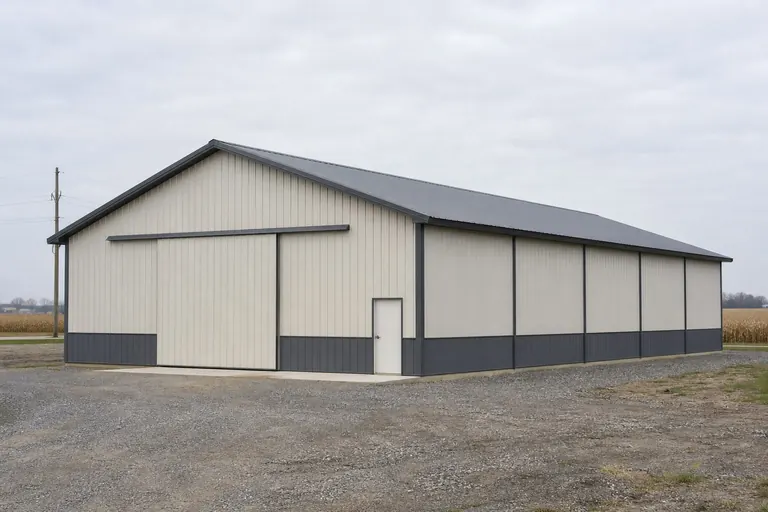 Combined hay and equipment storageOn a 604-acre-average operation, one building frequently needs to do both jobs rather than each getting a dedicated structure.Livestock support on a working parcelShelter and feed access integrated with existing corrals or fencing suits a moderate-scale Utah farm layout.Province-specific access buildingColorado Plateau and Basin and Range sites sometimes favor a simpler open-sided structure than the Rocky Mountain Province's snow-country brief.
Example Configuration — for planning purposes only.
Footprint
Sizes that suit a Utah farm operation
A moderate average operating scale keeps most Utah pole barn enquiries below the wide-span mega-building range typical of larger-acreage grazing states.
30′ × 40′
1,200 sq ft
A common single-operation starting point for hay and equipment storage on a moderate-scale Utah farm.
40′ × 60′
2,400 sq ft
Suits combined hay, feed and equipment storage where the operation runs closer to the state average.
40′ × 80′
3,200 sq ft
Adds capacity for a larger equipment fleet or a second storage bay without widening the frame.
60′ × 100′
6,000 sq ft
For the larger end of Utah operations that exceed the state's average farm scale.
Example Configuration — for planning purposes only.
Footprint pages carry the layout and door detail for each of these; this page only explains why Utah briefs tend to land in this range.
Preparation
Before you request a Utah pole barn quote
Four things settled in advance make the difference between a comparable quote and a re-quote on a Utah farm parcel.
Step 1
Describe your actual acreage and operation size
Do not default to a large-state assumption; Utah's average farm is 604 acres, and your specific scale should drive the building size, not a statewide guess.
Step 2
Identify your physiographic province and elevation
Tell your quoting contact whether the site sits in Rocky Mountain, Colorado Plateau or Basin and Range terrain, and roughly what elevation.
Step 3
Contact your local building department
Utah's code administration is coordinated through a statewide commission, but your local department still applies it to your specific parcel and use.
Step 4
Flag seasonal access constraints
If the site is higher-elevation or Rocky Mountain Province terrain, note any winter access limitation before scheduling delivery.
Questions
Utah pole barn questions
Questions we can answer honestly at state level, with the ones we cannot routed to whoever actually owns them.
The 2022 Census of Agriculture put the average Utah farm at 604 acres across 17,386 farms, both down slightly from 2017. That is a moderate operating scale, smaller than the multi-thousand-acre averages seen in some neighbouring states.
Yes. Utah sits at the convergence of three physiographic provinces — the Rocky Mountain Province, the Colorado Plateau and the Basin and Range — and which one a parcel falls in changes terrain, access and moisture exposure more than the county name does.
Permit requirements are set by your local building department. Utah's Division of Professional Licensing works with the Uniform Building Code Commission toward statewide consistency, but your specific parcel and use are still confirmed locally.
Utah's terrain runs from 2,350 feet at Beaver Dam Wash toward 13,528 feet at Kings Peak. Elevation within that range affects seasonal access and moisture exposure for a pole barn's ventilation strategy, independent of which province the site sits in.
The 2022 Census of Agriculture recorded 17,386 farms, down about 6% from 2017, with total land in farms down about 3% over the same period. This page does not assert a cause for that trend, but it is worth factoring into long-lived building decisions.
We do not publish state-level prices, because a credible number depends on your specification, site work and current material pricing. Our cost pages cover what drives the number; a quote covers your building.
Sources for the Utah facts on this page
This page states no code requirement, wind speed, snow load, permit rule, price or supplier claim. The state-specific facts it does use are listed with their publisher below.
The 2022 Census of Agriculture counted 17,386 farms in Utah (down about 6% from 2017).
USDA NASS · 2022 · Tier 1
https://www.nass.usda.gov/Publications/AgCensus/2022/Online_Resources/County_Profiles/Utah/cp99049.pdfLand in farms in Utah totaled 10,494,923 acres in the 2022 Census, down about 3% from 2017.
USDA NASS · 2022 · Tier 1
https://www.nass.usda.gov/Publications/AgCensus/2022/Online_Resources/County_Profiles/Utah/cp99049.pdfAverage Utah farm size in the 2022 Census was 604 acres, up about 3% from 2017.
USDA NASS · 2022 · Tier 1
https://www.nass.usda.gov/Publications/AgCensus/2022/Online_Resources/County_Profiles/Utah/cp99049.pdfUtah lies at the convergence of three physiographic provinces: the Rocky Mountain Province (Uinta and Wasatch mountains) in the northeast, the Colorado Plateau in the east/southeast, and the Basin and Range in the west.
Utah Division of State History (History to Go) · current reference page · Tier 2
https://historytogo.utah.gov/unique-setting/Utah has three distinct climate zones: desert (33% of the state), steppe (43%), and highland/mountain (24%), reflecting the valley-to-mountain precipitation and snowfall contrast.
Utah Agriculture in the Classroom · current reference sheet · Tier 3
https://cdn.agclassroom.org/ut/lessons/cc/ut_elevation_precip_maps.pdfUtah's highest point is Kings Peak at 13,528 feet and its lowest point is Beaver Dam Wash at 2,350 feet, illustrating the mountain-versus-valley elevation and climate contrast used in state education materials.
Utah Agriculture in the Classroom (agclassroom.org, hosted via Utah State University Extension network) · current reference sheet · Tier 3
https://cdn.agclassroom.org/ut/lessons/cc/ut_elevation_precip_maps.pdf