
Pole barn · NV
Pole Barns in Nevada
Nevada's farmland is overwhelmingly grazing land: USDA's 2022 Census of Agriculture puts pastureland at 4,819,992 of the state's 5,896,654 total farm acres, next to just 653,891 acres of cropland and 61,686 acres of woodland. That land use, spread across a shrinking count of 3,122 farms (down 9% since 2017) averaging 1,889 acres each, points most Nevada pole barn projects toward hay, feed and livestock-support buildings on very large grazing allotments rather than row-crop equipment sheds — and it puts them squarely inside a rain-shadow desert climate that behaves very differently in the state's south than in its north.
The intersection
Grazing land, not cropland, sets the Nevada pole barn brief
A pole barn's job depends heavily on what the surrounding land is used for, and Nevada's farmland is overwhelmingly grazing land rather than cropland.
USDA's 2022 Census of Agriculture records 5,896,654 acres of land in farms statewide, of which 4,819,992 acres — more than eight in ten — are classed as pastureland. Cropland accounts for just 653,891 acres, with 61,686 acres of woodland rounding out the total. That composition means the typical Nevada pole barn brief is built around hay storage, feed handling and livestock support on grazing operations, not the grain-bin-and-combine equipment shed common in row-crop states.
The farm count backing that acreage is shrinking: 3,122 farms in 2022, down 9% from 2017, spread across an average of 1,889 acres each. Fewer operations working that much acreage tend to consolidate structures rather than build several small ones, which shows up as demand for wider clear-span buildings capable of storing more hay or supporting more livestock infrastructure per structure.
Layered on top of that land-use pattern is Nevada's rain-shadow desert climate, driven by the Sierra Nevada intercepting Pacific storm moisture before it reaches the state's Basin and Range interior. NOAA's 2022 State Climate Summary calls Nevada the driest state in the country overall, which supports open or well-ventilated hay storage in much of the state — but the same summaries document a real divide between the Sierra front and the drier basin country farther east, so ventilation and moisture strategy still benefit from checking the actual site's local climate normal rather than the statewide superlative.
Site context
How the pole barn brief differs across Nevada grazing country
Elevation and proximity to the Sierra Nevada front shape ventilation and moisture strategy differently than a simple state-level average would suggest.
High-desert grazing allotments
The setting for most of the state's large pastureland acreage. Open or well-ventilated hay storage suits the low-moisture baseline, with wide spans favored by consolidated, larger operations.
Sierra-front and higher-elevation ranch land
Closer to the mountain front, the same rain-shadow mechanism that dries the basin delivers more moisture and snow; roof pitch and hay-storage moisture protection deserve a specific look here.
Limited cropland pockets
Where the state's smaller cropland acreage sits, a pole barn brief looks more like grain or implement storage than the grazing-support buildings typical elsewhere in the state.
Sites nearer active permitting offices
Nevada authorized 19,994 new housing units in 2024, evidence that local departments statewide process construction routinely; your local office remains the only source for what your specific parcel requires.
Exposure
Ventilation strategy follows the grazing-land moisture profile
A grazing-dominated land base with a dry statewide baseline still needs a moisture strategy matched to the specific site's local climate normal, not the state's driest-in-the-nation label alone.
Hay stored in a low-moisture environment can often rely on open-sided or ridge-ventilated construction to prevent mold and spoilage, which fits Nevada's overall dry classification. But the state's own climate narrative describes real variation by elevation and proximity to the Sierra Nevada, so a pole barn built near the mountain front benefits from more attention to roof drainage and moisture ingress than one built deep in the drier basin country.
Because most Nevada farmland is pastureland rather than cropland, the building itself is also more likely to be asked to support livestock functions — shelter, feed access, equipment for herd management — alongside hay storage, which affects door width, interior clearance and how the structure connects to corrals or fencing on the working parcel.
- Match ventilation to your local normal, not the state average
- Confirm whether your site is closer to Sierra-front moisture or deep basin dryness before finalizing hay-storage ventilation.
- Plan for livestock functions, not just storage
- A grazing-dominated parcel often asks the pole barn to support herd management alongside hay and feed.
- Size for the allotment, not just the herd today
- Large average holdings mean the building's clear span is worth planning against future herd or hay-volume growth.
Get Nevada pole barn quotes
Tell us your hay volume, herd size and rough footprint. We route it with the Nevada and pole barn context already attached.
Configuration
What Nevada pole barns are usually asked to do
On a grazing-dominated operation, the typical brief centers on hay, feed and livestock support rather than row-crop equipment.
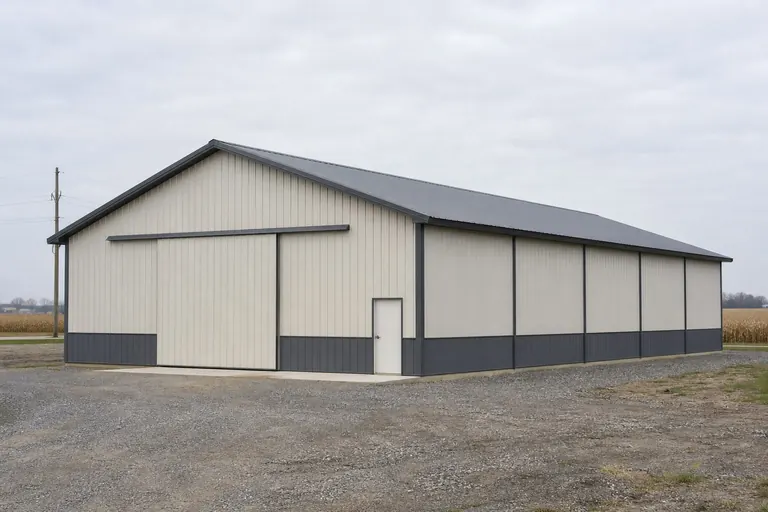 Hay and feed storageVentilation, dry storage and door width for larger loads are priorities given the state's pastureland-heavy land use.Livestock support structureShelter and equipment access connected to corrals or fencing on a grazing allotment is a common Nevada configuration.Equipment storage on remaining croplandIn the state's smaller cropland pockets, a more conventional implement-storage brief still applies.
Example Configuration — for planning purposes only.
Footprint
Sizes that suit a Nevada grazing operation
Large average holdings and consolidated farm counts push Nevada pole barn enquiries toward wider spans than a small cropland state would typically need.
40′ × 60′
2,400 sq ft
A common baseline for hay and feed storage on a mid-size grazing operation.
40′ × 80′
3,200 sq ft
Adds length for larger hay volume or combined feed-and-equipment storage.
60′ × 100′
6,000 sq ft
Where a large grazing allotment centralizes most hay and equipment storage in one structure.
60′ × 120′
7,200 sq ft
For the higher end of consolidated Nevada ranch operations needing maximum single-building capacity.
Example Configuration — for planning purposes only.
Footprint pages carry the layout and door detail for each of these; this page only explains why the Nevada brief tends to skew wider.
Preparation
Before you request a Nevada pole barn quote
Four things resolved in advance make the difference between a comparable quote and a re-quote on a Nevada grazing parcel.
Step 1
Contact your local building department
Ask what your parcel, elevation and use require before you fix the specification; requirements are set locally, not statewide.
Step 2
Describe hay volume and herd size
A grazing operation's storage and shelter needs drive clear span and door width more than a general footprint number does.
Step 3
Confirm your local climate normal
Sierra-front sites and deep basin sites face different moisture and snow profiles even within the same state.
Step 4
Plan connection to corrals or fencing
If the building supports livestock functions, confirm access points and door placement relative to existing infrastructure.
Questions
Nevada pole barn questions
Questions we can answer honestly at state level, with the ones we cannot routed to whoever actually owns them.
USDA's 2022 Census of Agriculture recorded 4,819,992 of Nevada's 5,896,654 total farm acres as pastureland, versus just 653,891 acres of cropland. That land-use split is why most pole barn briefs in the state center on hay and livestock support.
Permit requirements depend on your county or municipality, your parcel and how the building is used. Your local building department is the only reliable source for that answer.
No. NOAA calls Nevada the driest U.S. state overall, but the state's own climate narrative documents real variation by elevation and proximity to the Sierra Nevada. Confirm your site's local climate normal before finalizing a ventilation strategy.
The 2022 Census of Agriculture put the state's average farm at 1,889 acres, among the largest in the country, across a shrinking count of 3,122 farms. Many pole barn sites sit on grazing allotments of that scale.
We do not publish state-level prices, because a credible number depends on your specification, site work and current material pricing. Our cost pages cover what drives the number; a quote covers your building.
Sources for the Nevada facts on this page
This page states no code requirement, wind speed, snow load, permit rule, price or supplier claim. The state-specific facts it does use are listed with their publisher below.
Nevada had 3,122 farms in 2022, down 9% from 2017.
USDA National Agricultural Statistics Service (NASS) · 2022 · Tier 1
https://www.nass.usda.gov/Publications/AgCensus/2022/Online_Resources/County_Profiles/Nevada/cp99032.pdfNevada had 5,896,654 acres of land in farms in 2022, an average farm size of 1,889 acres, among the largest average farm sizes in the country.
USDA NASS · 2022 · Tier 1
https://www.nass.usda.gov/Publications/AgCensus/2022/Online_Resources/County_Profiles/Nevada/cp99032.pdfOf Nevada's land in farms in 2022, pastureland accounted for 4,819,992 acres, cropland 653,891 acres, and woodland 61,686 acres.
USDA NASS · 2022 · Tier 1
https://www.nass.usda.gov/Publications/AgCensus/2022/Online_Resources/County_Profiles/Nevada/cp99032.pdfNOAA's State Climate Summaries 2022 states Nevada is the driest state in the United States, with temperatures having risen almost 2.4°F since the beginning of the 20th century.
NOAA National Centers for Environmental Information (NCEI) · State Climate Summaries 2022 · Tier 1
https://statesummaries.ncics.org/chapter/nv/The Nevada State Climate Office (University of Nevada, Reno) explains the Sierra Nevada wrings moisture from Pacific storms while the Rocky Mountains block Gulf of Mexico moisture, and the resulting dry air contributes to Nevada's extreme temperature swings.
Nevada State Climate Office, University of Nevada, Reno · Extension reference page · Tier 2
https://www.unr.edu/nevada-climate-office/about-our-climateLocal building permit offices in Nevada authorized 19,994 new privately-owned housing units in 2024.
U.S. Census Bureau · 2024 (full calendar year) · Tier 1
https://www.census.gov/construction/bps/stateannual.html