
Garden shed · NH
Garden Sheds in New Hampshire
A garden shed in New Hampshire is rarely dropped onto an already-open lot. USDA's 2022 Census of Agriculture shows woodland covering about 249,287 of the state's roughly 417,187 farmed acres — more than cropland (105,297 acres) and pastureland (24,246 acres) combined — so clearing is frequently the first real step in siting even a small structure. NOAA's 1991-2020 normal for Concord adds roughly 67.7 inches of average annual snowfall on top of that, and University of New Hampshire climatologists note the state has considerable place-to-place climate variation tied to latitude, topography, and coastal proximity, the same variation behind Mount Washington's 'World's Worst Weather' reputation.
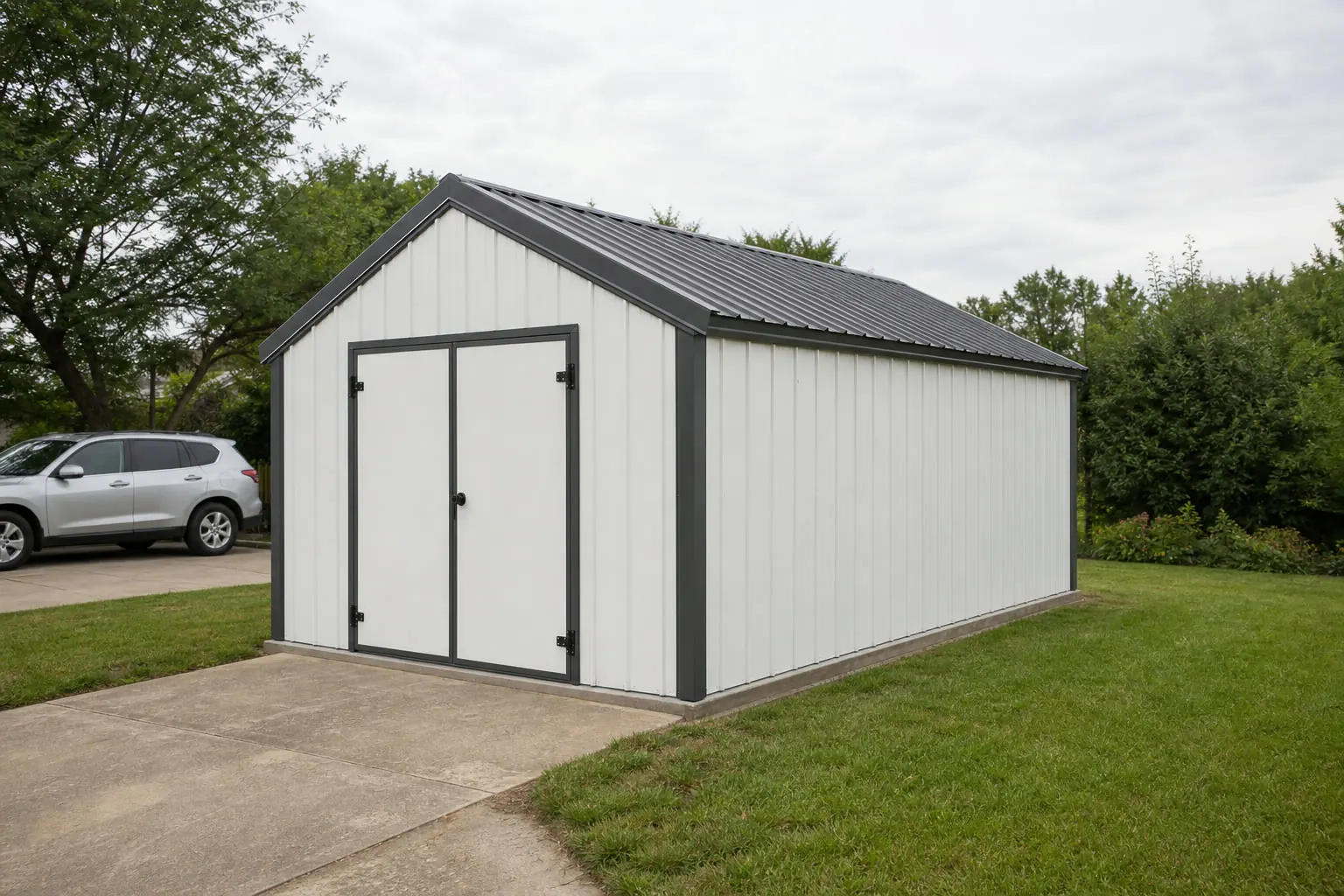
The intersection
What a New Hampshire site changes about a garden shed
The shed itself is a simple steel-frame structure everywhere. What differs here is how much clearing and winter it has to plan around before it goes up.
USDA's 2022 Census of Agriculture shows New Hampshire's farmland is dominated by woodland: about 249,287 acres, well ahead of cropland (105,297 acres) and pastureland (24,246 acres) combined, out of roughly 417,187 total farmed acres statewide. Translated to a residential or small-plot garden shed project, that means tree removal, stump grinding, and root-zone grading are frequently part of the site-prep scope before a slab or gravel pad is even discussed — a step many flatter, less-forested states skip entirely.
Winter changes the shed itself, not just the site. NOAA's 1991-2020 normal for Concord shows roughly 67.7 inches of average annual snowfall alongside about 41.95 inches of annual precipitation. That is not a design-load conversation — leave engineering specifics to your local building department — but it does mean roof pitch, door swing clearance under a snow load, and which direction the roof sheds are worth deciding before the shed goes in, not after the first storm buries the door.
New Hampshire's own climatologists, along with University of New Hampshire research summarized by CoCoRaHS, describe the state — home to Mount Washington and its 'World's Worst Weather' reputation — as having considerable place-to-place variation in temperature and precipitation tied to latitude, topography, and proximity to the coast. A shed sited in the Seacoast lowlands and one sited in the northern foothills face genuinely different exposure even under the same statewide snowfall normal, which is why a local site assessment should drive the final roof and siting decision rather than a single number.
Site context
How terrain and climate vary across New Hampshire
The state climatologist's documented variation is the most useful lens for anticipating what a quote should account for.
Seacoast lowlands
Milder coastal influence but still subject to nor'easter snow and wind; confirm drainage and wind exposure with a local site visit.
Merrimack Valley and central lowlands
Where most of the state's modest new construction concentrates; clearing is still common but grading is typically straightforward.
White Mountains and northern foothills
Higher elevation, heavier snowfall, and denser forest cover; clearing scope and footing prep deserve extra attention here.
Exposure
Clearing and snow shed are the two recurring variables
Almost every New Hampshire garden shed conversation eventually returns to how much tree work the site needs and how the roof sheds snow.
Because so much of the state's undeveloped land is wooded, clearing is often the first real cost and scheduling variable in a New Hampshire garden shed project — not the shed itself. Confirming tree removal, stump grinding, and root disruption before your builder quotes a footprint avoids a mid-project surprise, even for a small structure.
With Concord's normal near 67.7 inches of annual snowfall, a small shed's roofline should still be oriented to shed away from the door and any walk path. Deciding this at design time, rather than after the first heavy snow, keeps the door usable through a genuinely long New Hampshire winter.
Because climate exposure varies meaningfully with elevation and coastal proximity, describing your specific town's conditions to your builder — rather than assuming a single statewide profile — helps avoid both under- and over-building a small structure.
- Tree and stump clearing
- Budget site clearing as its own scope item on wooded New Hampshire parcels, even for a small shed.
- Roof shed direction
- Confirm which way the roof sheds before fixing the shed's placement near a walk path or door.
- Elevation and coastal exposure
- A White Mountains site and a Seacoast site face different conditions even at the same statewide snowfall normal.
Get New Hampshire garden shed quotes
Tell us your lot's clearing needs, elevation, and what you're storing. We route it with the New Hampshire and garden shed context attached.
Configuration
What New Hampshire garden sheds are usually asked to do
Given the state's wooded land base and small-farm pattern, most New Hampshire sheds serve a narrow, specific purpose.
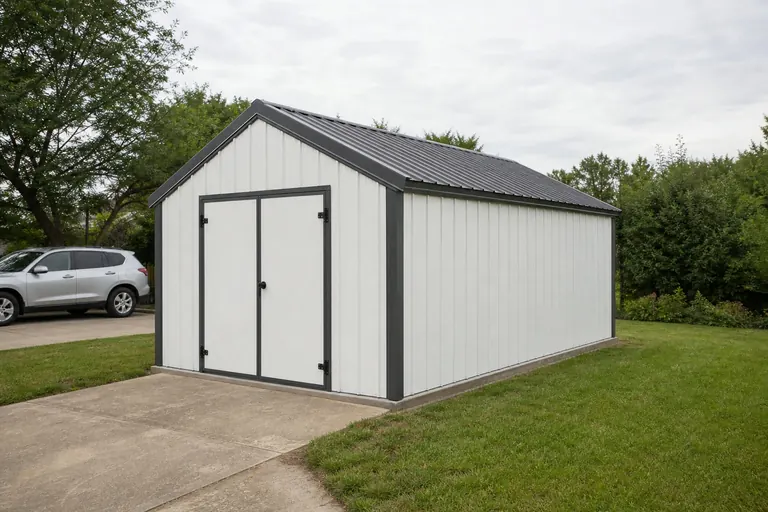 Garden and hand-tool storageA frequent brief on residential lots: a dry, secure spot for tools, mowers, and seasonal gear once clearing is done.Small-farm equipment shelterCompact equipment and feed storage sized to the state's smaller average farm operations.Seasonal and firewood storageDry storage for firewood and winter equipment, a common need given the length of a New Hampshire winter.
Example Configuration — for planning purposes only.
Footprint
Sizes that fit a New Hampshire site
Whether the site is a cleared residential yard or a wooded rural parcel changes which footprint makes the most sense.
8′ × 10′
80 sq ft
A compact footprint that limits the clearing needed on a wooded residential lot.
10′ × 12′
120 sq ft
Room for a mower and hand tools without an oversized clearing footprint.
12′ × 16′
192 sq ft
A practical small-farm size for equipment, feed, and firewood storage.
12′ × 20′
240 sq ft
Larger option for combined garden, equipment, and seasonal storage.
Example Configuration — for planning purposes only.
Footprint pages carry the door and layout detail; this page explains why the New Hampshire brief weighs clearing scope against footprint size.
Preparation
Before you request a New Hampshire quote
These items address frequent re-quote triggers for a New Hampshire garden shed.
Step 1
Check setback rules with your local building department
Accessory structure setbacks vary by town; confirm before fixing a footprint.
Step 2
Get a clearing estimate for your site
Because most undeveloped land is wooded, tree and stump removal is a common precondition even for a small shed.
Step 3
Fix roof shed direction against snow load
Decide this before the shed is set, not after the first storm.
Step 4
Describe your elevation and coastal proximity
A White Mountains site and a Seacoast site face different exposure even under the same statewide normal.
Questions
New Hampshire garden shed questions
Honest state-level answers, with jurisdiction-specific items routed to the office that owns them.
Permit requirements depend on your municipality, lot, and structure size. Your local building department is the only reliable source; ask before finalizing dimensions.
We do not state design loads on this page. Concord's NOAA normal of about 67.7 inches of average annual snowfall is planning context only; your local building department determines the actual design requirement for your site.
Possibly, and often yes. USDA data shows woodland covers a large share of the state's farmed acreage, well ahead of cropland and pastureland combined, so tree and stump removal is a common precondition on wooded parcels.
There's no official typical size. Compact 8x10 through 12x20 footprints tend to fit both residential and small-farm needs, depending on clearing scope and intended use.
Yes. State climatologists document considerable place-to-place variation tied to latitude, topography, and coastal proximity — the same variation behind Mount Washington's 'World's Worst Weather' reputation — so a Seacoast site and a northern foothills site plan differently.
Sources for the New Hampshire facts on this page
This page states no code requirement, wind speed, snow load, permit rule, price or supplier claim. The state-specific facts it does use are listed with their publisher below.
Of New Hampshire's land in farms in 2022, woodland accounted for 249,287 acres, more than cropland (105,297 acres) and pastureland (24,246 acres) combined, reflecting the state's forested character.
USDA NASS · 2022 · Tier 1
https://www.nass.usda.gov/Publications/AgCensus/2022/Online_Resources/County_Profiles/New_Hampshire/cp99033.pdfConcord, NH's 1991-2020 annual normal precipitation is 41.95 inches with 67.7 inches of annual snowfall.
National Weather Service (NOAA), Gray/Portland ME office · 1991-2020 · Tier 1
https://www.weather.gov/media/gyx/climo/CONSeasonal.pdfUniversity of New Hampshire climatologists note the state, home to Mount Washington and its reputation for the 'World's Worst Weather,' has considerable place-to-place variation in temperature and precipitation due to latitude, topography, and proximity to the coast.
New Hampshire State Climatologist / CoCoRaHS · State climatologist reference article · Tier 2
https://media.cocorahs.org/docs/ClimateSum_NH.pdfNew Hampshire had 3,949 farms in 2022, down 4% from 2017.
USDA National Agricultural Statistics Service (NASS) · 2022 · Tier 1
https://www.nass.usda.gov/Publications/AgCensus/2022/Online_Resources/County_Profiles/New_Hampshire/cp99033.pdfLocal building permit offices in New Hampshire authorized 4,965 new privately-owned housing units in 2024.
U.S. Census Bureau · 2024 (full calendar year) · Tier 1
https://www.census.gov/construction/bps/stateannual.html