
Pole Barn · MS
Pole Barns in Mississippi
A post-frame pole barn set on Delta alluvial ground answers to different soil behavior than one anchored into central Mississippi's loess hills or the sandier Coastal Plain near the Gulf. With 10,251,497 acres still in farms statewide even after a decade of consolidation, Mississippi pole barns are doing double duty as equipment storage, hay barns and workshop space across genuinely different ground conditions from one end of the state to the other.
The Mississippi Context
Post embedment starts with which region the barn sits in
Mississippi's land splits into distinct resource areas, and a pole barn's post depth and footing detail should follow that split rather than a single statewide default.
Mississippi State University Extension's land-resource-area mapping separates the Mississippi Delta, an alluvial plain built from river-deposited sediment, from the state's central loess hills and its Coastal Plain to the south. For a pole barn, that distinction is not academic: alluvial Delta soil tends to be deep, fine-grained and moisture-retentive, which changes how far a post needs to be set and whether a concrete collar or a wider footing pad is the right call compared to a hill-country site with more natural drainage and slope.
The state's underlying land base is still large. The 2022 Census of Agriculture counted 10,251,497 acres in Mississippi farms, down only 2% from 2017 even though the number of farms fell 11% over the same period. That combination — fewer operators, nearly the same total acreage — points to a pole barn's practical role: equipment and hay storage scaled for a bigger single operation rather than several smaller ones, which affects clear-span width and door placement more than it affects the post-frame method itself.
None of this changes the basic post-frame build sequence. Posts are set first, then girts, trusses, and metal skin follow. What Mississippi's regional soil variation changes is how deep those posts go and whether a soils test is worth the cost before the layout is finalized.
Regional Planning
What changes post-frame planning across the state
Delta, hill country and Coastal Plain sites each shift the footing and site-prep conversation for a pole barn.
Mississippi Delta
Flat alluvial ground simplifies grading for a pole barn's building pad, but the same moisture-retentive soil that Extension documents for the Delta means post embedment and any concrete collar should be sized from a local soils check rather than copied from a hill-country spec.
Loess Hills & Central Mississippi
More relief here often means cut-and-fill work before a level pad is achievable, and a pole barn sited on a slope benefits from a retaining strategy on the low side rather than trying to force a flat footprint onto sloped ground.
Coastal Plain & Piney Woods (South Mississippi)
Sandier soils in parts of the Coastal Plain can drain faster, which is generally favorable for post-frame footings, but closer Gulf exposure raises separate wind-detailing questions that a local engineer should size for that specific site.
Weather Response
Detailing for sustained rain and thunderstorm frequency, not snow
Mississippi's climate and storm-history sources point pole barn planning toward drainage capacity and structural connections rather than snow-load design.
Jackson's 1991-2020 climate normal from NOAA's National Centers for Environmental Information records 57.35 inches of annual precipitation against roughly 1.0 inch of average annual snowfall. For a pole barn's open-bay or lean-to design, that means gutter and downspout sizing, along with grading away from the building pad, carry more design weight than roof snow-load capacity would in a colder state.
A Mississippi State University Extension and Agricultural & Forestry Experiment Station bulletin documents the frequency and distribution of thunderstorms, lightning and tornadoes across the state, and NWS Jackson separately compiles 1950-2021 tornado statistics for its forecast area. Together, those sources are the reason a pole barn's roof-to-post and post-to-footing connections deserve engineered hardware rather than the lightest connection the post-frame method allows — the specific wind rating for a given county, though, comes from the authority having jurisdiction, not from a statewide average.
- Sized Gutters & Grading
- Matched to a 57.35-inch annual rainfall normal rather than snow accumulation.
- Engineered Connection Hardware
- Roof-to-post and post-to-footing hardware sized for documented thunderstorm and tornado frequency, confirmed locally.
- Region-Specific Post Embedment
- Delta alluvial soil, loess hill terrain and Coastal Plain sand each warrant a distinct footing check.
Start your Mississippi pole barn project
Get connected with specialists who understand Mississippi's Delta, hill-country and coastal site conditions.
Application
How Mississippi properties are using pole barns
Three common Mississippi land-use patterns for a post-frame pole barn.
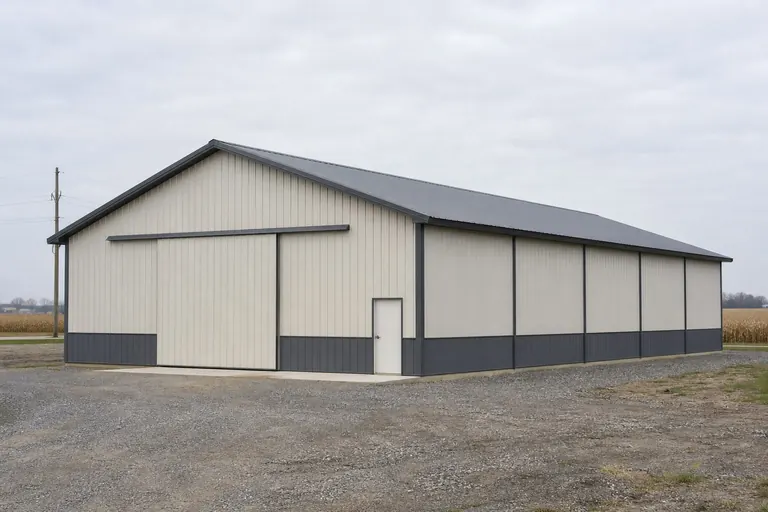 Delta Equipment & Grain StorageA wide clear-span layout on flat alluvial ground, sized for row-crop equipment on a consolidated operation.Hill-Country Hay & Livestock BarnA smaller footprint set into graded loess terrain, often paired with cattle or poultry operations common in the central hill country.Piney Woods Timber & Equipment ShedA storage-focused build on forested Coastal Plain land, with wind-hardware detailing sized for closer Gulf exposure.
Example Configuration — for planning purposes only.
Before You Build
Mississippi-specific checks before finalizing a pole barn spec
A short list of verifications tied to Mississippi's own soil, storm and permitting sources.
- Get a regional soils check, not a statewide assumptionMSU Extension documents real soil differences between the Delta, loess hills and Coastal Plain; confirm post embedment depth against a site-specific soils reading.
- Confirm your county's agricultural exemption statusWhether a pole barn qualifies for an agricultural building exemption from standard permitting varies by county; check with the local building department before assuming exempt status.
- Review documented thunderstorm and tornado frequency for your areaThe MAFES bulletin and NWS Jackson's 1950-2021 Storm Data compilation both point to Mississippi's real severe-weather frequency; use them to justify engineered connection hardware in your build spec.
- Size gutters and grading for the local rainfall normalJackson's 57.35-inch annual precipitation normal is a planning input for drainage, not a footnote; confirm your specific area's normal with NOAA/NWS Jackson if it differs from the Jackson station.
Questions
Mississippi Pole Barn FAQ
Direct answers for planning a post-frame building on Mississippi land.
It depends on the county and whether the structure qualifies for an agricultural exemption; requirements vary across Mississippi's counties, so confirm with your local building department before starting site work.
MSU Extension documents the Delta as an alluvial plain distinct from the state's loess hills and Coastal Plain, and that soil difference is a real input to post embedment and footing design; a site-specific soils check is the right way to confirm depth rather than assuming a statewide default.
Mississippi's documented thunderstorm, lightning and tornado frequency, compiled in an MSU Extension/MAFES bulletin and in NWS Jackson's 1950-2021 Storm Data statistics, supports engineered connection hardware as a standard specification; the exact wind rating for your site comes from the authority having jurisdiction or a project engineer, not a statewide figure.
No, it is a minor one statewide. Jackson's 1991-2020 climate normal shows about 1.0 inch of average annual snowfall, so roof design attention goes to sustained-rainfall drainage capacity instead, based on the 57.35-inch annual precipitation normal.
Yes; wide clear-span post-frame layouts are common for equipment and grain storage on Mississippi's larger, consolidated farm operations, which averaged 328 acres per farm in the 2022 Census of Agriculture.
Proximity to the Gulf Coast can raise wind exposure for southern Mississippi sites, but the specific requirement should come from a local engineer or the authority having jurisdiction for that county rather than a single statewide assumption.
Sources for the Mississippi facts on this page
This page states no code requirement, wind speed, snow load, permit rule, price or supplier claim. The state-specific facts it does use are listed with their publisher below.
Mississippi had 10,251,497 acres of land in farms in 2022, a 2% decrease since 2017, with an average farm size of 328 acres.
USDA NASS · 2022 · Tier 1
https://www.nass.usda.gov/Publications/AgCensus/2022/Online_Resources/County_Profiles/Mississippi/cp99028.pdfMississippi had 31,290 farms in 2022, an 11% decrease since 2017.
USDA National Agricultural Statistics Service (NASS) · 2022 · Tier 1
https://www.nass.usda.gov/Publications/AgCensus/2022/Online_Resources/County_Profiles/Mississippi/cp99028.pdfMississippi State University Extension identifies the Mississippi Delta as an alluvial-plain land resource area with soils formed from sediments left by the Mississippi River, distinct from the state's loess and coastal-plain regions.
Mississippi State University Extension Service · Extension reference material · Tier 2
https://extension.msstate.edu/agriculture/soils/mississippi-land-resource-areasA Mississippi State University Extension/Agricultural & Forestry Experiment Station bulletin documents the frequency and distribution of thunderstorms, lightning strikes, and tornadoes across Mississippi.
Mississippi State University, Mississippi Agricultural & Forestry Experiment Station · MAFES bulletin (state climatologist authored) · Tier 2
https://www.mafes.msstate.edu/publications/bulletins/b1198.pdfJackson, MS's 1991-2020 annual normal precipitation is 57.35 inches with essentially negligible average annual snowfall (about 1.0 inch).
NOAA National Centers for Environmental Information (NCEI) · 1991-2020 · Tier 1
https://www.ncei.noaa.gov/access/services/data/v1?dataset=normals-annualseasonal-1991-2020&stations=USW00003940&format=json&dataTypes=ANN-PRCP-NORMAL,ANN-SNOW-NORMALNWS Jackson's compiled Storm Data statistics for 1950-2021 document Mississippi's long-term tornado history for the state, sourced from the NOAA/NCEI Storm Data database.
National Weather Service (NOAA), Jackson MS office · 1950-2021 · Tier 1
https://www.weather.gov/jan/severe_statistics