Pole barn · CA
Pole Barns in California
A California pole barn is, in most cases, a working farm or ranch storage building, and the state's agricultural scale is the honest backdrop for why post-frame construction shows up so often on that land. The 2022 USDA Census of Agriculture counted 63,134 farms in California, averaging 383 acres across 24,190,604 acres of farmland, and that scale routinely calls for equipment, hay and feed storage that a small outbuilding cannot meet. What changes the planning conversation from a similar barn in a purely local-code state is that even a non-residential post-frame building in California still sits inside CAL FIRE's statutory Fire Hazard Severity Zone mapping, which classifies land by fuel loading, slope, fire weather and wind on a parcel-specific basis, and, where a permit is triggered, the statewide Title 24 framework administered by the California Building Standards Commission. Add in 11 distinct geomorphic provinces and a Mediterranean climate whose precipitation the State Climatologist describes as ranging from over 100 inches a year on the north coast to under 5 inches in the southeastern deserts, and the same open-span pole barn footprint faces very different footing, drainage and defensible-space conditions depending on where in California it sits.
The intersection
California's farm scale explains the pole barn, but two state systems still apply
A pole barn's post-frame design is built to cover large open spans cheaply, which matches California's working-land scale — but even a purely agricultural building still answers to CAL FIRE and, where permitted, Title 24.
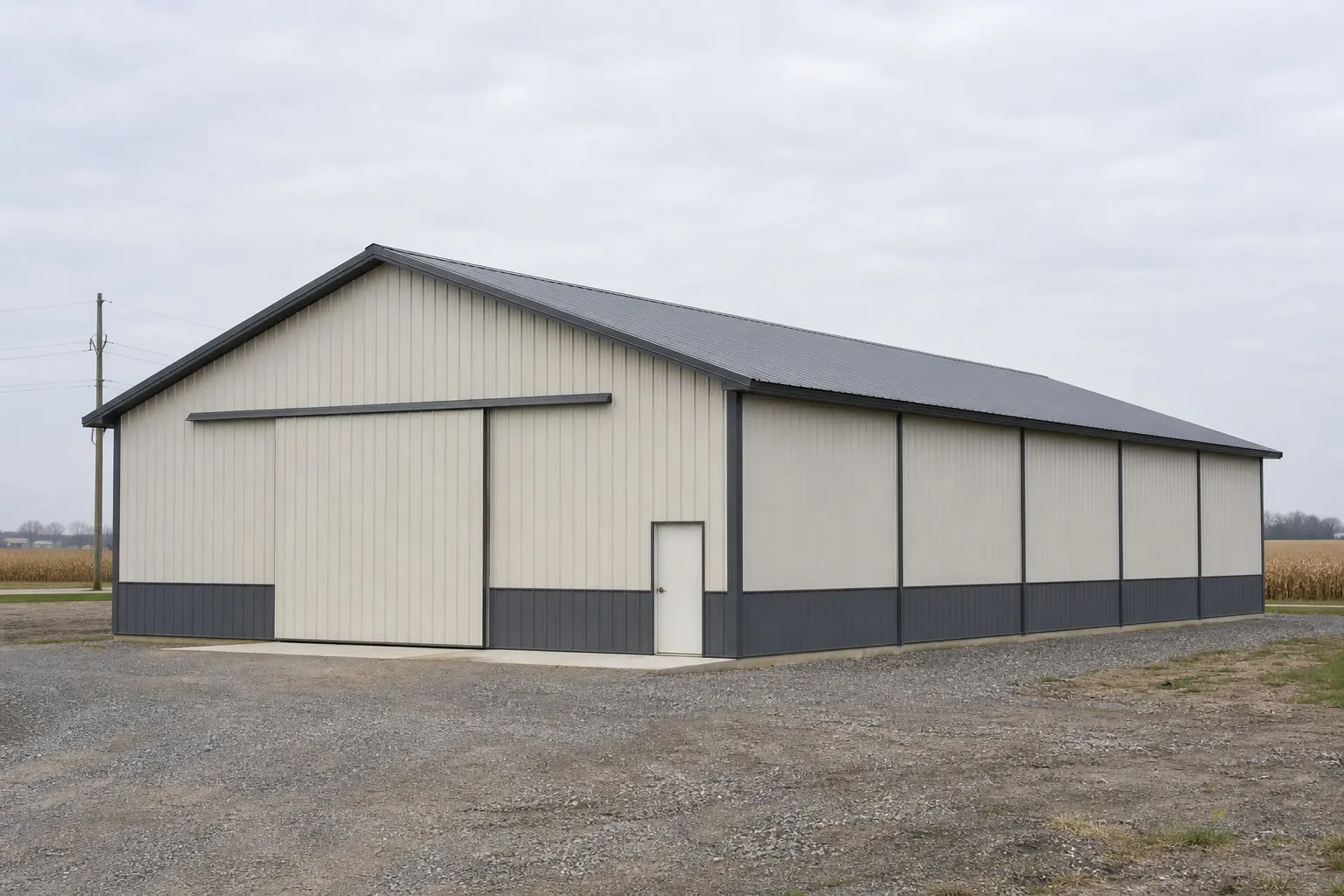
The 2022 USDA Census of Agriculture counted 63,134 farms in California, averaging 383 acres across 24,190,604 acres of farmland. That scale is smaller on average than some Plains and Midwest agricultural states, but it is still large enough to generate genuine equipment, hay, feed and livestock storage needs that a small garden shed cannot meet. A pole barn's open-span post-frame layout, uninterrupted by interior support columns, is built for exactly that kind of flexible working storage.
What is distinctly Californian is that a working, non-residential storage building does not sit outside the state's fire and code systems just because no one lives in it. CAL FIRE is required by Public Resources Code 4202 and Government Code 51178 to classify land into Fire Hazard Severity Zones based on fuel loading, slope, fire weather and wind, and that classification is parcel-specific — it applies to the land, not to the occupancy of whatever gets built on it. Where a pole barn does require a local permit, the California Building Standards Commission's statewide Title 24 framework is the baseline the local building department applies, even for a non-residential structure. Neither system is described here with a specific zone or permit threshold, because those are parcel-level and jurisdiction-level answers, not statewide ones.
Terrain adds a third layer worth naming before siting a foundation. The California Geological Survey recognizes 11 distinct geomorphic provinces, from the flat, drainage-managed Central Valley where much of the state's working farmland sits, to the Sierra Nevada's slope and access constraints, to the arid Mojave and Colorado Desert provinces. A post-frame building's footing and drainage plan should reflect which of those provinces the parcel is actually in, which is a site-visit question for your builder or a local engineer, not a statewide default.
Site context
How California terrain changes pole barn site conditions
The same open-span pole barn design meets very different ground and moisture conditions depending on which of California's geomorphic provinces the parcel sits in.
Central Valley
Much of the state's working farmland sits in this flat province, where drainage and existing irrigation infrastructure are the recurring site-planning variables for a storage building's footing and grading.
Coast Ranges
The State Climatologist notes north coast areas can average over 100 inches of annual precipitation, which raises roof drainage and moisture management above what a valley or desert site would need.
Sierra Nevada / mountain provinces
Elevation, slope and access length change grading and delivery logistics; a site visit is the only reliable way to plan a specific mountain parcel's footing.
Mojave and Colorado Desert provinces
The State Climatologist describes southeastern deserts as averaging under 5 inches of annual precipitation, a dramatically different drainage and ventilation basis than a coastal or valley site.
Use case
What a California pole barn is doing versus a barndominium or garage
Three California building types share a steel or post-frame lineage but answer different questions; keeping the use case straight changes what a buyer should plan for.
| Question | Pole barn | Barndominium |
|---|---|---|
| Primary use | Working storage: equipment, hay, feed, livestock shelter | Combined residence and shop or storage space |
| Occupancy classification | Typically non-residential, decided locally | A residential occupancy question for the local building department |
| Fire zone relevance | Defensible-space clearance around the structure and stored fuel | Defensible-space clearance plus exterior material choices for a home |
| Design priority | Clear span, door height and eave clearance for equipment | Separation between living and working space |
Primary use
- Pole barn
- Working storage: equipment, hay, feed, livestock shelter
- Barndominium
- Combined residence and shop or storage space
Occupancy classification
- Pole barn
- Typically non-residential, decided locally
- Barndominium
- A residential occupancy question for the local building department
Fire zone relevance
- Pole barn
- Defensible-space clearance around the structure and stored fuel
- Barndominium
- Defensible-space clearance plus exterior material choices for a home
Design priority
- Pole barn
- Clear span, door height and eave clearance for equipment
- Barndominium
- Separation between living and working space
Get California pole barn quotes
Tell us your acreage, region and intended use, and we route it with the California fire-zone and terrain context already attached.
Configuration
Common California pole barn configurations
California farm and ranch operations at the state's average scale tend toward a handful of recurring layouts, driven by what the building has to hold.
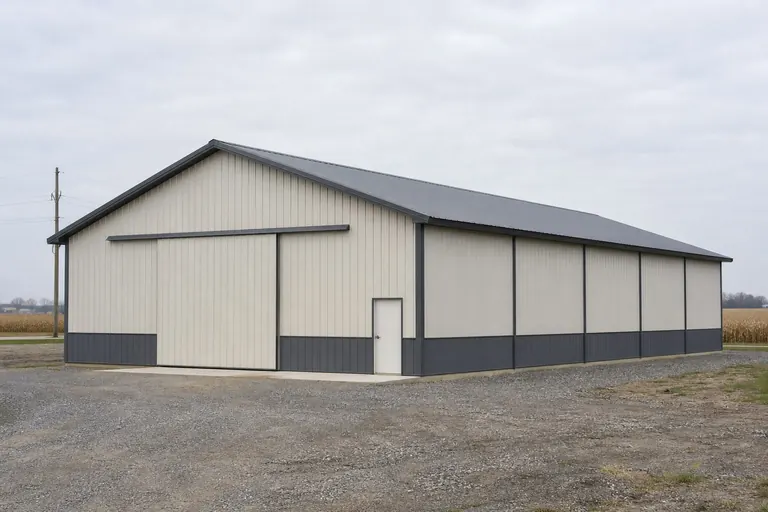 Open equipment bayWide clear-span bays sized for tractors, implements and trailers, with no interior partitions so equipment can be repositioned freely.Hay and feed storageEnclosed or partially enclosed bays prioritizing ventilation and moisture control, especially relevant on the wetter north coast.
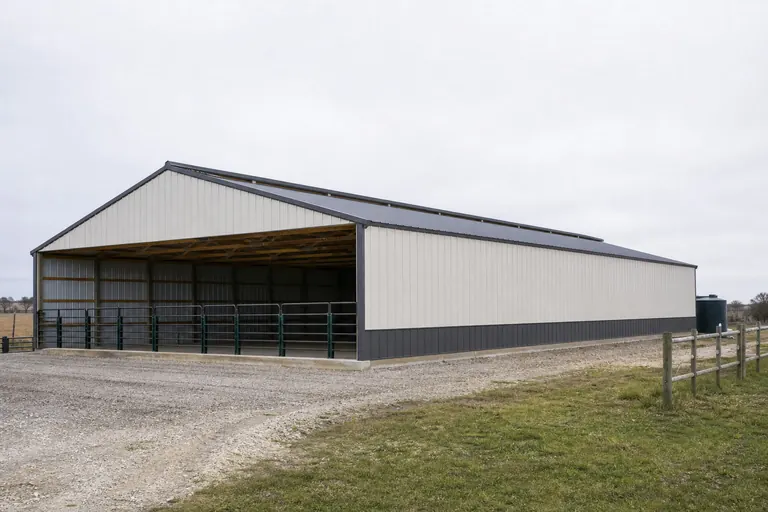 Livestock run-in shelterOpen-sided or three-sided structures giving livestock shade and wind break without full enclosure.
Example Configuration — for planning purposes only.
Footprint
Sizes that suit California working-land scale
At a 383-acre average farm size, footprint decisions are usually driven by what equipment or how much feed the building has to hold, not by lot constraints.
30′ × 40′
1,200 sq ft
A common starting point for a single-operation's equipment and hay storage.
40′ × 60′
2,400 sq ft
Suits combined equipment and feed storage on a mid-size operation.
40′ × 80′
3,200 sq ft
Room for multiple equipment bays on a larger acreage operation.
Example Configuration — for planning purposes only.
Footprint pages carry bay and door allocation for each size; this page explains only why California siting matters for these dimensions.
Preparation
Before you request a California pole barn quote
Five things resolved up front help avoid a California-specific delay on an agricultural post-frame project.
Step 1
Look up your parcel's Fire Hazard Severity Zone
CAL FIRE's mapping applies to the land regardless of whether the structure is residential, so check it even for a purely working building.
Step 2
Confirm permit requirements with your local building department
Ask whether your pole barn's size and use trigger a permit under Title 24 before finalizing the design.
Step 3
Name the geomorphic province, not just the county
Valley, coast, mountain or desert siting changes drainage, soil and moisture planning even within the same state.
Step 4
List every intended use up front
A building priced for hay storage alone that later needs to house equipment or livestock is a common source of re-quoting.
Step 5
Ask about defensible-space clearance around the structure
If your zone lookup shows elevated fire exposure, clearance requirements can affect where equipment and fuel storage sit relative to the barn.
Questions
California pole barn questions
Honest answers at the state level, with fire-zone, permitting and engineering questions routed to whoever actually owns them.
That depends on your local building department's application of Title 24 to your specific size and use. Some agricultural structures qualify for different treatment locally; confirm with your county before finalizing plans.
Yes, in practice. CAL FIRE's Fire Hazard Severity Zone mapping applies to the land itself, not just to residences, so it is worth checking for any structure on a wildland-adjacent parcel.
There is no official typical size. California's 383-acre average farm size supports mid-size working buildings, and 30x40 through 40x80 are common starting points depending on equipment and storage needs.
The California Geological Survey's 11 geomorphic provinces carry different drainage, soil and moisture conditions. A site visit from your builder or a local engineer is the way to get a parcel-specific answer.
We do not publish state-level prices, since cost depends on size, specification, site work and current material pricing. Our cost pages explain what drives the number; a builder quote covers your specific project.
No. A pole barn is a working, typically non-residential storage structure; a barndominium combines living space with a shop or storage area and raises a separate residential occupancy question under Title 24.
Sources for the California facts on this page
This page states no code requirement, wind speed, snow load, permit rule, price or supplier claim. The state-specific facts it does use are listed with their publisher below.
California had 63,134 farms in 2022 per the USDA Census of Agriculture.
USDA National Agricultural Statistics Service (NASS) · 2022 · Tier 1
https://www.nass.usda.gov/Publications/AgCensus/2022/Full_Report/Volume_1,_Chapter_1_State_Level/California/Land in farms in California totaled 24,190,604 acres in 2022.
USDA NASS · 2022 · Tier 1
https://www.nass.usda.gov/Publications/AgCensus/2022/Full_Report/Volume_1,_Chapter_1_State_Level/California/The average farm size in California was 383 acres in 2022.
USDA NASS · 2022 · Tier 1
https://www.nass.usda.gov/Publications/AgCensus/2022/Full_Report/Volume_1,_Chapter_1_State_Level/California/CAL FIRE, under the state Office of the State Fire Marshal, is required by law (Public Resources Code 4202 / Government Code 51178) to classify lands into Fire Hazard Severity Zones based on fuel loading, slope, fire weather, and wind, without this evidence assigning any specific zone.
California Department of Forestry and Fire Protection (CAL FIRE) / Office of the State Fire Marshal · current program; 2024 FHSZ maps referenced · Tier 2
https://osfm.fire.ca.gov/what-we-do/community-wildfire-preparedness-and-mitigation/fire-hazard-severity-zonesThe California Building Standards Commission (CBSC) administers the California Building Standards Code, Title 24 of the California Code of Regulations, as the state's building standards framework.
California Department of General Services, Building Standards Commission (CBSC) · 2025 Triennial Edition, effective Jan 1, 2026 · Tier 2
https://www.dgs.ca.gov/bsc/The California Geological Survey (state geological survey) divides the state into 11 recognized geomorphic provinces, including the Coast Ranges, Central Valley, Sierra Nevada, Basin and Range, Mojave Desert, Colorado Desert, Transverse Ranges, Peninsular Ranges, Klamath Mountains, Cascade Range, and Modoc Plateau.
California Department of Conservation, California Geological Survey · 2002 (revised) · Tier 2
https://www.conservation.ca.gov/cgs/documents/publications/cgs-notes/CGS-Note-36.pdfThe California State Climatologist describes California as having a Mediterranean climate overall, with precipitation concentrated October through April and dry conditions May through September, strongly modulated by mountains and the Pacific Ocean, with north coast areas averaging over 100 inches of annual precipitation and southeastern deserts under 5 inches.
California Department of Water Resources / Office of the State Climatologist (republished via CoCoRaHS) · n/a (narrative climatology) · Tier 2
https://media.cocorahs.org/docs/ClimateSum_CA.pdf