Barndominium · CA
Barndominiums in California
A California barndominium is a residence first, which is exactly why two statewide systems attach to it that a simple pole barn or garage never triggers. The California Building Standards Commission administers Title 24 of the California Code of Regulations as one statewide building-standards framework, so unlike a state with purely local code adoption, the code question starts from a single named body. But CAL FIRE is separately required by state law (Public Resources Code 4202 and Government Code 51178) to classify land into Fire Hazard Severity Zones based on fuel loading, slope, fire weather and wind — and that classification is parcel-specific, not a statewide answer. For a structure people will actually live in, that lookup has to happen before the floor plan is finalized, not after. Layered underneath both systems is land use: the USDA counted 63,134 farms in California in 2022, averaging 383 acres, so a meaningful share of barndominium sites sit on working agricultural land where septic, well and access questions matter as much as the fire lookup does.
The intersection
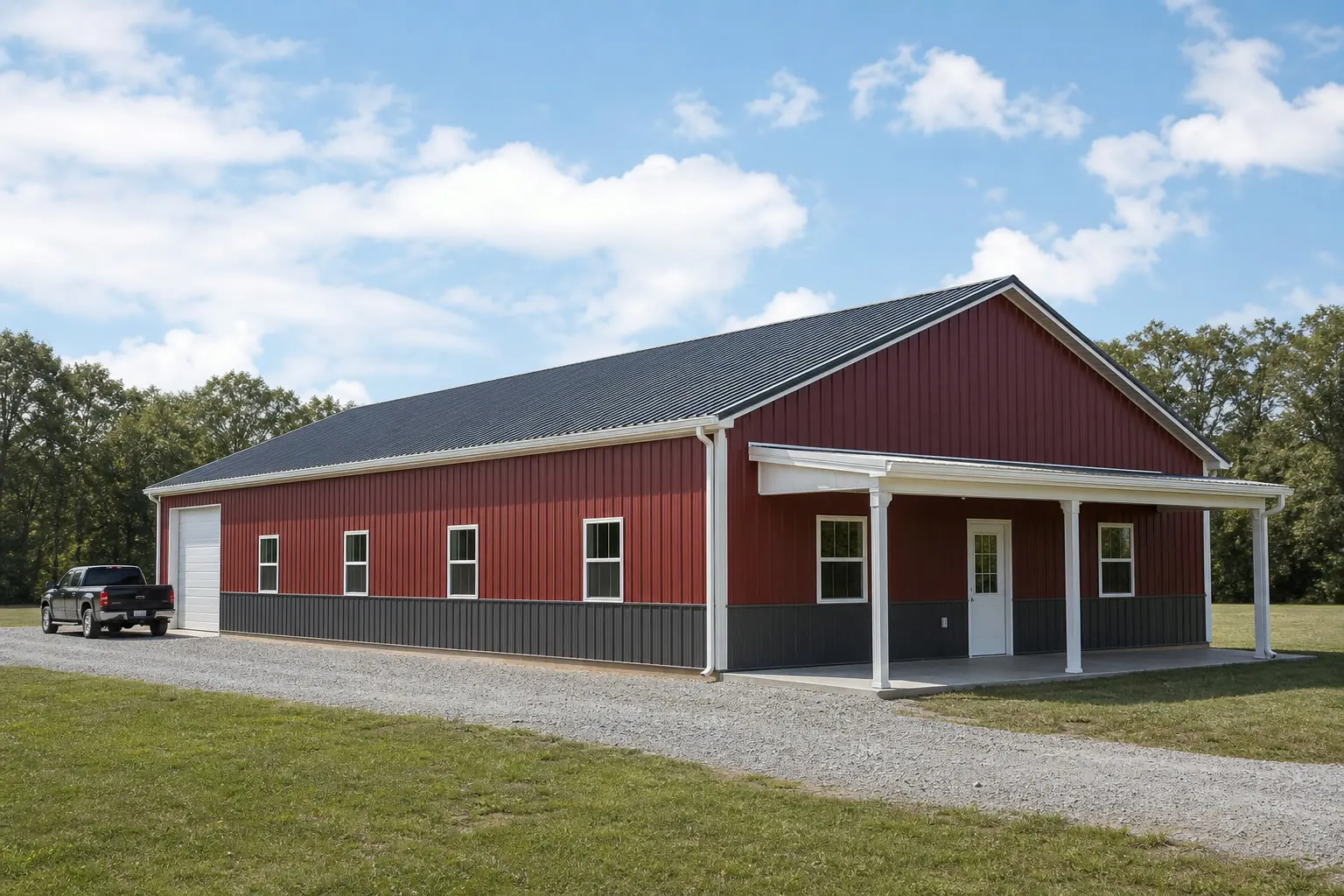
A California barndominium answers to two systems, not one
Because a barndominium is a residence, it triggers a statewide code framework and a separate, parcel-specific fire classification — two layers most other states fold into a single local decision.
The California Building Standards Commission administers Title 24 of the California Code of Regulations as the state's building standards framework, which means the code baseline for a residence is set statewide rather than invented city by city. That is a more consistent starting point than a state with purely local code adoption. It does not, however, make the barndominium's occupancy classification or accessory-versus-dwelling status automatic — that determination is still made by the local building department reviewing the specific plan.
Separately, CAL FIRE is required by Public Resources Code 4202 and Government Code 51178 to classify land into Fire Hazard Severity Zones based on fuel loading, slope, fire weather and wind. This is a statutory mapping program, not a single number for the state — the zone that applies to a given barndominium site depends entirely on that parcel's mapped classification, which has to be looked up, not assumed. For a structure with a residential end, that lookup can affect exterior material choices, defensible-space planning and insurance underwriting, so it belongs at the very start of the project, alongside the first call to the local building department.
Neither system is described here with a specific zone, code edition or permit threshold, because none of those are safely generalized from a state-level page. What is worth carrying into the first planning conversation is that both questions exist and both are answered by parcel, not by county or region.
Site context
How California's geomorphic provinces change the barndominium site
The California Geological Survey divides the state into 11 recognized geomorphic provinces, a practical lens for anticipating site work on a specific parcel.
Central Valley
Much of the state's working farmland sits in this province. Flat terrain generally simplifies grading, but drainage and irrigation infrastructure already on a working parcel are worth mapping before siting a combined living-and-shop footprint.
Coast Ranges
The State Climatologist notes north coast areas can average over 100 inches of annual precipitation, so roof drainage, grading and moisture management deserve more attention here than in drier provinces.
Sierra Nevada / mountain provinces
Elevation and slope both change access, foundation and delivery logistics; a site visit from a local builder or engineer is the only reliable way to plan a specific mountain parcel.
Mojave and Colorado Desert provinces
The State Climatologist describes southeastern deserts as averaging under 5 inches of annual precipitation, a very different moisture and ventilation planning basis than a coastal or valley site.
Process
Title 24 versus fire hazard zone: two separate lookups
A California barndominium buyer benefits from treating these as two distinct conversations rather than one.
| Question | Title 24 (statewide framework) | Fire Hazard Severity Zone (parcel-specific) |
|---|---|---|
| Who administers it | California Building Standards Commission, statewide | CAL FIRE / Office of the State Fire Marshal, mapped by parcel |
| What it covers | Building standards baseline applied locally | Fuel, slope, fire weather and wind classification for the specific site |
| Where to get a definitive answer | Local building department applying Title 24 to the plan | CAL FIRE's mapping tools or the local fire authority for the exact parcel |
| When to check it | Before finalizing occupancy classification and plans | Before finalizing exterior materials and defensible-space planning |
Who administers it
- Title 24 (statewide framework)
- California Building Standards Commission, statewide
- Fire Hazard Severity Zone (parcel-specific)
- CAL FIRE / Office of the State Fire Marshal, mapped by parcel
What it covers
- Title 24 (statewide framework)
- Building standards baseline applied locally
- Fire Hazard Severity Zone (parcel-specific)
- Fuel, slope, fire weather and wind classification for the specific site
Where to get a definitive answer
- Title 24 (statewide framework)
- Local building department applying Title 24 to the plan
- Fire Hazard Severity Zone (parcel-specific)
- CAL FIRE's mapping tools or the local fire authority for the exact parcel
When to check it
- Title 24 (statewide framework)
- Before finalizing occupancy classification and plans
- Fire Hazard Severity Zone (parcel-specific)
- Before finalizing exterior materials and defensible-space planning
Get California barndominium quotes
Tell us your parcel's fire hazard zone status, acreage and region. We route it with the California and barndominium context already attached.
Configuration
What a California barndominium usually has to combine
On a 383-acre average farm, or on a smaller rural lot, the configuration decision is usually about separating living space from working space in a way that satisfies both Title 24 and the parcel's fire zone.
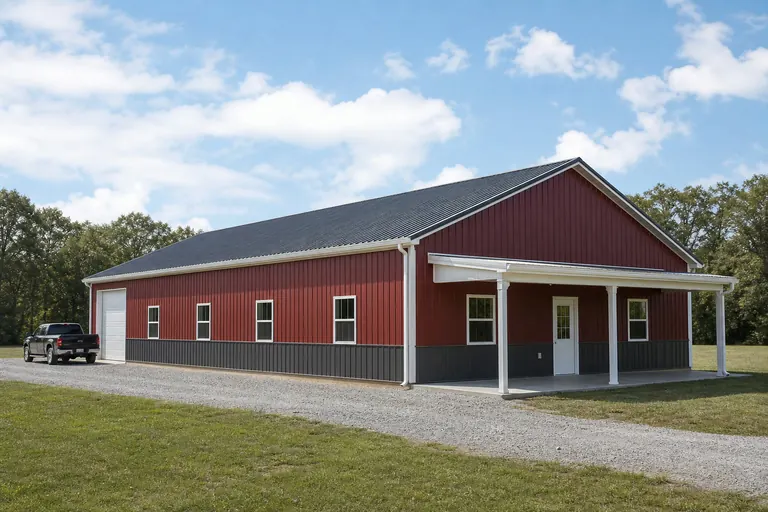 Living quarters plus shopA finished residential end and an open working end, with the fire-rated or insulated separation between them decided locally under Title 24, not by a statewide formula.
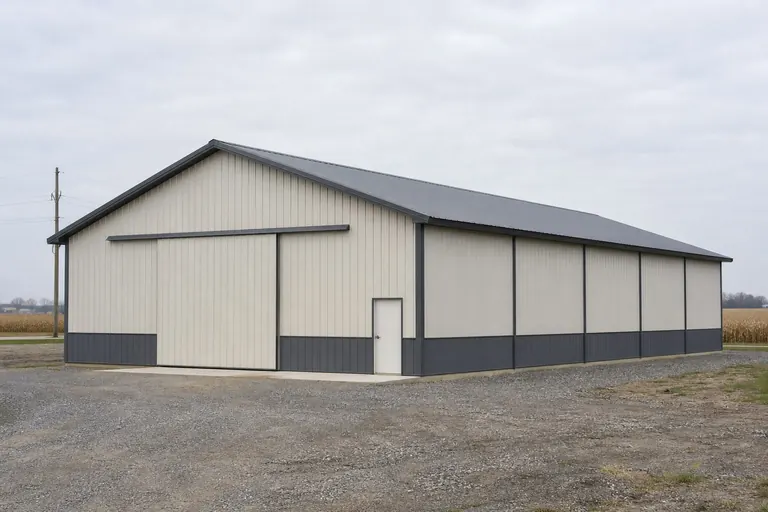 Living plus equipment storageWhere the working end shelters farm equipment, door height and turning radius drive the plan, and defensible-space clearance around fuel storage becomes a fire-zone conversation.
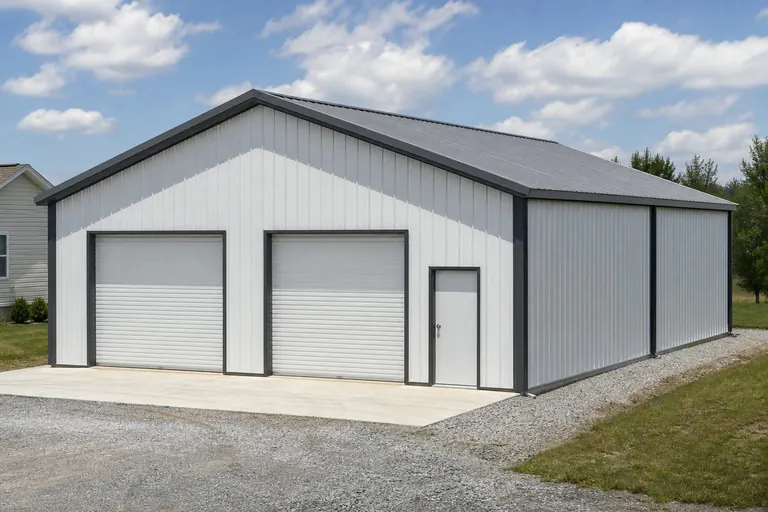 Living plus detached garageSome California buyers keep the residence and vehicle storage as separate structures on the same parcel, which can change how each structure is classified for permitting.
Example Configuration — for planning purposes only.
Footprint
Sizes that suit a California acreage barndominium
Larger rural and agricultural parcels remove the pressure to minimize footprint, so acreage-sited California enquiries commonly run larger than urban-infill projects.
40′ × 60′
2,400 sq ft
A workable minimum for a genuine living-plus-shop split without cramping either end.
30′ × 80′
2,400 sq ft
A longer, narrower footprint suited to a linear living-to-shop layout on an open parcel.
30′ × 100′
3,000 sq ft
Common where the shop end needs to handle full-size farm equipment alongside the residence.
Example Configuration — for planning purposes only.
Footprint pages carry the room and bay allocation for each size; this page explains only why California siting pushes toward these dimensions.
Preparation
Before you request a California barndominium quote
Five things resolved up front keep a hybrid residential build from needing a second round of quoting.
Step 1
Look up your parcel's Fire Hazard Severity Zone
Check with CAL FIRE or your local fire authority before finalizing exterior materials or defensible-space planning.
Step 2
Confirm occupancy classification with your local building department
Ask specifically how they classify a combined living-and-shop structure under Title 24 before you fix the floor plan.
Step 3
Confirm septic and well capacity for the site
Agricultural and rural parcels rarely have municipal utilities, and capacity limits can affect the residential square footage you can support.
Step 4
Name the geomorphic province, not just the county
Valley, coast, mountain or desert siting changes drainage, moisture and access planning even within the same state.
Step 5
State every function the building will serve
A residence-plus-shop brief priced as a residence alone is a frequent cause of a second round of quoting.
Questions
California barndominium questions
Honest answers at the state level, with jurisdictional and pricing questions routed to whoever actually owns them.
Legality and classification depend on your local building department applying Title 24 of the California Building Standards Code to your specific plan, alongside your parcel's CAL FIRE fire hazard classification. There is no single statewide yes-or-no answer separate from those two lookups.
Yes, in practice. CAL FIRE is required by state law to classify land into Fire Hazard Severity Zones based on fuel, slope, fire weather and wind, and the zone is parcel-specific. Check it before finalizing exterior materials and site layout.
Yes, the California Building Standards Commission administers Title 24 of the California Code of Regulations as a single statewide framework, but your local building department still applies it to your specific parcel and plan.
There is no official typical size. California's 383-acre average farm size supports larger footprints on agricultural parcels, and 40x60 through 30x100 are common starting points for a combined living-and-shop layout.
We do not publish state-level prices, because cost depends on specification, finish level, site work and current material pricing. Our cost pages explain what drives the number; a builder quote covers your specific project.
Yes. The State Climatologist describes a Mediterranean pattern overall, but north coast areas can average over 100 inches of annual precipitation while southeastern deserts see under 5 inches, so a site-specific conversation with your builder matters more than a statewide assumption.
Sources for the California facts on this page
This page states no code requirement, wind speed, snow load, permit rule, price or supplier claim. The state-specific facts it does use are listed with their publisher below.
The California Building Standards Commission (CBSC) administers the California Building Standards Code, Title 24 of the California Code of Regulations, as the state's building standards framework.
California Department of General Services, Building Standards Commission (CBSC) · 2025 Triennial Edition, effective Jan 1, 2026 · Tier 2
https://www.dgs.ca.gov/bsc/CAL FIRE, under the state Office of the State Fire Marshal, is required by law (Public Resources Code 4202 / Government Code 51178) to classify lands into Fire Hazard Severity Zones based on fuel loading, slope, fire weather, and wind, without this evidence assigning any specific zone.
California Department of Forestry and Fire Protection (CAL FIRE) / Office of the State Fire Marshal · current program; 2024 FHSZ maps referenced · Tier 2
https://osfm.fire.ca.gov/what-we-do/community-wildfire-preparedness-and-mitigation/fire-hazard-severity-zonesCalifornia had 63,134 farms in 2022 per the USDA Census of Agriculture.
USDA National Agricultural Statistics Service (NASS) · 2022 · Tier 1
https://www.nass.usda.gov/Publications/AgCensus/2022/Full_Report/Volume_1,_Chapter_1_State_Level/California/The average farm size in California was 383 acres in 2022.
USDA NASS · 2022 · Tier 1
https://www.nass.usda.gov/Publications/AgCensus/2022/Full_Report/Volume_1,_Chapter_1_State_Level/California/The California State Climatologist describes California as having a Mediterranean climate overall, with precipitation concentrated October through April and dry conditions May through September, strongly modulated by mountains and the Pacific Ocean, with north coast areas averaging over 100 inches of annual precipitation and southeastern deserts under 5 inches.
California Department of Water Resources / Office of the State Climatologist (republished via CoCoRaHS) · n/a (narrative climatology) · Tier 2
https://media.cocorahs.org/docs/ClimateSum_CA.pdfThe California Geological Survey (state geological survey) divides the state into 11 recognized geomorphic provinces, including the Coast Ranges, Central Valley, Sierra Nevada, Basin and Range, Mojave Desert, Colorado Desert, Transverse Ranges, Peninsular Ranges, Klamath Mountains, Cascade Range, and Modoc Plateau.
California Department of Conservation, California Geological Survey · 2002 (revised) · Tier 2
https://www.conservation.ca.gov/cgs/documents/publications/cgs-notes/CGS-Note-36.pdfFEMA's National Risk Index scores U.S. communities, including California counties, across 18 defined natural hazard types.
FEMA · current dataset · Tier 1
https://www.fema.gov/about/openfema/data-sets/national-risk-index-data