
Pole barn · NM
Pole Barns in New Mexico
New Mexico's farm economy is consolidating, not shrinking in value: the 2022 Census of Agriculture counted 20,976 farms, down 16% from 2017, while total market value of products sold climbed 14% higher over the same span. Fewer, larger operations working an average of 1,865 acres each are the audience for most New Mexico pole barns, and NOAA's description of the state as arid to semi-arid with high year-to-year precipitation variability means the building is planned around infrequent but intense monsoon runoff rather than a steady wet season.
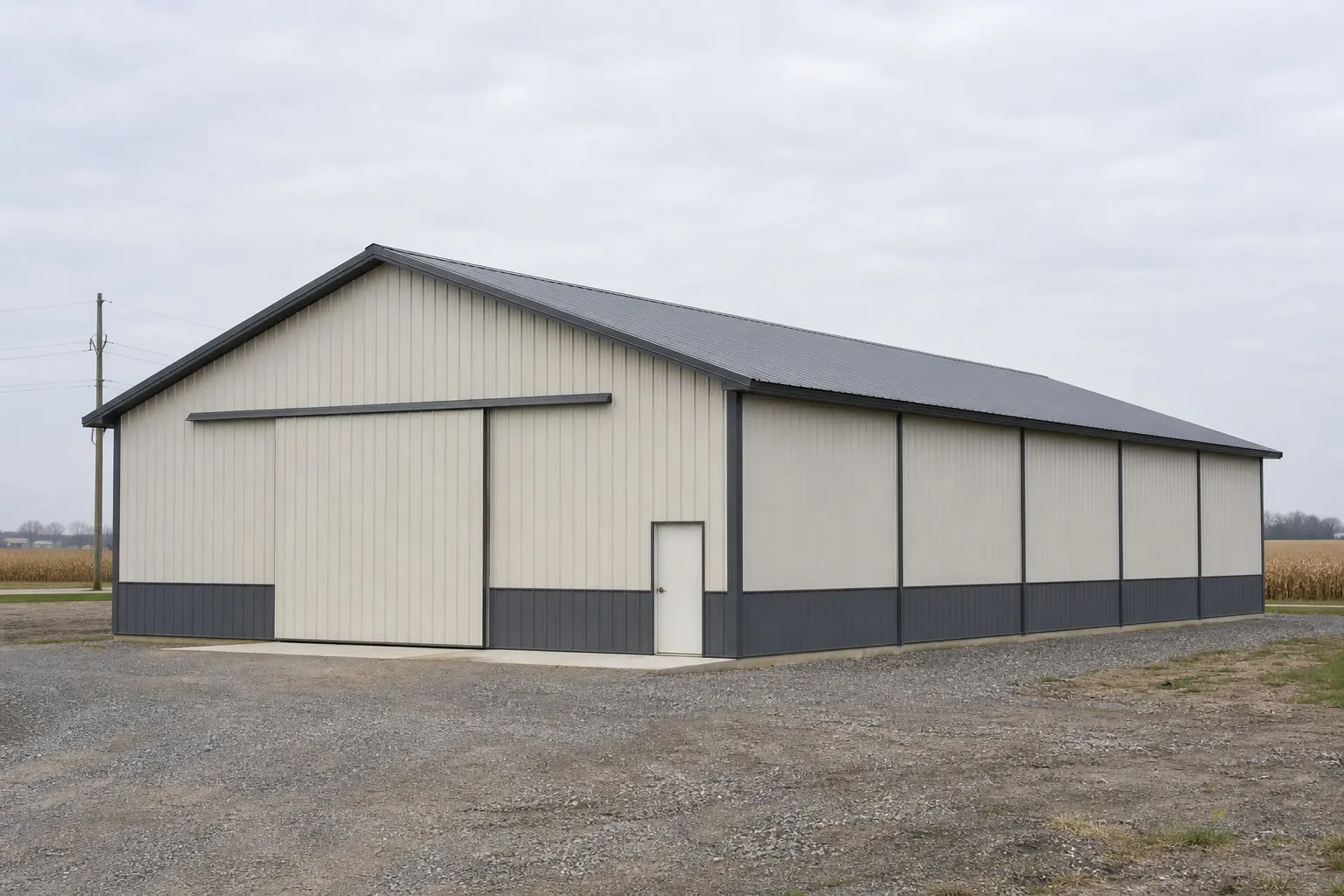
The intersection
What a New Mexico site actually changes about a pole barn
New Mexico's farm economy is getting fewer and bigger, and its climate delivers rain rarely but hard. Both facts point a pole barn toward larger, drainage-conscious buildings rather than small, frequent ones.
The 2022 Census of Agriculture counted 20,976 farms in New Mexico, down 16% from 2017, farming 39,128,563 acres at an average of 1,865 acres each — among the largest average farm sizes in the country. At the same time, total market value of products sold rose 14% higher over the same five-year span. Read together, those numbers describe consolidation into fewer, larger, more productive operations rather than a state losing agricultural activity. For a post-frame buyer, that usually means the building has to do more work per structure: one large equipment or hay building serving a bigger footprint, instead of several smaller buildings spread across smaller parcels.
The second change is water behavior. NOAA's State Climate Summaries describe New Mexico as arid to semi-arid with high year-to-year precipitation variability, driven substantially by the North American monsoon. The Albuquerque station's 1991-2020 normal of 8.84 inches of annual precipitation with 7.9 inches of snow is low by national standards, but the variability matters more than the average: a pole barn's roof and pad drainage need to handle an intense, short monsoon event even in a year that finishes dry overall. That is a different design conversation than a steady-rainfall state, even at a similar or higher annual total.
Both changes land on the same practical decisions: how wide a clear span the building needs to serve a genuinely large working area, and how the roof, gutters and pad grading are specified to survive infrequent but intense runoff rather than constant moisture. Wind speeds, snow loads and any permit thresholds that apply to your parcel are set locally; nothing on this page substitutes for confirming those with your building department.
Site context
How the build site differs across New Mexico ranch country
The state's hazard mitigation plan groups its natural hazards as drought, wildfire, flooding and severe wind/dust events, which maps onto genuinely different site conditions depending on elevation and terrain.
Open range and low-elevation rangeland
The setting for most of the state's 1,865-acre-average operations. Wind and dust exposure are the recurring site conditions; anchoring, door hardware and dust-sealing at openings are worth discussing with a builder here.
Arroyo and low-lying drainage paths
Flash flooding from monsoon storms is part of the documented state hazard profile. Pad elevation relative to a dry wash matters even where the wash is empty most of the year.
Higher-elevation forested edges
Wildfire is named alongside drought in the state hazard plan. A pole barn near wooded terrain warrants a conversation with the local fire authority about clearance and material choices.
Sites nearer active permitting offices
New Mexico authorized 7,572 new housing units in 2024, evidence that local building departments across the state are actively processing construction; use that as reassurance the process is well understood locally, not as a substitute for asking them directly.
Exposure
Infrequent, intense water is the recurring New Mexico detail
A low annual precipitation total does not mean a pole barn can skimp on drainage; it means the drainage plan has to work for a rare, hard event rather than continuous moisture.
Because New Mexico's rainfall arrives concentrated in the monsoon window, a pole barn roof that sheds water slowly during a steady drizzle elsewhere in the country instead has to move a short, heavy pulse of runoff away from the pad quickly here. Gutter sizing, downspout placement and the grade around the perimeter are the details that actually get tested during a real New Mexico storm event.
Wind and dust are the other recurring theme, consistent with the wind/dust events named in the state's hazard mitigation plan. On an open rangeland site, door and opening hardware that seals well against blown dust, and a building orientation that considers prevailing wind, are practical planning questions worth raising with your builder — separate from, and not a substitute for, any wind-design requirement your local building department applies to the structure itself.
- Size drainage for a burst, not an average
- Plan gutters and grading around a short, intense monsoon event rather than the low annual total alone.
- Address dust at every opening
- Door and vent hardware that seals well reduces the routine maintenance burden of a windy, dusty site.
- Confirm arroyo distance
- If a dry wash crosses or borders the parcel, ask a site engineer about flood exposure even in a dry season.
Get New Mexico pole barn quotes
Tell us your operation's scale, equipment list and rough footprint. We route it with the New Mexico and pole barn context already attached.
Configuration
What New Mexico pole barns are usually asked to do
On a consolidated, large-acreage operation, the typical brief is a single large building doing one job well rather than several small buildings doing several jobs.
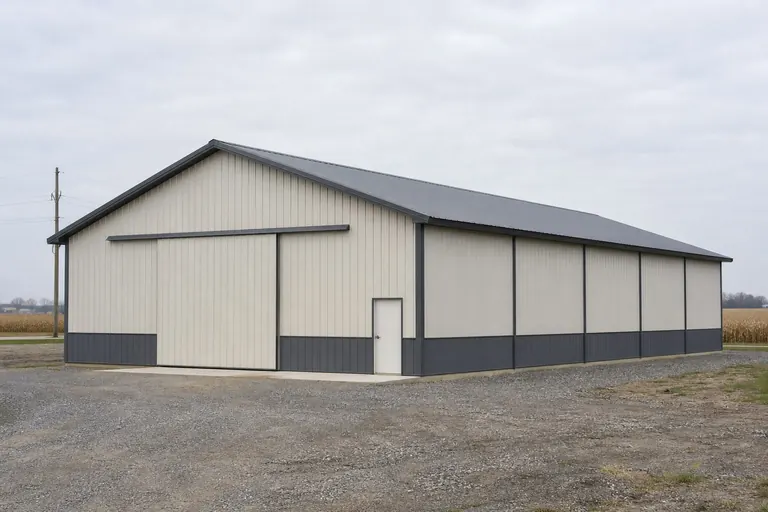 Equipment storage at scaleWider clear spans that store a larger equipment fleet fit the pattern of fewer, larger New Mexico operations better than a small mixed-use bay.Hay and feed storageVentilation, door width for larger loads, and a dry, elevated pad are the priorities on an operation managing more acreage per structure.
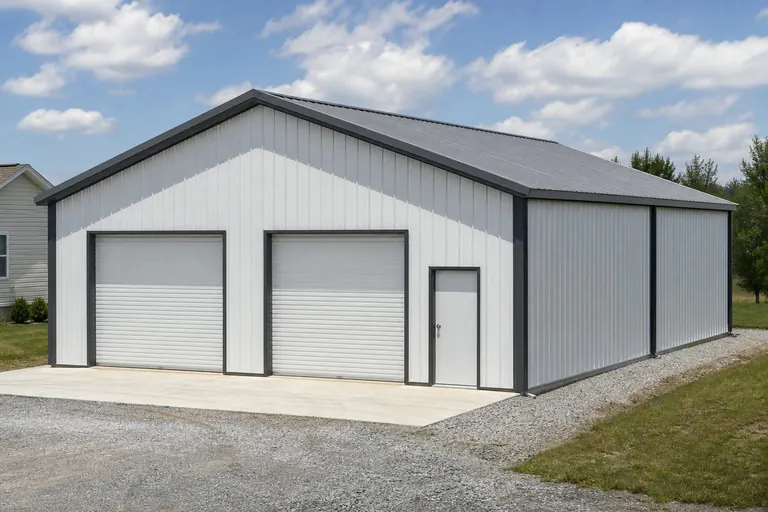 Working ranch shopWhere equipment maintenance is centralized on a large parcel, a dedicated shop end with wider doors is a common addition.
Example Configuration — for planning purposes only.
Footprint
Sizes that suit a consolidated New Mexico operation
Fewer, larger operations push New Mexico pole barn enquiries toward wider spans than a small-farm state would typically need.
40′ × 60′
2,400 sq ft
A common baseline for equipment storage on a mid-size consolidated operation.
40′ × 80′
3,200 sq ft
Adds length for a larger fleet or a combined hay-and-equipment brief.
60′ × 100′
6,000 sq ft
Where a large-acreage operation centralizes most equipment storage in one structure.
60′ × 120′
7,200 sq ft
For the higher end of consolidated ranch operations needing maximum single-building capacity.
Example Configuration — for planning purposes only.
Footprint pages carry the layout and door detail for each of these; this page only explains why the New Mexico brief tends to skew wider.
Preparation
Before you request a New Mexico pole barn quote
Four things resolved in advance make the difference between a comparable quote and a re-quote on a New Mexico ranch parcel.
Step 1
Contact your local building department
Ask what your parcel, elevation and use require before you fix the specification; requirements are set locally, not statewide.
Step 2
Describe fleet size, not just square footage
A larger, consolidated operation's equipment list drives clear span and door width more than a general footprint number does.
Step 3
Flag arroyo or wash proximity
Flood exposure from monsoon runoff is worth raising even on a site that looks dry most of the year.
Step 4
Ask about wind and dust detailing
Door seals, hardware and orientation on an open rangeland site are worth specifying up front rather than retrofitting.
Questions
New Mexico pole barn questions
Questions we can answer honestly at state level, with the ones we cannot routed to whoever actually owns them.
The 2022 Census of Agriculture recorded an average New Mexico farm size of 1,865 acres, among the largest in the country, with fewer farms (20,976, down 16% since 2017) holding more total acreage. Larger operations tend to specify wider, higher-capacity buildings rather than several smaller ones.
Permit requirements depend on your county or municipality, your parcel and how the building is used. Your local building department is the only reliable source for that answer, and it is worth asking before you finalize dimensions.
No. NOAA describes the state's climate as arid to semi-arid with high year-to-year precipitation variability, driven largely by the monsoon, so rainfall is concentrated into short, intense events. Roof and pad drainage still need to handle those bursts even where the annual total is low.
We do not publish state-level prices, because a credible number depends on your specification, site work and current material pricing. Our cost pages cover what drives the number; a quote covers your building.
The state's 2023 Hazard Mitigation Plan names wildfire among New Mexico's documented natural hazards, particularly near wooded or higher-elevation terrain. Ask your local fire authority about clearance and siting considerations for your specific parcel.
Sources for the New Mexico facts on this page
This page states no code requirement, wind speed, snow load, permit rule, price or supplier claim. The state-specific facts it does use are listed with their publisher below.
New Mexico had 20,976 farms in 2022, down 16% from 2017.
USDA National Agricultural Statistics Service (NASS) · 2022 · Tier 1
https://www.nass.usda.gov/Publications/AgCensus/2022/Online_Resources/County_Profiles/New_Mexico/cp99035.pdfNew Mexico had 39,128,563 acres of land in farms in 2022, an average farm size of 1,865 acres, among the largest average farm sizes in the country.
USDA NASS · 2022 · Tier 1
https://www.nass.usda.gov/Publications/AgCensus/2022/Online_Resources/County_Profiles/New_Mexico/cp99035.pdfNew Mexico's 2022 Census of Agriculture total market value of products sold was $2,949,036,000, up 14% from 2017.
USDA NASS · 2022 · Tier 1
https://www.nass.usda.gov/Publications/AgCensus/2022/Online_Resources/County_Profiles/New_Mexico/cp99035.pdfNOAA's State Climate Summaries key messages for the Southwest region describe New Mexico's climate as arid to semi-arid with high year-to-year precipitation variability driven substantially by the North American monsoon.
NOAA National Centers for Environmental Information (NCEI) · State Climate Summaries 2022 · Tier 1
https://statesummaries.ncics.org/chapter/nm/Albuquerque's 1991-2020 annual normal precipitation is 8.84 inches with 7.9 inches of annual snowfall.
NOAA National Centers for Environmental Information (NCEI) · 1991-2020 · Tier 1
https://www.ncei.noaa.gov/access/services/data/v1?dataset=normals-annualseasonal-1991-2020&dataTypes=ANN-PRCP-NORMAL,ANN-SNOW-NORMAL&stations=USW00023050&format=jsonThe 2023 State of New Mexico Hazard Mitigation Plan, prepared to meet FEMA's 44 CFR Part 201 planning criteria, documents the state's natural hazard profile including drought, wildfire, flooding, and severe wind/dust events across its counties.
New Mexico Department of Homeland Security and Emergency Management · 2023-2028 · Tier 2
https://connect.nm.gov/uploads/1/4/1/9/141989814/2023_state_of_new_mexico_hazard_mitigation_plan_3.pdf