
Pole barn · AL
Pole Barns in Alabama
A post-frame pole barn in Alabama sits on ground that is not the same statewide: the Alabama Cooperative Extension System maps seven major soil areas, from Black Belt prairie clay to Coastal Plain sand, and the state's 37,362 farms average 231 acres apiece. Layered on top is a humid subtropical climate NOAA describes as having mild winters, hot humid summers, and Gulf-influenced precipitation. None of that sets a post spacing, a footing depth or a wind rating on this page; it explains why an Alabama pole barn buyer should confirm soil and drainage with a local contractor before locking a footprint.
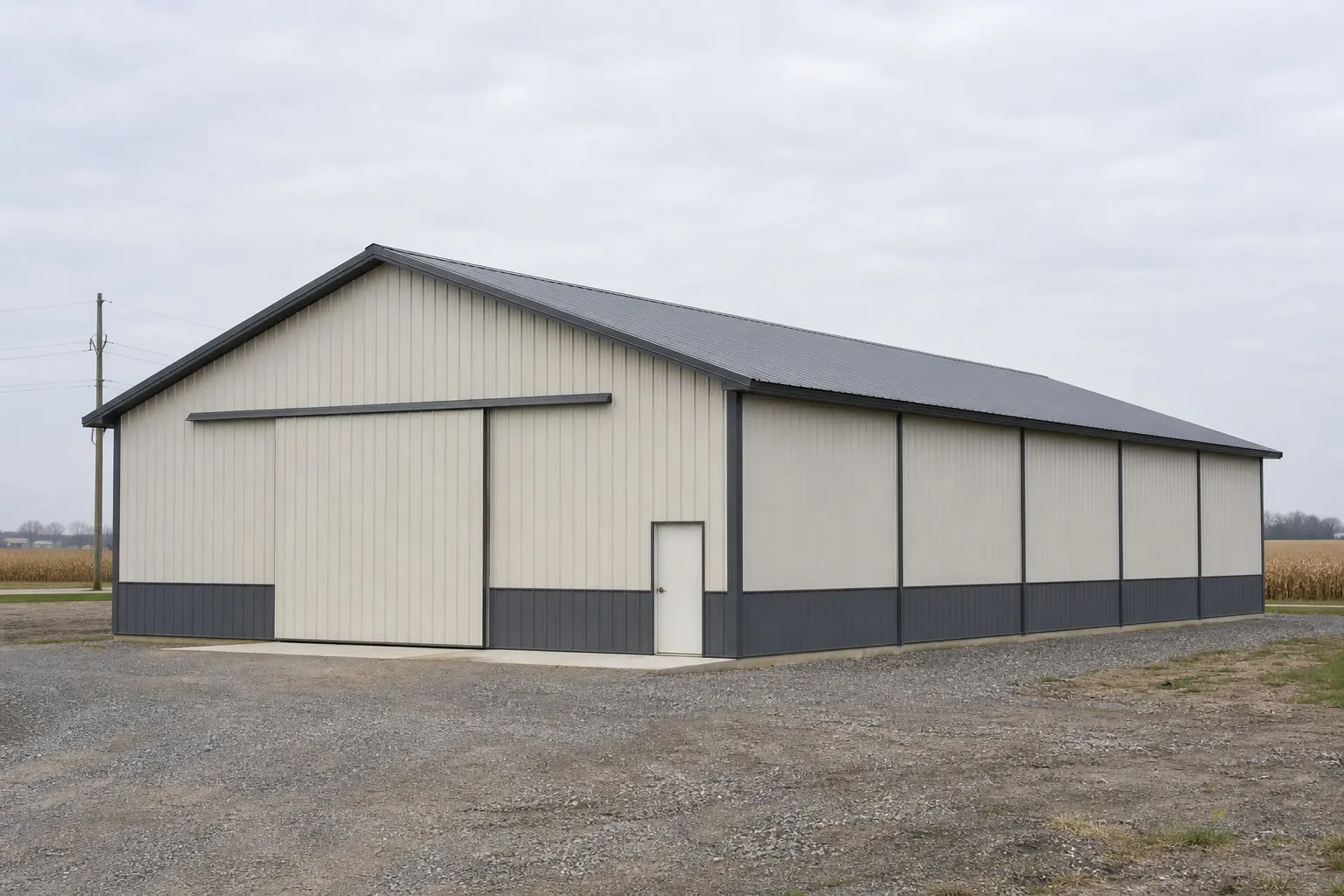
The intersection
What an Alabama site actually changes about a pole barn
The post-frame building itself does not change across state lines. What changes in Alabama is the ground under the posts, the scale of the parcel it usually sits on, and how much water the roof has to shed.
The Alabama Cooperative Extension System identifies seven major soil areas across the state based on an NRCS soil-area map: the Limestone Valleys and Uplands, Blackland Prairie, Coastal Plain, Major Flood Plains and Terraces, Coastal Marshes and Beaches, Appalachian Plateau, and Piedmont Plateau. A pole barn's post footings behave differently in heavy Black Belt clay than in sandier Coastal Plain ground, which is a conversation worth having with your contractor before spacing and footing depth are finalized, not after.
Parcel scale is the second change. Alabama's 2022 Census of Agriculture counted 37,362 farms, down 8% since 2017, across 8,629,101 acres of land in farms, for an average farm size of 231 acres, up 9% since 2017. That points toward fewer, larger operations where one post-frame building is commonly asked to combine equipment storage, hay and a workshop rather than being built as a single-purpose shed.
The third change is water. NOAA NCEI's narrative 'Climate of Alabama' describes a humid subtropical climate with mild winters, hot humid summers, and Gulf-influenced precipitation. For a pole barn, that translates into a practical detail: where roof water discharges relative to the doors you drive through, and whether the pad sits above surrounding grade, matter more here than in a drier climate.
Site context
How the build site differs across Alabama
Alabama's named soil areas are the most useful lens for anticipating site work before a quote.
Black Belt prairie
Heavy, dark clay soils spanning roughly 12 to 21 central Alabama counties. Worth flagging to your contractor for footing design before spacing is fixed.
Coastal Plain
Sandier, more permeable ground in southern Alabama, closer to the Gulf-influenced hazard profile FEMA scores for that region.
Appalachian Plateau and Piedmont Plateau
Northern and interior terrain with more slope variation; grading and delivery-truck access are worth confirming before you fix a footprint.
Exposure
Water management is a recurring Alabama detail
NOAA's humid subtropical description for Alabama, with Gulf-influenced precipitation, means an Alabama pole barn spends much of its life shedding water.
That climate narrative is descriptive context, not a design value, and nothing on this page converts it into a load or a gutter specification. Used correctly, it is a prompt: for a building holding equipment, hay or a workshop, the details that pay for themselves are the ones that move water away from the posts and the slab edge.
In practice that means agreeing on finished pad height relative to surrounding grade, deciding whether gutters and downspouts are in scope, and confirming where roof water discharges relative to daily-use doors. None of this is Alabama-specific engineering; it is the detail most often skipped and most often felt given the state's Gulf-influenced precipitation pattern.
- Pad height and grade
- Confirm the finished floor sits above surrounding grade, especially on flatter Coastal Plain and Black Belt parcels.
- Roof water routing
- Decide gutter scope up front; retrofitting after the apron is poured costs more.
- Approach and apron
- The area you drive over daily takes the wettest wear and is worth planning alongside the building.
Get Alabama pole barn quotes
Tell us your county, the functions the building has to serve and your rough footprint. We route it with the Alabama and pole barn context already attached.
Configuration
What Alabama pole barns are usually asked to do
On a 231-acre average operation, the realistic brief is a single building combining two or three functions, so division and access matter more than total span.
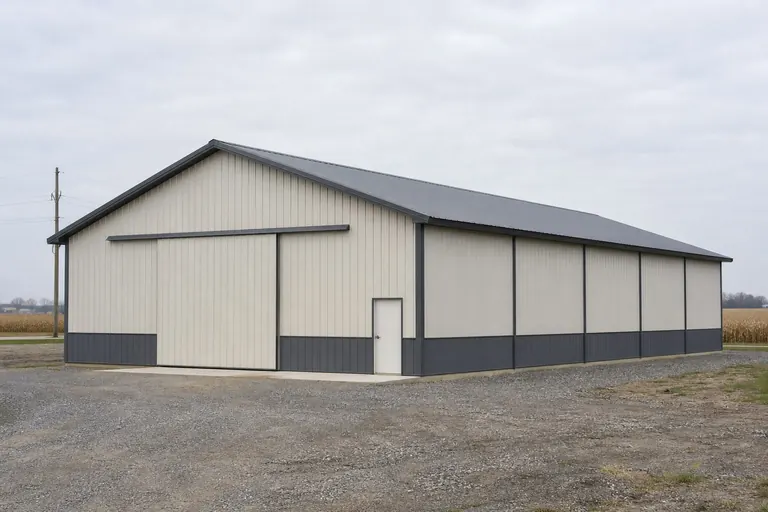 Equipment plus workshopA clear equipment bay with a partitioned, better-finished work end. Decide early whether the partition is structural or a later addition.
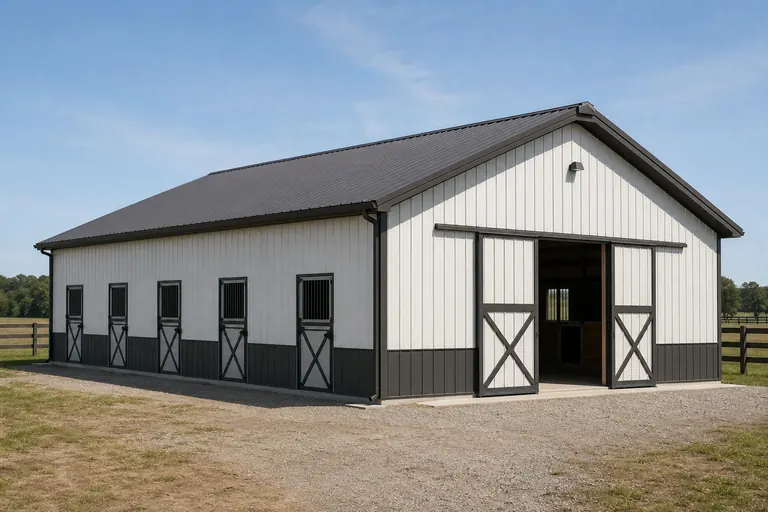 Livestock and hayVentilation and door placement drive this configuration more than square footage, particularly for humid summer weather.
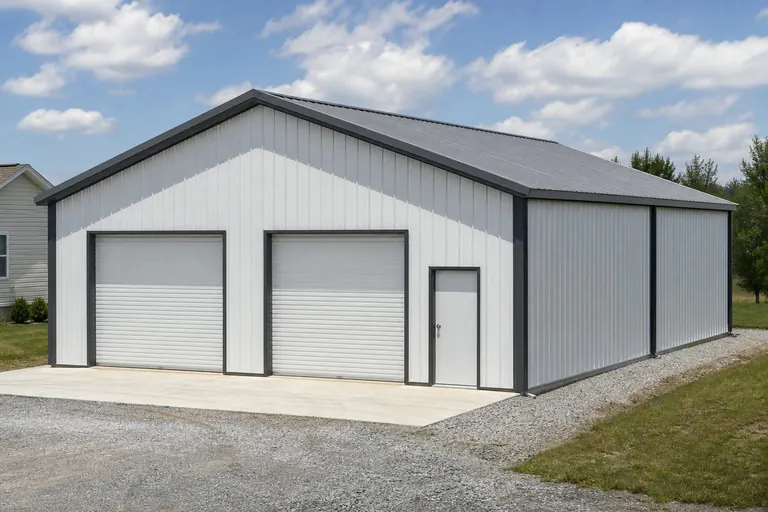 Storage plus vehiclesWhere the same building shelters trailers, a truck and general storage, door width and headroom are the constraints people regret.
Example Configuration — for planning purposes only.
Footprint
Sizes that suit a mixed-use Alabama building
Mixed use is what pushes Alabama enquiries into the mid range: enough width for equipment to turn, enough length to divide the building without wasting either end.
30′ × 40′
1,200 sq ft
The smallest footprint that still divides into an equipment bay and a work end.
30′ × 50′
1,500 sq ft
Adds length rather than width, usually the cheaper way to gain a third function.
40′ × 60′
2,400 sq ft
The common choice where equipment needs to turn inside the building.
40′ × 80′
3,200 sq ft
Where hay storage and equipment genuinely need separating within one envelope.
Example Configuration — for planning purposes only.
Footprint pages carry the layout and door detail for each of these; this page only explains why the Alabama brief lands in this range.
Preparation
Before you request an Alabama pole barn quote
Four things resolved in advance make the difference between a comparable quote and a re-quote.
Step 1
Identify your parcel's soil area
Ask whether your site sits in Black Belt clay, Coastal Plain sand or another of Alabama's seven soil areas.
Step 2
Contact your local building department
Ask what your site and use require before you fix the specification.
Step 3
Fix the daily access path
Where you will drive in, and with what, sets door sizing and apron scope.
Step 4
State every function the building serves
A mixed-use brief priced as single-use is a frequent cause of a second round of quoting.
Questions
Alabama pole barn questions
Questions we can answer honestly at state level, with the ones we cannot routed to whoever actually owns them.
The Alabama Cooperative Extension System maps seven distinct soil areas, so conditions genuinely vary by parcel. What footing depth or spacing your specific site needs is a question for a licensed engineer and your local building department; we do not state footing specifications here.
Permit requirements depend on your county, your parcel and how the building will be used. Your local building department is the only reliable source for that answer.
There is no official typical size. Alabama's 231-acre average farm size favors one mixed-use building, and mixed-use briefs commonly land between 30x40 and 40x60.
We do not publish state-level prices, because a credible number depends on your specification, site work and current material pricing. Our cost pages cover what drives the number.
NOAA describes Alabama's climate as humid subtropical with Gulf-influenced precipitation, which is a reason to discuss moisture-resistant fasteners and finish options with your builder, though we do not specify materials on this page.
Sources for the Alabama facts on this page
This page states no code requirement, wind speed, snow load, permit rule, price or supplier claim. The state-specific facts it does use are listed with their publisher below.
The Alabama Cooperative Extension System identifies seven major soil areas across the state, including the Limestone Valleys and Uplands, Blackland Prairie, Coastal Plain, Major Flood Plains and Terraces, Coastal Marshes and Beaches, Appalachian Plateau, and Piedmont Plateau, based on an NRCS soil-area map.
Alabama Cooperative Extension System (Auburn University) · ACES reference publication · Tier 2
https://www.aces.edu/blog/topics/crop-production/major-soil-areas-of-alabama/The Alabama Black Belt, named for its dark, rich prairie soils, spans roughly 12 to 21 counties across the central part of the state depending on the criteria used to define it.
Encyclopedia of Alabama (Auburn University / Alabama Humanities Alliance) · Reference article · Tier 2
https://encyclopediaofalabama.org/article/black-belt-region-in-alabama/Alabama had 37,362 farms in 2022, down 8% from 2017.
USDA National Agricultural Statistics Service (NASS) · 2022 · Tier 1
https://www.nass.usda.gov/Publications/AgCensus/2022/Online_Resources/County_Profiles/Alabama/cp99001.pdfAlabama had 8,629,101 acres of land in farms in 2022, an average farm size of 231 acres, up 9% from 2017.
USDA NASS · 2022 · Tier 1
https://www.nass.usda.gov/Publications/AgCensus/2022/Online_Resources/County_Profiles/Alabama/cp99001.pdfNOAA NCEI publishes a narrative 'Climate of Alabama' describing the state's humid subtropical climate with mild winters and hot, humid summers, and Gulf-influenced precipitation.
NOAA National Centers for Environmental Information (NCEI) · Historical narrative (NCEI climate normals series) · Tier 1
https://www.ncei.noaa.gov/data/climate-normals-deprecated/access/clim60/states/Clim_AL_01.pdfAlabama's total land area was measured at 50,645.3 square miles as of the 2010 Census.
U.S. Census Bureau · 2010 Census · Tier 1
https://www.census.gov/geographies/reference-files/2010/geo/state-local-geo-guides-2010/alabama.htmlFEMA's National Risk Index is an interactive county/tract-level tool covering 18 natural hazards, including hurricane, tornado, flooding, and wildfire, that can be queried for Alabama counties such as Mobile and Jefferson.
Federal Emergency Management Agency (FEMA) · Current NRI release · Tier 1
https://www.fema.gov/flood-maps/products-tools/national-risk-index