
Metal garage · WI
Metal Garages in Wisconsin
A Wisconsin metal garage is often being added at the same time a household is dealing with new construction or a growing property, and the Census Bureau's 2023 Annual Building Permits report shows some Wisconsin metros moving fast on that front: Sheboygan's housing units authorized rose 283.6% and Racine's rose 221.5% year-over-year into 2023, among the largest percentage gains nationally that year. Meanwhile the Wisconsin State Climatology Office does not publish one statewide snow figure; it splits the state into climate divisions, with roughly 51 inches of average annual snowfall statewide masking real north-south and lake-effect variation. That combination — new-construction pace in specific metros, and regional rather than statewide winter exposure — is what actually shapes a Wisconsin metal garage plan.
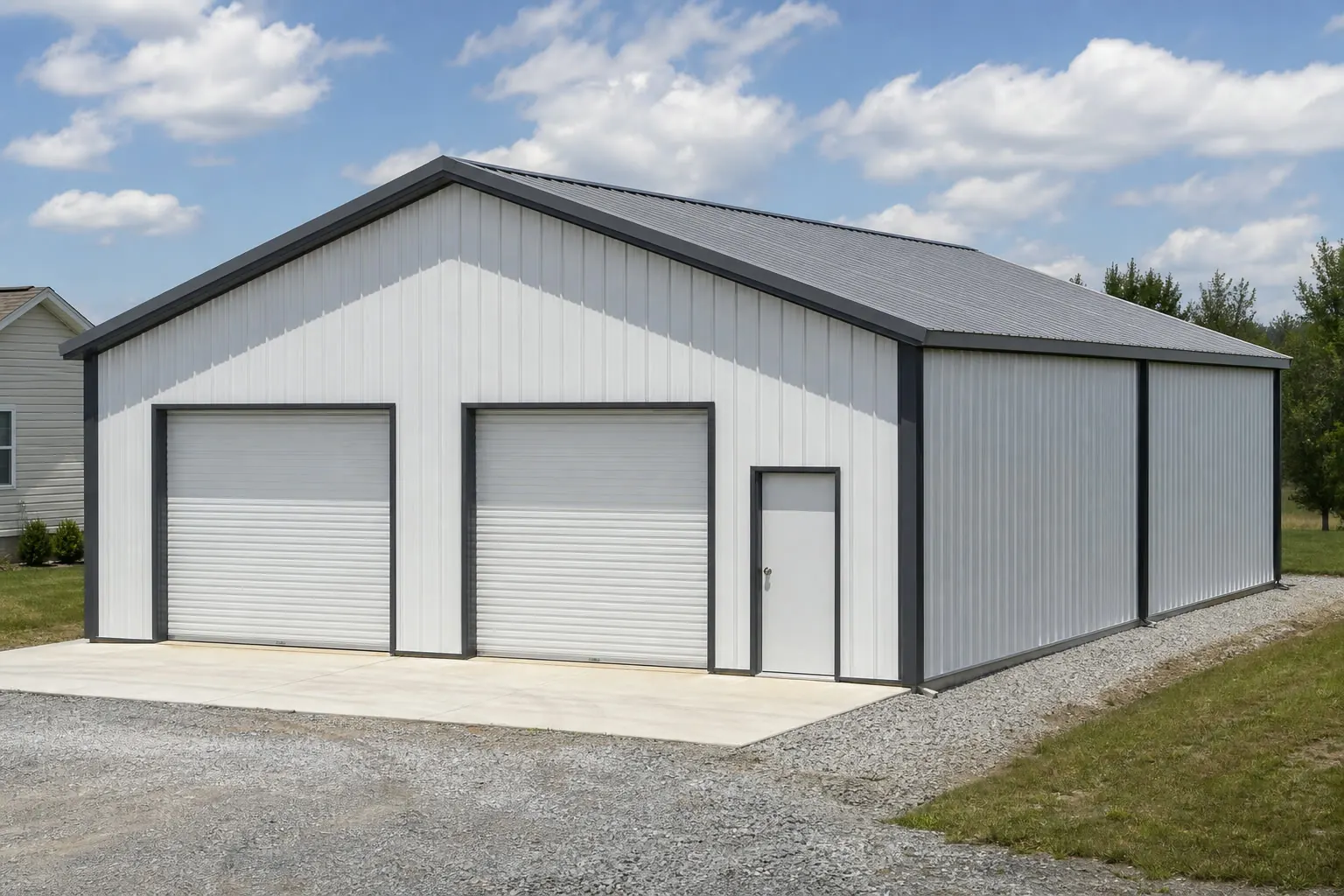
The intersection
What a Wisconsin site actually changes about a metal garage
Fast-growing metro permitting activity and regional snow exposure are the two real inputs.
The Census Bureau's 2023 Annual Building Permits highlights report singled out Sheboygan (+283.6%) and Racine (+221.5%) as among the state's, and the country's, fastest-growing metros for housing units authorized year-over-year. That is context worth knowing if you are adding a metal garage in one of those areas: new-construction neighborhoods often mean utility connections, driveway grading and setback lines are being finalized at the same time as your garage, so coordinating timing with your builder and local building department matters more than it would on an established lot.
The second input is Wisconsin's climate, which the state's own climatologists refuse to treat as a single number. The Wisconsin State Climatology Office divides the state into distinct climate divisions, and while the statewide average runs near 51 inches of annual snowfall, that figure blends genuinely different northern, southern and Lake Michigan-corridor experiences. A metal garage's roof pitch, gutter placement and door clearance are worth planning against your specific region, not the statewide blend.
NOAA NCEI's broader narrative on the state describes a continental climate with cold, snowy winters shaped by the Great Lakes and Canadian air masses, and the same 1991-2020 normals period NCEI uses to characterize that pattern is the basis a local building department draws on for frost depth and foundation requirements — not a figure this page states. For a sealed metal garage, that continental swing between summer humidity and winter cold is also the reason interior condensation is a year-round design question here, not just a winter one.
Site context
How the metal-garage brief differs across Wisconsin
Metro permitting pace and regional snow exposure both vary enough to matter.
Southeastern metros (Sheboygan, Racine and similar)
Faster recent new-construction permitting activity per Census data means a garage project here may be coordinated alongside broader site development, not a standalone retrofit.
Northern interior
Colder, snowier divisional normals; roof pitch and eave clearance are worth confirming with a local builder rather than the statewide average.
Lake Michigan corridor
Lake-effect moderation and lake-effect snow both appear in the divisional climate data; site-specific advice beats a statewide assumption near the shoreline.
Exposure
Roof geometry and door clearance for Wisconsin snow
Roughly 51 inches of average annual snowfall statewide, per the state climatology office, makes roof geometry and door-swing clearance worth resolving up front.
This page does not state a design snow load; that number comes from your local building department based on your specific site and region. What the statewide snowfall normal usefully flags is that a metal garage's roof pitch, where snow sheds relative to the door, and how much clear space the door needs to swing or roll through winter accumulation are worth resolving with your builder before the slab is poured.
Statewide annual precipitation near 34.9 inches also means driveway grading and drainage away from the garage slab matter across three seasons, not only during snowmelt — particularly relevant if your garage is going in alongside new-construction site grading in a fast-permitting metro.
A sealed metal garage compounds the humidity question further: unlike an open carport, it traps interior air, so moisture drawn in on a wet fall day can condense on cool steel surfaces overnight. A vent kit or gable vent is a modest addition relative to the building and reduces that condensation risk on stored vehicles and tools, a detail worth more attention in Wisconsin's wet-and-freezing climate than in a drier, milder state.
- Roof pitch matched to your climate division
- Confirm against your region, not the statewide average.
- Door clearance for snow accumulation
- Plan swing or rollup clearance for realistic winter snowpack at your door location.
- Slab drainage and grading
- Coordinate with any concurrent site or driveway work, especially in newer developments.
Get Wisconsin metal garage quotes
Tell us your climate region, vehicle count and rough footprint. We route it with the Wisconsin and metal-garage context already attached.
Configuration
What Wisconsin metal garages are usually asked to do
New-construction pace and vehicle storage needs drive the common configurations.
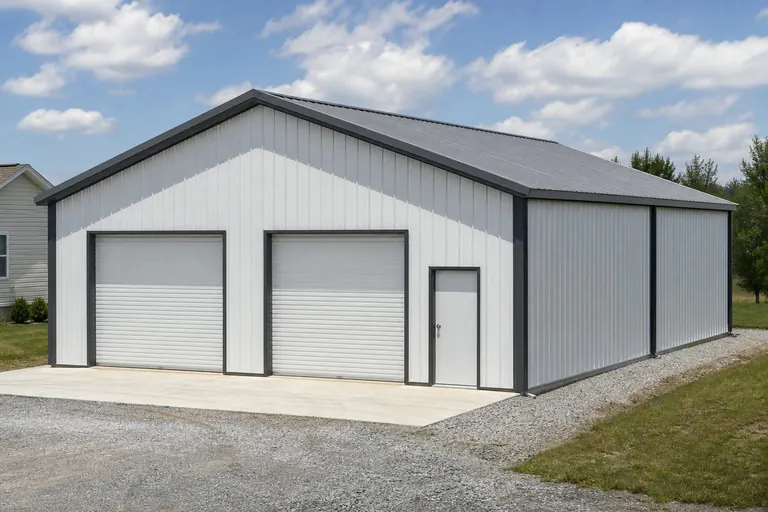 New-build vehicle storageA garage added alongside new home construction, often in a fast-permitting metro, sized for one to two vehicles.Winter equipment and vehicle protectionSnowblowers, ATVs and seasonal vehicles kept out of winter weather between uses.
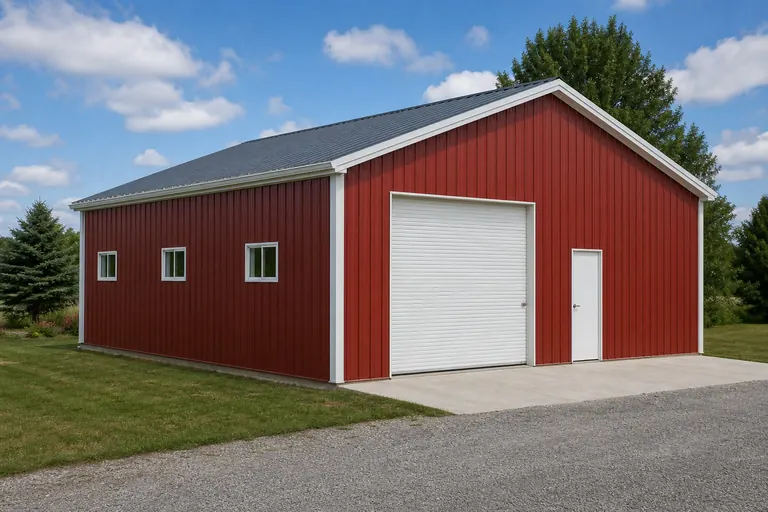 Workshop-garage combinationA garage bay paired with a small workbench area for maintenance and projects.
Example Configuration — for planning purposes only.
Footprint
Sizes that suit a Wisconsin metal garage
New-construction garages tend to be sized for a set number of vehicles plus modest storage.
20′ × 20′
400 sq ft
A single-vehicle garage sized for a new-construction lot.
24′ × 30′
720 sq ft
The common two-vehicle choice with room for winter equipment storage.
30′ × 40′
1,200 sq ft
Where the garage also serves as a small workshop or holds a boat or RV.
Example Configuration — for planning purposes only.
Footprint pages carry layout and door detail; this page explains why Wisconsin briefs land in this range.
Preparation
Before you request a Wisconsin metal-garage quote
Four things resolved in advance make quotes comparable.
Step 1
Contact your local building department
Snow load, setback and permit thresholds are set locally; ask before finalizing the plan, especially on a newer lot.
Step 2
Name your climate division
Tell your builder whether the site is northern interior, southeastern metro, or the Lake Michigan corridor.
Step 3
Coordinate with concurrent site work
If the garage is going in alongside new-construction grading or a driveway, sequence the work with your builder and contractor.
Step 4
Confirm door clearance for winter snow
Realistic snow accumulation at the door location changes swing or rollup clearance needs.
Step 5
Check your county's hazard profile
FEMA's National Risk Index scores 18 natural hazard types at the county level, including winter weather and strong wind; review your county alongside your building department's requirements.
Questions
Wisconsin metal garage questions
Questions answered honestly at state level; the rest routed to whoever owns them.
Permit requirements depend on your jurisdiction, parcel and use. Your local building department is the only reliable source, particularly on a recently platted lot.
We do not state snow load values. Statewide snowfall normals run near 51 inches annually, but your design snow load comes from your local building department based on your site and region.
Census data shows metros like Sheboygan and Racine authorizing many more housing units recently, which can mean busier permit offices and contractor schedules; ask your local building department and builder about current timelines.
The state climatology office publishes different regional climate normals for northern and southern divisions, so it is worth discussing roof pitch and door clearance with a local builder for your specific region.
We do not publish state-level prices, since size, doors and site work drive the number. Our cost pages explain what drives cost; a quote covers your building.
Sources for the Wisconsin facts on this page
This page states no code requirement, wind speed, snow load, permit rule, price or supplier claim. The state-specific facts it does use are listed with their publisher below.
The Census Bureau's 2023 Annual Building Permits highlights report tracks year-over-year percent change in total housing units authorized by state, with Wisconsin metro areas Sheboygan (+283.6%) and Racine (+221.5%) among the report's largest percentage gainers from 2022 to 2023.
U.S. Census Bureau · 2022-2023 · Tier 1
https://www.census.gov/construction/bps/pdf/2023annualhighlights.pdfThe U.S. Census Bureau's Building Permits Survey publishes annual state-level totals of new privately-owned housing units authorized by permit, including Wisconsin, in its Permits by State Annual data files.
U.S. Census Bureau · Annual series, latest final year available · Tier 1
https://www.census.gov/construction/bps/stateannual.htmlThe Wisconsin State Climatology Office divides the state into distinct climate divisions and publishes divisional (regional) climate normals for temperature, precipitation and snowfall separately from statewide figures, reflecting the state's north-south and lake-effect climate variation.
Wisconsin State Climatology Office (UW-Madison) · 1991-2020 · Tier 2
https://climatology.nelson.wisc.edu/wisconsin-climate-divisions/climate-normals/Wisconsin's statewide 1991-2020 annual normal precipitation is about 34.9 inches with roughly 51 inches of annual snowfall, per the Wisconsin State Climatology Office's statewide averages.
Wisconsin State Climatology Office (UW-Madison) · 1991-2020 · Tier 2
https://climatology.nelson.wisc.edu/wisconsin-historic-climate-data/statewide-climate-normals/Wisconsin's statewide 1991-2020 annual normal precipitation is about 34.9 inches with roughly 51 inches of annual snowfall, per the Wisconsin State Climatology Office's statewide averages.
Wisconsin State Climatology Office (UW-Madison) · 1991-2020 · Tier 2
https://climatology.nelson.wisc.edu/wisconsin-historic-climate-data/statewide-climate-normals/Wisconsin's total land area was measured at 54,157.8 square miles as of the 2010 Census, ranking 25th among states.
U.S. Census Bureau · 2010 Census · Tier 1
https://www.census.gov/geographies/reference-files/2010/geo/state-local-geo-guides-2010/wisconsin.htmlNOAA NCEI publishes a narrative 'Climate of Wisconsin' describing the state's continental climate with cold, snowy winters influenced by the Great Lakes and Canadian air masses.
NOAA National Centers for Environmental Information (NCEI) · Historical narrative (NCEI climate normals series) · Tier 1
https://www.ncei.noaa.gov/data/climate-normals-deprecated/access/clim60/states/Clim_WI_01.pdfFEMA's National Risk Index dataset defines and scores 18 natural hazard types (avalanche, coastal flooding, cold wave, drought, earthquake, hail, heat wave, hurricane, ice storm, inland flooding, landslide, lightning, strong wind, tornado, tsunami, volcanic activity, wildfire, winter weather) at the county level nationwide, including all 72 Wisconsin counties.
Federal Emergency Management Agency (FEMA) · Current NRI release · Tier 1
https://www.fema.gov/about/openfema/data-sets/national-risk-index-data