
Metal garage · ID
Metal Garages in Idaho
Idaho covers 82,643 square miles — the 11th-largest land area of any state — but averages only about 19 people per square mile, one of the lowest population densities in the country. For a metal garage buyer, that combination usually means a rural or semi-rural parcel where confirming site conditions and the local building department matters more than it would in a dense suburb. It also means the parcel sits in one of three genuinely different terrain types the Idaho Geological Survey documents statewide: Basin and Range in the south, the volcanic Snake River Plain, and the mountainous central Idaho batholith. This page covers what that combination changes about siting and specifying a garage.
The intersection
A rural default changes the permitting starting point
Idaho's low statewide population density means most metal garage buyers are dealing with a county building department and a less-standardized process than a dense metro.
The Census Bureau measured Idaho's land area at 82,643.12 square miles, 11th largest of any state, against a population density of only about 19 persons per square mile. That gap is the practical reason a garage buyer's first call should go to the specific county or city office covering the parcel: with so much of the state sparsely populated, permitting practices and inspection routines can vary meaningfully from one county to the next in ways a single statewide answer can't capture.
That is not a defect in the system, and it is not something this page can resolve generically — code editions and permit thresholds are exactly the kind of detail only the local building department can answer correctly. What it does mean is that identifying the correct office and calling before finalizing a garage size or slab plan is worth doing early rather than assuming a neighboring county's rule applies.
That county-level variation extends to hazard exposure as well. FEMA's National Risk Index scores wildfire, landslide, and other categories by county and tract for Idaho, so two garages sited an hour apart can carry meaningfully different risk profiles even though both sit within the same low-density landscape.
Site preparation
What Idaho's terrain zones change about a garage slab
A short comparison of the three terrain zones the Idaho Geological Survey documents statewide.
| Terrain zone | What the geology suggests | Site-prep question to ask |
|---|---|---|
| Snake River Plain (volcanic) | Basalt bedrock and unusual drainage tied to the Yellowstone hotspot track, per USGS | Whether shallow rock affects standard slab or footing depth |
| Basin and Range (south) | More typical rangeland relief with real local slope variation | Whether the lot needs grading before a slab can be poured level |
| Central Idaho batholith (mountains) | Mountainous terrain where access often dominates the site budget | Whether the delivery truck and concrete truck can reach the pad |
Snake River Plain (volcanic)
- What the geology suggests
- Basalt bedrock and unusual drainage tied to the Yellowstone hotspot track, per USGS
- Site-prep question to ask
- Whether shallow rock affects standard slab or footing depth
Basin and Range (south)
- What the geology suggests
- More typical rangeland relief with real local slope variation
- Site-prep question to ask
- Whether the lot needs grading before a slab can be poured level
Central Idaho batholith (mountains)
- What the geology suggests
- Mountainous terrain where access often dominates the site budget
- Site-prep question to ask
- Whether the delivery truck and concrete truck can reach the pad
Climate scope
Why a single Idaho climate normal doesn't cover the whole state
The most complete NOAA normal readily available for Idaho comes from a single Boise-area station, and it explicitly does not describe the rest of the state.
NOAA's 1991-2020 normal for the Boise Air Terminal station shows about 11.5 inches of annual precipitation and roughly 17.6 inches of annual snowfall, reflecting the semi-arid Treasure Valley climate. That figure is useful context for a Treasure Valley garage build, but it is a single low-elevation valley reading — northern Idaho and mountain-elevation sites see meaningfully different snow accumulation, and no single statewide normal captures that range accurately.
For a metal garage, the practical takeaway isn't a design value — none is asserted here — it's that a buyer outside the Treasure Valley should ask their local building department or the NWS office serving their region for a site-specific expectation rather than assuming Boise's numbers apply.
- Confirm roof and door specs locally
- Snow accumulation assumptions from a Boise-area normal don't transfer to northern or mountain Idaho sites.
- Ask about drainage on volcanic-plain lots
- Basalt near the surface can change how water moves away from a slab; check before pouring.
- Treat the FEMA NRI tool as the hazard reference
- For wildfire, landslide or other exposure specific to your parcel, use FEMA's own dataset rather than a generalized statement.
Get Idaho metal garage quotes
Tell us your county, how the garage will be used and your rough footprint. We route it with the Idaho and metal garage context already attached.
Configuration
What Idaho metal garages are usually asked to do
Rural lot sizes and a strong agricultural backdrop shape how Idaho buyers typically configure a metal garage.
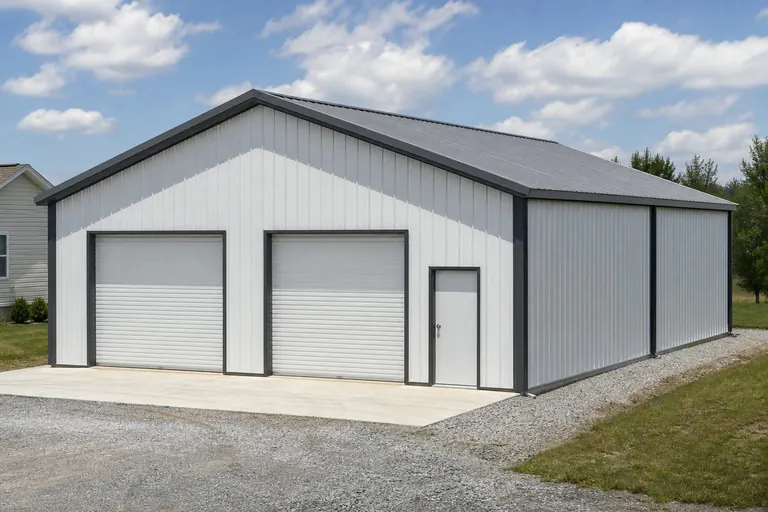 Vehicle and equipment storageA straightforward bay for vehicles and smaller equipment, common on rural residential lots where an attached garage isn't practical.Garage plus workshop endA partitioned section for tools or hobby work alongside vehicle storage, useful on larger rural parcels with room to spare.
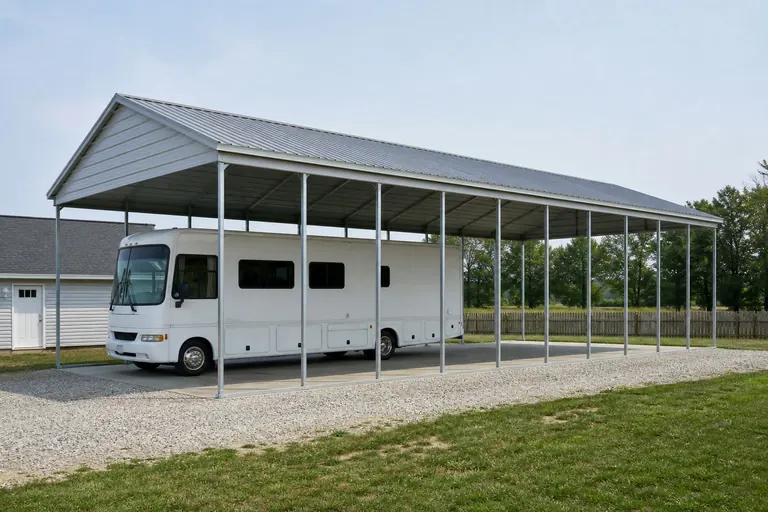 RV or oversized vehicle bayTaller door openings for RVs, boats or trailers common on acreage properties; check clearance against the tallest item before fixing a footprint.
Example Configuration — for planning purposes only.
Footprint
Sizes that fit an Idaho garage brief
Idaho enquiries commonly reflect rural residential lots with room for a standalone garage rather than a tight urban footprint.
24′ × 30′
720 sq ft
A common two-car starting point for a rural residential lot.
30′ × 40′
1,200 sq ft
Room for a partitioned shop end alongside vehicle storage.
20′ × 30′
600 sq ft
A compact option where the lot or budget sets the limit.
40′ × 60′
2,400 sq ft
A larger footprint for buyers combining vehicle storage with a workshop or small business use.
Example Configuration — for planning purposes only.
Footprint pages carry layout and door detail for each of these; this page only explains why Idaho briefs tend to land in this range, reflecting general rural demand patterns rather than any single supplier's product line.
Questions
Idaho metal garage questions
Questions we can answer honestly at state level, with anything jurisdiction-specific routed to whoever actually owns it.
It depends on your county or city and how the structure is classified. With Idaho's population spread thin across 82,643 square miles, permitting practices vary by jurisdiction, so your local building department is the source to confirm before finalizing a design. Two neighboring counties can apply different rules to the same size garage, which is exactly why written confirmation from your specific office is worth getting before you order materials.
Yes. The Idaho Geological Survey documents three terrain zones statewide — southern Basin and Range, the volcanic Snake River Plain, and the central Idaho batholith mountains — and site preparation for a garage slab can differ meaningfully depending on which one applies.
Not reliably outside the Treasure Valley. NOAA's 1991-2020 normal for Boise Air Terminal is a single low-elevation station and does not represent northern or mountain-elevation Idaho, where snow accumulation is meaningfully different.
There's no official typical size, but Idaho enquiries commonly land between 24x30 and 40x60, reflecting rural residential lots with room for a standalone building rather than a tight urban footprint.
We don't publish state-level prices here, because a credible number depends on your specification, site prep and current material pricing. Our cost pages cover what drives the number; a quote covers your building.
Sources for the Idaho facts on this page
This page states no code requirement, wind speed, snow load, permit rule, price or supplier claim. The state-specific facts it does use are listed with their publisher below.
Idaho's total land area was measured at 82,643.12 square miles as of the 2010 Census, the 11th largest of any U.S. state, with a population density of only about 19.0 persons per square mile.
U.S. Census Bureau · 2010 Census · Tier 1
https://www.census.gov/geographies/reference-files/2010/geo/state-local-geo-guides-2010/idaho.htmlThe Idaho Geological Survey's statewide Geologic Map of Idaho documents the state's varied terrain, spanning Basin and Range structures in the south, the volcanic Snake River Plain, and the mountainous central Idaho batholith terrain to the north.
Idaho Geological Survey, University of Idaho · 2012 · Tier 2
https://idahogeology.org/pub/Maps/Geologic_Map_of_ID_booklet_3.pdfUSGS research on the Snake River Plain describes it as a prominent, broad volcanic-terrain river drainage cutting a wide arc across southern Idaho, with its geologic history tied to the Yellowstone hotspot track.
U.S. Geological Survey (USGS), Yellowstone Volcano Observatory · USGS reference article · Tier 1
https://www.usgs.gov/observatories/yvo/news/snake-river-plain-a-tale-two-basinsBoise's 1991-2020 annual climate normal precipitation is about 11.5 inches with roughly 17.6 inches of annual snowfall, reflecting the semi-arid Treasure Valley climate.
NOAA National Centers for Environmental Information (NCEI) · 1991-2020 · Tier 1
https://www.ncei.noaa.gov/access/services/data/v1?dataset=normals-monthly-1991-2020&dataTypes=MLY-PRCP-NORMAL,MLY-SNOW-NORMAL&format=csv&stations=USW00024131FEMA's National Risk Index platform (hazards.fema.gov) is the authoritative county/tract-level source for Idaho natural hazard exposure scores across 18 hazard types, including hazard categories such as wildfire, landslide, and earthquake that are tracked for Idaho specifically.
Federal Emergency Management Agency (FEMA) · Current NRI dataset · Tier 1
https://www.fema.gov/flood-maps/products-tools/national-risk-index