
Metal Garage · WA
Metal Garages in Washington
A metal garage in Washington is rarely a one-size decision, because the state a buyer is standing in has two working climates. NOAA's 1991-2020 normal for Sea-Tac Airport puts annual precipitation at 39.34 inches, which means a west-side garage spends a large share of the year damp inside and out, while the Washington Geological Survey's Columbia Basin — the arid lowland covering the state's entire southeastern corner — asks a garage to manage heat and dust instead. Layer in a statewide housing-permit count that the Census Bureau put at 37,778 new units in 2024, down from 49,030 two years earlier, and it is clear garages here are increasingly being added to existing lots rather than built alongside new houses.
The intersection
What a Washington site changes about a metal garage
Washington's split climate and its recent housing-permit trend both change how a garage should be planned here, before a single dimension is picked.
On the west side, NOAA's Sea-Tac normal of 39.34 inches of annual precipitation (and 6.3 inches of annual snowfall) describes conditions the National Weather Service's Seattle office treats separately from the state's drier interior. A garage built there is going to be damp, both from ambient humidity and from wet vehicles and equipment being brought inside, for a meaningfully larger share of the year than in most other states. Ventilation, a sealed and sloped floor, and door seals earn their keep here in a way they would not in a dry climate.
East of the Cascades, the Washington Geological Survey's Columbia Basin — an arid lowland spanning the state's entire southeastern portion — flips the priority list. A garage there deals more with heat buildup, dust infiltration around doors, and sun exposure on unshaded walls than with standing moisture. Because the same state genuinely contains both conditions, this page treats them as two separate specification conversations rather than one generic garage recommendation.
Overlaid on both is a statewide trend worth knowing before requesting a quote: Census Bureau building-permit data shows Washington authorized 37,778 new privately-owned housing units in 2024, down from 49,030 in 2022 and roughly flat against 2023's 37,097. Fewer new homes statewide generally means a larger share of new garages are retrofits onto existing driveways and utility connections rather than components of a fresh new-build plan — worth mentioning to a contractor up front.
Specification
Moisture control on one side, dust control on the other
A west-side garage and an east-side garage are solving different environmental problems, which changes what is worth asking for in a spec.
For a west-side garage, floor drainage, a vented ridge or gable, and weatherstripped doors reduce the day-to-day moisture load that Sea-Tac's precipitation normal implies. None of this is a code requirement stated here — it is a practical response to how often the building will be wet.
For a Columbia Basin garage, the more useful questions are about door seals against blowing dust, wall orientation relative to prevailing sun, and whether interior storage needs shade more than it needs drainage. The two lists genuinely do not overlap much, which is the point of asking a buyer which side of the state their site is on before quoting.
- West-side priority
- Floor slope, drainage, and interior ventilation to manage sustained dampness.
- East-side priority
- Door sealing and orientation to manage heat and windblown dust rather than moisture.
- Retrofit consideration
- Confirm existing driveway grade and utility runs when adding a garage to an already-built property.
Context
Why Washington garage additions skew toward existing lots
The state's cooling new-housing permit trend is useful context for how a garage project gets planned.
The Census Bureau's Building Permits Survey shows a clear statewide direction: 49,030 authorized units in 2022, down to 37,097 in 2023, and 37,778 in 2024. That multi-year plateau after a steep drop suggests that new-home construction, and the garages that would be built alongside it, make up a smaller share of total garage demand than they did a few years ago. A buyer adding a garage to a property that already has a house, driveway, and utility connections is now more the norm than the exception in Washington, which is why this page treats retrofit siting as a first-class topic rather than an edge case.
For a retrofit garage specifically, this trend is a reason to ask a contractor directly about scheduling rather than assuming the same lead times that applied during the busier 2022 construction season, since crew and material availability tends to track overall building volume in a given year.
Get Washington metal garage quotes
Tell us which side of the Cascades your site is on and whether it's a retrofit or new build. We route it with the Washington and metal-garage context already attached.
Configuration
How Washington metal garage briefs differ by site
A retrofit garage on an established lot and a garage on rural acreage are solving different problems even before climate is added.
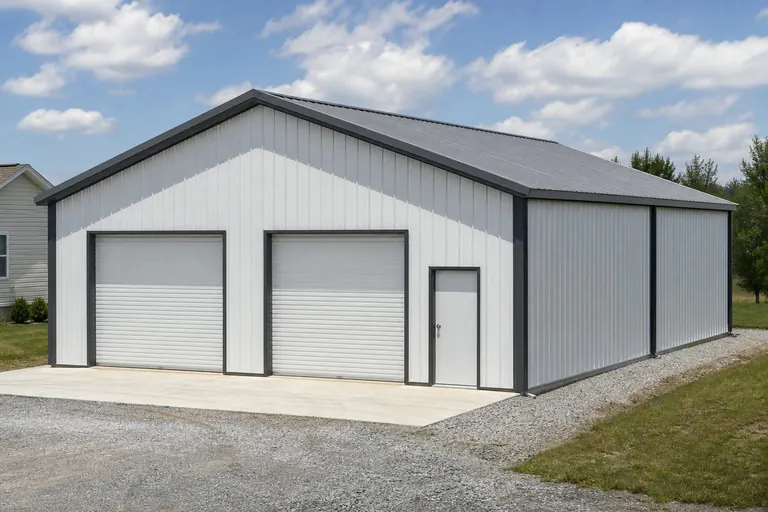 Retrofit driveway garageAdded to an already-built property, matching existing driveway grade and utility runs, increasingly the common case given the state's cooling new-housing permit trend.West-side workshop garageA vehicle bay plus a finished work end, ventilated and drained against Sea-Tac's sustained precipitation normal.Columbia Basin storage garageSited on flatter, drier interior ground, prioritizing dust sealing and sun-orientation over drainage.
Example Configuration — for planning purposes only.
Site prep
Slab and utility planning differ for a retrofit versus a new-build garage
Washington's falling new-housing permit count means a growing share of garage projects are being fit onto lots that already have a house, driveway, and utilities in place, which changes what needs checking before a slab is poured.
On a retrofit lot, the practical questions are whether the existing driveway grade lines up with a new slab, whether electrical service has spare capacity for a garage circuit, and whether the existing drainage path already handles roof runoff from an added structure. None of this is unique to Washington, but it is a more common conversation here now than it was when new-housing permits stood at 49,030 in 2022, before falling to 37,778 by 2024.
On a new-build lot, the garage slab and utility runs are typically planned alongside the house from the outset, which avoids the retrofit questions but still runs into the same west/east climate split for the panel and drainage decisions covered above.
Preparation
Before you request a Washington metal garage quote
These points shorten the path to a comparable quote.
Step 1
State which side of the state your site is on
Moisture-first and dust-first specs differ enough that this changes the recommendation.
Step 2
Note whether this is a retrofit or new-build site
Existing driveway grade and utility runs matter more on already-built parcels.
Step 3
Check with your local building department
Snow-load, wind, and permit questions are jurisdiction-specific; we do not state them here.
Questions
Washington metal garage questions
Honest state-level answers, with jurisdiction-specific items routed appropriately.
The structure itself is similar, but the priorities differ: west-side sites, represented by Sea-Tac's 39.34-inch annual precipitation normal, benefit from moisture and drainage planning, while Columbia Basin sites are more about heat and dust control.
Permit requirements depend on your county or city jurisdiction and the garage's size and use. Your local building department is the only reliable source for that answer.
Census Bureau data shows statewide new-housing permits have fallen from 49,030 (2022) to 37,778 (2024), which suggests a growing share of garage projects are additions to already-built properties rather than new-build pairings, though this is a statewide trend, not a guarantee for any one parcel.
We don't specify products here, but west-side moisture and east-side dust are different problems worth mentioning to your supplier when discussing door seals and materials.
We do not publish state-level prices; costs depend on size, materials, and site work. Our cost pages cover what drives the number.
Sources for the Washington facts on this page
This page states no code requirement, wind speed, snow load, permit rule, price or supplier claim. The state-specific facts it does use are listed with their publisher below.
Seattle-Tacoma International Airport's 1991-2020 annual climate normal precipitation is 39.34 inches with an annual normal snowfall of 6.3 inches.
NOAA National Centers for Environmental Information (NCEI) · 1991-2020 · Tier 1
https://www.ncei.noaa.gov/access/services/data/v1?dataset=normals-annualseasonal-1991-2020&dataTypes=ANN-PRCP-NORMAL,ANN-SNOW-NORMAL&stations=USW00024233&format=jsonNWS Seattle publishes climate information pages for western Washington, including precipitation plots distinguishing the wetter coastal/Cascades-influenced west side from the drier interior.
National Weather Service (NOAA), Seattle WA office · Ongoing NWS climatology records · Tier 1
https://www.weather.gov/sew/CliPlotThe Washington Geological Survey (part of the state Department of Natural Resources) names and maps distinct geologic/physiographic provinces across the state, including the Cascade Range and the Columbia Basin, the latter a wide, arid lowland occupying the entire southeastern portion of Washington.
Washington State Department of Natural Resources, Washington Geological Survey · Reference material, current · Tier 2
https://dnr.wa.gov/washington-geological-survey/explore-popular-geology/geologic-provinces-washington/columbia-basinWashington builders and developers were authorized (by building permit) to build 37,778 total new privately-owned housing units in 2024, down from 49,030 units in 2022 and 37,097 units in 2023.
U.S. Census Bureau · 2022-2024 · Tier 1
https://www2.census.gov/econ/bps/State/st2024a.txt