
Horse barn · IN
Horse Barns in Indiana
Indiana's own geological survey has gone to the trouble of naming the state's physiographic regions — moraine country, till plains, lake country among them — in a level of documented detail that most states don't have on record in one place. That matters for a horse barn less as trivia and more as a reminder: siting, drainage, and foundation choices genuinely differ across a state this varied, and a barn plan copied from a flat till-plain farm won't necessarily suit a moraine-country parcel. Add 53,599 working farms across 14.6 million acres and a building-code system where the state itself, through IDHS, runs plan review rather than leaving it entirely to a patchwork of counties, and Indiana's horse-barn planning conversation is really about terrain and process, not a generic stall list.
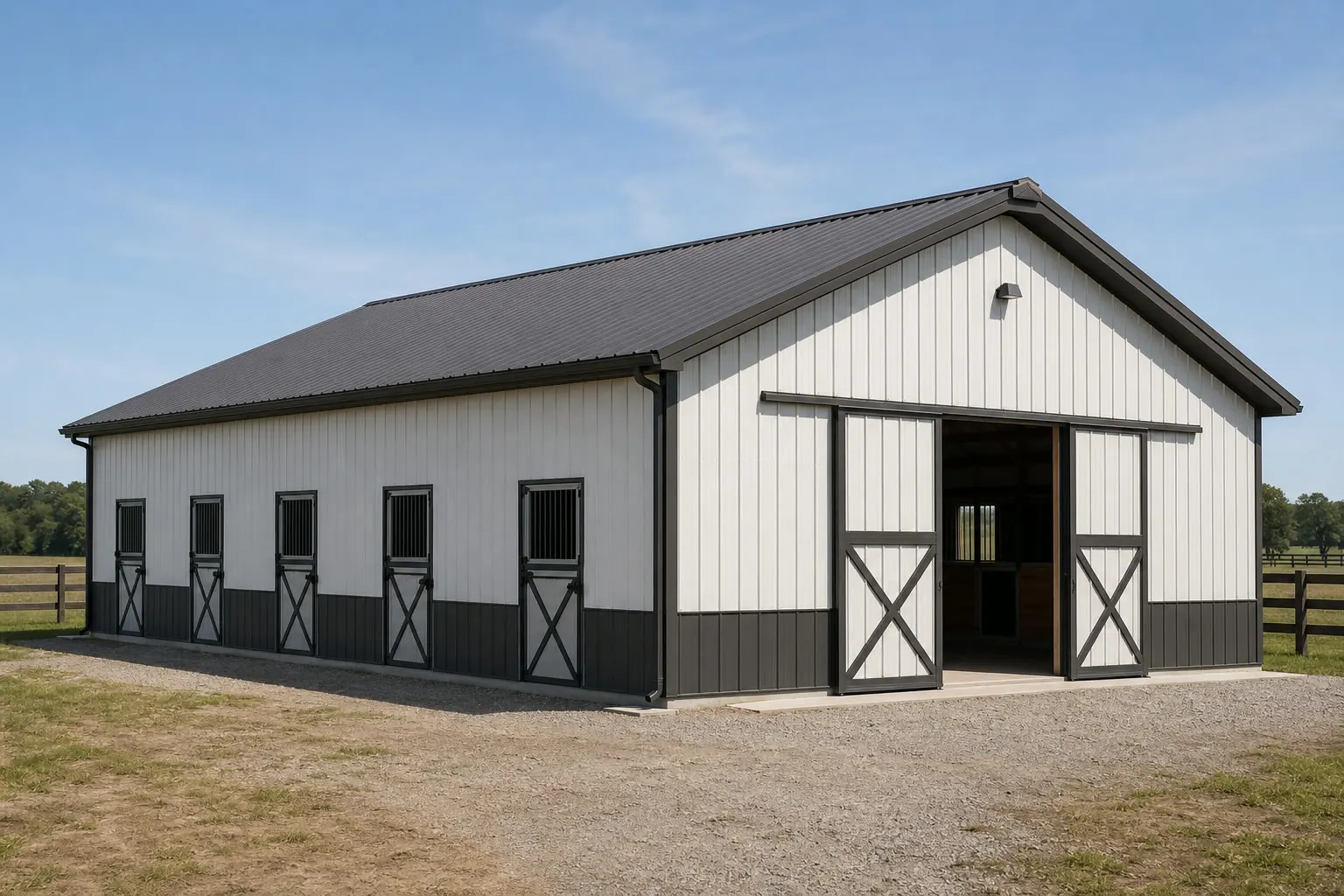
A State That Names Its Own Terrain
Most states don't have a single authoritative reference naming their physiographic regions; Indiana does, through the Indiana Geological Survey's Special Report 61 and the DNR's related natural-regions scheme. That level of documented terrain variety is exactly why a horse barn plan should start from your own site rather than a generic template — a barn sited well on flat till-plain ground may need very different drainage handling on moraine country. This page walks through what that variety, Indiana's working-farm scale, and its state-run plan review process actually mean for planning.
Site Planning
Why Indiana's Named Regions Matter for Barn Siting
Indiana's geological survey documents named physiographic regions, which is a reason to treat site drainage as parcel-specific rather than assumed.
The 'Physiographic Divisions of Indiana' (Gray, 2000) and the related 'Natural Regions of Indiana' scheme name zones such as moraine country, till plains, and lake country. This page does not attempt to draw exact regional boundaries for your parcel — that is a site-specific question — but the existence of this much documented terrain variety is itself useful: it tells you not to assume your neighbor's barn foundation approach, three counties over, applies to your ground.
For a horse barn specifically, that means checking your own site's drainage pattern before committing to a floor plan. A barn placed low relative to a paddock gate will move mud toward exactly the spot horses and handlers cross most often, and that is an earthworks fix after the fact rather than a carpentry one.
Indiana's total land area of 36,420 square miles spans this named variety, so treat any terrain-specific claim about your project as something to verify on your own parcel, ideally with a site visit, rather than as a statewide given.
FEMA's National Risk Index scores the same 18 named hazards, including inland flooding, for every Indiana county, and that county-level view is a more useful planning input for a horse barn pad than a general terrain description. A barn sited on ground that scores higher for inland flooding in your county's own NRI report is a signal to raise the pad, improve perimeter drainage, or reconsider the exact spot on the parcel before pouring footings.
On the climate side, NWS Indianapolis publishes daily 1991-2020 climate normals rather than a single seasonal figure, so a barn's ventilation ridge, door placement and bedding schedule are better matched to the specific weeks your horses will be stalled most heavily than to one averaged annual number. Ask your local NWS office for the daily normals nearest your build date if timing barn completion around a particular season.
Who Is Building
A Working Farm Base, Not Just an Equine Specialty
Indiana's 53,599 farms suggest many horse-barn buyers are running horses alongside other farm operations.
53,599 farms worked 14,602,240 acres in Indiana as of the 2022 Census of Agriculture, a farm count down about 4% from 2017. That scale, spread across a state with named terrain variety, points to a horse-barn buyer who is frequently combining stalls with general farm storage rather than running a dedicated boarding operation.
A barn asked to do double duty — stalls at one end, equipment or feed storage at the other — needs the aisle width, door placement, and dividing-wall position planned around both uses from the start, not retrofitted once stalls are already framed.
We do not have a verified statewide horse or pony population figure for Indiana in this evidence pack, and we are not going to estimate one. Size your barn to your own horses and program, not to a number we can't back with a source.
Get Indiana Horse Barn Quotes
Tell us your stall count, any secondary use, and your rough footprint. We route it with the Indiana terrain and review-path context attached.
Reference
Indiana Figures This Page Relies On
Every figure below carries a named publisher and period.
| Measure | Figure | Source |
|---|---|---|
| Farms (2022) | 53,599 | USDA NASS |
| Land in farms (2022) | 14,602,240 acres | USDA NASS |
| Total land area | 36,420 sq mi | U.S. Census Bureau |
| Named terrain reference | Physiographic Divisions of Indiana (Special Report 61) | Indiana Geological Survey |
| Code adoption/enforcement | Fire Prevention and Building Safety Commission / IDHS | Indiana DHS |
| Equine inventory | Not confirmed in evidence — not estimated here | Evidence registry |
Farms (2022)
- Figure
- 53,599
- Source
- USDA NASS
Land in farms (2022)
- Figure
- 14,602,240 acres
- Source
- USDA NASS
Total land area
- Figure
- 36,420 sq mi
- Source
- U.S. Census Bureau
Named terrain reference
- Figure
- Physiographic Divisions of Indiana (Special Report 61)
- Source
- Indiana Geological Survey
Code adoption/enforcement
- Figure
- Fire Prevention and Building Safety Commission / IDHS
- Source
- Indiana DHS
Equine inventory
- Figure
- Not confirmed in evidence — not estimated here
- Source
- Evidence registry
Configuration
What an Indiana Horse Barn Is Usually Asked to Do
Given the working-farm base documented above, briefs are often mixed-use.
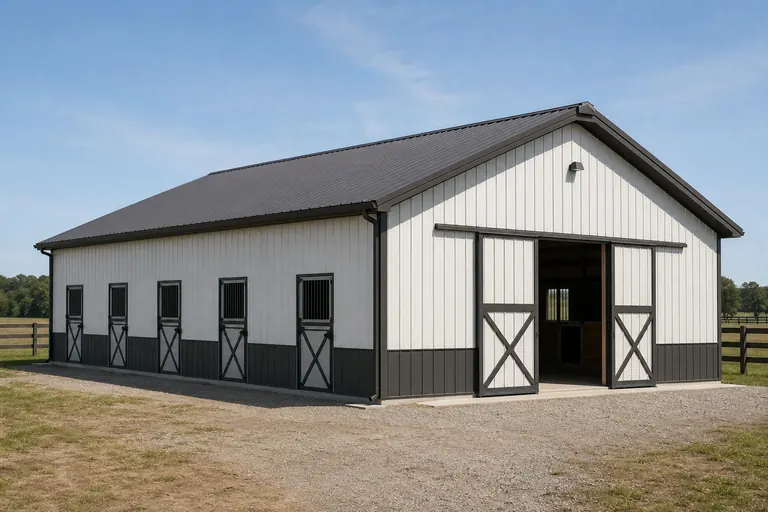 Stalls plus feed/tack storageA compact stall run paired with a small dedicated storage area, common on smaller working farms.Stalls plus equipment bayA center-aisle stall section next to an open equipment bay, suited to farms running horses alongside other operations.Larger center-aisle barnFor bigger stall counts, aisle width and door placement drive the plan more than the shell; that detail lives on the type-level page.
Example Configuration — for planning purposes only.
Footprint
Sizes That Fit a Mixed-Use Indiana Barn
Starting points, not recommendations independent of your own program.
30′ × 40′
1,200 sq ft
A compact start for a handful of stalls plus a small feed or tack area.
36′ × 48′
1,728 sq ft
Room for a center-aisle layout without committing to a large boarding operation.
40′ × 60′
2,400 sq ft
Space for stalls and a genuine secondary storage or equipment bay.
Example Configuration — for planning purposes only.
Confirm terrain and drainage specifics for your own parcel; footprint alone doesn't resolve siting.
Questions
Indiana Horse Barn Questions
Answered plainly, with local-specific items routed to the right office.
Indiana's own geological survey names distinct physiographic regions across the state, which is a reminder to check your own site's drainage and grade rather than assume a statewide pattern.
The Fire Prevention and Building Safety Commission adopts the state code by rule, and IDHS carries out plan review and enforcement; confirm whether your project is reviewed directly by IDHS or a locally delegated department.
We don't have a confirmed statewide equine inventory figure in this evidence pack, so this page doesn't estimate one — size your barn to your own horses and program.
There's no official typical size. Because many Indiana sites mix stalls with general farm storage, briefs commonly fall between 30x40 and 40x60, but your own program should set the number.
We don't publish state-level prices here; cost depends on specification, site work, and current material costs. Our cost pages explain the drivers, and a quote covers your specific building.
Sources for the Indiana facts on this page
This page states no code requirement, wind speed, snow load, permit rule, price or supplier claim. The state-specific facts it does use are listed with their publisher below.
The Indiana Geological Survey classifies the state into physiographic regions in its Special Report 61.
Indiana Geological Survey (Indiana University) · 2000 (Special Report 61) · Tier 2
https://scholarworks.iu.edu/dspace/items/6e9ea94d-c556-4629-98ea-26e0b518745dNumber of farms in Indiana in 2022, per the state statistician's public comments on the Census of Agriculture.
USDA NASS (data); Brownfield Ag News (reporting) · 2022 Census of Agriculture · Tier 1
https://www.nass.usda.gov/Publications/AgCensus/2022/Full_Report/Volume_1,_Chapter_2_County_Level/Indiana/st18_2_045_045.pdfLand in farms in Indiana in 2022 per NASS county-level state total table.
USDA National Agricultural Statistics Service · 2022 · Tier 1
https://www.nass.usda.gov/Publications/AgCensus/2022/Full_Report/Volume_1,_Chapter_2_County_Level/Indiana/st18_2_045_045.pdfNOAA NCEI publishes a narrative 'Climate of Indiana' summary describing precipitation and snowfall patterns across the state's climatic regions.
NOAA National Centers for Environmental Information (NCEI) · Climatography of the U.S. series · Tier 1
https://www.ncei.noaa.gov/data/climate-normals-deprecated/access/clim60/states/Clim_IN_01.pdfIndiana's Department of Homeland Security, through its Fire Prevention and Building Safety Commission and Code Enforcement/Building Plan Review functions, adopts and administers the state building code.
Indiana Department of Homeland Security (IDHS) · Current program pages; 2026 Indiana Building Code adoption in progress per Indiana Register filing · Tier 2
https://www.in.gov/dhs/building-plan-review/NWS Indianapolis publishes daily 1991-2020 climate normals for Indianapolis including precipitation and snowfall by date.
National Weather Service (NOAA) · 1991-2020 · Tier 1
https://preview.weather.gov/media/ind/climatenormals.pdfFEMA's National Risk Index scores the same 18 named natural hazards for Indiana counties as for all other states.
FEMA · Current release · Tier 1
https://www.fema.gov/flood-maps/products-tools/national-risk-index