
Garden shed · MA
Garden Sheds in Massachusetts
A garden shed in Massachusetts almost always has to earn its footprint. USDA's 2022 Census of Agriculture puts the state's average farm at just 66 acres — among the smallest in the country — and Census building-permit data shows single-unit homes were a minority of 2024 authorized construction (5,626 of 14,338 units). Whether the site is a small working farm or a dense residential lot, space is the constraint a shed has to respect, and roughly 49 inches of average annual snowfall at Boston Logan adds a second constraint most low-snow states never have to plan around.
The intersection
What a Massachusetts site changes about a garden shed
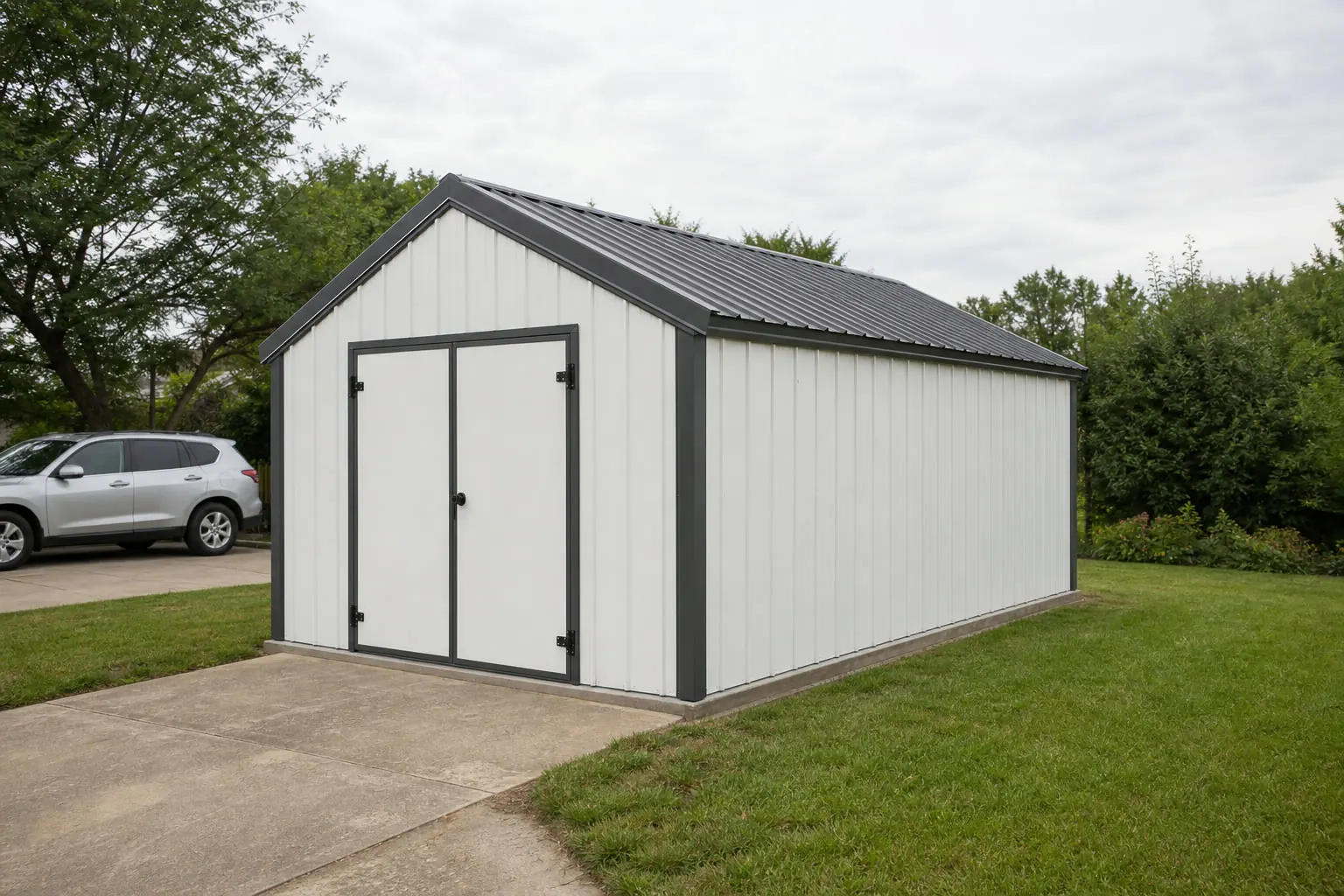
The shed itself is a simple steel-frame structure everywhere. What differs here is how little slack the lot gives you.
USDA's 2022 Census of Agriculture shows Massachusetts averaging just 66 acres per farm, one of the smallest averages nationwide, across 7,083 farms statewide (down from 7,241 in 2017). On working land this small, a shed has to be sized to what a compact operation actually needs — seed, hand tools, a mower, maybe a small tiller — rather than sized for room to grow, the way a larger Midwest farm might plan.
The same space discipline shows up residentially. Census Bureau permit data shows Massachusetts builders were authorized for 14,338 new housing units in 2024, and only 5,626 of those were single-unit structures. A state building this much multi-unit and infill housing tends to have smaller residential lots on average, which means a garden shed buyer here is more often solving a setback puzzle than picking from an open field of options.
Winter changes the shed itself, not just the site. Boston Logan's NOAA normals show about 49 inches of average annual snowfall, with January and February each averaging close to 14 inches. That is not a design-load conversation — leave engineering specifics to your local building department — but it does mean roof pitch, door swing clearance under a snow load, and where snow sheds off the roof are worth deciding before the shed goes in, not after the first storm buries the door.
A shed's small footprint changes which of FEMA's 18 tracked hazard types actually matter day to day. A structure this size rarely faces the same wind-loading conversation a large clear-span barn does, but anchoring and tie-down still belong in the planning discussion for coastal Massachusetts counties, where the same National Risk Index dataset flags hurricane and coastal-wind exposure that an inland Berkshires county doesn't carry to the same degree.
Site context
How terrain changes shed siting across Massachusetts
The USGS upland/coastal split is a useful lens for anticipating what the ground under a shed pad will actually do.
Western uplands and Berkshires
Rolling to hilly ground, sometimes with shallow bedrock near the surface. A quick site check before pouring a pad avoids surprises.
Central valleys
Generally moderate grading; check existing garden or yard drainage before placing a shed downhill of it.
Southeastern Coastal Plain
Flatter, sandier soil that drains differently than upland clay; confirm the pad sits above standing water after heavy rain.
Use case
Why small footprints dominate the Massachusetts brief
Both the working-land and residential data point the same direction: compact, purposeful sheds rather than oversized ones.
A 66-acre average farm doesn't need — or usually have room to justify — a large outbuilding footprint. Most small Massachusetts operations are better served by a shed sized to specific tasks: overwintering equipment, storing feed or supplies dry, or keeping hand tools organized near a garden plot, rather than a general-purpose barn.
On residential lots, the same logic applies for a different reason. With denser housing patterns statewide, side and rear yards tend to be tighter, and a compact shed that clears setback lines is easier to site than a larger structure that forces a variance conversation with the local building department.
- Task-specific sizing
- Match the shed to what you're actually storing, not to available square footage you don't have.
- Setback-first planning
- Confirm your town's accessory-structure setback before settling on a footprint.
- Snow-aware roofline
- Pick a roof pitch and door placement that account for winter snow shed, not just summer use.
- County-level hazard awareness
- FEMA's National Risk Index covers 18 hazard types across the state's 14 counties, so a coastal county's flood and wind exposure reads differently than an inland Berkshires county's.
Get Massachusetts garden shed quotes
Tell us your lot or plot size, terrain, and what you're storing. We route it with the Massachusetts and garden shed context attached.
Configuration
What Massachusetts garden sheds are usually asked to do
Given the small-lot and small-farm pattern, most Massachusetts sheds serve a narrow, specific purpose.
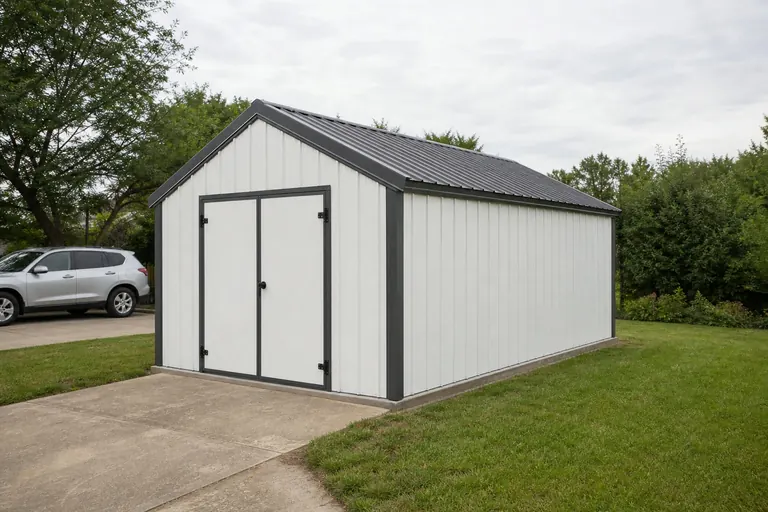 Garden and hand-tool storageA frequent brief on residential lots: a dry, secure spot for tools, mowers, and seasonal gear.Small-farm equipment shelterCompact equipment and feed storage sized to a 66-acre-average operation rather than a large farm.Overflow storage for multi-unit propertiesA shared or single-owner shed on a denser lot, filling the gap left by limited garage or basement space.
Example Configuration — for planning purposes only.
Footprint
Sizes that fit a Massachusetts lot
Both the residential and small-farm data point toward compact footprints over large ones.
8′ × 10′
80 sq ft
A tight residential footprint that clears many town setback lines.
10′ × 12′
120 sq ft
Room for a mower and hand tools without crowding a small yard.
12′ × 16′
192 sq ft
A practical small-farm size for equipment and feed storage.
12′ × 20′
240 sq ft
Larger option for combined garden and light equipment storage.
Example Configuration — for planning purposes only.
Footprint pages carry the door and layout detail; this page explains why the Massachusetts brief tends to stay compact.
Preparation
Before you request a Massachusetts quote
These items address frequent re-quote triggers for a Massachusetts garden shed.
Step 1
Check setback rules with your local building department
Accessory structure setbacks vary by town; confirm before fixing a footprint on a tight lot.
Step 2
Describe your terrain
Upland ledge and coastal drainage require different pad prep; tell your builder which you have.
Step 3
Plan roof pitch and door clearance for snow
Decide this before the shed is set, not after the first storm.
Step 4
Size to task, not to available yard space
A shed sized to what you're storing is easier to site and cheaper than an oversized one.
Questions
Massachusetts garden shed questions
Honest state-level answers, with jurisdiction-specific items routed to the office that owns them.
Permit requirements depend on your municipality, lot, and structure size. Your local building department is the only reliable source; ask before finalizing dimensions.
We do not state design loads on this page. Boston Logan's climate normals show about 49 inches of average annual snowfall as planning context only; your local building department determines the actual design requirement for your site.
USDA's 2022 Census of Agriculture puts the state's average farm at 66 acres, among the smallest nationally, and Census permit data shows a housing mix weighted toward multi-unit construction. Both point toward tighter available space than in many other states.
There's no official typical size. Compact 8x10 through 12x20 footprints tend to fit both small-farm and residential-lot constraints better than larger options.
USGS documents genuinely different terrain across the state — upland ledge in the west versus Coastal Plain sediment in the southeast — so pad prep should be based on a site visit, not assumed from your town name alone.
Sources for the Massachusetts facts on this page
This page states no code requirement, wind speed, snow load, permit rule, price or supplier claim. The state-specific facts it does use are listed with their publisher below.
Massachusetts had 464,451 acres of land in farms in 2022, an average farm size of 66 acres -- among the smallest average farm sizes in the country.
USDA NASS · 2022 · Tier 1
https://www.nass.usda.gov/Publications/AgCensus/2022/Full_Report/Volume_1,_Chapter_1_State_Level/Massachusetts/st25_1_001_001.pdfMassachusetts had 7,083 farms in 2022, down from 7,241 in 2017.
USDA National Agricultural Statistics Service (NASS) · 2022 (with 2017 comparison) · Tier 1
https://www.nass.usda.gov/Publications/AgCensus/2022/Full_Report/Volume_1,_Chapter_1_State_Level/Massachusetts/st25_1_001_001.pdfBuilders in Massachusetts were authorized to construct 14,338 new privately-owned housing units in 2024, of which 5,626 were single-unit structures.
U.S. Census Bureau · 2024 (final annual estimates) · Tier 1
https://www.census.gov/construction/bps/stateannual.htmlBoston Logan Airport's NOAA 1991-2020 climate normals show total annual precipitation of about 43.6 inches and average annual snowfall of about 49 inches.
NOAA National Centers for Environmental Information (NCEI) · 1991-2020 · Tier 1
https://www.ncei.noaa.gov/access/services/data/v1?dataset=normals-monthly-1991-2020&format=pdf&stations=USW00014739USGS Geomorphology of New England (Professional Paper 1208) describes Massachusetts as spanning crystalline upland terrain (including the Berkshires in the west) and Coastal Plain sediments along the southeast, reflecting a mix of glacially shaped hill country and low coastal terrain.
U.S. Geological Survey · 1982 · Tier 1
https://pubs.usgs.gov/pp/1208/report.pdfFEMA's National Risk Index is the federal tool for county- and state-level natural hazard exposure data for Massachusetts's 14 counties, covering 18 hazard types including coastal flooding, hurricane, and winter weather.
Federal Emergency Management Agency (FEMA) · Current NRI release · Tier 1
https://www.fema.gov/flood-maps/products-tools/national-risk-index