
Garden shed · MI
Garden Sheds in Michigan
Michigan garden shed projects are defined by local climate conditions and diverse municipal zoning rules. Whether you are in the Upper Peninsula facing early winter starts or the agricultural Lower Peninsula, local regulations and ground conditions dictate the site plan. Start by checking your local municipality for shed placement guidelines.
Foundations
Site selection in Michigan
Your site location dictates your shed's foundation needs.
In the Michigan climate, shed foundations aren't just about weight—they're about frost management. With a two-peninsula geography, the frost depth can vary significantly from the southern border to the tip of the Upper Peninsula. Regardless of size, ensuring your shed sits on a well-drained surface is essential to preventing foundation shift as the ground freezes and thaws throughout the year. For smaller sheds, a gravel pad or a pressure-treated timber base may suffice, but it must be level and provide a way for water to escape. If your shed sits in a low spot, the freeze-thaw cycle of a Michigan winter will quickly lead to sticking doors and a racked frame.
Identifying your site's hydrologic province is a useful step even for a small structure like a garden shed. If you are in a province characterized by heavy clay, you will need more significant site prep to prevent water from pooling under the building. Michigan's 45,581 farms provide a testament to the state's diverse soil; what works for a shed in the sandy soils of the Lake Michigan coast may not work in the rich, heavy soils of the Saginaw Valley. A simple 'crushed stone' base is often the best choice for Michigan gardeners, as it allows for drainage while providing a stable, level surface that resists the movement caused by the frost.
Climate data for Michigan shows consistent precipitation year-round, which means your shed's materials need to be ready for constant moisture. Metal sheds are popular in Michigan because they resist the rot and insect damage that can plague wood structures in the humid Great Lakes environment. However, even a metal shed needs to be properly ventilated to prevent interior condensation. When the cold Michigan night meets a slightly warmer morning, moisture will condense on the inside of the roof panels. Choosing a shed with built-in gable vents or adding a small solar fan can keep your tools dry and rust-free.
Regulatory
Navigating Michigan's local shed rules
Shed permits in Michigan are handled at the local township or city level.
Confirm your shed's status with your township before you buy: many Michigan homeowners assume a small shed is exempt from all oversight, but while a size threshold (often 200 square feet) frequently waives the structural building permit, zoning permits and setback requirements almost always still apply. In a suburban Michigan backyard, you may be required to keep your shed a certain distance from the property line or the main house. These rules are not statewide; they are decided by your local planning commission. A quick call to your township office can save you from a costly relocation later.
Beyond setbacks, some Michigan homeowners' associations (HOAs) have their own rules about shed appearance and materials. While the state's residential construction volume is high (21,750 units in 2024), many of these units are in planned communities with strict aesthetic guidelines. You may be required to match the shed's roofing material or color to your home. In rural Michigan, where the average farm size is 208 acres, these rules are often more relaxed, but you still need to ensure your building doesn't interfere with existing utilities or septic drain fields.
Finally, consider the hazard data for your specific Michigan county. FEMA notes that winter weather and ice storms are a risk across the entire state. For a garden shed, this means you shouldn't skimp on the roof's structural capacity. While you might not need a full engineering report for a small shed, choosing a model with a reinforced roof frame is a wise move in Michigan. A heavy snow load or a thick layer of ice can cause a cheaply made shed roof to buckle, potentially damaging your lawn mower, snow blower, or other valuable gardening tools.
- 200 Square Foot Rule
- Many Michigan jurisdictions waive building permits for sheds under 200 sq ft, but zoning permits still apply.
- Setback Requirements
- Check local ordinances for the required distance between your shed and property lines or other structures.
- Septic Field Awareness
- On rural Michigan lots, ensure your shed is not placed over a septic tank or drain field.
Usage
Optimizing your shed for the Michigan season
The Michigan garden shed is more than storage; it's the headquarters for a short but intense growing season.
Michigan's gardening season is relatively short, which makes the efficiency of your shed even more important. A well-organized shed allows you to transition quickly from winter storage to spring planting. Many Michigan gardeners use their sheds to start seeds or protect delicate plants during the late frosts that often occur in May. If you plan to use your shed this way, consider adding windows or a skylight to capture the limited early-season Michigan sun. Just remember that a shed with windows will also lose heat more quickly, so you may need a small, safe heating element for those cold Michigan nights.
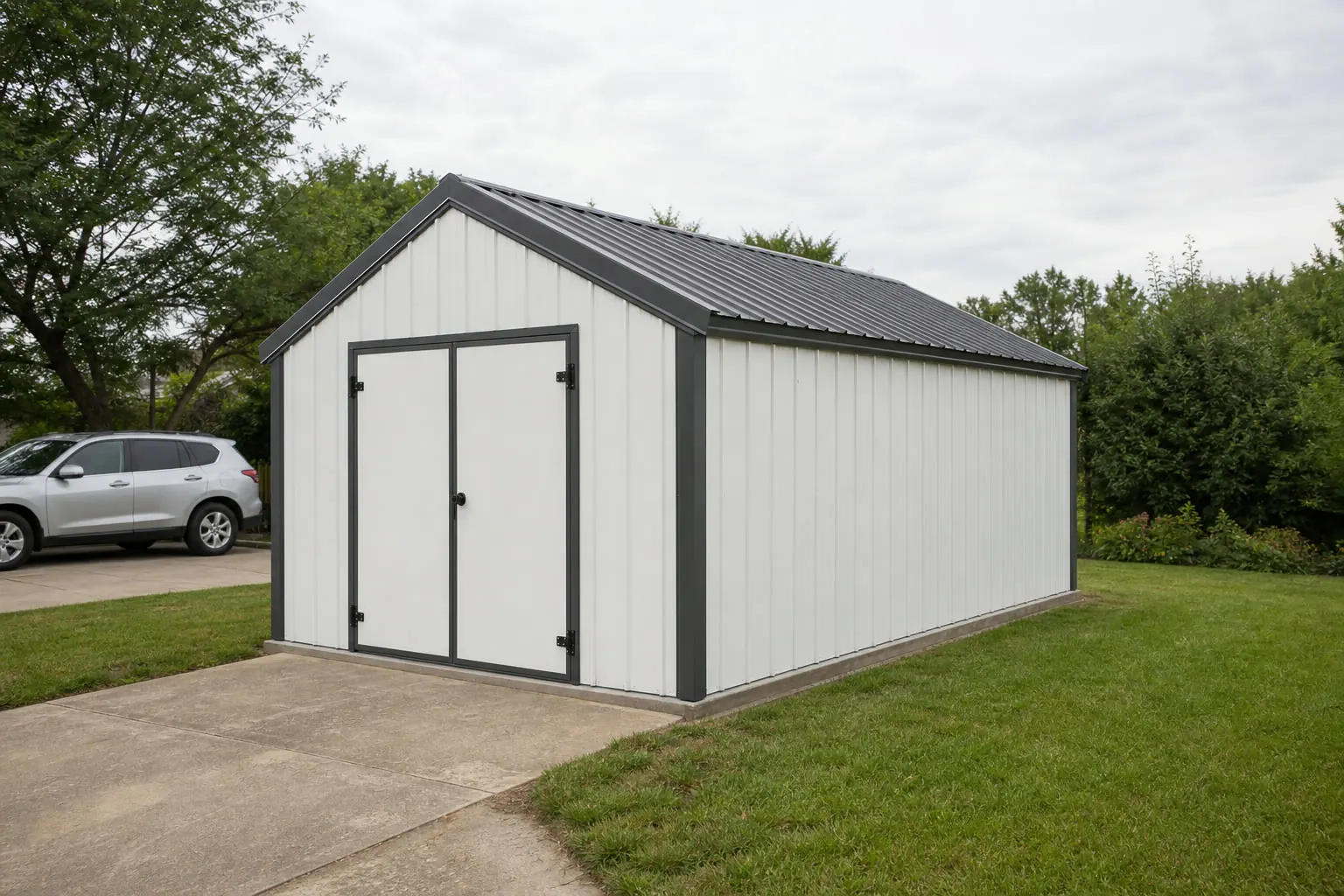
Given the prevalence of power equipment like snow blowers and tillers in Michigan, your shed's door width is a critical consideration. A standard single door may be too narrow for a modern wide-deck mower or a large dual-stage snow blower. Opting for double doors (providing a 60-inch or 72-inch opening) makes it much easier to move equipment in and out, especially when there is snow on the ground. Also, consider the threshold; a low-profile threshold or a small ramp is essential for moving heavy machinery without straining your back or damaging the shed.
Lastly, think about the impact of Michigan's wildlife on your shed. From mice and chipmunks to the occasional raccoon or opossum, small animals will look for a dry place to spend the winter. A metal shed with a tight-fitting floor and sealed doors is much more resistant to these intruders than a wood shed with gaps at the base. Keeping your birdseed and fertilizer in sealed containers inside the shed will further discourage unwanted visitors. This is a practical reality of Michigan outdoor living that every shed owner should plan for.
Garden Shed Quotes
Ready to find the right shed for your Michigan garden?
Before You Order
Michigan Garden Shed Siting Checklist
These are local answers, not a statewide default — confirm each one before you pick a spot.
Step 1
Confirm your township's shed size threshold
A size exemption from the structural permit (often near 200 sq ft) does not remove the separate zoning permit and setback review that most Michigan municipalities still apply.
Step 2
Ask about your parcel's frost depth
The foundation approach needed to resist frost heave varies by hydrologic province across Michigan's two peninsulas, so a base that works near Detroit can be inadequate farther north.
Step 3
Map septic and utility lines on rural lots
On larger Michigan parcels, confirm the shed site avoids the septic drain field and any buried utility runs before the pad is graded.
Step 4
Size the door to your equipment, not just the shed
If the shed will store a snow blower or wide-deck mower, measure the largest tool before choosing between a single and double door opening.
Footprints
Garden Shed Footprints Common in Michigan
Michigan buyers tend to size a shed around seasonal equipment storage as much as garden tools.
8′ × 10′
80 sq ft
A compact tool shed for hand equipment, sized to fit under many townships' simpler zoning review.
10′ × 16′
160 sq ft
Room for a single-stage snow blower or small mower plus shelving, a common suburban Lower Peninsula choice.
12′ × 24′
288 sq ft
A wide-door footprint for a dual-stage snow blower, wide-deck mower, and seasonal garden supplies.
Example Configuration — for planning purposes only.
Confirm your township's setback and size thresholds before finalizing a footprint; requirements are set locally, not statewide.
FAQ
Michigan Garden Shed FAQ
Common questions for Michigan homeowners.
Yes, but you must still follow local zoning and building codes. If your shed exceeds the local size threshold, you will need to submit plans for approval.
Metal is highly durable and low-maintenance in Michigan's humid climate. Wood is aesthetic but requires regular painting or staining to prevent rot.
Using a proper anchoring system (such as auger anchors or concrete bolts) is highly recommended, especially in the more open areas of Michigan's agricultural plains.
Even a small shed benefits from a level, well-drained base such as a gravel pad. A true poured foundation is rarely required for a standard garden shed, but confirm with your township if the structure exceeds their size threshold.
Setback distances are set locally and can range from a few feet to several yards depending on your municipality. Always confirm the exact figure with your township before siting the shed.
Sources for the Michigan facts on this page
This page states no code requirement, wind speed, snow load, permit rule, price or supplier claim. The state-specific facts it does use are listed with their publisher below.
USGS describes Michigan as consisting of two peninsulas -- the Upper Peninsula and Lower Peninsula, separated by the Straits of Mackinac -- and notes it is the only U.S. state touching four of the five Great Lakes, giving it the longest freshwater coastline in the country.
U.S. Geological Survey · 2021 · Tier 1
https://pubs.usgs.gov/publication/fs20213047USGS Water-Resources Investigations Report 91-4120 delineates named hydrologic provinces across Michigan's Upper and Lower Peninsulas, prepared in cooperation with the Michigan DNR Geological Survey Division.
U.S. Geological Survey, in cooperation with Michigan Dept. of Natural Resources · 1991 · Tier 1
https://pubs.usgs.gov/wri/1991/4120/report.pdfFEMA's National Risk Index is the federal tool for county- and state-level natural hazard exposure data for Michigan's 83 counties, covering 18 hazard types including winter weather, ice storm, and severe/strong wind.
Federal Emergency Management Agency (FEMA) · Current NRI release · Tier 1
https://www.fema.gov/flood-maps/products-tools/national-risk-indexMichigan had 45,581 farms in 2022, down from 47,641 in 2017.
USDA National Agricultural Statistics Service (NASS) · 2022 (with 2017 comparison) · Tier 1
https://www.nass.usda.gov/Publications/AgCensus/2022/Full_Report/Volume_1,_Chapter_1_State_Level/Michigan/st26_1_001_001.pdfDetroit Metro Airport's NOAA 1991-2020 climate normals show total annual precipitation of roughly 34-35 inches, with January and February mean snowfall near 12-14 inches each.
NOAA National Centers for Environmental Information (NCEI) · 1991-2020 · Tier 1
https://www.ncei.noaa.gov/access/services/data/v1?dataset=normals-monthly-1991-2020&format=pdf&stations=USW00094847