
Garden shed · DE
Garden Sheds in Delaware
A garden shed is small enough that most planning questions are about the backyard, not the state, but Delaware's small footprint still produces a real site split. The Delaware Geological Survey places all but the hills of northern New Castle County in the low-relief Atlantic Coastal Plain, which describes most suburban and small-acreage lots in Kent, Sussex and southern New Castle County. On flat Coastal Plain ground, a shed's pad and drainage plan matters more than it would on a sloped lot, because water has fewer places to go on its own.
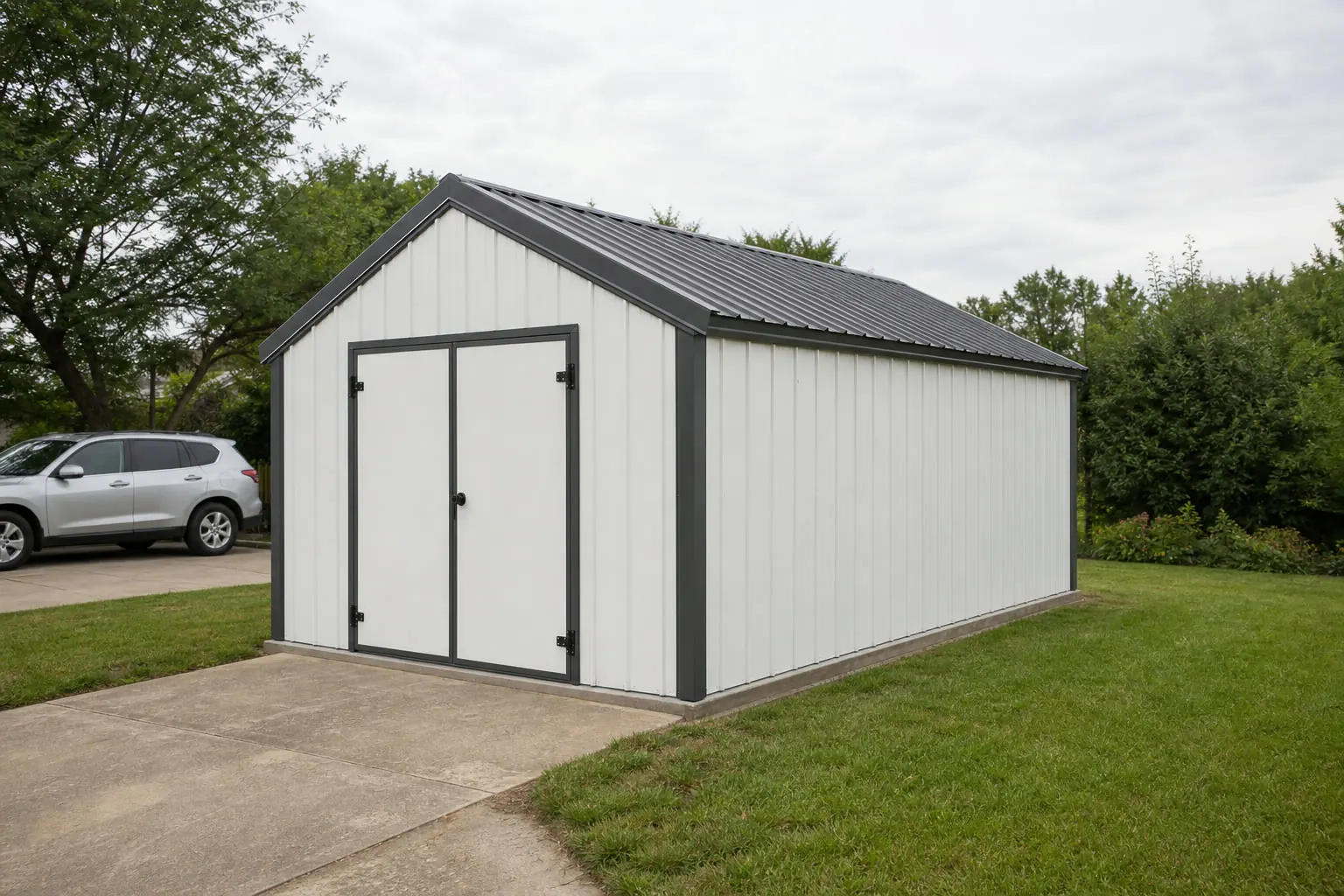
The intersection
What a Delaware backyard actually changes about a garden shed
A garden shed does not need engineering-level site analysis, but Delaware's terrain split still decides whether drainage or grading is the first question.
The Delaware Geological Survey is clear that only the hills of northern New Castle County fall within the Appalachian Piedmont; the rest of the state, including all of Kent and Sussex counties and southern New Castle County, sits in the low-relief Atlantic Coastal Plain. Most Delaware suburban and small-acreage lots are on that flat Coastal Plain ground, which means a shed's pad usually needs to manage standing water rather than manage slope.
Delaware's small size — 1,948.5 square miles, the second-smallest state by the 2010 Census — means this backyard picture is fairly consistent statewide, with the northern New Castle County exception being the main departure from it. A buyer does not need to research dramatically different regional terrain the way a larger state's shed page would require; the main variable is simply whether the lot happens to sit in that northern hill zone.
Delaware also counted 2,158 farms in 2022 across 522,834 acres, averaging 242 acres each. On those small-acreage properties a garden shed frequently functions as an overflow building for hand tools and lawn equipment that does not need the bay width or ventilation of a larger equipment shed, and it is typically sited near the house rather than near the working buildings, a distinction worth naming when describing the property to a builder.
Exposure
Why pad drainage matters even for a small shed
At roughly 45.3 inches of annual precipitation and 20.2 inches of snowfall at Wilmington, a flat-lot Delaware shed benefits from a deliberate pad even though the structure itself is small.
That figure is NOAA's 1991-2020 climate normal for the Wilmington New Castle County Airport station, measured against a climate record dating back to 1894, and it is not a design value for any specific yard. What it supports is a simple habit: on flat Coastal Plain ground, water sitting under or beside a shed floor is a longer-term problem than the modest cost of a gravel, paver or small concrete pad addresses up front.
The other detail worth deciding before delivery is where the shed's roof water goes relative to the rest of the yard. A shed without gutters on a flat lot can create a wet strip along one side that outlasts the rain itself; deciding gutter scope before placement, rather than after, avoids that.
Wilmington's normal also includes roughly 20.2 inches of average annual snowfall. That is too light to be a structural concern for a small shed, but it is enough to slide off a metal roof onto whatever sits immediately beside it, so leaving a couple of feet of clearance along the eave side is a low-cost habit worth adopting from the start.
- Pad choice
- A gravel, paver or small concrete pad is inexpensive relative to the shed and helps avoid a frequent flat-lot complaint: a floor that stays damp.
- Roof water direction
- Site the shed so roof runoff drains away from foundations, fences and neighboring property lines.
- Northern New Castle County exception
- If your lot is in the Piedmont hill zone, check for slope before fixing the pad location; a level spot may need to be built rather than assumed.
Configuration
What Delaware garden sheds are usually used for
On the state's typical suburban and small-acreage lots, garden sheds tend to split into a few recurring uses.
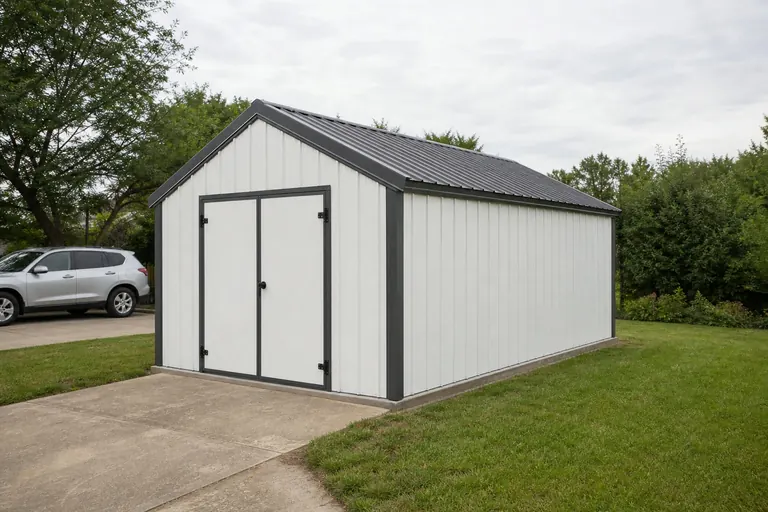 Lawn and garden equipmentA frequent use on a standard suburban lot: mowers, tools and seasonal equipment kept dry and out of the main garage.
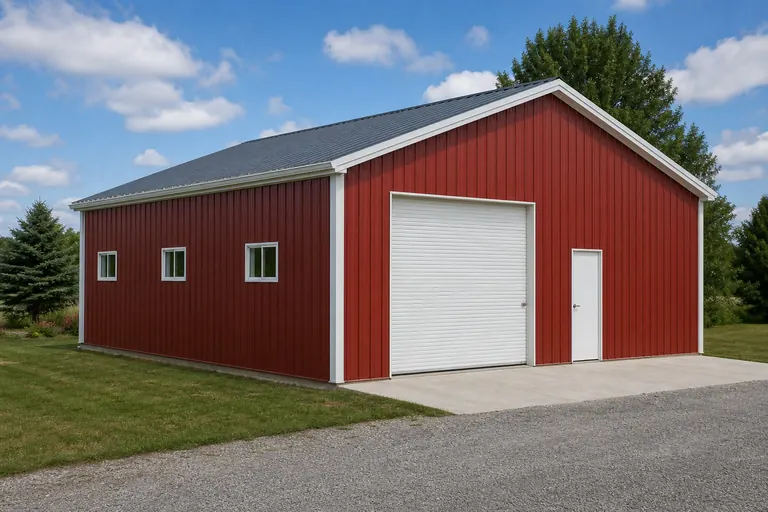 Small workshop or hobby spaceA slightly larger shed used for light hobby work, common on Kent and Sussex county lots with more yard space.Seasonal and outdoor storagePool equipment, patio furniture and seasonal items on properties near Delaware's coastal communities.
Example Configuration — for planning purposes only.
Get Delaware garden shed quotes
Tell us your lot type, intended use and rough size. We route it with the Delaware and garden shed context already attached.
Footprint
Sizes that suit a Delaware backyard
Flat lots rarely force a smaller footprint, so Delaware shed sizing is usually driven by intended use rather than site constraints.
8′ × 10′
80 sq ft
A compact footprint for basic lawn and garden equipment on a standard suburban lot.
10′ × 16′
160 sq ft
Common where the shed also serves as light hobby or workshop space.
12′ × 20′
240 sq ft
A larger option for properties with more yard space, common in Kent and Sussex counties.
Example Configuration — for planning purposes only.
Footprint pages carry the layout and door detail for each of these; this page only explains why Delaware buyers land in this range.
Preparation
Before you place a Delaware garden shed order
A few things resolved in advance keep a small project simple.
- Check local zoning setbacksSetback distances from property lines and easements are set locally; confirm with your local building or zoning department before finalizing placement.
- Decide on a pad before deliveryFlat Coastal Plain lots benefit from a gravel, paver or concrete pad chosen before the shed arrives, not after.
- Plan roof water directionSite the shed so runoff does not pool against foundations, fences or neighboring lots.
- Note if your lot is in the Piedmont hill zoneNorthern New Castle County lots may need a leveled site rather than a naturally flat one.
Questions
Delaware garden shed questions
Questions we can answer honestly at state level, with the ones we cannot routed to whoever actually owns them.
Permit thresholds and setback rules are set locally and often depend on the shed's footprint. Your local building or zoning department is the only reliable source for your specific lot.
Wilmington's 1991-2020 climate normal is about 45.3 inches of annual precipitation. On flat Coastal Plain lots, which cover most of the state, a simple pad and thought-out roof drainage help avoid a frequent complaint: a floor that stays damp.
There is no official typical size. Compact 8x10 sheds suit basic equipment storage, while 10x16 and 12x20 sizes are common where the shed doubles as light hobby or workshop space, particularly on larger Kent and Sussex county lots.
Most Delaware lots sit on flat Coastal Plain ground, so grading is rarely a major issue. If your lot is in the Piedmont hill zone of northern New Castle County, checking for slope before choosing a pad location is worth doing first.
We do not publish state-level prices, since cost depends on size, materials and site work. Our cost pages cover what drives the number; a quote covers your project.
Sources for the Delaware facts on this page
This page states no code requirement, wind speed, snow load, permit rule, price or supplier claim. The state-specific facts it does use are listed with their publisher below.
The Delaware Geological Survey states the entire state lies within two physiographic provinces, the Appalachian Piedmont and the Atlantic Coastal Plain, separated by the Fall Line; only the hills of northern New Castle County lie within the Piedmont, with the rest of the state in the low-relief Coastal Plain.
Delaware Geological Survey, University of Delaware · DGS reference material · Tier 2
https://www.dgs.udel.edu/delaware-geology/summary-geologic-history-delawareDelaware's total land area was measured at 1,948.5 square miles as of the 2010 Census, the second-smallest of any U.S. state.
U.S. Census Bureau · 2010 Census · Tier 1
https://www.census.gov/geographies/reference-files/2010/geo/state-local-geo-guides-2010/delaware.htmlWilmington's 1991-2020 annual climate normal precipitation is about 45.3 inches with roughly 20.2 inches of annual snowfall.
NOAA National Centers for Environmental Information (NCEI) · 1991-2020 · Tier 1
https://www.ncei.noaa.gov/access/services/data/v1?dataset=normals-monthly-1991-2020&dataTypes=MLY-PRCP-NORMAL,MLY-SNOW-NORMAL&format=csv&stations=USW00013781NWS Mount Holly, NJ (which serves Wilmington, DE) issues an annual climate summary for Wilmington citing the 1991-2020 climate normal period against a climate record period dating to 1894.
National Weather Service (NOAA), Mount Holly NJ office · 1991-2020 normal / 1894-present record · Tier 1
https://forecast.weather.gov/product.php?issuedby=ILG&product=CLA&site=NWSDelaware had 2,158 farms in 2022, covering 522,834 acres of land in farms, an average farm size of 242 acres.
USDA National Agricultural Statistics Service (NASS) · 2022 · Tier 1
https://www.nass.usda.gov/Publications/AgCensus/2022/Online_Resources/Congressional_District_Profiles/cd1001.pdf