
Carport · DE
Carports in Delaware
A carport's open sides mean weather has a more direct path to whatever is parked underneath than it would with an enclosed garage, which makes Delaware's geography and climate relevant from the first siting decision. The Delaware Geological Survey places nearly the entire state in the low-relief Atlantic Coastal Plain, with only the hills of northern New Castle County in the Appalachian Piedmont, so most Delaware carport sites are flat lots where the orientation of the open side, not the slope of the ground, determines how much wind-driven rain reaches a parked vehicle.
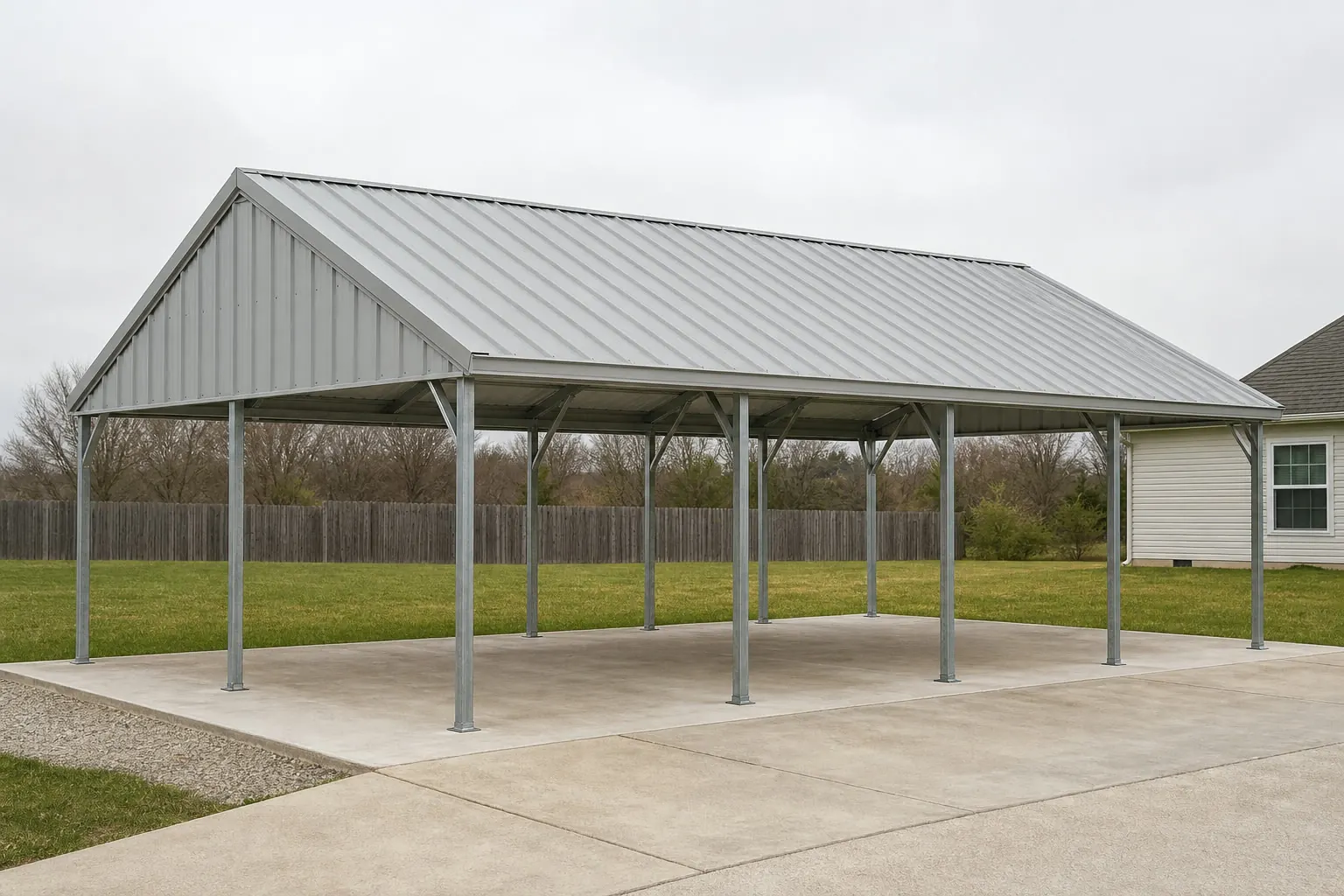
The intersection
Why an open structure makes Delaware's geography matter more
A carport has no walls to block weather, so the flat Coastal Plain geography covering most of Delaware becomes the main siting consideration rather than a background fact.
The Delaware Geological Survey's physiographic map is unambiguous: apart from hills in northern New Castle County within the Appalachian Piedmont, the entire state lies in the low-relief Atlantic Coastal Plain. For a carport, flat ground means there is rarely a natural windbreak or slope to rely on, so the decision that actually changes outcomes is which way the open bays face relative to the yard's typical wet-weather direction.
Delaware's compact size — 1,948.5 square miles, the second-smallest state by the 2010 Census — keeps this picture consistent whether the lot is near Wilmington, in central Kent County, or down toward the Sussex County line. A carport buyer in most of the state is working with the same flat-ground logic; only a lot in that northern Piedmont hill zone introduces a genuine slope consideration.
Sussex County's farm base, at 1,053 operations across 262,079 acres in 2022, means a meaningful share of Delaware carport enquiries come from working land rather than a subdivision. On these properties the open-sided structure often needs to clear a loaded pickup, a stock trailer, or a tractor with an attached implement, not just a passenger car, so confirming the tallest and widest item that will use the carport before ordering matters more here than on a typical suburban lot.
Exposure
Orientation and drainage for an open structure
At roughly 45.3 inches of annual precipitation, Wilmington's climate normal supports a simple rule: orient the carport's more sheltered side toward prevailing wet weather and plan roof runoff before delivery.
That figure comes from NOAA's 1991-2020 climate normal for the Wilmington New Castle County Airport station, measured against a record dating to 1894; it describes typical conditions, not a design load for any specific lot. What it supports for a carport is a placement habit rather than an engineering figure: a carport with any partial side wall or gable end benefits from facing that closed side toward the direction wind-driven rain most often arrives.
Roof runoff is a second, separate decision. A flat-lot carport without a gutter can shed a surprising volume of water directly onto the pad below during a normal Delaware storm season, so deciding gutter scope and where that water drains, away from the parked vehicle and any adjacent structure, is worth settling before the unit is installed rather than after.
Wilmington's normal also carries roughly 20.2 inches of average annual snowfall. An open carport lacks the sealed roof cavity of an enclosed garage, so snow sliding off the leading edge in one sheet is a normal event rather than a defect; leaving a few feet of clearance in front of the structure for that snow to shed, rather than parking a vehicle directly against the drip line, avoids a routine seasonal nuisance.
- Orient the sheltered side first
- If the carport has any partial wall or gable end, face it toward the yard's typical wet-weather direction.
- Plan roof runoff
- Decide gutter scope and drainage direction before delivery so water does not pool under the parked vehicle.
- Confirm coastal exposure separately
- Properties near Delaware's shoreline should check FEMA's National Risk Index for county-level flood and wind exposure rather than assume a statewide figure.
Configuration
What Delaware carports are usually protecting
Delaware's mix of suburban lots, working farms and coastal recreation properties produces a few recurring carport uses.
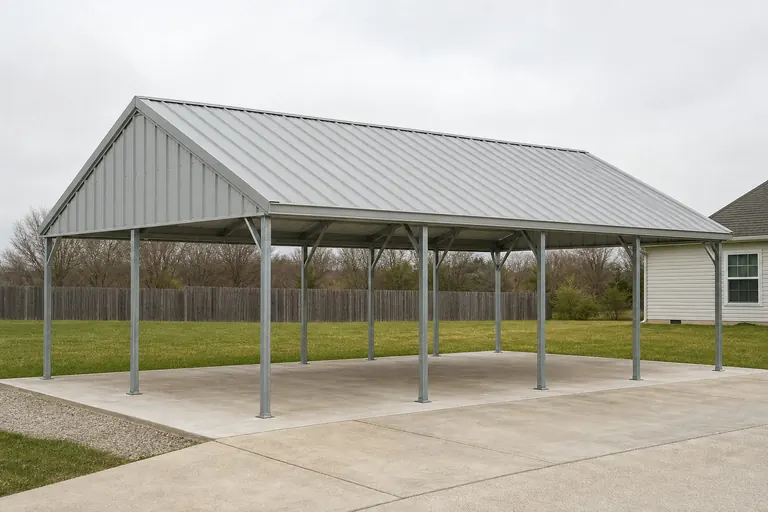 Daily-driver vehicle coverKeeping one or two vehicles out of direct rain on a suburban New Castle County or Kent County lot, sized to the household's vehicle count.Farm equipment and truck coverOn Sussex and Kent county operations, open-sided cover for tractors, implements and farm trucks that do not need a fully enclosed building.
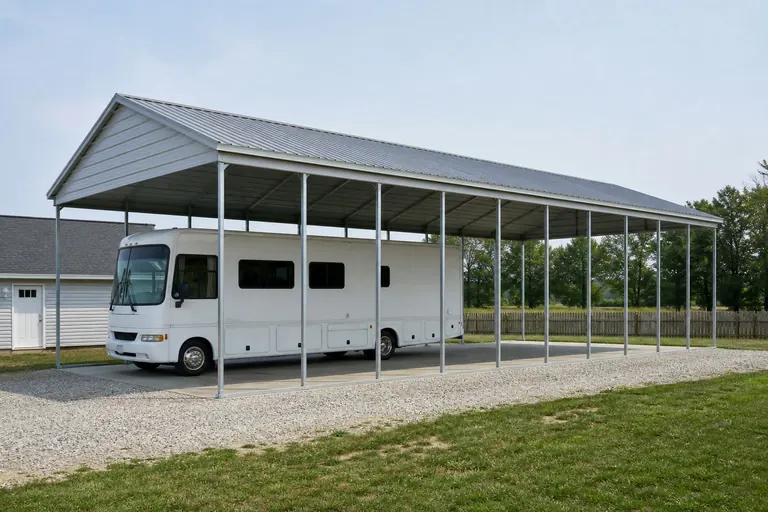 Boat and RV storageNear Delaware's coastal communities, taller carports sized for boats or RVs kept close to home between trips.
Example Configuration — for planning purposes only.
Get Delaware carport quotes
Tell us your vehicle or equipment needs, lot type and rough size. We route it with the Delaware and carport context already attached.
Footprint
Sizes that suit Delaware's typical uses
Carport sizing in Delaware tracks vehicle count and use rather than any site constraint, since flat lots rarely limit footprint the way a sloped lot would.
18′ × 20′
360 sq ft
A standard two-vehicle footprint for a suburban New Castle or Kent county home.
20′ × 30′
600 sq ft
Common where a truck or small farm equipment needs cover alongside a passenger vehicle.
24′ × 36′
864 sq ft
A larger option for boat, RV or multi-vehicle cover near coastal Sussex County properties.
Example Configuration — for planning purposes only.
Footprint pages carry the bay layout and clearance detail for each of these; this page explains why Delaware buyers land in this range.
Preparation
Before you place a Delaware carport order
A short list resolved in advance keeps an open-sided structure performing as intended.
- Confirm setback and zoning rules locallySetback distances and any permit thresholds are set by your local jurisdiction; confirm before finalizing placement.
- Pick the orientation before deliveryFace any partially enclosed side toward prevailing wet-weather direction rather than deciding after installation.
- Settle the pad and drainage planA gravel, paver or concrete pad with a clear runoff direction prevents standing water under a parked vehicle.
- Check coastal hazard exposure if applicableProperties near tidal water should reference FEMA's National Risk Index by county or tract rather than assume a generic figure.
- Leave room for snow to shedAn open-sided carport sheds accumulated snow off its leading edge; keep a clearance zone in front of the structure rather than parking directly against it.
Questions
Delaware carport questions
Questions we can answer honestly at state level, with anything jurisdiction-specific routed to the right office.
Permit thresholds and setback rules are set locally and often depend on footprint and whether the structure is anchored. Your local building or zoning department is the only reliable source for your specific lot.
There's no single statewide answer, but Wilmington's climate normal of about 45.3 inches of annual precipitation supports orienting any partially enclosed side toward the yard's typical wet-weather direction, especially on the flat Coastal Plain lots that cover most of the state.
It can be near tidal or low-lying areas. FEMA's National Risk Index (hazards.fema.gov/nri) provides county- and tract-level hazard exposure scores; check yours before finalizing placement rather than relying on a statewide assumption.
There is no official typical size. An 18x20 footprint suits one or two vehicles, while 20x30 and larger options accommodate a truck, farm equipment, or boat and RV storage, especially in Sussex County's coastal areas.
We do not publish state-level prices, since cost depends on size, materials, anchoring and site work. Our cost pages cover what drives the number; a quote covers your specific project.
Sources for the Delaware facts on this page
This page states no code requirement, wind speed, snow load, permit rule, price or supplier claim. The state-specific facts it does use are listed with their publisher below.
The Delaware Geological Survey states the entire state lies within two physiographic provinces, the Appalachian Piedmont and the Atlantic Coastal Plain, separated by the Fall Line; only the hills of northern New Castle County lie within the Piedmont, with the rest of the state in the low-relief Coastal Plain.
Delaware Geological Survey, University of Delaware · DGS reference material · Tier 2
https://www.dgs.udel.edu/delaware-geology/summary-geologic-history-delawareDelaware's total land area was measured at 1,948.5 square miles as of the 2010 Census, the second-smallest of any U.S. state.
U.S. Census Bureau · 2010 Census · Tier 1
https://www.census.gov/geographies/reference-files/2010/geo/state-local-geo-guides-2010/delaware.htmlWilmington's 1991-2020 annual climate normal precipitation is about 45.3 inches with roughly 20.2 inches of annual snowfall.
NOAA National Centers for Environmental Information (NCEI) · 1991-2020 · Tier 1
https://www.ncei.noaa.gov/access/services/data/v1?dataset=normals-monthly-1991-2020&dataTypes=MLY-PRCP-NORMAL,MLY-SNOW-NORMAL&format=csv&stations=USW00013781FEMA's National Risk Index platform (hazards.fema.gov) is the authoritative county/tract-level source for Delaware natural hazard exposure scores across 18 hazard types, including coastal flooding and hurricane categories relevant to a low-lying, low-elevation coastal state.
Federal Emergency Management Agency (FEMA) · Current NRI dataset · Tier 1
https://www.fema.gov/flood-maps/products-tools/national-risk-indexSussex County, Delaware's largest county by farmland, had 1,053 farms on 262,079 acres in 2022, with 32% of farmland-in-use acres reported irrigated.
USDA NASS · 2022 · Tier 1
https://www.nass.usda.gov/Publications/AgCensus/2022/Online_Resources/County_Profiles/Delaware/cp10005.pdf