
Carport · NC
Carports in North Carolina
North Carolina doesn't have one climate or one terrain — NOAA's own narrative traces the state's progression from the Atlantic Coastal Plain, through the rolling Piedmont, to the Appalachian mountains in the far west, and a separate NOAA state climate summary documents that landfalling hurricanes here are highly variable year to year, with storm intensity and rainfall rates projected to increase. An open-sided carport has no walls to slow wind-driven rain, which makes that hurricane exposure and the specific physiographic province a property sits in more relevant than a single statewide weather script. At the same time, the state's housing market is moving: privately-owned housing units authorized by building permit rose 5.0% from 2022 to 2023, evidence that a lot of North Carolina carports are being planned alongside new construction, not retrofit projects.
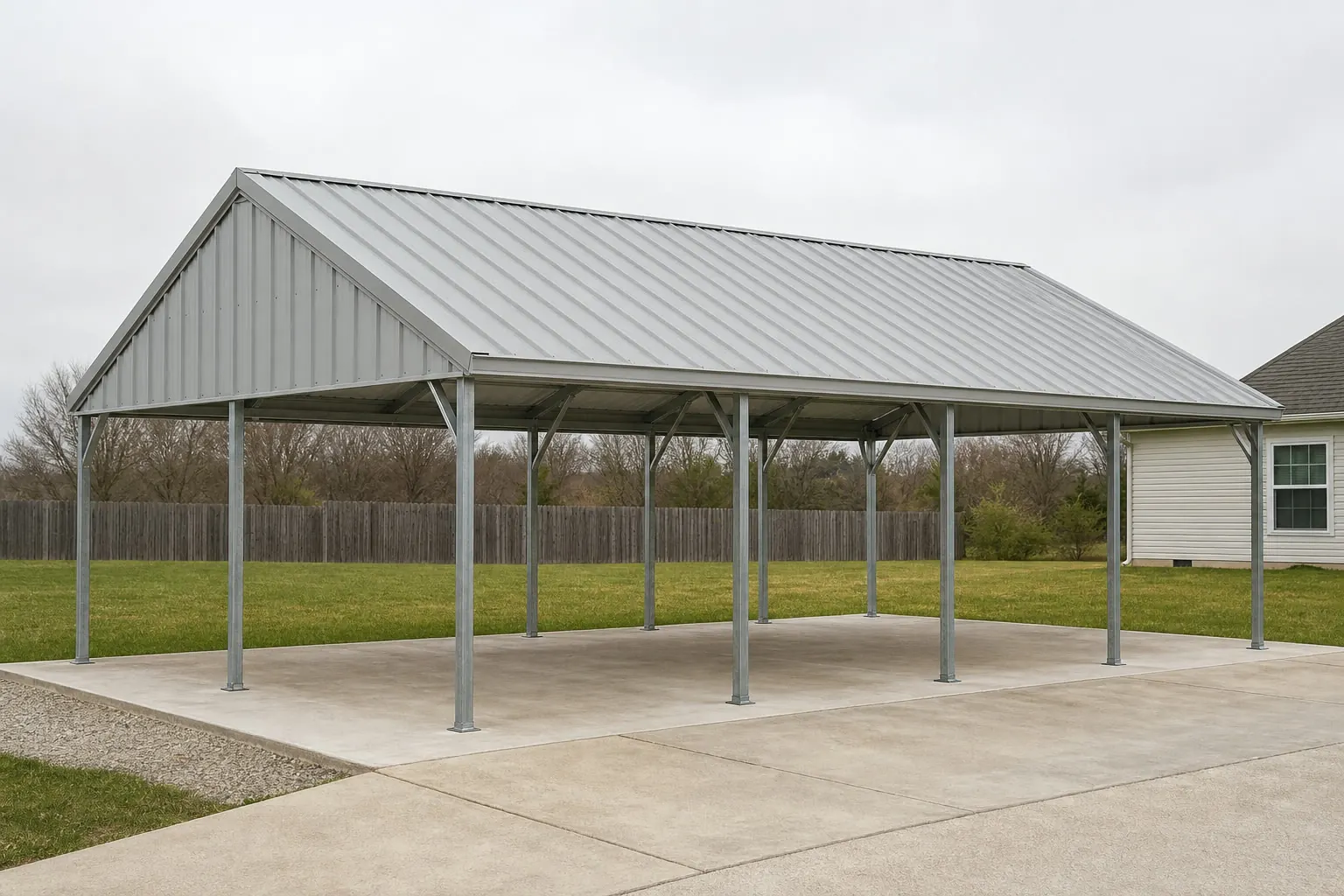
Storm Exposure
An Open-Sided Structure and a Documented Hurricane Pattern
NOAA documents that North Carolina's landfalling hurricanes vary widely year to year, with storm intensity and rainfall projected to rise — relevant to a structure with no walls.
A carport's entire design premise is an open bay with a roof and no walls, which means wind-driven rain reaches whatever is parked underneath regardless of how well the roof itself is built. NOAA's State Climate Summary for North Carolina states plainly that the number of landfalling hurricanes is highly variable from year to year, and that hurricane-associated storm intensity and rainfall rates are projected to increase. That's a documented trend, not a design value — it does not tell you a wind speed or a load requirement for your specific site.
What it does mean is that a coastal North Carolina carport buyer has a real reason to ask a local engineer or building official about anchoring and orientation before finalizing a design, and that a Piedmont or mountain buyer, further from direct landfall exposure, still deals with the rainfall side of the same storm systems. Either way, the specific wind and rain design values belong to your local building department, not a statewide script.
Terrain
Three Provinces, Three Siting Conversations
USGS research names three distinct North Carolina physiographic provinces, and each raises a different practical question for a carport site.
Coastal Plain (East)
Low, flat terrain closest to direct hurricane landfall exposure; ask about anchoring, flood-zone status, and wind-driven rain orientation with the local building department.
Piedmont (Central)
Rolling terrain where over half the state's population depends on groundwater, per NC State Extension reference material; grading and drainage away from a slab foundation deserve attention here.
Blue Ridge / Appalachian Mountains (West)
Higher-elevation terrain where slope and access, not floor area, often drive site-prep cost, and where the state's coastal storm exposure is more attenuated but not absent.
State Reference
North Carolina Figures Behind This Page
Sourced figures only; none of these implies a specific design value.
| Metric | Value | Source |
|---|---|---|
| Housing permits authorized (2023) | 98,853 units, up 5.0% from 94,118 (2022) | U.S. Census Bureau |
| Farms (2022) | 42,817 (-8% since 2017) | USDA NASS |
| Average farm size (2022) | 190 acres | USDA NASS |
| Physiographic provinces | Coastal Plain, Piedmont, Blue Ridge | U.S. Geological Survey |
| Hazard data source | FEMA National Risk Index (county/tract level, 18 hazard types) | FEMA |
Housing permits authorized (2023)
- Value
- 98,853 units, up 5.0% from 94,118 (2022)
- Source
- U.S. Census Bureau
Farms (2022)
- Value
- 42,817 (-8% since 2017)
- Source
- USDA NASS
Average farm size (2022)
- Value
- 190 acres
- Source
- USDA NASS
Physiographic provinces
- Value
- Coastal Plain, Piedmont, Blue Ridge
- Source
- U.S. Geological Survey
Hazard data source
- Value
- FEMA National Risk Index (county/tract level, 18 hazard types)
- Source
- FEMA
Plan Your North Carolina Carport
Tell us your region — coast, Piedmont, or mountains — and whether it's new construction or a retrofit, and we'll route the right questions to you.
Building Activity
A State Where New Construction Is Accelerating
North Carolina's housing permit total grew 5.0% in a single year, context worth knowing if you're planning a carport alongside a new home.
The U.S. Census Bureau's 2023 Annual Building Permits highlights show North Carolina's statewide total of privately-owned housing units authorized by building permit rising from 94,118 in 2022 to 98,853 in 2023. That's a state-level count of new homes, not carports specifically, but it's a reasonable signal of active residential building activity — and a carport is frequently specified as part of the same building phase as a new house rather than added years later.
If you're building new, ask your general contractor or local building department how a carport gets folded into the same permit and inspection process as the home, since the two often move through the same review at once rather than as fully separate applications. If you're adding a carport to an existing property instead, the permit path may differ — confirm directly with your local building department.
- New build vs. retrofit
- Ask whether your carport can be permitted alongside new-home construction or needs a separate application.
- Confirm province-specific site needs
- Coastal, Piedmont, and mountain sites raise different foundation and drainage questions, and Piedmont buyers in particular should ask about local groundwater depth before excavating a footing, since NC State Extension material notes over half of North Carolina's population relies on groundwater in that province.
- Check farm-use exemptions
- On working land, ask the county whether any agricultural exemption applies to a farm-use carport.
Configurations
Carport Configurations Common to North Carolina Sites
Three configurations that respond to the storm exposure and terrain context above.
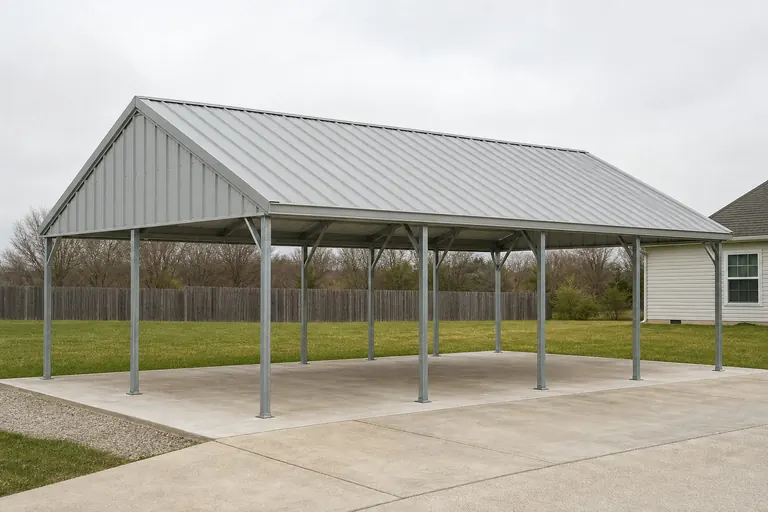 Coastal Anchored CarportExtra attention to anchoring and orientation given documented hurricane variability near the coast.Piedmont Residential CarportA standard footprint with drainage planning suited to rolling central North Carolina terrain.Mountain Farm CarportA working-use bay sized for the state's 190-acre-average farms in Blue Ridge and foothill counties.
Example Configuration — for planning purposes only.
Footprint
Common North Carolina Carport Footprints
A starting range before a site-specific plan accounts for your province and use.
18′ × 20′
360 sq ft
A compact single-vehicle carport for a residential lot.
20′ × 30′
600 sq ft
Room for a vehicle plus general storage on a standard suburban or rural parcel.
24′ × 40′
960 sq ft
A longer bay suited to trucks, trailers, or farm equipment.
Example Configuration — for planning purposes only.
Confirm any local wind, flood-zone, or drainage requirement with your building department before finalizing a size.
Questions
North Carolina Carport Questions
Honest answers, with technical or local specifics routed to the right office.
NOAA documents that North Carolina's landfalling hurricanes vary widely year to year, with rainfall and storm intensity projected to increase. That doesn't set a specific wind rating for your project, but it's a real reason to ask a local engineer or building official about anchoring, especially near the coast.
Potentially. USGS research names three distinct physiographic provinces here — Coastal Plain, Piedmont, and Blue Ridge — each with a different geologic setting. Ask a local foundation contractor how your specific province affects your slab or footing plan.
Often, yes, but confirm with your local building department; North Carolina's housing permit total grew 5.0% from 2022 to 2023, and many carports are specified during the same new-build permitting process rather than added later.
Use FEMA's National Risk Index (hazards.fema.gov), which scores North Carolina counties and tracts across 18 hazard categories, rather than relying on a general statewide hurricane claim.
There's no official typical size, but with the state's average farm at 190 acres, most farm-use carports here are modest working bays rather than the largest multi-implement structures seen in bigger-acreage farm states. Confirm sizing against your specific equipment.
Sources for the North Carolina facts on this page
This page states no code requirement, wind speed, snow load, permit rule, price or supplier claim. The state-specific facts it does use are listed with their publisher below.
NOAA's State Climate Summaries note that the number of landfalling hurricanes in North Carolina is highly variable year to year, and hurricane-associated storm intensity and rainfall rates are projected to increase.
NOAA National Centers for Environmental Information (NCEI) · 2022 summary · Tier 1
https://statesummaries.ncics.org/downloads/NorthCarolina-StateClimateSummary2022.pdfUSGS-affiliated research (e.g., Scientific Investigations Report 2009-5149) characterizes North Carolina's Piedmont and Blue Ridge physiographic provinces, distinct from the state's Atlantic Coastal Plain province, based on differing regional geologic settings.
U.S. Geological Survey (USGS) · 2009 USGS report · Tier 1
https://pubs.usgs.gov/sir/2009/5149/North Carolina's statewide total of privately-owned housing units authorized by building permits rose from 94,118 in 2022 to 98,853 in 2023, a 5.0% increase.
U.S. Census Bureau · 2023 (with 2022 comparison) · Tier 1
https://www.census.gov/construction/bps/pdf/2023annualhighlights.pdfNorth Carolina had 42,817 farms in 2022, down 8% since 2017.
USDA National Agricultural Statistics Service (NASS) · 2022 · Tier 1
https://www.nass.usda.gov/Publications/AgCensus/2022/Online_Resources/County_Profiles/North_Carolina/cp99037.pdfNorth Carolina had 8,128,136 acres of land in farms in 2022, an average farm size of 190 acres.
USDA NASS · 2022 · Tier 1
https://www.nass.usda.gov/Publications/AgCensus/2022/Online_Resources/County_Profiles/North_Carolina/cp99037.pdfFEMA's National Risk Index is the authoritative source for county- and state-level natural hazard exposure ratings across 18 hazard types, viewable via FEMA's own interactive report tool.
Federal Emergency Management Agency (FEMA) · Current NRI release · Tier 1
https://www.fema.gov/flood-maps/products-tools/national-risk-indexNC State Extension publishes reference material describing groundwater conditions across the state's Piedmont and Blue Ridge provinces, noting over half of North Carolina's population depends on groundwater for drinking water.
NC State University Extension · NC State Extension reference publication · Tier 2
https://content.ces.ncsu.edu/ground-water-in-the-piedmont-and-blue-ridge-provinces-of-north-carolina