
Carport · NY
Carports in New York
A carport in New York is planned around two different realities depending on where the parcel sits. Upstate and rural New York still counted 30,650 farms in 2022, working 6,502,286 acres of farmland at a 212-acre average — enough working acreage that a carport is often placed beside a farm lane or equipment yard rather than a paved suburban driveway. Wherever the site sits, the winter load case is real: the Albany station's 1991-2020 normals record about 40.9 inches of annual precipitation and roughly 61 inches of annual snowfall, and FEMA's National Risk Index scores winter weather among the hazards it tracks county by county across the state. An open carport roof has to shed that volume of snow onto a surface, drive, or lane that then has to be usable the next morning.
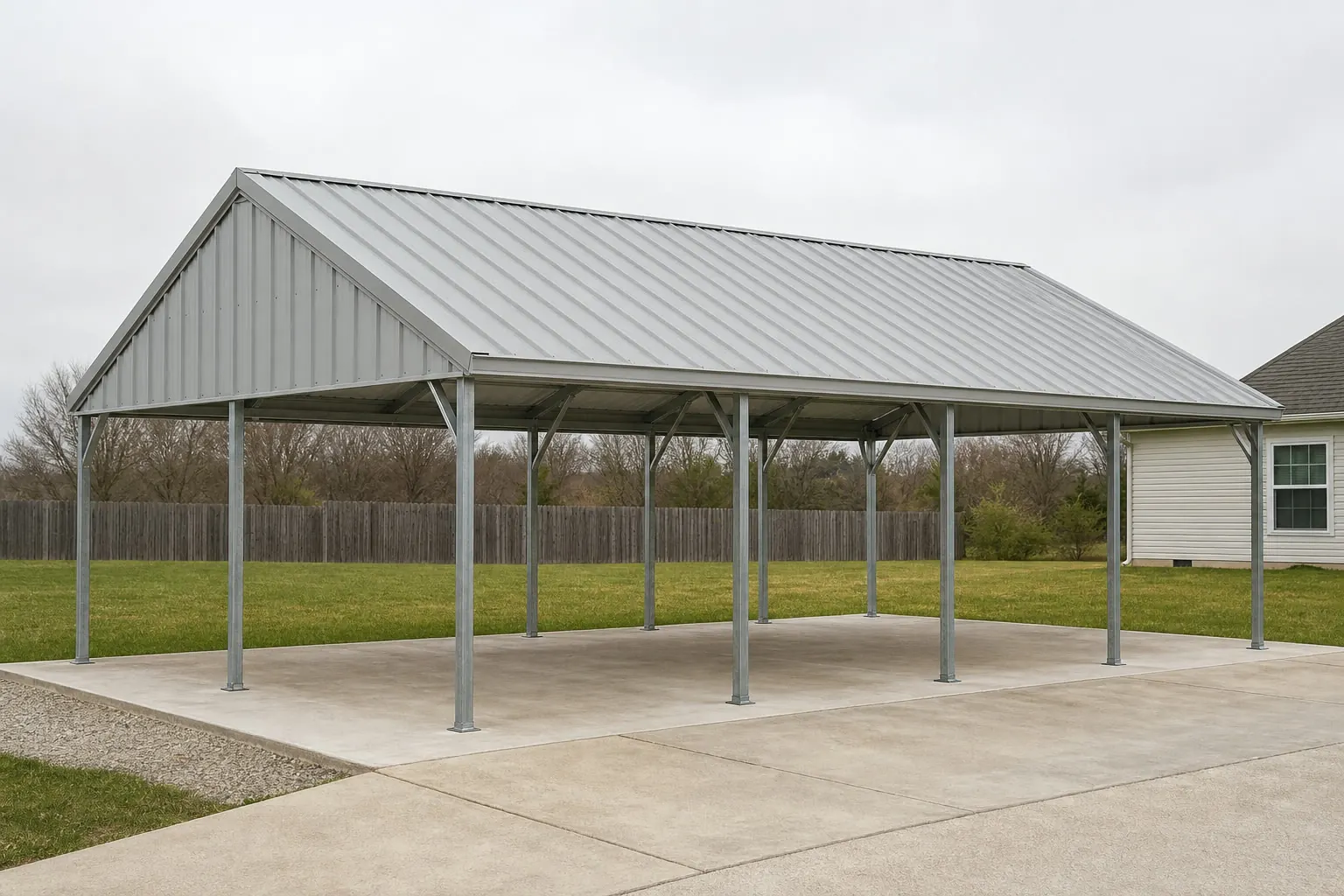
A Farm-Lane and Winter-Load Structure
New York carport projects split into two working conditions rather than one. Upstate and rural counties still hold 30,650 farms across 6,502,286 acres, a 212-acre average, so a real share of carports are sited on gravel drives, farm lanes and equipment yards rather than paved residential driveways. Wherever the parcel sits, the Albany station's 1991-2020 normals put annual precipitation near 40.9 inches with roughly 61 inches of snowfall, and FEMA's National Risk Index scores winter weather among the 18 hazard types it tracks county by county. The carport that works in New York is specified for that snow volume and sited for the surface it actually sheds onto.
Siting
Farm Lane or Residential Drive Changes the Plan
Confirm whether your carport sits on a working farm surface or a paved residential drive before choosing anchoring and grading, because the two conditions call for different bases.
New York's 2022 Census of Agriculture counted 30,650 farms working 6,502,286 acres, an average of 212 acres per farm. That average parcel size means many rural carport buyers have room to place the structure well clear of the house, often beside a barn, an equipment shed or a farm lane. The tradeoff is that the surface underneath is frequently gravel, packed earth or a mowed strip rather than a poured slab, which changes how anchors are set and how the roof's runoff is managed.
On a residential or suburban New York lot the opposite condition applies: the carport usually sits close to an existing paved drive, and local zoning and setback rules — administered town by town and county by county — govern how close it can sit to a property line. Ask your local building department for the setback, height and lot-coverage rules that apply before configuring a footprint, and ask specifically whether an open, unenclosed carport is treated differently from an enclosed garage.
Either way, the shed line deserves a decision before the frame orientation is fixed. On a gravel or dirt surface, an undirected shed line erodes a rut under the drip edge over a few winters; a stone apron or a directed gutter solves it cheaply if it is planned before the posts are set rather than after.
Specification
Specifying a Carport for New York Winters
An open carport roof in New York has to be specified to shed a real volume of snow without collapsing the roof or burying the drive.
- Get local design values before you configureAsk your county or town building department for the snow load, wind speed and frost depth used on your parcel. NOAA publishes 1991-2020 normals station by station across New York rather than one statewide figure, so the local answer is the operative one.
- Treat roof pitch as a snow-shedding decisionWith Albany's normals near 61 inches of annual snowfall, a low-pitch roof accumulates load that a steeper pitch would shed; discuss pitch options with your supplier rather than defaulting to the shallowest available profile.
- Plan where the shed snow actually landsA carport roof concentrates snow and meltwater into a line along the eave. On a farm lane that line needs a stone apron or drainage swale; on a residential drive it needs to avoid a walkway or a neighbor's boundary.
- Anchor to the surface you actually haveGravel, packed earth, an existing slab and new concrete each need a different anchoring approach. Tell your supplier the real surface before ordering, not the surface you plan to add later.
- Confirm the county's hazard profile before finalizingFEMA's National Risk Index scores winter weather among 18 hazard types at the county level; pulling your county's report is a sourced way to see how your specific location compares to the statewide picture.
- Ask about partial enclosure earlyA windbreak wall changes both the wind behavior of an open structure and, in many New York municipalities, how it is classified for setback and permit purposes. Ask before assuming it is a minor add-on.
Get carport quotes for your New York property
Tell suppliers your surface type, your county's snow guidance, and your town's setback rules. Those three answers make New York quotes comparable.
Footprints
Carport Footprints for New York Sites
New York footprints range from tight suburban side-yard covers to farm-scale equipment bays, and the site type usually decides which end of the range applies.
12′ × 24′
288 sq ft
Single-vehicle cover that fits a suburban side yard within typical town setback lines.
20′ × 24′
480 sq ft
Two vehicles side by side where a residential drive is wide enough to support it.
24′ × 30′
720 sq ft
Farm-lane cover for a vehicle plus equipment, sized to the working acreage many upstate parcels carry.
Example Configuration — for planning purposes only.
Confirm setback, height and coverage rules with your town or county before selecting a footprint.
Site Context
Upstate, Western New York and the Downstate Metro
New York's carport brief differs by region even though the statewide winter hazard applies broadly.
Upstate farm counties
Home to much of the state's 30,650 farms and 6,502,286 acres of farmland, where carports commonly sit beside barns and equipment yards on gravel or dirt surfaces, and where local snow normals — station by station per NOAA — run heavy.
Western New York (Albion area)
NOAA maintains 1991-2020 station normals for locations including Albion, a reminder that lake-effect-influenced areas can differ materially from the Albany benchmark station used elsewhere on this page; confirm local figures rather than assuming a single statewide value.
Downstate and metro New York
Denser, more built-out parcels where local zoning and setback rules — administered town by town — are usually the binding constraint on carport size and placement, with less farm-lane siting available.
Evidence Position
What This Page Does Not Claim
No New York snow load, wind speed, permit threshold, code edition or price appears here. Those come from your county or town.
The New York facts used above are the ones we can source: NOAA's Albany station 1991-2020 normals, NOAA NCEI's station-level normals product covering New York locations including Albion, USDA NASS's 2022 Census of Agriculture farm and acreage counts for New York, and FEMA's National Risk Index as the federal county-level hazard tool.
We also record what we could not verify. A single official statewide (not single-station) NOAA precipitation or snowfall normal for New York was not located, so the Albany figure is carried as a representative station value rather than a statewide design number, and the exact statewide 2023 housing-permit total was not confirmed from a complete Census BPS table in this evidence cycle.
Questions
New York Carport Questions
The New York-specific answers a general carport page cannot give.
That is decided locally, and we do not publish a statewide threshold. Ask your town or county building department whether an open, unenclosed carport of your intended size and height needs a permit, and whether it counts toward lot coverage.
Ask your local building department for the design values used on your parcel. Albany's 1991-2020 normals show roughly 61 inches of annual snowfall, but NOAA publishes normals station by station across New York, and lake-effect areas can run heavier.
Many New York carports sit on gravel or dirt farm surfaces — the state's 212-acre average farm size leaves room for it — but the anchoring method has to match that surface, and it is worth confirming with your supplier before ordering.
Siting is. Upstate parcels more often have farm-lane room and gravel surfaces; downstate and suburban lots are usually governed more tightly by local setback and coverage rules. The winter-weather hazard applies broadly, per FEMA's National Risk Index scoring.
That is a site-specific drainage decision. On a gravel or dirt surface, plan a stone apron or swale under the eave; on a paved drive, direct it away from walkways and the neighbor's boundary before the posts are set.
Pricing sits with the cost silo. The New York-variable costs are the base or pad work for your actual surface, snow-rated roof specification, and any local permit or setback requirements.
Sources for the New York facts on this page
This page states no code requirement, wind speed, snow load, permit rule, price or supplier claim. The state-specific facts it does use are listed with their publisher below.
Albany, NY's 1991-2020 annual normal precipitation is about 40.9 inches with roughly 61 inches of annual snowfall at the Albany station.
National Weather Service (NOAA), Albany NY office · 1991-2020 · Tier 1
https://www.weather.gov/media/aly/Climate/ALB_Normals_1991-2020.pdfNOAA NCEI's station normals product provides 1991-2020 monthly temperature, precipitation and snowfall normals for New York stations including Albion, NY, via the U.S. Climate Normals dataset.
NOAA National Centers for Environmental Information (NCEI) · 1991-2020 · Tier 1
https://www.ncei.noaa.gov/access/services/data/v1?dataTypes=MLY-TMAX-NORMAL,MLY-TMIN-NORMAL,MLY-TAVG-NORMAL,MLY-PRCP-NORMAL,MLY-SNOW-NORMAL&dataset=normals-monthly-1991-2020&format=pdf&stations=USC00300055New York had 30,650 farms in 2022, down 8% since 2017.
USDA National Agricultural Statistics Service (NASS) · 2022 · Tier 1
https://www.nass.usda.gov/Publications/AgCensus/2022/Online_Resources/County_Profiles/New_York/cp99036.pdfNew York had 6,502,286 acres of land in farms in 2022, an average farm size of 212 acres.
USDA NASS · 2022 · Tier 1
https://www.nass.usda.gov/Publications/AgCensus/2022/Online_Resources/County_Profiles/New_York/cp99036.pdfFEMA's National Risk Index is the authoritative source for county- and state-level natural hazard exposure ratings across 18 hazard types, viewable via FEMA's own interactive report tool.
Federal Emergency Management Agency (FEMA) · Current NRI release · Tier 1
https://www.fema.gov/flood-maps/products-tools/national-risk-index