
Carport · MO
Carports in Missouri
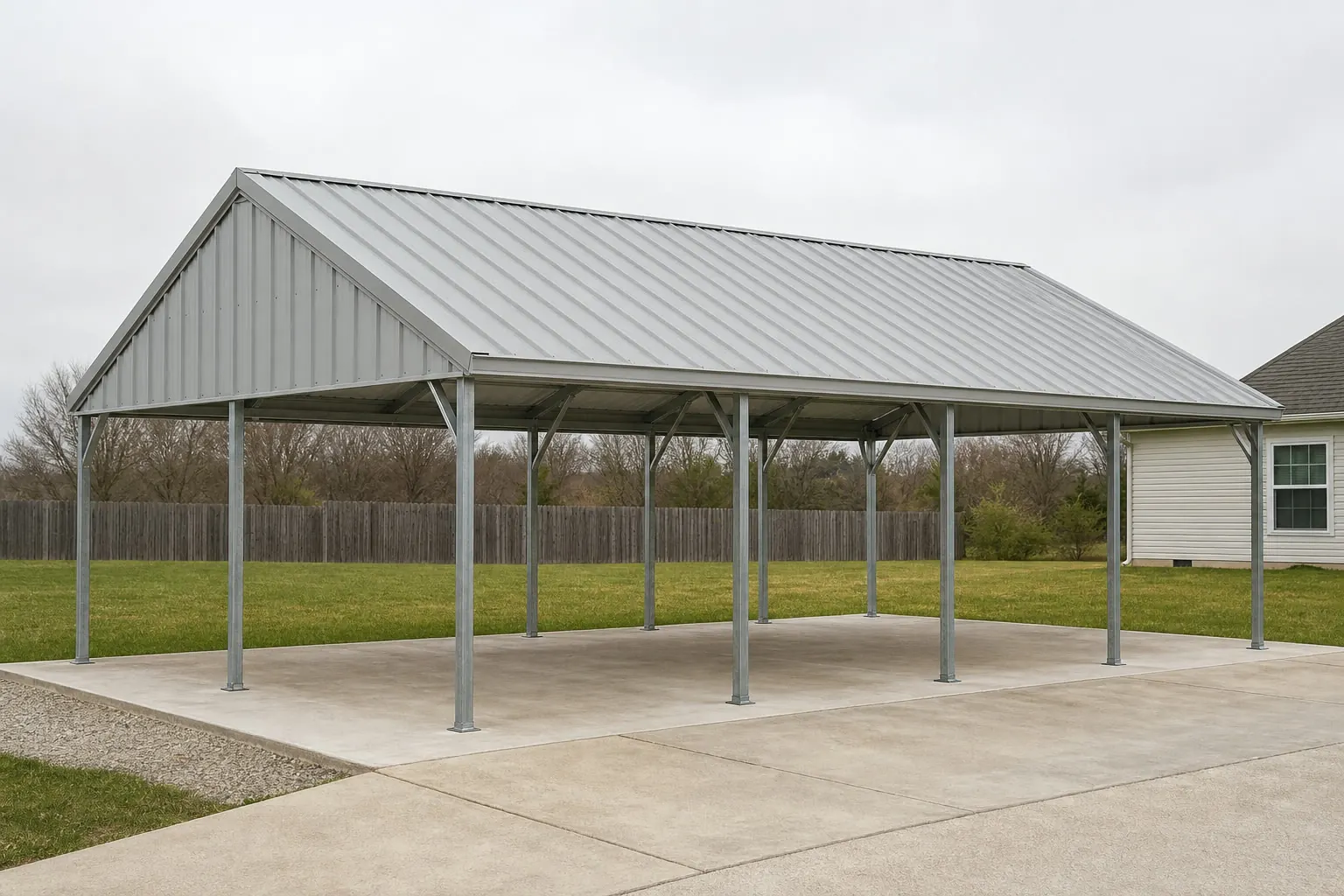
A carport is a small structure, but in Missouri it still runs into the state's core planning quirk: there is no single statewide mandatory building code, and county commissions are separately empowered by statute to control construction and issue permits. That means whether a carport needs a permit at all — and what anchoring or setback rules apply — depends on the county the parcel sits in, not on a uniform state rulebook. Add the Missouri Geological Survey's description of the Ozark Plateau as rugged terrain covering roughly two-thirds of the state's southern and central footprint, and even a simple post-and-roof carport pad has to answer a site-specific question before it goes in the ground.
Permitting
Even a Carport Runs Into Missouri's County Rule
Missouri's absence of a single statewide building code reaches all the way down to a structure as simple as a carport.
Missouri Revised Statute 64.170 gives county commissions the authority to control construction and issue building permits, and there is no companion statewide code covering the gaps between counties. For a carport, this means the permit threshold — whether it's based on square footage, whether it's attached to a driveway or freestanding, or whether it sits on a foundation versus gravel — is a county-specific answer. A carport that needs no permit in one rural Missouri county may require one in a neighboring county or an incorporated city.
It is worth being clear that the Missouri Division of Fire Safety, whose rulemaking authority under Chapter 320 is scoped to fire-safety matters within the Department of Public Safety, is not the office reviewing a carport's zoning setbacks or anchoring. That review, when required, happens at the county or municipal level. Before ordering a carport, a call to the local building or zoning office to confirm setback distances from property lines and whether an HOA has additional material or appearance restrictions is the most useful ten minutes a Missouri buyer can spend.
Site Engineering
Ozark Ground Changes How a Carport Pad Gets Built
A carport's footings are simple, but where those footings sit in Missouri is not always simple.
The Missouri Geological Survey describes the Ozark Plateau, covering roughly 33,000 of the state's 50,000 square miles, as rugged terrain with lofty hills and deep valleys. On that ground, a carport site often needs grading before post footings or a slab pad can go in level, and shallow bedrock can mean standard auger anchors hit rock sooner than expected. In wooded Ozark valleys, tree cover can also reduce wind exposure on a carport compared with an open site — a genuine site-by-site variable rather than a statewide condition.
Outside the Ozark footprint, on the flatter ground that makes up much of northern and western Missouri, excavation for a carport pad is typically more straightforward, but open farmland can mean less natural windbreak. Missouri's 68,746.3 square miles (U.S. Census Bureau) include both conditions, so the right anchoring approach — deeper auger anchors, a poured concrete pad, or ballast — depends on reading the specific site rather than assuming a single Missouri-wide answer.
Missouri's continental climate, described by NOAA NCEI as cold winters and hot, humid summers, also plays into roof style. A vertical-panel roof sheds snow and ice more readily than a horizontal one, which matters on a Missouri carport left unheated and exposed through winter, while a lighter roof color reduces heat buildup underneath during the humid summer months. Procurement order matters too: because the county permit review and the site grading are separate tracks that do not depend on each other, a Missouri buyer can request county confirmation of setback and permit status while the Ozark site is still being graded, rather than treating the two steps as strictly sequential. That overlap can shave real time off a project on rugged ground, where grading itself is the longer of the two tasks.
Site Planning
Siting a Carport Across Missouri's Terrain Range
Missouri's Ozark-to-flatland range means a carport's pad and anchoring plan should be chosen for the specific site, not assumed from a generic checklist.
- Confirm the county's permit threshold before orderingSince Missouri has no statewide code, the square-footage or foundation trigger for a carport permit is set locally and varies between counties.
- Grade Ozark sites before anchoringShallow bedrock and sloped ground on the Ozark Plateau often mean the pad needs leveling and excavation planning that flatter sites can skip.
- Match anchoring to exposure, not just footprintA wooded Ozark valley and an open farmland site carry different wind exposure even for the same carport size.
- Choose a roof style for both winter ice and summer heatMissouri's continental climate calls for a roof and anchoring approach suited to both cold-season ice shedding and hot, humid summer exposure.
Get Missouri Carport Quotes
Protect your vehicles with a carport sited for your county's permit rules and your parcel's terrain. Connect with Missouri suppliers.
Configuration
Common Missouri Carport Briefs
County permit variance and the Ozark/flatland split shape a handful of recurring Missouri carport configurations.
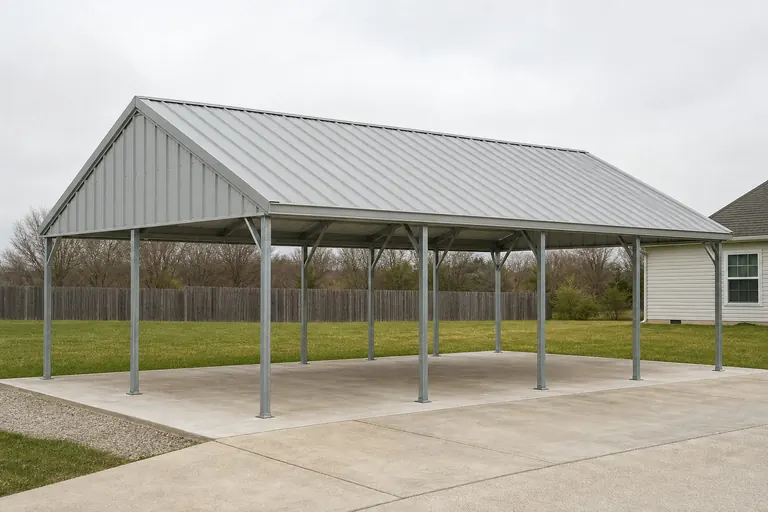 The Farmstead CoverA single or double bay near the farmhouse on open, flatter ground typical of Missouri's northern and western counties.The Ozark Hillside PadA graded, leveled site built around sloped terrain and shallow bedrock common in southern Missouri.
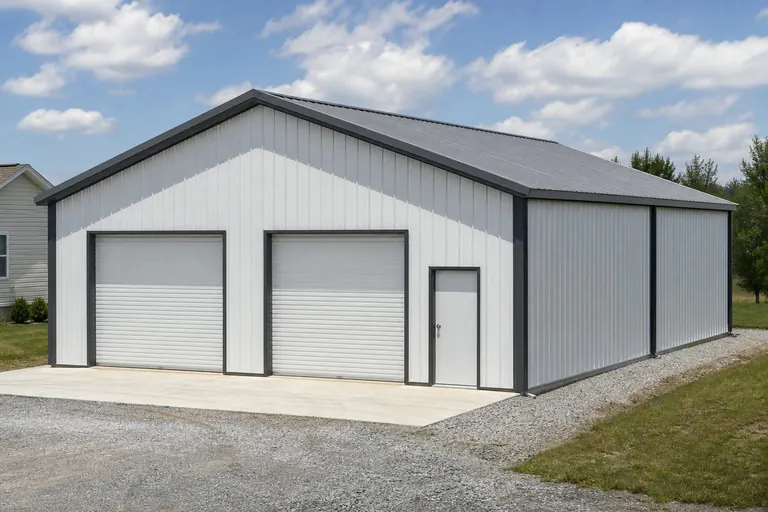 The Town-Lot ShelterA compact carport sited to meet a municipality's setback and appearance rules within an incorporated Missouri city.
Example Configuration — for planning purposes only.
Footprints
Carport Sizes Common on Missouri Properties
Sizing depends on the vehicle count and whether the pad sits on graded Ozark ground or open flatland.
12′ × 21′
252 sq ft
A single-vehicle bay suited to a town lot with tighter setback limits.
18′ × 26′
468 sq ft
A two-vehicle bay common on rural Missouri driveways.
24′ × 40′
960 sq ft
A wider bay for an RV, boat, or light farm implement alongside a vehicle.
Example Configuration — for planning purposes only.
Confirm setback and permit thresholds with your county or municipality before finalizing a footprint.
Questions
Missouri Carport FAQ
Direct answers about carport rules and siting in Missouri.
It depends on the county. Missouri has no single statewide mandatory building code, so county commissions set their own permit thresholds under RSMo 64.170, and requirements vary from one county to the next.
No. Its rulemaking authority is scoped to fire-safety matters within the Department of Public Safety, not carport zoning or structural approval, which is handled at the county or municipal level.
It can. The Missouri Geological Survey describes the Ozark Plateau, covering roughly 33,000 of the state's 50,000 square miles, as rugged terrain with shallow bedrock, which can require grading and different footing depths than flatter Missouri ground.
A vertical-panel roof is generally a better fit given NOAA NCEI's description of Missouri's continental climate with cold winters and hot, humid summers, since it sheds snow and ice more readily than a horizontal panel design.
Often, yes, though it's site-specific. Tree cover in wooded Ozark valleys can reduce wind exposure compared with an open site on Missouri's flatter northern or western farmland, but a confirmed design wind speed should still come from your local building department.
Your county building or zoning office, or your municipality's planning department if the parcel sits within city limits, since Missouri permitting is handled locally rather than through a single state agency.
Sources for the Missouri facts on this page
This page states no code requirement, wind speed, snow load, permit rule, price or supplier claim. The state-specific facts it does use are listed with their publisher below.
Missouri has no single statewide mandatory building code; the Missouri Division of Fire Safety administers state fire-safety-related rules while county commissions are separately empowered by statute to control construction and issue building permits.
Missouri General Assembly / Justia (statute text) · 2025 Missouri Revised Statutes · Tier 2
https://law.justia.com/codes/missouri/title-vi/chapter-64/section-64-170/The Missouri Division of Fire Safety (within the Department of Public Safety) is created and given fire-safety rulemaking authority by statute.
Missouri General Assembly / Justia (statute text) · 2025 Missouri Revised Statutes · Tier 2
https://law.justia.com/codes/missouri/title-xxi/chapter-320/section-320-202/The Missouri Geological Survey (part of Missouri DNR) describes the Ozarks region — covering about 33,000 of the region's 50,000 square miles within Missouri — as rugged, with lofty hills, deep valleys, and cold clear springs and streams south of the Missouri River.
Missouri Geological Survey, Missouri Department of Natural Resources · Fact sheet, rev. 2016 (orig. 2002) · Tier 2
https://dnr.mo.gov/print/document-search/pub0655Missouri's total land area is 68,746.3 square miles.
U.S. Census Bureau · Current Census Bureau geography data · Tier 1
https://data.census.gov/profile/Missouri?g=0400000US29NOAA NCEI publishes a narrative 'Climate of Missouri' describing the state's continental climate with cold winters and hot, humid summers.
NOAA National Centers for Environmental Information (NCEI) · Historical narrative (NCEI climate normals series) · Tier 1
https://www.ncei.noaa.gov/data/climate-normals-deprecated/access/clim60/states/Clim_MO_01.pdf