
Carport · IA
Carports in Iowa
A carport in Iowa is a critical defense against the state's extreme weather, but it must be more than just a roof on four posts. With record-breaking temperatures reaching 110°F and winter lows plummeting to -30°F, your carport needs to handle significant thermal stress and heavy snow loads. More importantly, in a state where straight-line wind events like derechos are a recurring reality, the anchor system and structural engineering of an Iowa carport are what determine if it survives the season or becomes a liability.
Engineering
Building for the Iowa sky
In Iowa, the primary failure point for carports is not the material, but the engineering for wind and snow.
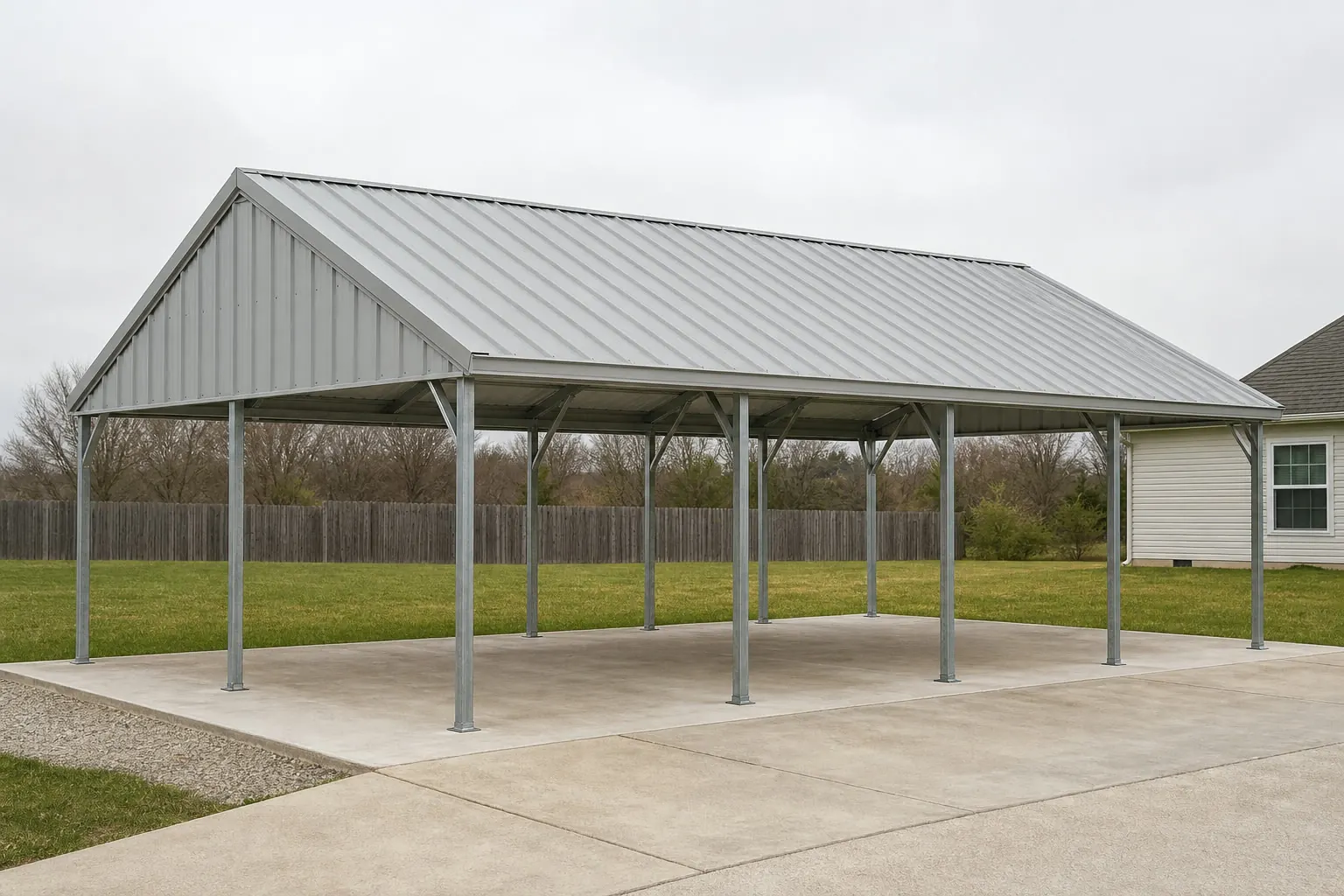
Iowa is famously flat, which means there is little to slow down the wind. A carport, being an open structure, is particularly vulnerable to uplift. When a high-wind event like a derecho hits, the carport acts like a wing. In Iowa, we strongly advise against using basic rebar anchors for anything other than temporary shade. For a permanent installation, you should insist on heavy-duty auger anchors or, better yet, bolting the structure directly to a concrete pad or piers. Ask your installer to document the anchoring method against the design wind speed your local building department requires for your parcel; that connection is what keeps the building on the ground during a severe wind event.
Snow is the second major factor shaping an Iowa carport's roof design. Iowa winters can be unpredictable, often delivering heavy, wet snow that can collapse a lightweight horizontal roof. A 'vertical roof' design—where the panels run from the ridge to the eaves—is the standard recommendation for Iowa. This allows snow and ice to slide off more efficiently, reducing the weight on the frame. It also prevents the water pooling and rusting that can occur on horizontal panels over time.
Thermal protection is often overlooked until the Iowa summer arrives. With temperatures hitting 110°F, a vehicle parked in direct sunlight can reach internal temperatures that damage electronics and upholstery. A metal carport provides significant relief, but the color you choose matters. Light-colored roofs (like white or light gray) reflect more solar radiation, keeping the area beneath the carport several degrees cooler than a dark-colored roof would.
Procedural
Iowa local zoning for carports
Carport permitting in Iowa is handled at the local level and often depends on whether the structure is permanent or temporary.
In many Iowa cities like Des Moines or Cedar Rapids, a carport is considered an 'accessory structure.' Even if it is a pre-engineered metal kit, you may still need a permit if it exceeds a certain square footage or is anchored to a permanent foundation. Zoning rules also dictate 'setbacks'—how close the carport can be to your neighbor's property line or the street. Don't assume that because the structure is open-sided, it doesn't need to meet these rules.
In rural Iowa counties, the oversight might be minimal, but you should still check with the County Assessor's office. If your carport is large enough to house a tractor or RV, it might be classified differently than a simple single-car structure. Furthermore, if you are in a neighborhood with a Homeowners Association (HOA), there may be additional rules about the appearance and materials allowed for carports, even if the city or county gives you the green light.
Finally, think about the future. If you plan to eventually enclose your carport to make it a garage, you should build it to garage-level structural standards from day one. In Iowa, a building that is 'upgraded' later often runs into permitting issues if the original frame wasn't engineered for the added weight and wind resistance of walls.
Site Planning
Choosing where an Iowa carport actually belongs
Iowa's 55,857.1 square miles run from flat drift plain to the steep Loess Hills, and where a carport sits on that range changes the grading and anchoring work before a single post goes in.
- Grade the pad before you anchor, not afterOn the Des Moines Lobe's flatter ground, a light grade and gravel base is usually enough. In the Loess Hills corridor along the western border, the same shortcut leaves posts sitting on a slope that erodes under Iowa's heavy spring rain, so a leveled and compacted pad is the starting point there, not an upgrade.
- Read the site for wind exposure, not just wind speedA carport tucked behind a house, machine shed or windbreak row of trees behaves differently than one standing alone in an open yard. Iowa's flat, largely treeless plains mean an exposed pad sees the full force of a straight-line wind event that a sheltered pad never feels.
- Plan drainage around the footingsStanding water at the base of a post accelerates corrosion and, in a freeze-thaw state like Iowa, contributes to the frost heave that works posts loose over several winters. Route roof runoff and yard grading away from every footing.
- Match the anchor to the exposure, not the building sizeA small single-car carport in an open Iowa field can need the same auger or concrete anchoring as a larger structure in a sheltered yard, because exposure — not footprint — drives uplift risk in this state's hazard profile.
Get Iowa Carport Quotes
Protect your vehicles from Iowa's wind and snow. Connect with local carport suppliers.
Configuration
Common Iowa carport briefs
Iowa carport buyers typically fall into a handful of recurring use cases shaped by farm operations, acreage living, and small-town lots.
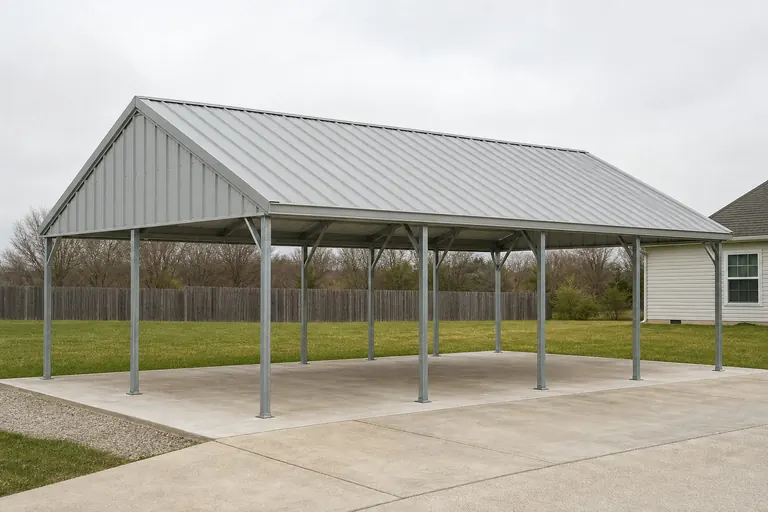 The Implement BayA wide, tall clear-span structure sized for a combine head or grain cart, sited near existing farm infrastructure rather than the house.The Driveway ShelterA single or double-car span attached to an existing driveway in town, sized to fit within a lot's setback lines.
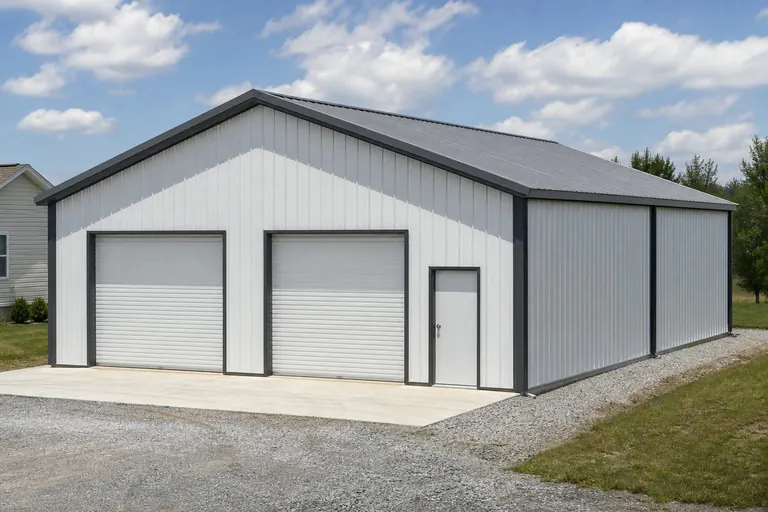 The RV / Boat CoverA taller, longer bay built for seasonal recreational equipment, often the first step before a buyer later encloses it into a garage.
Example Configuration — for planning purposes only.
Footprints
Carport sizes common on Iowa properties
Sizing depends on whether the carport shelters a single vehicle, a farm truck and implement, or an RV.
12′ × 21′
252 sq ft
A single-vehicle bay common on Iowa town lots with tight setback limits.
18′ × 26′
468 sq ft
A two-vehicle bay sized for a truck and car side by side on a rural driveway.
24′ × 40′
960 sq ft
A wider bay for an RV, boat, or light farm implement alongside a vehicle.
Example Configuration — for planning purposes only.
Confirm setback and lot-coverage limits with your city or county before finalizing a footprint.
Questions
Iowa Carport FAQ
Common questions about protecting vehicles in the Iowa climate.
A vertical roof is best for Iowa because it handles snow accumulation more effectively and is generally more structurally sound for high-wind areas.
It's not strictly required, but it is highly recommended for permanent anchoring and to prevent the soil-sinking that can occur in Iowa's wet spring months.
If it is properly anchored with mobile-home auger anchors or bolted to concrete, and the anchoring is documented against your local design wind speed, it has a much higher chance of survival. Basic rebar anchors are often insufficient for Iowa storm cycles.
Yes. USGS describes this western Iowa band as steep silt bluffs with roughly 200 feet of relief above the Missouri River floodplain, so a level, graded and compacted pad matters more there than on the flatter ground found across most of the state.
It provides real protection against sun, hail impact angle and light precipitation, but FEMA's National Risk Index tracks hail, tornado and severe wind among Iowa's scored hazards, and an open-sided carport is never a storm shelter. Treat it as vehicle protection, not severe-weather protection.
Sources for the Iowa facts on this page
This page states no code requirement, wind speed, snow load, permit rule, price or supplier claim. The state-specific facts it does use are listed with their publisher below.
NWS Des Moines climatological records (1878-present) list a record daily high of 110°F (July 25, 1936 and August 4, 1918) and a record low daily minimum of -30°F (January 5, 1884) at the Des Moines station.
National Weather Service (NOAA), Des Moines IA office · 1878-2025 period of record · Tier 1
https://www.weather.gov/media/dmx/Climate/DesMoinesOverallExtremesClimateData.pdfNWS Des Moines climatological records (1878-present) list a record daily high of 110°F (July 25, 1936 and August 4, 1918) and a record low daily minimum of -30°F (January 5, 1884) at the Des Moines station.
National Weather Service (NOAA), Des Moines IA office · 1878-2025 period of record · Tier 1
https://www.weather.gov/media/dmx/Climate/DesMoinesOverallExtremesClimateData.pdfIowa's total land area was measured at 55,857.1 square miles as of the 2010 Census.
U.S. Census Bureau · 2010 Census · Tier 1
https://www.census.gov/geographies/reference-files/2010/geo/state-local-geo-guides-2010/iowa.htmlThe Loess Hills of western Iowa rise roughly 200 feet above the flat Missouri River floodplain and form a narrow band running north-south for about 200 miles along the Missouri River, with steep angles and sharp bluffs on their western side.
U.S. Geological Survey (USGS) · USGS reference publication · Tier 1
https://www.usgs.gov/publications/geology-loess-hills-iowaFEMA's National Risk Index dataset covers 18 natural hazards (including drought, tornado, hail, cold wave, and severe winter weather relevant to Iowa) at the county and Census tract level; FEMA has cited Iowa specifically in a published case study describing drought's importance to the state's water-dependent farm economy.
Federal Emergency Management Agency (FEMA) · Current FEMA case study/NRI release · Tier 1
https://www.fema.gov/case-study/drought-hazard-use-case