
Carport · KS
Carports in Kansas
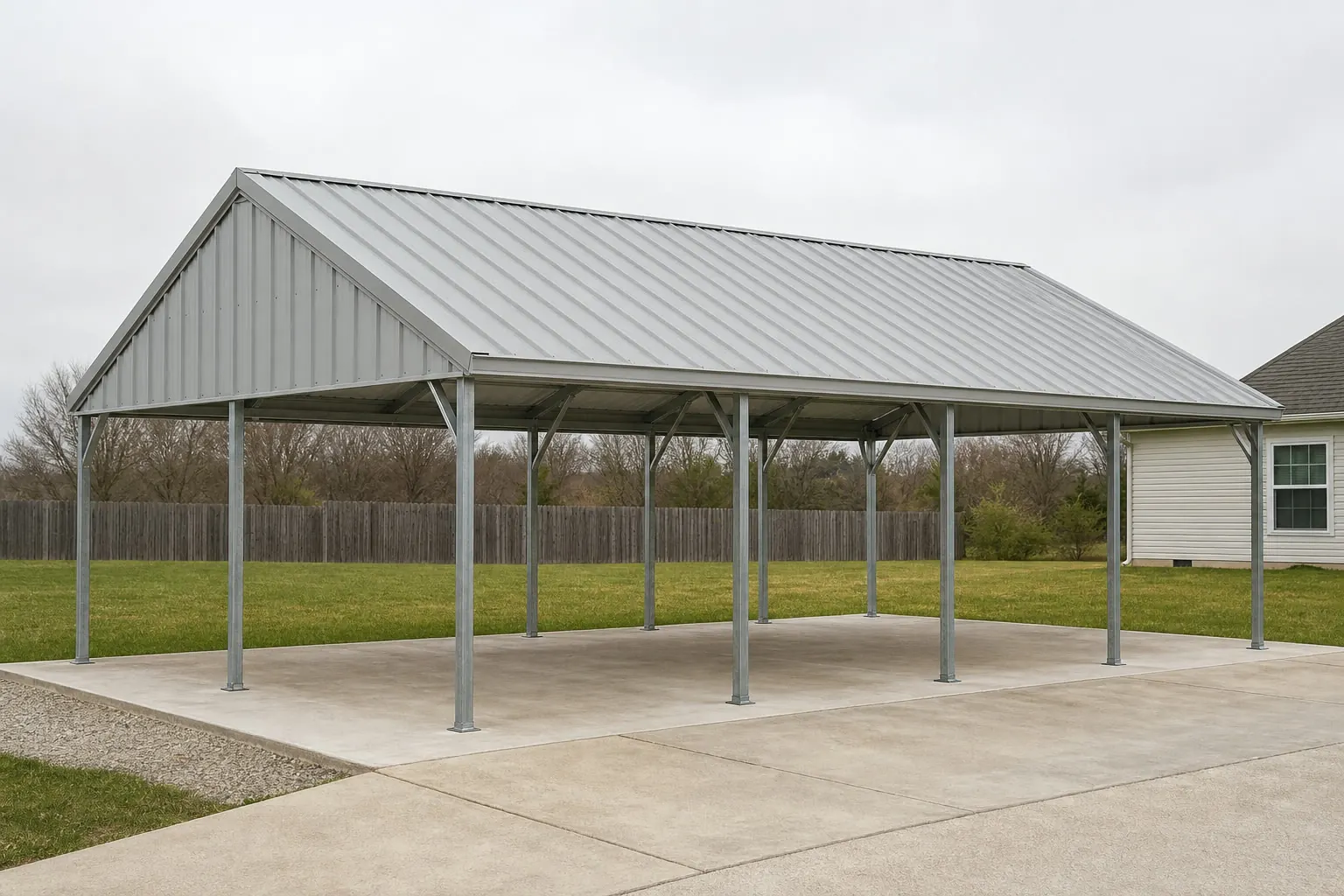
In Kansas, a carport is a specialized shield against a landscape defined by extreme weather. FEMA's National Risk Index identifies hail and severe wind as top-tier hazards for the state, making a durable metal carport a vital investment for protecting vehicles and equipment. On a farm base that averages 804 acres per operation, these structures are rarely just for cars; they house tractors, campers, and utility vehicles across a sprawling 81,758.7-square-mile territory. The honest Kansas story is about building a structure that can breathe in the heat of a semi-arid summer while remaining firmly anchored during a plains thunderstorm.
Environmental Risk
Building for the Hail Belt
A Kansas carport's most important job is not providing a garage; it is providing a shield against the state's top-tier hail and wind hazards.
FEMA's National Risk Index ranks Kansas as a high-exposure zone for both hail and severe wind. For a carport buyer, this means that 'standard' consumer-grade kits often fail the qualitative test. A structure that works in a sheltered coastal region will not suffice on the open Kansas plains. We recommend prioritizing 26-gauge steel roofing over the more common 29-gauge to ensure the building can withstand golf-ball-sized hail without suffering structural leaks or aesthetic failure.
Wind is the second, and arguably more dangerous, factor. In a state where 804-acre farms are the average, there are few natural barriers to break the wind's momentum. An open-sided carport acts as a wing during high-velocity gusts. Professional anchoring is not an optional upgrade; it is a structural necessity. Whether you are using auger anchors in the deep western soils or concrete footings in the rocky eastern regions, the building must be anchored to resist the uplift forces that characterize Kansas storms.
Siting and Scale
The 800-Acre Carport
On a typical Kansas operation, the carport is a detached tool, not an attached amenity.
In suburban environments, carports are often squeezed into narrow driveways. In Kansas, where the average farm size is 804 acres (USDA NASS 2022), you have the freedom of space, but that freedom comes with the challenge of exposure. A carport should never be placed in a vacuum. By siting the structure downwind of a larger barn or a line of trees, you can significantly reduce the wind load and the risk of debris damage. That wind-shadow effect is measurable in practice even without an engineering study: a carport tucked behind an existing pole barn or a mature tree line sees noticeably calmer air on its leeward side than the same structure standing alone in an open pasture. On the 804-acre average Kansas parcel, that windbreak is rarely automatic — it has to be chosen deliberately, because the nearest existing structure may be a quarter mile away. Where no windbreak exists yet, orienting the carport's open face away from the prevailing northwesterly winter flow, and toward the more sheltered southeast, does some of that work without adding a new building to the site plan.
The use case in Kansas also skews toward the agricultural. With over 44 million acres of farmland, these structures are frequently used to protect high-clearance sprayers, seed tenders, or horse trailers. This requires eave heights that far exceed the standard 7 or 8 feet. A Kansas carport is often a 12-foot to 14-foot tall structure, allowing for easy pull-through access for large-frame equipment that needs a break from the intense plains sun.
- UV Protection
- In the semi-arid west, a carport's primary role is preventing sun damage to tires and paint.
- Frost Mitigation
- In the humid east, an open structure keeps morning frost off windshields without the cost of a full garage.
- Snow Load Logic
- While not the primary hazard, ensure the roof pitch is sufficient to shed heavy, wet spring snows common to the region.
Design
Typical Kansas Carport Styles
Configurations adapted for the Sunflower State.
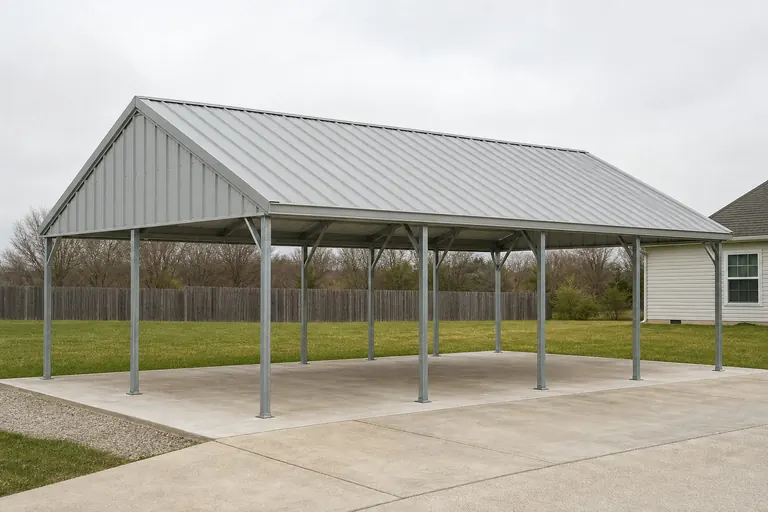 High-Clearance Ag14-foot eave heights for tractors and combines on 800-acre operations.RV & Camper ShieldExtra-long footprints (40'+) with enclosed sides for wind protection.Utility Lean-ToAttached to an existing barn to provide sheltered staging for daily operations.
Example Configuration — for planning purposes only.
Shield Your Equipment from Kansas Weather
Ready for a carport that can handle the wind and hail? Get a quote for a steel structure designed for the plains today.
Dimensions
Footprints for the Plains
Reflecting the varied equipment needs of Kansas buyers.
12′ × 20′
240 sq ft
Standard single-vehicle protection for a passenger truck.
24′ × 30′
720 sq ft
A common dual-vehicle size that fits a truck and a piece of utility equipment.
30′ × 50′
1,500 sq ft
Professional ag-scale carport for large machinery or multi-vehicle storage.
Example Configuration — for planning purposes only.
Width is measured from roof edge to roof edge; ensure your pad accounts for the specific frame dimensions.
Preparation
Before you order a Kansas carport
Four decisions resolved before you order keep a Kansas carport from becoming a second, more expensive project.
- Identify your substrateConfirm whether your pad sits on Flint Hills rock or deeper western soil before choosing an anchoring method. Rock-anchored bases and auger-anchored bases are not interchangeable, and finding out which one you need after delivery costs time.
- Measure the equipment, not the vehicleIf the carport will shelter a sprayer, seed tender, or camper as often as a truck, measure the tallest and widest item you own, not the smallest, before fixing eave height and width.
- Confirm your county's permit positionRural agricultural exemptions for open-sided structures are common in Kansas but not universal, and city limits around Wichita or Topeka enforce permits consistently. Ask your local building department before you finalize a footprint.
- Plan the anchoring budget as part of the quoteBecause wind, not appearance, is the primary design driver here, treat auger anchors, concrete piers, or tie-down hardware as a line item from the first quote rather than an afterthought.
Questions
Kansas Carport FAQ
Honest answers for protecting your vehicles in Kansas.
Yes, provided you choose the right gauge. While 29-gauge steel can be punctured by large hail, 26-gauge steel is significantly more resistant. It won't stop a tornado, but it will prevent the routine hail damage that plagues Kansas vehicle owners.
It's all about the anchoring. In Kansas, you should never rely on simple rebar pins. You need either mobile home augers (for dirt) or heavy-duty expansion bolts (for concrete). Ideally, your carport should be tied into the ground at every leg.
It varies by county. Many rural Kansas counties with 804-acre average farms do not require permits for open-sided agricultural structures, but city limits in places like Wichita or Topeka always do. Check with your local building department first.
Cost and ventilation. In the humid-to-semi-arid transition zone, an open structure provides natural cooling and prevents moisture trap, while being significantly more affordable for protecting large-frame agricultural equipment.
Yes, more than it would in a sheltered state. With few natural windbreaks across an average 804-acre parcel, orienting the open side away from the prevailing northwesterly winter wind, and using any existing barn or tree line as a buffer, meaningfully reduces the load your anchoring has to resist.
Sources for the Kansas facts on this page
This page states no code requirement, wind speed, snow load, permit rule, price or supplier claim. The state-specific facts it does use are listed with their publisher below.
FEMA's National Risk Index dataset assesses 18 natural hazards (including tornado, hail, drought, and severe wind, all historically significant to Kansas) at the county and Census tract level via its interactive online tool.
Federal Emergency Management Agency (FEMA) · Current NRI release · Tier 1
https://www.fema.gov/about/openfema/data-sets/national-risk-index-dataKansas had 44,794,702 acres of land in farms in 2022, an average farm size of 804 acres — the largest average farm size figure among the four-state group reviewed here (IL, IA, KS, LA).
USDA NASS · 2022 · Tier 1
https://www.nass.usda.gov/Publications/AgCensus/2022/Full_Report/Volume_1,_Chapter_1_State_Level/Kansas/st20_1_001_001.pdfKansas's total land area was measured at 81,758.7 square miles as of the 2010 Census.
U.S. Census Bureau · 2010 Census · Tier 1
https://www.census.gov/geographies/reference-files/2010/geo/state-local-geo-guides-2010/kansas.htmlNOAA NCEI's State Climate Summary for Kansas states the state is a region of transition between the humid conditions to the east and semi-arid conditions to the west, and that temperatures have risen about 1.5°F since the beginning of the 20th century, with greater warming in winter and spring than summer and fall.
NOAA National Centers for Environmental Information (NCEI) · State Climate Summaries series, 2022 · Tier 1
https://statesummaries.ncics.org/downloads/Kansas-StateClimateSummary2022.pdfKansas had a total of 9,504 new privately-owned housing units authorized by building permits in 2023, decreasing to 9,063 units in 2024.
U.S. Census Bureau · 2023-2024 · Tier 1
https://www2.census.gov/econ/bps/State/st2024a.txtKansas had 55,734 farms in 2022, down from 58,569 in 2017.
USDA National Agricultural Statistics Service (NASS) · 2022 (with historical comparison back to 1992) · Tier 1
https://www.nass.usda.gov/Publications/AgCensus/2022/Full_Report/Volume_1,_Chapter_1_State_Level/Kansas/st20_1_001_001.pdf