
Carport · MS
Carports in Mississippi
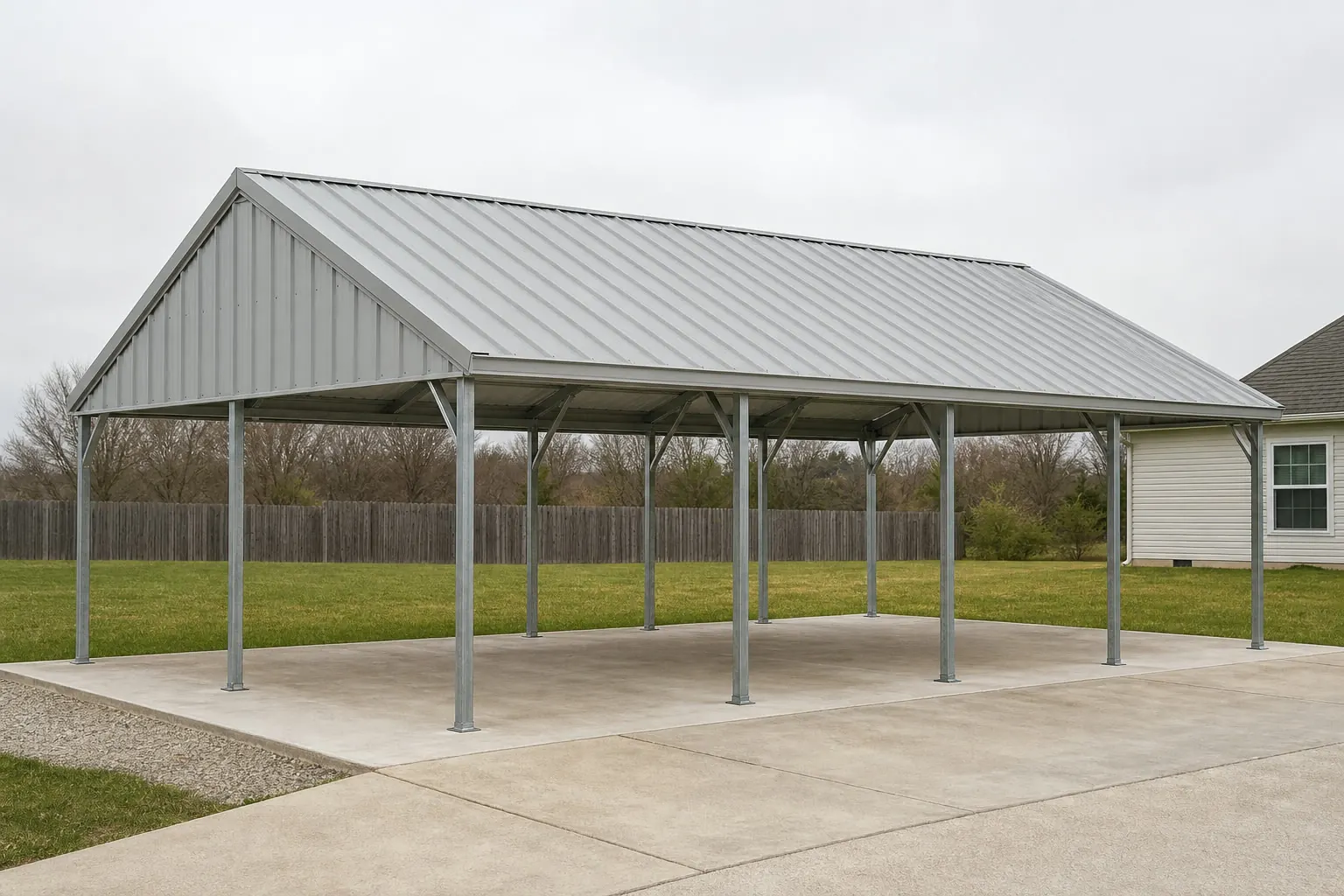
A Mississippi carport spends most of the year shedding rain rather than snow, so the design conversation that matters most is drainage, ventilation and anchoring against documented thunderstorm and tornado frequency rather than roof snow load. Whether the slab sits on Delta alluvial ground, central loess hills, or Coastal Plain sand near the Gulf, the anchoring detail changes even when the open-sided steel structure above it looks the same.
The Mississippi Context
An open-sided structure means anchoring is the design priority
Mississippi's documented thunderstorm and tornado frequency is the reason a carport's ground anchoring deserves as much attention as its footprint.
A carport has no walls to distribute wind load the way an enclosed pole barn or barndominium does, so its resistance to uplift comes almost entirely from how well the posts are anchored into the ground or slab. A Mississippi State University Extension and Agricultural & Forestry Experiment Station bulletin documents the statewide frequency and distribution of thunderstorms, lightning strikes and tornadoes, and NWS Jackson separately compiles 1950-2021 Storm Data tornado statistics for the state. Together, those sources are the practical reason to specify upgraded anchor bolts, deeper post embedment, or engineered tie-downs for a Mississippi carport rather than defaulting to the lightest anchoring option available.
The specific wind rating a carport needs to meet is not a number this page asserts; that figure comes from the local building department or a project engineer reviewing the site, since it can vary by county and by how close the property sits to the Gulf Coast versus further inland.
Regional Planning
Slab and drainage planning shifts across the state
Delta, hill-country and Coastal Plain sites each present a different slab-drainage starting point for a carport.
Mississippi Delta
MSU Extension documents the Delta as a moisture-retentive alluvial plain. A carport slab here benefits from a deliberate crown and perimeter drainage rather than a flat pour, since standing water is more likely to linger on this soil type after a rain event.
Loess Hills & Central Mississippi
More natural relief in the hill country generally helps surface drainage, but a sloped lot may need a retaining edge or a leveled cut before the carport's slab or gravel pad goes in. Because the state's total relief spans 806 feet from the Gulf coastline to Woodall Mountain near Iuka, a hill-country parcel toward the higher end of that range can carry noticeably steeper approach grades than a Delta or coastal site, which affects how much cut-and-fill work a contractor budgets before the pad is poured.
Coastal Plain & Piney Woods (South Mississippi)
Sandier soils can drain faster in parts of the Coastal Plain, but closer proximity to the Gulf raises the anchoring conversation described above; a local engineer should confirm the wind-rating expectation for that specific county.
Climate Response
Detailing for a wet, snow-free climate
Jackson's climate normals show why a Mississippi carport's roof and slab detailing lean toward drainage capacity rather than snow-load resistance.
NOAA's National Centers for Environmental Information records a 1991-2020 annual precipitation normal of 57.35 inches for the Jackson-Evers station, with roughly 1.0 inch of average annual snowfall. NWS Jackson describes the surrounding forecast area's climate as humid subtropical, with rainfall potential spread through the year rather than concentrated in a short season. For a carport, that pattern means roof panel overlap, gutter add-ons if used, and slab slope toward a drain point matter more day-to-day than any snow-load allowance.
Because a carport is open-sided, humidity and rainfall exposure also affect what gets stored beneath it. Vehicles, equipment and boats parked under a Mississippi carport are shielded from direct rain but still sit in the state's high ambient humidity, which is worth factoring into any decision about adding partial side panels for extra weather protection.
- Slab Slope & Crown
- Directs sustained rainfall runoff away from parked vehicles and equipment rather than pooling underneath.
- Upgraded Anchor Hardware
- Sized against documented statewide thunderstorm and tornado frequency, confirmed locally.
- Optional Partial Side Panels
- A common add-on where humidity and wind-driven rain make a fully open structure less practical.
Start your Mississippi carport project
Get connected with specialists who understand Mississippi's storm-frequency and regional soil conditions.
Application
How Mississippi properties use carports
Common Mississippi carport applications tied to the state's rural and coastal land-use mix.
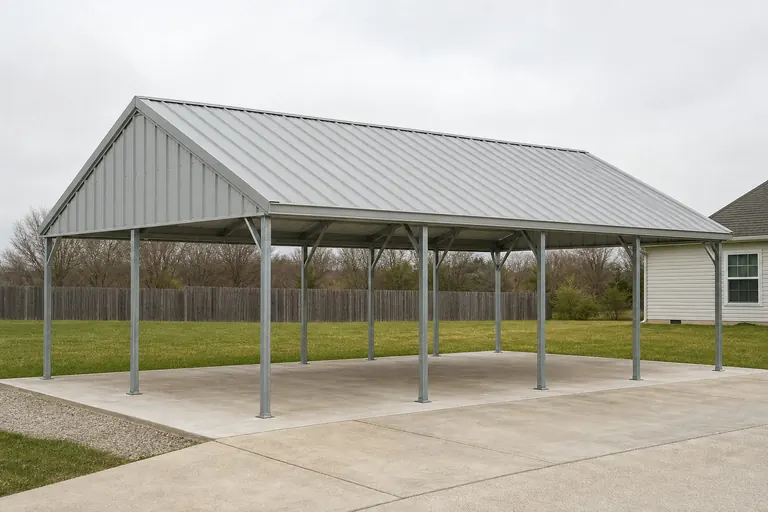 Delta Farm Vehicle CoverA straightforward open bay for trucks and light equipment on flat alluvial ground, with slab crown added for drainage.Hill-Country Residential Add-OnA single or double-bay carport sited alongside a home in the central loess hills, graded into a sloped lot.Coastal & Piney Woods Boat/RV CoverA taller-clearance carport near the Gulf Coast or forested south, anchored to a local engineer's wind-rating spec.
Example Configuration — for planning purposes only.
Before You Build
Mississippi-specific checks before installing a carport
Verifications worth completing before a Mississippi carport slab is poured or posts are set.
- Confirm your county's anchoring and wind requirementsThere is no single statewide wind number asserted here; get the specific anchoring requirement from your local building department or an engineer for your county.
- Check permit requirements with your local building departmentMississippi's 7,700 authorized housing units in 2023 reflect a steady residential permitting environment, but accessory-structure rules like carport setbacks and permit thresholds vary by county and municipality.
- Plan slab drainage for your specific soil regionMSU Extension's Delta-versus-hill-country soil distinction affects how much slab crown or perimeter drainage a carport needs; a moisture-retentive Delta site generally needs more attention than a well-drained hill site.
- Review documented storm frequency for anchoring hardware decisionsThe MAFES thunderstorm/tornado bulletin and NWS Jackson's 1950-2021 Storm Data compilation both support specifying upgraded anchor hardware rather than the minimum available option.
Questions
Mississippi Carport FAQ
Direct answers for planning an open-sided steel carport in Mississippi.
It depends on the county or municipality; accessory-structure permit thresholds vary across Mississippi, so confirm directly with your local building department before installation.
The specific engineered wind rating should come from your local building department or a project engineer for that county. Mississippi's documented thunderstorm and tornado frequency, from an MSU Extension/MAFES bulletin and NWS Jackson's 1950-2021 Storm Data statistics, is a reason to favor upgraded anchor hardware generally.
No, it is minimal statewide. Jackson's 1991-2020 climate normal shows about 1.0 inch of average annual snowfall, so drainage capacity for the 57.35-inch annual rainfall normal is the more relevant design factor.
Yes, generally. MSU Extension documents Delta alluvial soil as more moisture-retentive than the state's loess hills or Coastal Plain, so a carport slab there benefits from deliberate crown or perimeter drainage rather than a flat pour.
In many cases yes, if the structure's design anticipated the added wind load; confirm with your installer or engineer before ordering hardware, since retrofitting anchoring after the fact is harder than specifying it up front.
It can. Proximity to the Gulf Coast is a reason to have a local engineer confirm the wind-rating requirement for that specific county rather than assuming an inland Mississippi spec applies.
Sources for the Mississippi facts on this page
This page states no code requirement, wind speed, snow load, permit rule, price or supplier claim. The state-specific facts it does use are listed with their publisher below.
A Mississippi State University Extension/Agricultural & Forestry Experiment Station bulletin documents the frequency and distribution of thunderstorms, lightning strikes, and tornadoes across Mississippi.
Mississippi State University, Mississippi Agricultural & Forestry Experiment Station · MAFES bulletin (state climatologist authored) · Tier 2
https://www.mafes.msstate.edu/publications/bulletins/b1198.pdfNWS Jackson's compiled Storm Data statistics for 1950-2021 document Mississippi's long-term tornado history for the state, sourced from the NOAA/NCEI Storm Data database.
National Weather Service (NOAA), Jackson MS office · 1950-2021 · Tier 1
https://www.weather.gov/jan/severe_statisticsJackson, MS's 1991-2020 annual normal precipitation is 57.35 inches with essentially negligible average annual snowfall (about 1.0 inch).
NOAA National Centers for Environmental Information (NCEI) · 1991-2020 · Tier 1
https://www.ncei.noaa.gov/access/services/data/v1?dataset=normals-annualseasonal-1991-2020&stations=USW00003940&format=json&dataTypes=ANN-PRCP-NORMAL,ANN-SNOW-NORMALMississippi State University Extension identifies the Mississippi Delta as an alluvial-plain land resource area with soils formed from sediments left by the Mississippi River, distinct from the state's loess and coastal-plain regions.
Mississippi State University Extension Service · Extension reference material · Tier 2
https://extension.msstate.edu/agriculture/soils/mississippi-land-resource-areasThe total relief of Mississippi, from the Gulf coastline to the state's highest point at Woodall Mountain near Iuka, is 806 feet, and the state's landforms are grouped into physiographic regions.
Mississippi Humanities Council (Mississippi Encyclopedia) · Reference material · Tier 2
https://mississippiencyclopedia.org/entries/landforms/Building permit offices in Mississippi authorized construction of 7,700 new privately-owned housing units in 2023 (7,145 single-family buildings plus multi-unit structures).
U.S. Census Bureau · 2023 (final annual) · Tier 1
https://www2.census.gov/econ/bps/State/st2023a.txt