
Carport · TN
Carports in Tennessee
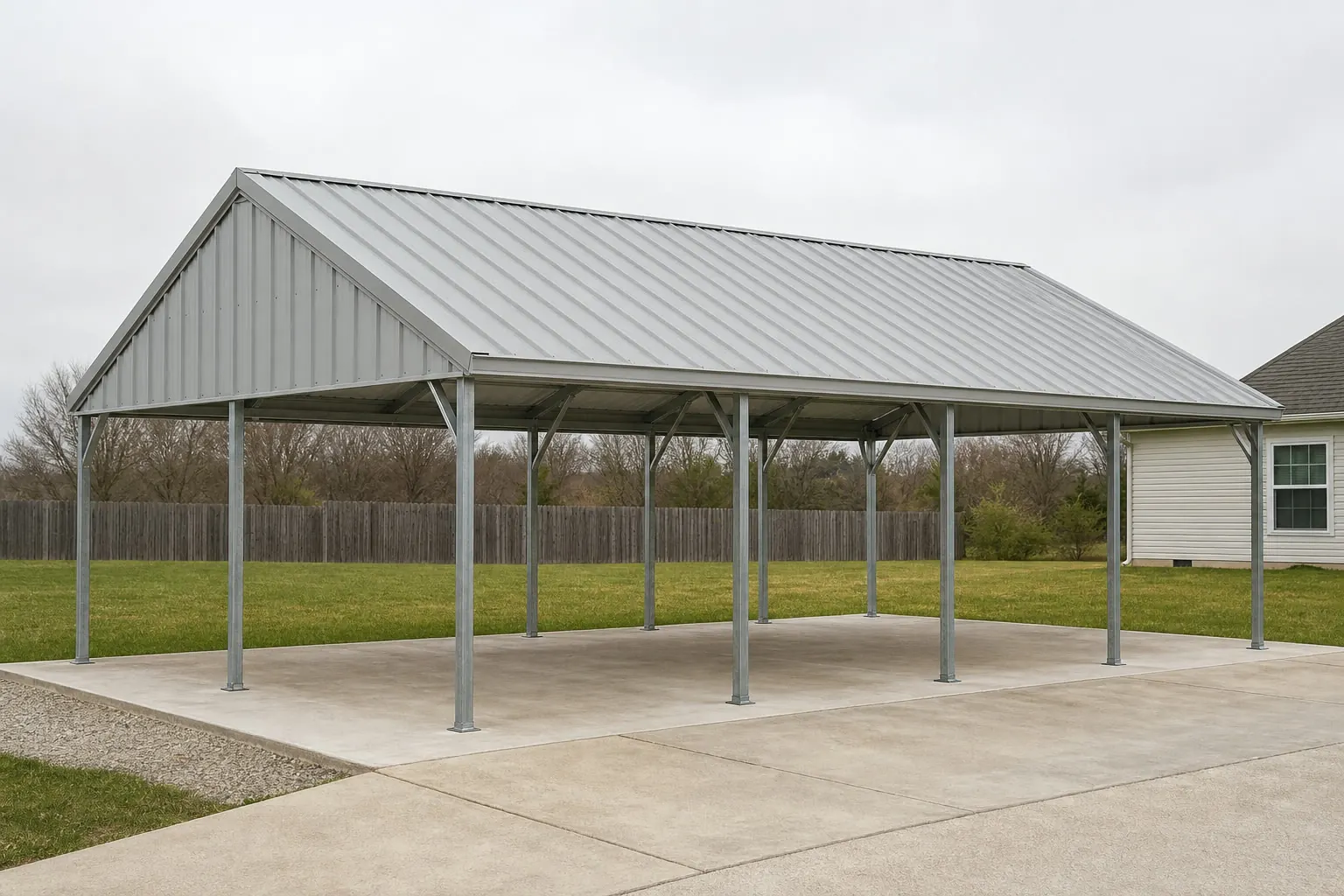
A carport in Tennessee is a smaller structure than a home or a storage building, but it still sits on the same varied ground, so the same regional questions apply before you fix a location or a roof style. The Tennessee Encyclopedia notes the state's long east-west axis crosses most of the geological provinces found in the east-central United States, and East Tennessee State University's Tennessee Climate Office divides the state into four climate divisions from the Mississippi lowlands to the Appalachian highlands. Add FEMA's county-level National Risk Index, which is the accurate way to check tornado, severe storm, and flood exposure for a specific Tennessee parcel, and a carport buyer here has three genuinely local questions to answer before ordering: where on that geographic axis is the site, which climate division does it sit in, and what does the county's own hazard profile show.
Site First
Where on the map your carport sits matters more than it seems
Tennessee's unusual length means even a small structure like a carport benefits from a location-specific siting check.
It is tempting to treat a carport as small enough that state geography doesn't matter, but Tennessee's shape argues otherwise. The Tennessee Encyclopedia describes the state as a narrow band running over 500 miles east-west, with that axis crossing the underlying geological grain so directly that most of the geological provinces of the east-central United States show up somewhere within the state. A carport's ground preparation, whether that's a compacted gravel pad or a poured concrete runner, performs differently depending on which of those provinces the parcel sits in, so a siting check specific to your county is worth the small extra step even for a structure this size.
ETSU's Tennessee Climate Office adds a second, related layer: the state splits into four distinct climate divisions running from the Mississippi lowlands in the west to the Appalachian highlands in the east. A carport roof detail chosen for a humid western division should be reconsidered, not assumed, if the actual site sits in a cooler eastern division instead.
Regional Notes
Siting notes along Tennessee's west-to-east span
General siting considerations tied to the state's documented geography and climate divisions.
Western Tennessee (Mississippi lowlands division)
Flatter, lower-lying ground per ETSU's climate mapping means grading and perimeter drainage around the carport pad take priority over slope correction.
Middle Tennessee
Terrain and soil vary enough across this region that a quick check of your specific parcel's drainage pattern before pouring a pad is worthwhile rather than assuming conditions match a neighboring county.
Eastern Tennessee (Appalachian highlands division)
More variable, sloped terrain per ETSU's mapping can make finding a level carport pad harder and may call for a small retaining or cut-and-fill step before installation.
Hazard & Climate Outlook
Planning around county hazard exposure and a drier long-range outlook
Two Tennessee-specific factors deserve a check before you finalize a carport's anchoring and drainage: county hazard exposure and the state's own long-range drought projection.
FEMA's National Risk Index scores hazard categories such as tornado, severe storm, and riverine flooding at the county and tract level for every Tennessee county. This pack did not retrieve a single statewide FEMA narrative ranking Tennessee's hazards, and none is asserted here; instead, pulling your specific county's NRI score before choosing an anchoring method for a lightweight structure like a carport is the accurate way to plan for wind exposure.
Separately, NOAA's 2022 State Climate Summary notes that Tennessee has seen comparatively little overall warming so far but projects future droughts to be more intense as higher temperatures deplete soil moisture faster. For a carport, that is a reason to plan the pad's drainage and surrounding grading for both extremes: heavy regional storm runoff in wetter periods, and dust or ground-cracking stress around the pad edge in drier stretches.
- Pull your county's NRI hazard score
- Confirm tornado, severe storm, and flood exposure for your specific county rather than assuming a single statewide level.
- Ask about wind anchoring locally
- A specific statewide wind design speed was not confirmed in this pack; your local building department sets the anchoring specification that applies to your site.
- Grade the pad for both wet and dry extremes
- Plan drainage for heavy storm events while also accounting for the state's own projected trend toward more intense future droughts.
Get your Tennessee carport quote
Talk to suppliers who can size and anchor a carport for your specific county's terrain and hazard exposure.
Dimensions
Common Tennessee carport footprints
Footprints suited to Tennessee residential and farm vehicle coverage needs.
12′ × 20′
240 sq ft
A single-vehicle cover suited to a truck or compact tractor.
20′ × 20′
400 sq ft
A two-vehicle residential cover, common on suburban and small-town driveways.
24′ × 36′
864 sq ft
A larger utility cover for multiple farm implements or a larger RV.
Example Configuration — for planning purposes only.
Allow extra width for vehicle doors and any attachments like ladder racks or loader buckets before finalizing a size.
Anchoring
Matching anchoring method to Tennessee ground and hazard exposure
The right anchoring approach depends on the parcel's soil conditions and its county-level hazard exposure, not on a single statewide default.
| Anchoring method | Typical use | Tennessee-specific consideration |
|---|---|---|
| Ground (mobile-home style) anchors | Budget installs on stable, well-drained soil | Confirm soil stability locally first; this method is a poor fit on ground affected by documented geologic variability such as the Cumberland Plateau region. |
| Concrete perimeter runners | Most residential and farm carports statewide | A reasonable balance of cost and holding strength, still worth pairing with a crowned pad for regional storm drainage. |
| Full concrete slab | Vehicles or equipment needing a clean, dry parking surface | Preferred where county-level FEMA NRI data shows higher storm or flood exposure and a more secure anchor point is warranted. |
Ground (mobile-home style) anchors
- Typical use
- Budget installs on stable, well-drained soil
- Tennessee-specific consideration
- Confirm soil stability locally first; this method is a poor fit on ground affected by documented geologic variability such as the Cumberland Plateau region.
Concrete perimeter runners
- Typical use
- Most residential and farm carports statewide
- Tennessee-specific consideration
- A reasonable balance of cost and holding strength, still worth pairing with a crowned pad for regional storm drainage.
Full concrete slab
- Typical use
- Vehicles or equipment needing a clean, dry parking surface
- Tennessee-specific consideration
- Preferred where county-level FEMA NRI data shows higher storm or flood exposure and a more secure anchor point is warranted.
Questions
Tennessee Carport FAQ
Direct answers for Tennessee carport shoppers.
Yes. The state's long east-west span crosses multiple geological provinces and four distinct climate divisions, so ground preparation and roof detailing appropriate in one part of the state are not automatically correct elsewhere.
We could not confirm a single statewide wind design value in this pack, so this page does not state one. Your local building department sets the anchoring specification for your specific site.
Use FEMA's National Risk Index tool, which scores tornado, severe storm, and riverine flooding exposure at the county and tract level for every Tennessee county, rather than relying on a single statewide hazard description.
NOAA's 2022 State Climate Summary projects more intense future droughts for Tennessee, so it's reasonable to plan pad drainage and grading with both heavy storm runoff and drier-stretch stress in mind.
Not always. A slab is worth prioritizing where your county's FEMA NRI data shows higher storm or flood exposure, or where you need a clean, dry surface for equipment; a gravel pad or concrete runners can suit lower-exposure, well-drained sites.
Yes, but plan for greater clear height and a wider footprint than a standard residential design, and confirm those dimensions with your supplier at order time.
Sources for the Tennessee facts on this page
This page states no code requirement, wind speed, snow load, permit rule, price or supplier claim. The state-specific facts it does use are listed with their publisher below.
The Tennessee Encyclopedia's Geologic Zones entry notes Tennessee is a narrow state over 500 miles long, with its long east-west axis crossing the grain of the underlying geology, so that most of the geological provinces of the east-central United States are represented somewhere within the state.
Tennessee Historical Society / Tennessee Encyclopedia · Reference entry · Tier 2
https://tennesseeencyclopedia.net/entries/geologic-zones/East Tennessee State University's Tennessee Climate Office describes the state as divided into four distinct climate divisions, reflecting topography that ranges from the lowlands of the Mississippi River in the west to the Appalachian mountains in the east.
East Tennessee State University (ETSU), Department of Geosciences · ETSU reference page · Tier 2
https://www.etsu.edu/cas/geosciences/tn-climate/tn-climatology.phpNOAA's 2022 State Climate Summary reports Tennessee, like much of the southeastern U.S., has experienced little overall warming since the beginning of the 20th century, though historically unprecedented warming is projected this century, and future droughts are projected to be more intense due to faster soil-moisture depletion at higher temperatures.
NOAA National Centers for Environmental Information (NCEI) · 2022 summary · Tier 1
https://statesummaries.ncics.org/downloads/Tennessee-StateClimateSummary2022.pdfFEMA's National Risk Index is the federal tool providing county- and tract-level natural hazard risk scoring (including tornado, severe storm, and riverine flooding categories relevant to Tennessee) for all Tennessee counties; a state-specific hazard narrative directly from FEMA was not retrieved in this session.
Federal Emergency Management Agency (FEMA) · Current NRI release · Tier 1
https://www.fema.gov/flood-maps/products-tools/national-risk-index