
Barndominium · SD
Barndominiums in South Dakota
A barndominium asks one building to be a house and a shop at the same time, and South Dakota makes both halves demanding. The State Climatologist describes the state's continental extremes as spanning a record high of 120°F and a record low of -58°F, among the largest ranges of any state, so the living envelope has to perform across conditions few dwellings face. The shop half is usually sized by an agricultural operation — the 2022 Census of Agriculture puts the state's average farm at 1,495 acres. And the project has to be delivered in a small market: 7,072 housing units were authorized statewide in 2023, down 24.9% from 9,421 in 2022.
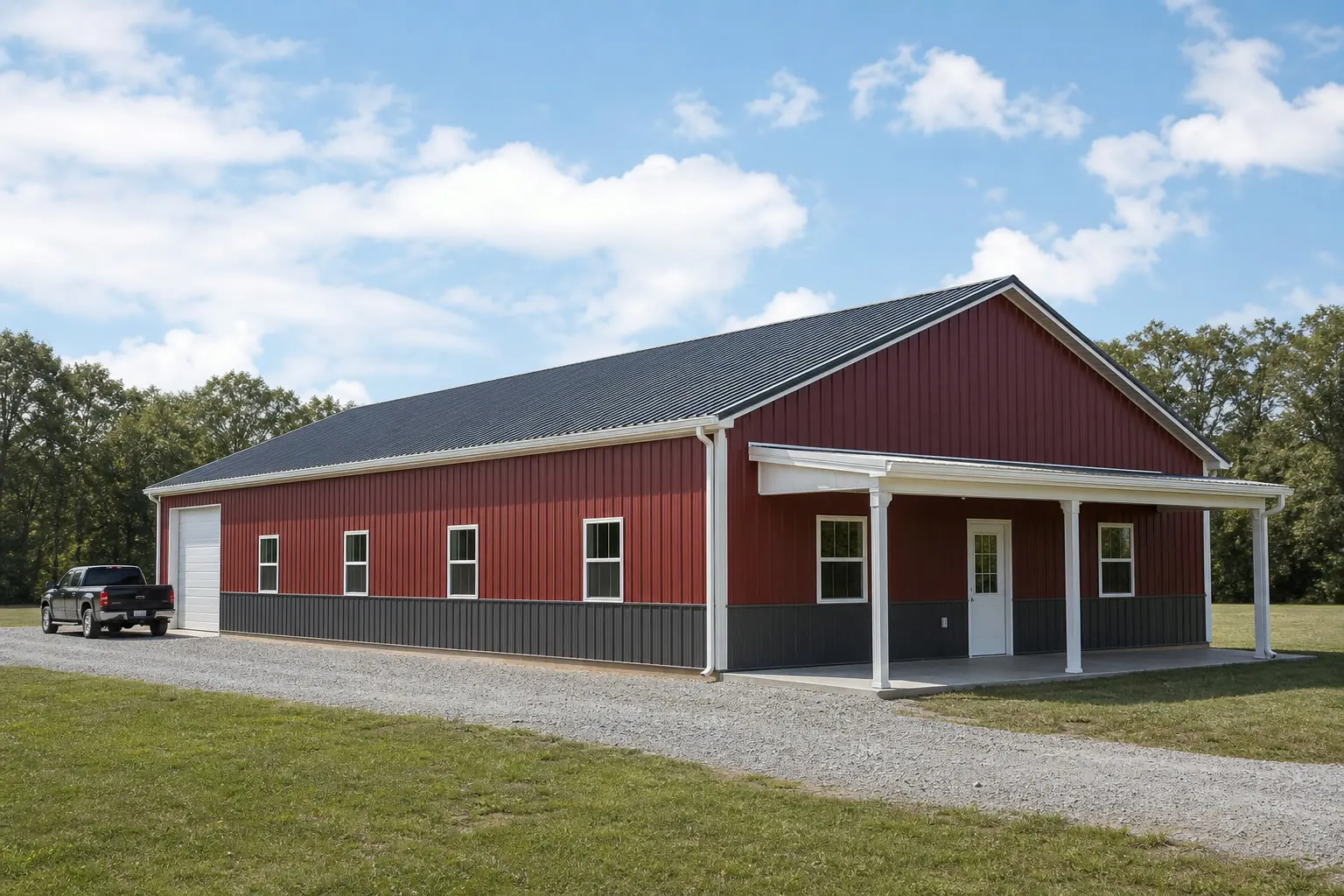
Two Buildings, One Shell, One Extreme Climate
The appeal of a barndominium in South Dakota is obvious: one foundation, one roof, and the shop attached to the house on land where the nearest service is a long drive away. The difficulty is that the two halves want opposite things. The living side wants a sealed, insulated, ventilated envelope capable of holding comfort across a range the State Climatologist puts between a record 120°F and a record -58°F. The shop side wants durability, height, big openings and tolerance for dirt, fuel and cold air rushing in every time a door opens. Projects succeed here when the separation between the two is designed deliberately at the start — structurally, thermally and mechanically — rather than treated as a wall drawn on a floor plan.
Envelope
Designing the Living Half for Continental Extremes
In South Dakota the living envelope has to work at both ends of the range, which makes continuous insulation, air sealing and mechanical ventilation core scope.
Most barndominium advice comes from milder states and treats insulation as a comfort choice. South Dakota does not permit that framing. The State Climatologist describes a continental range from a record high of 120°F to a record low of -58°F, among the largest of any state, and even ordinary seasons swing hard. A living space inside a steel shell needs continuous insulation that limits thermal bridging at the frame, an air barrier that is actually detailed at penetrations, and a mechanical ventilation strategy — because a tight envelope in a cold climate without planned ventilation moves the moisture problem indoors instead of solving it.
The winter trend adds a wrinkle. NOAA's 2022 State Climate Summary reports state temperatures have risen almost 2°F since 1900, with winter and nighttime minimums warming about twice as fast as daytime maximums. More crossings of the freezing point mean more melt and refreeze at thresholds, more moisture tracked into a heated shop, and more load on the vapour and drainage details between the shop bay and the living side. A barndominium designed only for deep cold, and not for repeated thaw, will show it at the shop-to-house junction first.
None of this requires a code number, and none is given. It requires that insulation, air sealing, vapour control and ventilation be designed together by someone who has done it in this climate, and that the county's frost depth and design loads be obtained before the foundation is set.
Design
Separating Shop From Home
The junction between the two halves is where South Dakota barndominiums succeed or fail.
- Design a genuine thermal breakThe shop will be colder, and cycling. Treat the shared wall as an exterior wall for insulation and air sealing purposes rather than an interior partition.
- Plan for fumes and combustion airVehicles, fuel and welding on one side of a wall from bedrooms demands ventilation and detection designed in, not retrofitted.
- Manage meltwater at the thresholdWith more melt-refreeze cycles than the historical pattern, a heated shop floor sheds water. Slope, drains and a floor detail at the shared wall keep it out of the living side.
- Decide the acoustic strategyA compressor or grinder next to a living room is a design problem. Mass, isolation and door placement handle it; drywall alone does not.
- Size the shop from your equipmentAt an average operation of 1,495 acres, South Dakota machinery is full scale. Establish door and eave height from what must fit before the residential layout is drawn.
- Confirm dwelling classification earlyHow your county treats a dwelling inside an agricultural-style structure affects inspections, septic and sometimes financing. Ask before design, not during permitting.
Get barndominium quotes for your South Dakota property
Tell suppliers your county, the equipment the shop must hold, and the level of finish you want on the living side. Those inputs make South Dakota quotes comparable.
Footprints
Barndominium Footprints for South Dakota Sites
Shop scale rather than house scale usually sets the overall envelope here.
40′ × 60′
2,400 sq ft
Compact shop-house: a modest living area with a genuine two-bay shop, workable where machinery is light.
40′ × 80′
3,200 sq ft
The common South Dakota balance — full living quarters at one end with a working equipment bay at the other.
60′ × 100′
6,000 sq ft
For operations parking full-scale machinery indoors alongside a complete residence, where site and budget allow.
Example Configuration — for planning purposes only.
Establish shop door and eave dimensions from your actual equipment before fixing the overall footprint.
Site Context
Where in South Dakota You Build
The state's east-west differences change foundations, utilities and logistics more than they change the floor plan.
Eastern plains
Flat, agricultural, with the most developed trade base and the Sioux Falls climate record maintained by NWS against the 1991-2020 normal period. Utility connections and contractor availability are typically easier here.
West River
Larger parcels and longer distances to suppliers and trades. Well and septic planning, delivery logistics and crew travel costs become a real part of the budget, and a slipped schedule is harder to recover.
Black Hills
USGS documents the Black Hills as a distinct uplifted dome in western South Dakota, and the Black Hills Hydrology Study has assessed the area's water resources since 1990. Rock, slope and water conditions make site investigation the first spend on these parcels rather than the last.
Evidence Position
Sourced Facts, and What We Refuse to Guess
Climate, agricultural and construction figures are cited; regulatory, lending and price outcomes are not.
Sourced above: the State Climatologist's record range of 120°F to -58°F; NOAA's 2022 State Climate Summary finding of almost 2°F warming since 1900 with faster winter and nighttime warming; Census authorization of 7,072 housing units in 2023, down 24.9% from 9,421 in 2022; the 2022 USDA Census of Agriculture average farm size of 1,495 acres; and USGS documentation of the Black Hills uplift and hydrology study.
Refused: any statement about South Dakota code adoption, county permit requirements, frost depths, snow loads, appraisal treatment of barndominiums, lender policy or price. Financing and classification in particular vary by county and by institution, and a confident published answer would be a fabrication.
Questions
South Dakota Barndominium Questions
South Dakota-specific answers for shop-house buyers.
Yes, if the envelope is designed for it. The State Climatologist describes a record range from 120°F to -58°F, so continuous insulation, careful air sealing and planned mechanical ventilation are core scope rather than optional upgrades.
Treat the shared wall as an exterior wall: insulate and air-seal it properly, plan ventilation and detection for fumes, address acoustics with mass rather than drywall alone, and detail the floor so meltwater from the shop cannot reach the living side.
Plan for a thin market. The state authorized 7,072 housing units in 2023, down 24.9% from the previous year, so crews experienced in residential-grade finishing inside a steel shell are in limited supply and book early.
Size it from your equipment, not from a plan book. With South Dakota operations averaging 1,495 acres, the machinery that needs to fit is usually full scale, and door and eave heights should be set before the residential layout is drawn.
Frequently. USGS documents the Black Hills as a distinct uplifted dome with its own hydrology study, and rock, slope and water conditions make site investigation, foundation design and well planning the leading variables there.
That is a lender-by-lender answer and we will not generalise. Ask early, because the answer can shape the design, the classification you seek from the county, and the construction sequence.
Sources for the South Dakota facts on this page
This page states no code requirement, wind speed, snow load, permit rule, price or supplier claim. The state-specific facts it does use are listed with their publisher below.
South Dakota's State Climatologist describes the state, located in the northern High Plains, as exhibiting continental climate extremes, with a range from a record high of 120°F to a record low of -58°F, among the largest such ranges of any U.S. state.
South Dakota State Climatologist (South Dakota State University / CoCoRaHS) · State climatologist reference summary · Tier 2
https://media.cocorahs.org/docs/ClimateSum_SD.pdfNOAA's 2022 State Climate Summary reports South Dakota temperatures have risen almost 2°F since the beginning of the 20th century, with winter and nighttime minimum temperatures warming about twice as fast as daytime maximums.
NOAA National Centers for Environmental Information (NCEI) · 2022 summary, trend since 1900 · Tier 1
https://statesummaries.ncics.org/downloads/SouthDakota-StateClimateSummary2022.pdfSouth Dakota had 7,072 total housing units authorized by building permits in 2023, down 24.9% from 9,421 units in 2022.
U.S. Census Bureau · 2023 (vs. 2022) · Tier 1
https://www.census.gov/construction/bps/pdf/2023annualhighlights.pdfSouth Dakota had 42,304,601 acres of land in farms in 2022 (down 2% since 2017), with an average farm size of 1,495 acres (up 4%), and market value of agricultural products sold of $12,935,225,000 (up 33%).
USDA NASS · 2022 · Tier 1
https://www.nass.usda.gov/Publications/AgCensus/2022/Online_Resources/County_Profiles/South_Dakota/cp99046.pdfUSGS geologic mapping and survey work (in cooperation with the South Dakota School of Mines and Technology) documents the Black Hills as a geologically distinct uplifted dome region in western South Dakota, with the Black Hills Hydrology Study (initiated 1990) assessing the area's water resources.
U.S. Geological Survey (USGS) · USGS Black Hills Hydrology Study, initiated 1990 · Tier 1
https://pubs.usgs.gov/ha/ha744c/ha744cIntro.html