
Barndominium · NV
Barndominiums in Nevada
Nevada is officially the driest state in the country, according to NOAA's 2022 State Climate Summary, yet a barndominium planned near Reno is not solving the same problem as one planned near Las Vegas. NOAA's 1991-2020 station normals show Las Vegas averaging 4.18 inches of precipitation a year with just 0.2 inches of snow, while Reno averages 7.35 inches with 20.9 inches of snow — a divide the state's own climate office traces to the Sierra Nevada intercepting Pacific storms before they reach the Basin and Range. Add in an average Nevada farm of 1,889 acres and most rural barndominium sites are also planning around distance from services, not just which side of that climate line they fall on.
The intersection
One state name, two very different roofs
A barndominium buyer researching Nevada as a single state can be misled by that framing, because the roof, drainage and site plan that make sense at one end of the state are the wrong answer at the other end.
NOAA's 1991-2020 climate normals record Las Vegas McCarran station averaging 4.18 inches of annual precipitation with just 0.2 inches of snow, while Reno International Airport averages 7.35 inches of precipitation and 20.9 inches of snow over the same normal period. Both are real, current Nevada numbers; neither describes 'Nevada's climate' on its own. A barndominium roof pitch, gutter capacity and any snow-shedding consideration a builder raises depend heavily on which of these two profiles is closer to the actual parcel.
The Nevada State Climate Office explains the mechanism: the Sierra Nevada wrings moisture out of Pacific storms before they can reach the state's eastern Basin and Range terrain, while the Rocky Mountains simultaneously block Gulf of Mexico moisture from the other direction. The result is a rain-shadow desert overall — NOAA's 2022 State Climate Summary calls Nevada the driest state in the country — but the shadow is deepest in the low valleys and considerably thinner at higher, more northern elevations near mountain ranges like the Sierra front.
None of this substitutes for an engineered snow-load or wind-design value, which is set locally and depends on your parcel's elevation and jurisdiction. What it does mean is that a Nevada barndominium buyer should treat 'Nevada' as a starting search term, not a finished climate profile, and confirm which side of the state's rain-shadow divide their actual site sits on before finalizing roof and drainage specifications with a builder.
Site context
Four Nevada settings, four different site briefs
Elevation and proximity to the Sierra Nevada front change the planning brief more than county lines do across Nevada's roughly 109,781 square miles.
Southern low-desert valleys
Represented by the 4.18-inch Las Vegas normal. Heat and sun exposure, not snow, dominate the planning conversation; drainage still matters during infrequent intense storms.
Reno-area and Sierra-front terrain
Represented by the 20.9-inch Reno snowfall normal. Roof pitch, snow retention and gutter capacity are worth a direct conversation with a builder here, in addition to whatever your local jurisdiction sets as a design requirement.
Large rural ranch acreage
The state's 1,889-acre average farm size sits in this category. Expect the access road, well, septic and utility run length to shape the build timeline as much as the structure itself.
Sites nearer an active permitting office
Nevada authorized 19,994 new housing units in 2024 through local permit offices, showing departments statewide process residential construction routinely; your local office remains the only source for what your parcel specifically requires.
Exposure
Drainage planning depends on which normal is closer
A statewide 'driest state' label can encourage a barndominium buyer to under-plan for water; the two station normals show why that instinct fails depending on location.
In the Las Vegas-normal end of the state, low annual totals mean drainage planning is about surviving a rare but intense summer storm rather than managing steady moisture — grading the pad and directing roof runoff away from the foundation still matters even where rain is infrequent.
In the Reno-normal end of the state, nearly 21 inches of annual snowfall changes the conversation to snow accumulation against walls, roof snow-shedding clearance for doors, and freeze-thaw behavior at the foundation edge — considerations a Las Vegas-area build simply does not face in the same way.
- Identify your normal before specifying the roof
- Ask which climate profile — desert-valley or Sierra-front — is closer to your actual parcel before fixing pitch and gutter capacity.
- Grade for the rare event, not the average
- Even in the driest parts of the state, pad grading should assume an occasional intense storm rather than the low annual mean.
- Confirm snow behavior locally in the north
- Roof snow retention and door clearance are worth a specific conversation with your builder if the parcel sits near the Sierra front.
Get Nevada barndominium quotes
Tell us where your parcel sits, your climate profile and rough footprint. We route it with the Nevada and barndominium context already attached.
Configuration
What a Nevada barndominium is usually asked to do
On a large, isolated parcel, the barndominium is often the only structure covering home, shop and equipment storage under one roofline.
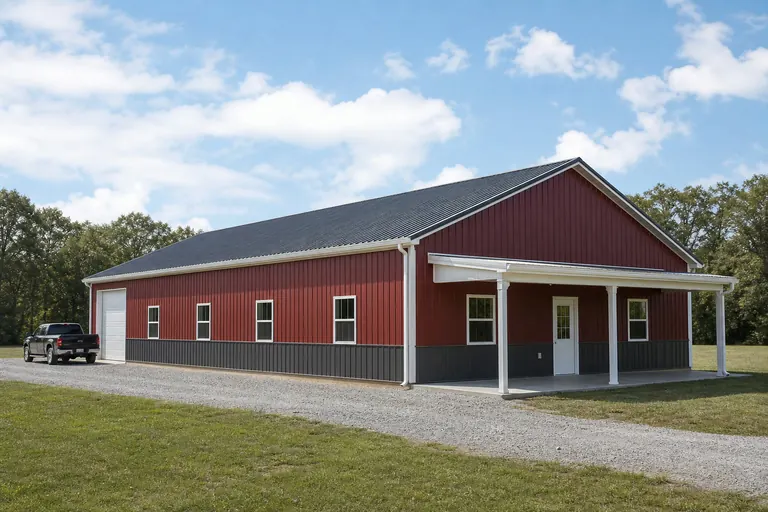 Living quarters plus attached shopA common Nevada configuration pairs finished living space with an unfinished bay for vehicles or ranch equipment, sharing one foundation and roofline.Primary residence on a working parcelWhere the barndominium is the sole residence on a large holding, utility runs and driveway grading typically drive layout more than aesthetic choices.
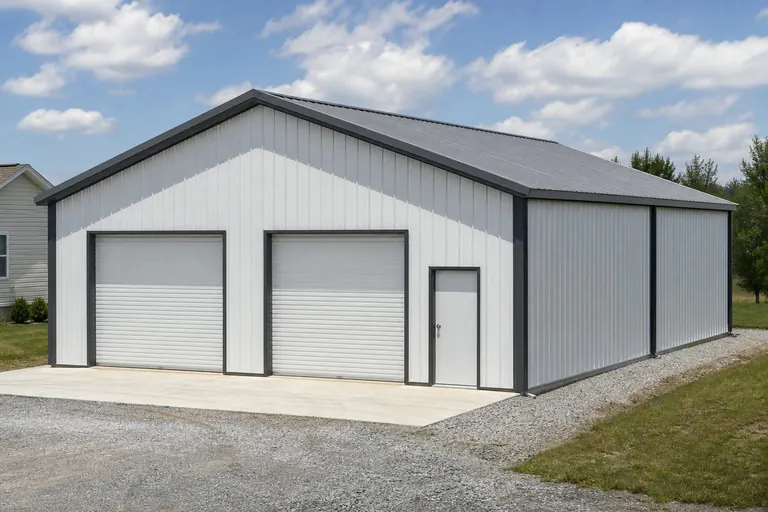 Weekend or seasonal desert retreatSome southern Nevada parcels host a barndominium used seasonally, with heat and sun exposure shaping window placement and shade structures.
Example Configuration — for planning purposes only.
Footprint
Sizes that suit a Nevada ranch-parcel barndominium
Isolation and a combined living-plus-shop brief push Nevada footprints toward width that supports both functions under one roof, regardless of which climate normal applies.
30′ × 50′
1,500 sq ft
A workable minimum for a living-space-plus-single-bay configuration on a smaller parcel.
40′ × 60′
2,400 sq ft
Common where the living quarters and an equipment bay both need real square footage.
40′ × 80′
3,200 sq ft
Adds a second bay or a larger shop end without widening the frame.
60′ × 80′
4,800 sq ft
For a working ranch parcel where the barndominium anchors both the residence and the main equipment storage.
Example Configuration — for planning purposes only.
Footprint pages carry layout and door detail for each of these; this page only explains why the Nevada brief tends to land in this range.
Preparation
Before you request a Nevada barndominium quote
Five things resolved in advance make the difference between a comparable quote and a re-quote on a Nevada parcel.
Step 1
Contact your local building department
Nevada's permitting and code administration is handled locally; ask what your parcel, elevation and use require before you fix the specification.
Step 2
Confirm which climate normal fits your site
Reno-area and Las Vegas-area sites face very different snow and precipitation profiles; do not spec a roof from the wrong end of the state.
Step 3
Confirm well and septic capacity
On a large rural parcel these frequently size the living quarters more than any design preference does.
Step 4
Measure the access road
A long or ungraded private drive can affect delivery logistics for the building shell; give your builder real distances.
Step 5
Describe every function the building serves
A combined home-and-shop brief priced as a residence only is a common cause of a second round of quoting.
Questions
Nevada barndominium questions
Questions we can answer honestly at state level, with the ones we cannot routed to whoever actually owns them.
No. NOAA's own 2022 State Climate Summary calls Nevada the driest state overall, but that statewide figure hides a sharp local divide: Reno's normal shows 20.9 inches of annual snowfall against Las Vegas's 0.2 inches. Drainage and roof planning should follow your actual site's normal, not the statewide superlative.
Permit requirements depend on your county or municipality, your parcel and how the building is used. Local permit offices in Nevada authorized 19,994 new housing units in 2024, so this is an active, well-understood process locally — but only your building department can tell you what your specific project needs.
The Nevada State Climate Office explains that the Sierra Nevada wrings moisture from Pacific storms before they reach the state's eastern terrain, and simultaneously the Rockies block Gulf of Mexico moisture reaching the state — a rain-shadow effect that is much stronger in the south than near the Sierra front where Reno sits.
There is no official typical size, but the 2022 Census of Agriculture put the state's average farm at 1,889 acres, among the largest average farm sizes nationally. Many rural barndominium sites sit on holdings of that scale, which is why access and utility distance are early planning questions.
We do not publish state-level prices, because a credible number depends on specification, site work, well/septic scope and current material pricing. Our cost pages cover what drives the number; a quote covers your building.
We could not confirm an official FEMA state-level hazard narrative for Nevada from a citable FEMA source in this research pass, so we do not make a wildfire claim here. Check FEMA's National Risk Index tool directly and ask your local fire authority and building department about your specific parcel.
Sources for the Nevada facts on this page
This page states no code requirement, wind speed, snow load, permit rule, price or supplier claim. The state-specific facts it does use are listed with their publisher below.
Las Vegas McCarran station 1991-2020 annual normal precipitation is 4.18 inches with 0.2 inches of annual snowfall.
NOAA National Centers for Environmental Information (NCEI) · 1991-2020 · Tier 1
https://www.ncei.noaa.gov/access/services/data/v1?dataset=normals-annualseasonal-1991-2020&dataTypes=ANN-PRCP-NORMAL,ANN-SNOW-NORMAL&stations=USW00023169&format=jsonReno International Airport station 1991-2020 annual normal precipitation is 7.35 inches with 20.9 inches of annual snowfall, illustrating Nevada's sharp north-south climate divide.
NOAA National Centers for Environmental Information (NCEI) · 1991-2020 · Tier 1
https://www.ncei.noaa.gov/access/services/data/v1?dataset=normals-annualseasonal-1991-2020&dataTypes=ANN-PRCP-NORMAL,ANN-SNOW-NORMAL&stations=USW00023185&format=jsonNOAA's State Climate Summaries 2022 states Nevada is the driest state in the United States, with temperatures having risen almost 2.4°F since the beginning of the 20th century.
NOAA National Centers for Environmental Information (NCEI) · State Climate Summaries 2022 · Tier 1
https://statesummaries.ncics.org/chapter/nv/Nevada had 5,896,654 acres of land in farms in 2022, an average farm size of 1,889 acres, among the largest average farm sizes in the country.
USDA NASS · 2022 · Tier 1
https://www.nass.usda.gov/Publications/AgCensus/2022/Online_Resources/County_Profiles/Nevada/cp99032.pdfThe Nevada State Climate Office (University of Nevada, Reno) explains the Sierra Nevada wrings moisture from Pacific storms while the Rocky Mountains block Gulf of Mexico moisture, and the resulting dry air contributes to Nevada's extreme temperature swings.
Nevada State Climate Office, University of Nevada, Reno · Extension reference page · Tier 2
https://www.unr.edu/nevada-climate-office/about-our-climateLocal building permit offices in Nevada authorized 19,994 new privately-owned housing units in 2024.
U.S. Census Bureau · 2024 (full calendar year) · Tier 1
https://www.census.gov/construction/bps/stateannual.html