
Barndominium · MS
Barndominiums in Mississippi
Mississippi's 10.25 million acres of farmland are now split across fewer, larger operations averaging 328 acres apiece, and that consolidation is exactly the kind of shift that puts a combined home-and-shop barndominium on the table for owners who previously ran two separate structures. Whether the parcel sits on Delta alluvial soil, the state's central loess hills, or the Piney Woods, the ground itself changes what a barndominium foundation and drainage plan need to do before the steel frame goes up.
Why Mississippi
Fewer, larger farms are reshaping the barndominium math
Mississippi lost farms but not farmland acreage between 2017 and 2022, and that shift toward bigger single operations is a direct driver for combined-use steel residences.
Mississippi recorded 31,290 farms in the 2022 Census of Agriculture, an 11% drop from five years earlier, while total land in farms fell only 2% to 10,251,497 acres. Read together, those two numbers describe consolidation: fewer operators are working roughly the same amount of land, at an average of 328 acres per farm. That is the backdrop against which a barndominium decision gets made — an owner managing a larger single tract has less appetite for maintaining a farmhouse, a separate equipment shed, and a detached garage as three buildings when one steel structure can hold living space, an equipment bay and covered parking under a single roof.
That same consolidation trend also changes the site logistics conversation. A larger single tract usually means the barndominium sits farther from a paved county road, so driveway length, culvert sizing and all-weather access for delivery trucks during construction deserve attention early, before the foundation is scheduled.
None of this changes how the permit gets filed. A barndominium built as a primary residence in Mississippi goes through the same municipal or county residential review as a conventional stick-built home in that jurisdiction — footing inspection, framing inspection, and a final before occupancy. What changes is the site engineering leading up to that first inspection.
Regional Planning
Delta, hill country and Piney Woods each set a different foundation question
Mississippi State University Extension groups the state's land into distinct resource areas, and the barndominium's footing plan should follow that grouping.
Mississippi Delta
Extension identifies the Delta as an alluvial-plain area built from sediment the Mississippi River deposited over time. That river-laid soil profile is generally deep and flat, which favors a straightforward slab, but it also holds moisture, so perimeter drainage and a vapor barrier under the slab are worth verifying with a local soils test rather than assuming a standard spec transfers unchanged.
Loess Hills & Central Mississippi
Away from the Delta, the terrain shifts to loess-derived hill country with more relief. A barndominium sited here is more likely to need cut-and-fill grading and a foundation plan that accounts for slope rather than a flat pad, which also affects where the equipment-bay end of the building sits relative to the house end.
Coastal Plain & Piney Woods (South Mississippi)
Southern Mississippi's Coastal Plain and forested Piney Woods carry sandier, faster-draining soils in places, but proximity to the Gulf raises separate questions about wind exposure and storm-shutter planning that a local engineer, not a statewide template, should size.
Climate Response
Designing the envelope for sustained humidity, not snow
Jackson's climate normals describe a wet, snow-free climate that shifts barndominium priorities toward drainage and condensation control.
The National Centers for Environmental Information's 1991-2020 normals for the Jackson-Evers station show 57.35 inches of annual precipitation against roughly 1.0 inch of average annual snowfall. NWS Jackson describes the surrounding forecast area as humid subtropical, with rainfall potential spread across the year rather than concentrated in a short winter season. A barndominium roof and gutter system in Mississippi is effectively sized against sustained rainfall volume, not snow load, which is the opposite planning priority from a northern-state guide.
That humid, wet-year-round profile also makes interior condensation control a standing concern for a steel-skinned residence. Warm, moisture-laden outside air meeting a cooler interior steel surface can sweat without a continuous thermal break and a vapor retarder detailed into the wall assembly, and that risk runs longer through the calendar in Mississippi than in a drier or colder state.
- Continuous Thermal Break
- Manages condensation risk across Mississippi's long humid season, not just a short summer window.
- Sustained-Rainfall Drainage
- Gutters, downspouts and site grading sized against a 57.35-inch annual normal rather than snow load.
- Soil-Specific Footing
- Delta alluvial soil, loess hill terrain and Coastal Plain sand each call for a distinct footing verification.
Start your Mississippi barndominium project
Get connected with specialists who understand Mississippi's Delta, hill-country and Gulf Coast site conditions.
Application
How Mississippi owners are pairing a barndominium with working land
Three common Mississippi property patterns for a residential steel building, tied to the state's own land use profile.
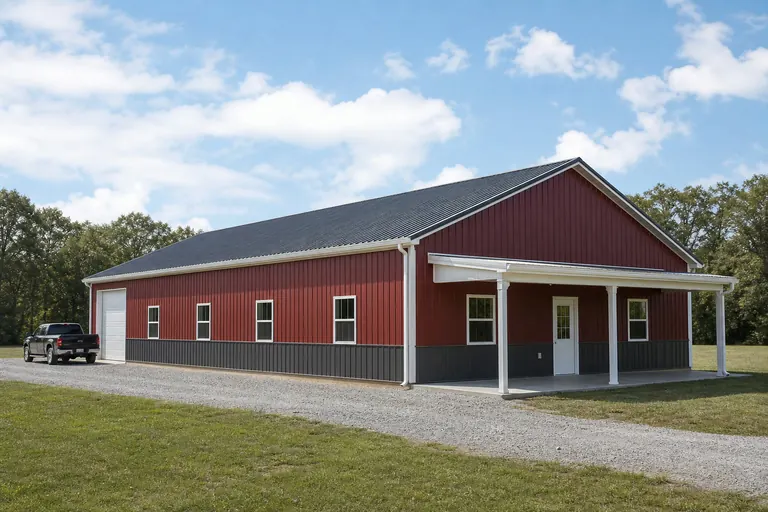 The Delta Row-Crop ResidenceA wide, single-story plan on flat alluvial ground, pairing full living space with an equipment bay sized for a consolidated operation nearer the 328-acre state average.The Hill-Country HomesteadA compact footprint set into sloped loess terrain, prioritizing grading and a smaller attached shop over maximum square footage.The Piney Woods Timber-Adjacent BuildA residence-forward layout on forested Coastal Plain land, with storm readiness and covered equipment storage as design drivers.
Example Configuration — for planning purposes only.
Risk & Readiness
Before you finalize a Mississippi barndominium spec
A short list of Mississippi-specific verifications worth doing before the foundation is poured.
- Pull your county's FEMA National Risk Index entryFEMA's statewide mean composite score across all 82 Mississippi counties is 50.9 out of 100, among the higher state averages nationally, but that mean hides real county variation — check your specific county's entry at FEMA's National Risk Index tool before finalizing structural specs.
- Review NWS Jackson's tornado history for your areaNWS Jackson's compiled Storm Data statistics covering 1950-2021 document Mississippi's long-term tornado record; a local safe-room or reinforced-room conversation with your builder is worth having before framing, especially given that history.
- Get a Delta-versus-hill soil check before the footing designExtension's land-resource mapping shows real soil differences across the state; a site-specific soils test, not a copy-paste footing spec, should drive the foundation plan.
- Confirm well/septic capacity if pairing with an existing farmhouseOn a consolidated larger tract, check with your county health department whether an existing system has capacity for the barndominium's added bedrooms and fixtures, or whether a dedicated system is required.
Questions
Mississippi Barndominium FAQ
Practical questions specific to planning a residential steel building in Mississippi.
Yes. Mississippi State University Extension groups Delta alluvial soils separately from the state's loess hills and Coastal Plain, and that grouping affects footing design, grading, and drainage planning enough to warrant a site-specific soils check rather than reusing a plan from a different part of the state.
Jackson's 1991-2020 climate normal records about 1.0 inch of average annual snowfall, a sourced fact rather than a load figure. Any required roof snow-load value is set by your local building department and project engineer, not by this page; on the rainfall side, sizing the roof and gutters against the 57.35-inch annual normal is worth discussing with your builder.
USDA's 2022 Census of Agriculture recorded 31,290 Mississippi farms, down 11% since 2017, with average farm size holding near 328 acres. Owners on these larger, consolidated tracts often have room to combine full residential space with a working shop bay in a single structure rather than maintaining separate buildings.
There is no statewide data suggesting that. Mississippi authorized 7,700 new housing units in 2023, and a barndominium built as a primary residence generally follows the same municipal or county residential permit sequence as any custom home; confirm specific requirements with your local building department.
It varies by county. FEMA's National Risk Index puts Mississippi's statewide mean composite hazard score at 50.9 of 100 across all 82 counties, but the authority having jurisdiction and FEMA's own county-level NRI entry are the right sources for your specific site rather than the statewide average.
Often yes, if the siting avoids drainage tile, irrigation infrastructure and existing field access routes; coordinate with your county's building department and any agricultural extension contact before finalizing the pad location.
Sources for the Mississippi facts on this page
This page states no code requirement, wind speed, snow load, permit rule, price or supplier claim. The state-specific facts it does use are listed with their publisher below.
Mississippi had 31,290 farms in 2022, an 11% decrease since 2017.
USDA National Agricultural Statistics Service (NASS) · 2022 · Tier 1
https://www.nass.usda.gov/Publications/AgCensus/2022/Online_Resources/County_Profiles/Mississippi/cp99028.pdfMississippi had 10,251,497 acres of land in farms in 2022, a 2% decrease since 2017, with an average farm size of 328 acres.
USDA NASS · 2022 · Tier 1
https://www.nass.usda.gov/Publications/AgCensus/2022/Online_Resources/County_Profiles/Mississippi/cp99028.pdfMississippi State University Extension identifies the Mississippi Delta as an alluvial-plain land resource area with soils formed from sediments left by the Mississippi River, distinct from the state's loess and coastal-plain regions.
Mississippi State University Extension Service · Extension reference material · Tier 2
https://extension.msstate.edu/agriculture/soils/mississippi-land-resource-areasJackson, MS's 1991-2020 annual normal precipitation is 57.35 inches with essentially negligible average annual snowfall (about 1.0 inch).
NOAA National Centers for Environmental Information (NCEI) · 1991-2020 · Tier 1
https://www.ncei.noaa.gov/access/services/data/v1?dataset=normals-annualseasonal-1991-2020&stations=USW00003940&format=json&dataTypes=ANN-PRCP-NORMAL,ANN-SNOW-NORMALBuilding permit offices in Mississippi authorized construction of 7,700 new privately-owned housing units in 2023 (7,145 single-family buildings plus multi-unit structures).
U.S. Census Bureau · 2023 (final annual) · Tier 1
https://www2.census.gov/econ/bps/State/st2023a.txtFEMA's National Risk Index reports Mississippi's 82 counties with a mean composite NRI risk score of 50.9 on FEMA's 0-100 relative scale (v1.20 release), among the higher state averages nationally.
Federal Emergency Management Agency (FEMA) · NRI v1.20 dataset · Tier 1
https://www.fema.gov/flood-maps/products-tools/national-risk-index