
Barndominium · ME
Barndominiums in Maine
A Maine barndominium is planned around a winter that delivers snow and rain in roughly equal seriousness. NOAA's 1991-2020 normals for the Portland Jetport station record January and February mean snowfall of about 15 to 19 inches each, layered on top of roughly 51 inches of annual precipitation spread fairly evenly across the year, so runoff management around the building pad matters in every season, not only in the depth of winter. That pad itself typically sits on ground the Maine Geological Survey describes as mantled by glacial and post-glacial sediments — till, marine clay, sand and gravel deposited as the last ice age retreated roughly 10,000 to 16,000 years ago — which makes a site-specific soils read a genuine prerequisite rather than a formality. USDA's 2022 Census of Agriculture counts 7,036 Maine farms averaging 174 acres, a scale that keeps most attached shop bays sized for a working operation rather than a hobby footprint.
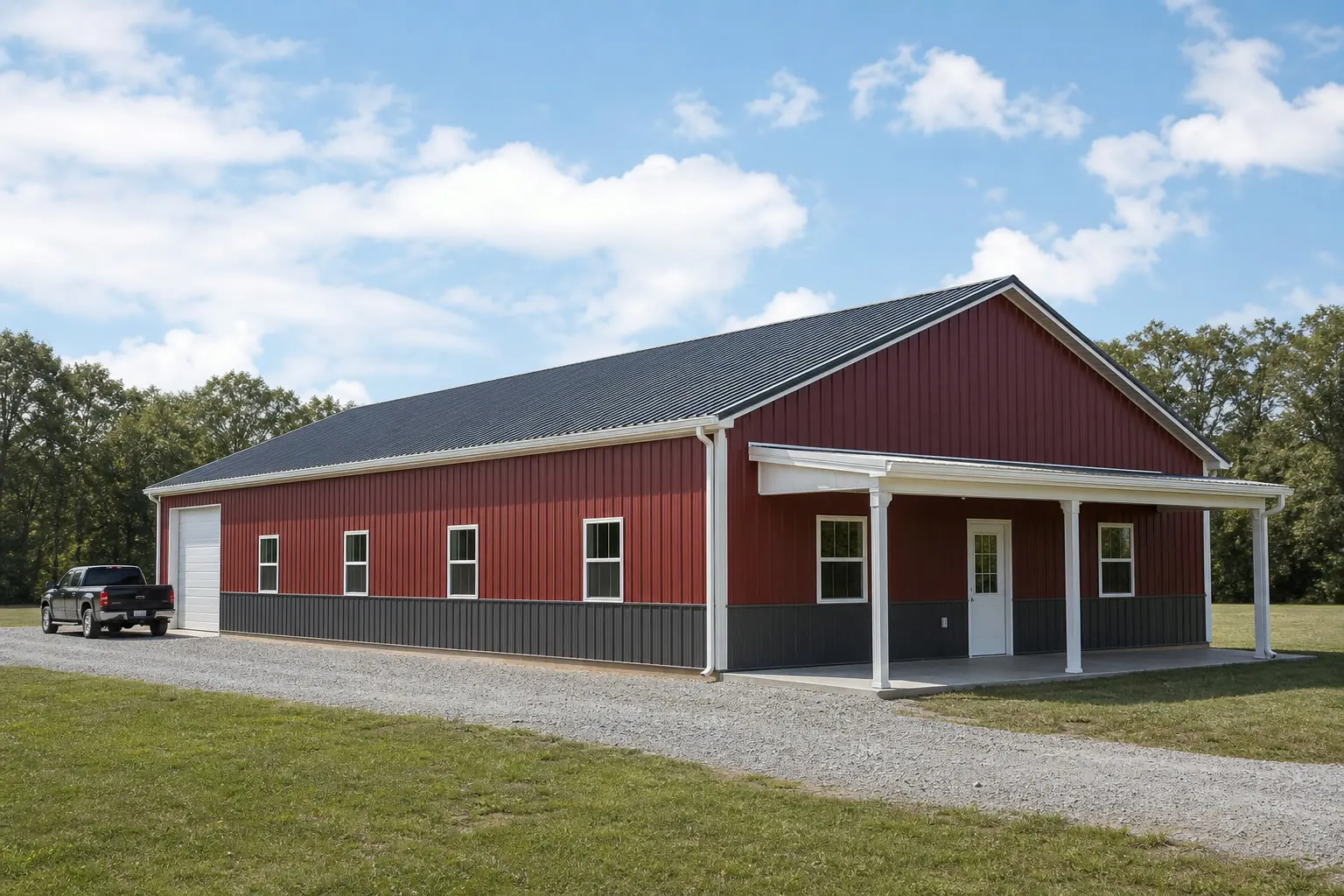
Snow, Rain and Ice-Age Ground
Maine's barndominium buyer is usually reconciling two site facts that most guides treat separately. NOAA's Portland Jetport normals put January and February snowfall at roughly 15 to 19 inches each month on average, on top of about 51 inches of annual precipitation distributed fairly evenly across the year — a winter that is heavy in both snow and moisture. Underneath that, the Maine Geological Survey describes the state's surface as mantled by glacial and post-glacial sediments left behind as the last ice age retreated roughly 10,000 to 16,000 years ago, meaning soil conditions can shift meaningfully within a short distance. Both facts argue for site-specific engineering before floor plans are finalized, not a one-size answer borrowed from a neighboring state.
Envelope
Building for snow load and moisture at the same time
A Maine barndominium envelope has to handle a winter that is wet as well as cold, which changes both roof and drainage decisions.
The NOAA 1991-2020 normals for Portland show January and February averaging roughly 15 to 19 inches of snowfall each, a pattern NWS Gray's own seasonal climate summary documents alongside station-level temperature and freeze-day counts for the Portland area. That figure is climate context, not a structural design value — the applicable roof design requirement for your specific municipality is set by the authority having jurisdiction, so confirm it with your local code official before roof framing is finalized.
What is worth planning around directly is the roughly 51 inches of annual precipitation the same Portland normals show, distributed fairly evenly through the year rather than concentrated in one season. That combination — heavy winter snow plus consistent year-round rainfall — means roof drainage, gutter capacity and grading away from the foundation deserve as much attention as the roof's structural rating, since a barndominium's attached shop bay creates more roof area and more concentrated runoff points than a simple rectangular home.
Site
Reading Maine's Glacial Ground Before You Site the Pad
Maine's glacially derived surficial geology means the parcel next door can have different bearing soil than yours, so a generic foundation assumption is a real risk here.
- Commission a site-specific soils testThe Maine Geological Survey's description of statewide till, marine clay, sand and gravel deposits means bearing capacity and drainage behavior genuinely vary parcel to parcel; a soils report for your exact pad location is worth the cost before foundation design is locked.
- Ask specifically about marine clayWhere a site sits on former marine clay deposits from post-glacial submergence, foundation and drainage design typically needs different handling than a till or sand-and-gravel site; your geotechnical engineer should identify which condition applies.
- Grade for both snowmelt and rainWith roughly 51 inches of annual precipitation on top of heavy winter snowfall, final grading around the barndominium's foundation should be designed to move both spring snowmelt and regular rain away from the structure.
- Confirm frost depth and footing design locallyFrost depth requirements are set by your municipal or county code office in Maine; no statewide frost figure is asserted here because none was verified against a citable source for this page.
- Size the shop bay from your actual equipmentWith Maine's average farm running 174 acres per USDA's 2022 Census of Agriculture, many shop bays are sized to hold real equipment; list what needs to fit before the footprint is finalized.
Get Maine barndominium quotes
Tell suppliers your county, your soil conditions if known, and the equipment your shop half must hold. We route it with the Maine and barndominium context already attached.
Land use
A shrinking but still substantial farm base
Maine's farm count and average acreage both point to a working-land context for many barndominium parcels, even as the total number of farms has declined.
USDA's 2022 Census of Agriculture counted 7,036 Maine farms, down from 7,600 in 2017, covering 1,225,046 acres of land in farms at an average of 174 acres per farm. That decline is worth naming honestly rather than glossing over: some barndominium sites in Maine are being carved out of land that was in active agricultural use within the last five years, which can carry different soil compaction, drainage tile or field-access considerations than long-vacant acreage. A 174-acre average also keeps a genuinely functional shop bay — sized for tractors, hay equipment or seasonal storage — a realistic design target rather than an oversized indulgence for many Maine buyers.
Footprint
Footprints that suit a Maine site-and-shop brief
Snow-shedding roof geometry and a working shop bay both push Maine footprints toward proven, moderately sized layouts rather than the largest available option.
30′ × 50′
1,500 sq ft
A residential-leaning footprint for a compact household on a constrained or sloped Maine parcel.
40′ × 60′
2,400 sq ft
A balanced living-plus-shop split suited to a working farm bay without oversizing the roof area.
40′ × 80′
3,200 sq ft
Room for full-scale equipment storage alongside complete living quarters on a larger acreage.
Example Configuration — for planning purposes only.
Confirm roof snow load design with your municipal code office before finalizing roof pitch and shop bay dimensions.
Questions
Maine barndominium questions
Honest state-level answers, with anything jurisdiction- or lender-specific routed to who actually owns it.
We do not publish a design figure on this page. NOAA's Portland normals show January and February averaging 15 to 19 inches of snowfall each, which is useful planning context, but the applicable structural design requirement for your parcel is decided by your municipal or county code office, so confirm it there before roof framing is finalized.
Yes. The Maine Geological Survey describes the state's surface as mantled by glacial and post-glacial sediments — till, marine clay, sand and gravel — left behind after the last ice age. That variability is a real reason to commission a site-specific soils test rather than assume a neighboring parcel's foundation design applies to yours.
Start from your actual equipment list. USDA's 2022 Census of Agriculture puts Maine's average farm at 174 acres, a scale that supports a genuinely functional shop bay for many buyers, but the right size depends on what you specifically need to store.
Maine's farm count fell from 7,600 in 2017 to 7,036 in 2022 per USDA NASS, so some available parcels were recently in active agricultural use. That can carry drainage or soil-compaction considerations worth discussing with a site contractor before you finalize a purchase.
Ask specifically how they plan to handle both winter snowmelt and the roughly 51 inches of annual precipitation NOAA's Portland normals record, since that combination puts real, year-round demand on gutters, roof drainage and site grading around a barndominium's larger roof footprint.
FEMA's National Risk Index covers all 16 Maine counties across 18 hazard types, but no single official statewide hazard-ranking narrative was available to cite directly here. Check the FEMA NRI tool for your specific county before finalizing site risk assumptions.
Sources for the Maine facts on this page
This page states no code requirement, wind speed, snow load, permit rule, price or supplier claim. The state-specific facts it does use are listed with their publisher below.
The Portland, ME NOAA 1991-2020 normals show winter monthly snowfall means around 15-19 inches in January and February, indicative of a snow-heavy northern New England winter.
NOAA National Centers for Environmental Information (NCEI) · 1991-2020 · Tier 1
https://www.ncei.noaa.gov/access/services/data/v1?dataset=normals-monthly-1991-2020&format=pdf&stations=USW00014764Portland, ME's NOAA 1991-2020 climate normals show annual precipitation totals of about 51 inches, distributed fairly evenly through the year with over 3 inches of rain most months.
NOAA National Centers for Environmental Information (NCEI) · 1991-2020 · Tier 1
https://www.ncei.noaa.gov/access/services/data/v1?dataset=normals-monthly-1991-2020&format=pdf&stations=USW00014764The Maine Geological Survey describes most of the state's surface as mantled by glacial and post-glacial sediments (till, marine clay, sand and gravel) deposited during and after the last ice age, which ended roughly 10,000-16,000 years ago.
Maine Geological Survey (Dept. of Agriculture, Conservation & Forestry) · MGS reference material · Tier 2
https://www.maine.gov/DACF/mgs/explore/surficial/facts/surficial.htmMaine had 1,225,046 acres of land in farms in 2022, an average farm size of 174 acres.
USDA NASS · 2022 · Tier 1
https://www.nass.usda.gov/Publications/AgCensus/2022/Full_Report/Volume_1,_Chapter_1_State_Level/Maine/st23_1_001_001.pdfMaine had 7,036 farms in 2022, down from 7,600 in 2017.
USDA National Agricultural Statistics Service (NASS) · 2022 (with 2017 comparison) · Tier 1
https://www.nass.usda.gov/Publications/AgCensus/2022/Full_Report/Volume_1,_Chapter_1_State_Level/Maine/st23_1_001_001.pdfBuilders in Maine were authorized to construct 6,034 new privately-owned housing units in 2024, of which 4,650 were single-unit structures.
U.S. Census Bureau · 2024 (final annual estimates) · Tier 1
https://www.census.gov/construction/bps/stateannual.html