
Barndominium · IL
Barndominiums in Illinois
Illinois does not have one terrain story, and that matters before a barndominium foundation is ever discussed. The Illinois State Geological Survey names a dozen physiographic divisions statewide, from the Chicago Lake Plain in the northeast to the Shawnee Hills Section in the deep south, and the flat till-plain ground that makes up much of central Illinois behaves nothing like the driftless bluff country near the Wisconsin border. Layer in two other Illinois-specific numbers worth knowing before you plan: the state's farm count fell 2% between 2017 and 2022 to 71,123 farms, even as total land in farms stayed above 26 million acres, while statewide housing permit activity rose 20.5% from 2023 to 2024. Put together, that is a state where working farmland is consolidating into fewer, still-large holdings while general residential building demand is accelerating — a combination that shapes both where a barndominium buyer is likely to find land and how competitive that state's builder and trade market currently is.
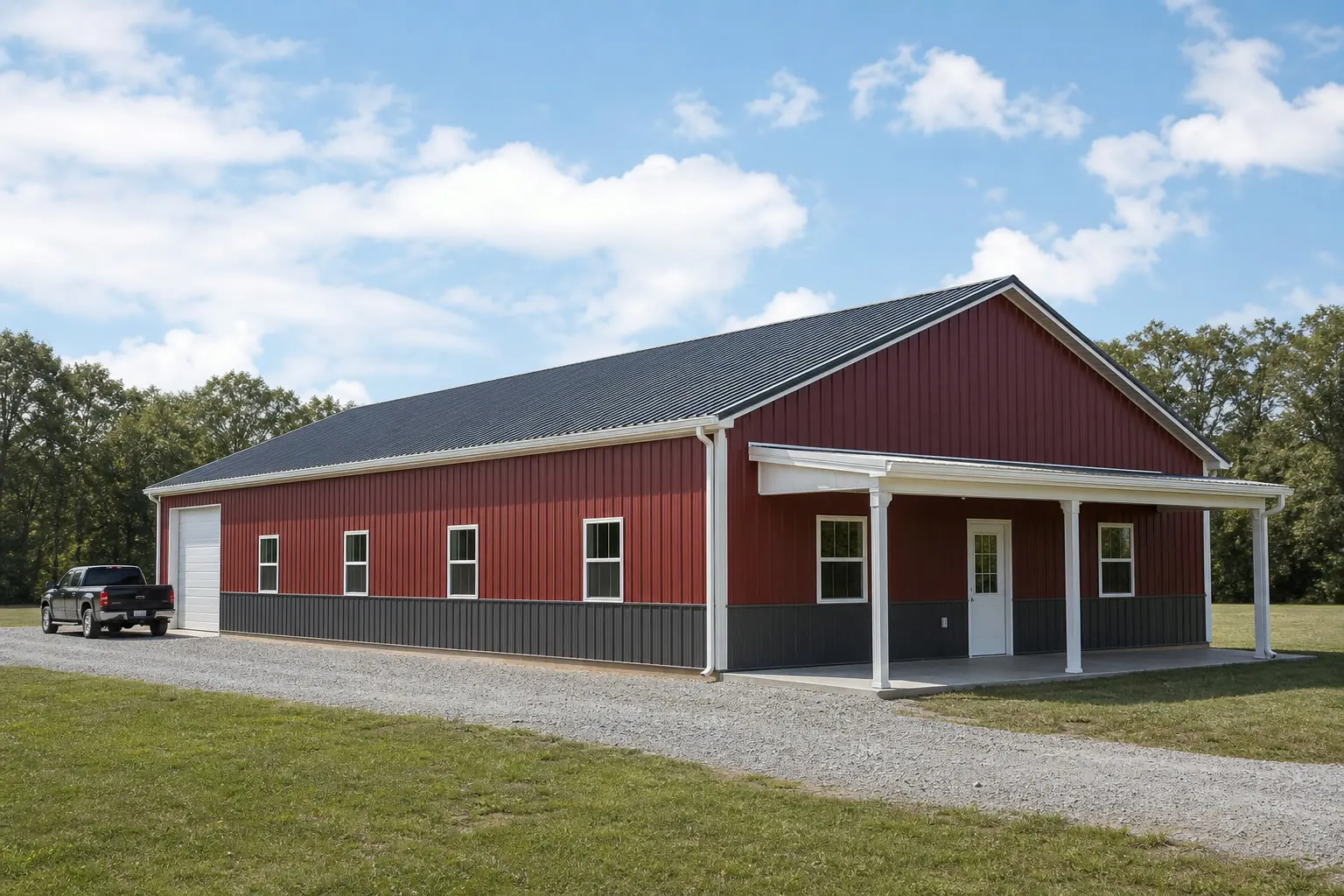
Terrain
Why 'Illinois terrain' is not one answer
The Illinois State Geological Survey names twelve physiographic divisions, and a barndominium sited in one behaves differently from one sited in another.
It's tempting to think of Illinois as flat prairie from border to border, and much of the state's central till plain does fit that description. But the Illinois State Geological Survey's reference map names a dozen distinct sections, including the Chicago Lake Plain in the northeast, the Wisconsin Driftless Section and Rock River Hill Country in the north, the Green River Lowland and Kankakee Plain, several named plains sections through the middle of the state, and the Mt. Vernon Hill Country, Shawnee Hills Section and Lincoln Hills toward the south. Those are not cosmetic distinctions — a lowland section and a hill-country section carry genuinely different drainage, slope and soil-bearing considerations for a slab-on-grade or pier foundation.
None of that terrain description substitutes for a soil test on your own parcel, and this page will not pretend it does. What it means practically is that a barndominium buyer should ask their site contractor which named physiographic section their land falls in before assuming a foundation approach that worked for a friend's build in a different part of the state will transfer directly.
Sourced figures
Illinois land and construction figures at a glance
These are the state-level numbers this page draws on; none are barndominium-specific counts.
| Metric | Value | Source |
|---|---|---|
| Farm count, 2022 | 71,123 (down 2% since 2017) | USDA NASS, 2022 Census of Agriculture |
| Land in farms, 2022 | 26,292,041 acres (avg. 370 acres/farm) | USDA NASS, 2022 Census of Agriculture |
| Total land area | 55,518.9 sq mi (2010 Census) | U.S. Census Bureau |
| New housing permits, 2023 | 16,863 units | U.S. Census Bureau |
| New housing permits, 2024 | 20,326 units (+20.5%) | U.S. Census Bureau |
Farm count, 2022
- Value
- 71,123 (down 2% since 2017)
- Source
- USDA NASS, 2022 Census of Agriculture
Land in farms, 2022
- Value
- 26,292,041 acres (avg. 370 acres/farm)
- Source
- USDA NASS, 2022 Census of Agriculture
Total land area
- Value
- 55,518.9 sq mi (2010 Census)
- Source
- U.S. Census Bureau
New housing permits, 2023
- Value
- 16,863 units
- Source
- U.S. Census Bureau
New housing permits, 2024
- Value
- 20,326 units (+20.5%)
- Source
- U.S. Census Bureau
Land and labor
Fewer farms, more permits: what that combination means
Illinois's farm count dropped while total farmland acreage held steady, and statewide housing permits jumped 20.5% in a single year.
Two Illinois trends are worth reading together rather than separately. The state's farm count fell from roughly 72,600 in 2017 to 71,123 in 2022, a 2% decline, while total land in farms stayed above 26 million acres — averaging out to a larger typical farm, 370 acres, than a state with a stable farm count and shrinking acreage would show. For a barndominium buyer hoping to build on a smaller rural parcel carved from a larger farm, that consolidation pattern is worth discussing directly with a local land agent, since it can affect how often smaller parcels come up for sale in a given county.
At the same time, statewide new privately-owned housing units authorized by permit rose from 16,863 in 2023 to 20,326 in 2024, a 20.5% increase. That is a general residential-construction indicator, not a barndominium-specific count, but a fast year-over-year rise in permitted housing statewide is a reasonable signal that framing crews, concrete contractors and other trades a post-frame residential build needs may be busier than in a flatter-demand year. Asking a builder directly about current lead time, rather than assuming last year's schedule still applies, is the practical response.
Neither figure tells you what a specific county looks like. Illinois is large and its residential construction activity is not evenly distributed between, say, the Chicago collar counties and rural downstate counties, so the statewide permit trend is a planning signal to raise with your builder, not a number to apply directly to your own timeline.
- Ask about smaller-parcel availability directly
- A land agent working your target county will know whether farm consolidation has reduced the supply of smaller rural parcels recently.
- Confirm current trade lead times with your builder
- A statewide 20.5% jump in permitted housing is a demand signal, not a guarantee your specific county's schedule has moved.
Planning a new-build barndominium in Illinois
Tell us your target footprint, whether you need an attached garage or shop, and your general area of the state. We route it with the Illinois and barndominium context already attached.
Site context
Illinois's named divisions, grouped for planning
The ISGS's twelve sections group into a few practical planning bands for a barndominium foundation conversation.
Northeast lowland (Chicago Lake Plain, Green River Lowland)
Lake-influenced and lowland ground where drainage planning deserves early attention, alongside the region's own lake-effect-influenced weather station data.
Northern hill and driftless country (Rock River Hill Country, Wisconsin Driftless Section)
More varied, hillier terrain than the state's central plains, where slope and excavation needs can differ from a flat-plain build.
Central plains (Till Plains, Springfield Plain, Galesburg Plain, Bloomington Ridged Plain, Kankakee Plain)
The state's most extensive flat-to-gently-rolling ground, generally the more straightforward foundation condition among Illinois's named sections.
Southern hill country (Mt. Vernon Hill Country, Shawnee Hills Section, Lincoln Hills)
More dissected, hillier terrain toward the state's southern tip, where a site-specific grading and drainage plan is worth budgeting for.
Configuration
How Illinois barndominium builds tend to get planned
With farmland consolidating into larger average holdings, Illinois new-build parcels vary widely in scale by region and by how the land was acquired.
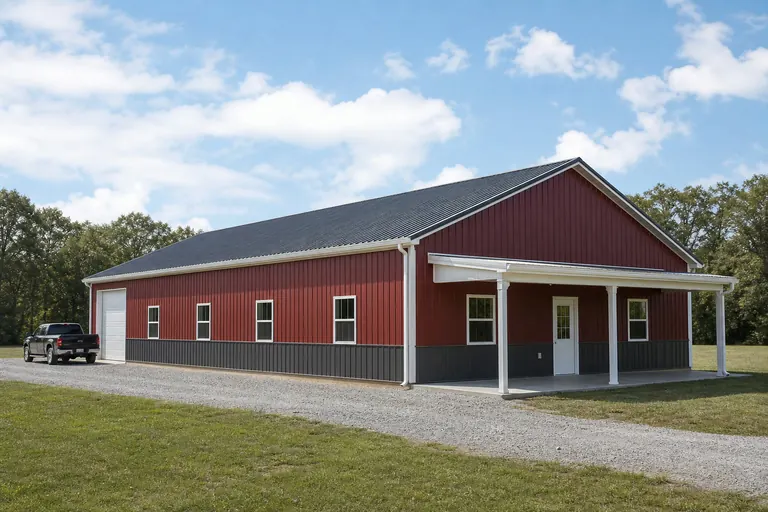 Residence on a carved-out rural parcelA smaller lot split from a larger working farm, where confirming zoning and access with the county is a first step given ongoing consolidation.Residence with attached shop or garageA workspace addition sized to household use rather than large farm equipment, common on non-farm rural and exurban parcels.Build on an active working farmA residence sited alongside existing farm operations, where the region's named physiographic section should inform the foundation plan.
Example Configuration — for planning purposes only.
Footprint
Sizes to consider for an Illinois barndominium
Illinois's average farm size of 370 acres gives buyers plenty of room, but footprint choice should still follow household need rather than available acreage.
30′ × 40′
1,200 sq ft
A frequent starting size for a residential-only build on a smaller carved-out parcel.
30′ × 50′
1,500 sq ft
Added length for an extra bedroom or bonus room.
40′ × 60′
2,400 sq ft
Room for a modest attached garage or shop alongside the residence.
40′ × 80′
3,200 sq ft
A larger combined residence-and-workspace option, more common on an active working farm.
Example Configuration — for planning purposes only.
Footprint pages carry layout and room-count detail; this page explains what changes about siting that footprint in Illinois specifically.
Questions
Illinois barndominium questions
Answered directly, with unverifiable numbers routed to your local building department.
It can. The Illinois State Geological Survey names twelve physiographic divisions statewide, from lowland and lake-plain ground in the northeast to hill country in the north and south, with the flattest, most extensive ground running through the state's central plains. Ask your site contractor which named section your parcel falls in.
Illinois's farm count fell 2% between 2017 and 2022, to 71,123 farms, while total land in farms stayed above 26 million acres, suggesting consolidation into fewer, larger holdings rather than a shrinking land base overall. A local land agent can speak to current availability of smaller parcels in your target county.
Statewide new housing permits rose 20.5% from 2023 to 2024. That's a general residential-construction indicator, not a barndominium-specific figure, but it's a reasonable reason to ask your builder directly about current lead times rather than assuming an older schedule still applies.
This page does not state a specific figure, because no single statewide value applies evenly across a state this size and this varied in terrain. Your local building department will supply the design values for your exact site.
There is no official typical size. Illinois's mix of smaller carved-out rural parcels and larger working farms supports a range from a compact 30x40 residential-only build up to a 40x80 combined residence-and-workspace layout.
We do not publish state-level prices, because the number depends on specification, site work, local labor availability and current material pricing. Our cost pages cover what drives the number; a builder quote covers your specific project.
Sources for the Illinois facts on this page
This page states no code requirement, wind speed, snow load, permit rule, price or supplier claim. The state-specific facts it does use are listed with their publisher below.
The Illinois State Geological Survey maps the state into named physiographic divisions including the Till Plains, Wisconsin Driftless Section, Rock River Hill Country, Green River Lowland, Great Lake Section (Chicago Lake Plain), Kankakee Plain, Springfield Plain, Galesburg Plain, Bloomington Ridged Plain, Mt. Vernon Hill Country, Shawnee Hills Section, and Lincoln Hills.
Illinois State Geological Survey, University of Illinois · ISGS reference map, 1993 (revised 1998), originally based on Leighton et al. 1948 · Tier 2
https://clearinghouse.isgs.illinois.edu/data/geology/physiographic-divisionsIllinois's total land area was measured at 55,518.9 square miles as of the 2010 Census.
U.S. Census Bureau · 2010 Census · Tier 1
https://www.census.gov/geographies/reference-files/2010/geo/state-local-geo-guides-2010/illinois.htmlIllinois had 71,123 farms in 2022, a decrease of 2% since 2017.
USDA National Agricultural Statistics Service (NASS) · 2022 · Tier 1
https://www.nass.usda.gov/Publications/AgCensus/2022/Online_Resources/County_Profiles/Illinois/cp99017.pdfIllinois had 26,292,041 acres of land in farms in 2022, an average farm size of 370 acres.
USDA NASS · 2022 · Tier 1
https://www.nass.usda.gov/Publications/AgCensus/2022/Online_Resources/County_Profiles/Illinois/cp99017.pdfIllinois had a total of 16,863 new privately-owned housing units authorized by building permits in 2023, rising to 20,326 units in 2024 (a 20.5% increase).
U.S. Census Bureau · 2023-2024 · Tier 1
https://www.census.gov/construction/bps/pdf/2024annualhighlights.pdfNOAA NCEI publishes a narrative 'Climate of Illinois' describing the state's location midway between the Continental Divide and the Atlantic Ocean and its continental climate of cold winters, warm summers, and frequent short-term fluctuations in weather.
NOAA National Centers for Environmental Information (NCEI) · Historical narrative (NCEI climate normals series) · Tier 1
https://www.ncei.noaa.gov/data/climate-normals-deprecated/access/clim60/states/Clim_IL_01.pdf