
Auto repair shop · CA
Auto Repair Shops in California
A California repair shop is planned around two facts that rarely appear together on the same page: the state runs one statewide building-standards framework administered by the California Building Standards Commission under Title 24, and CAL FIRE is required by law to classify land into Fire Hazard Severity Zones based on fuel loading, slope, fire weather and wind. The first means the code question starts from a single named body rather than a patchwork of state rules. The second means a shop's siting, vegetation clearance and access can change sharply depending on the parcel, and that classification has to be looked up for your address — it is never assumed from a state average. Add the Mediterranean pattern the State Climatologist describes, with precipitation concentrated October through April and dry conditions the rest of the year, and a California shop's bay layout, drainage and ventilation strategy diverge from a shop built for a wetter or colder state. This page covers what those conditions change about the building, not how to run a shop.
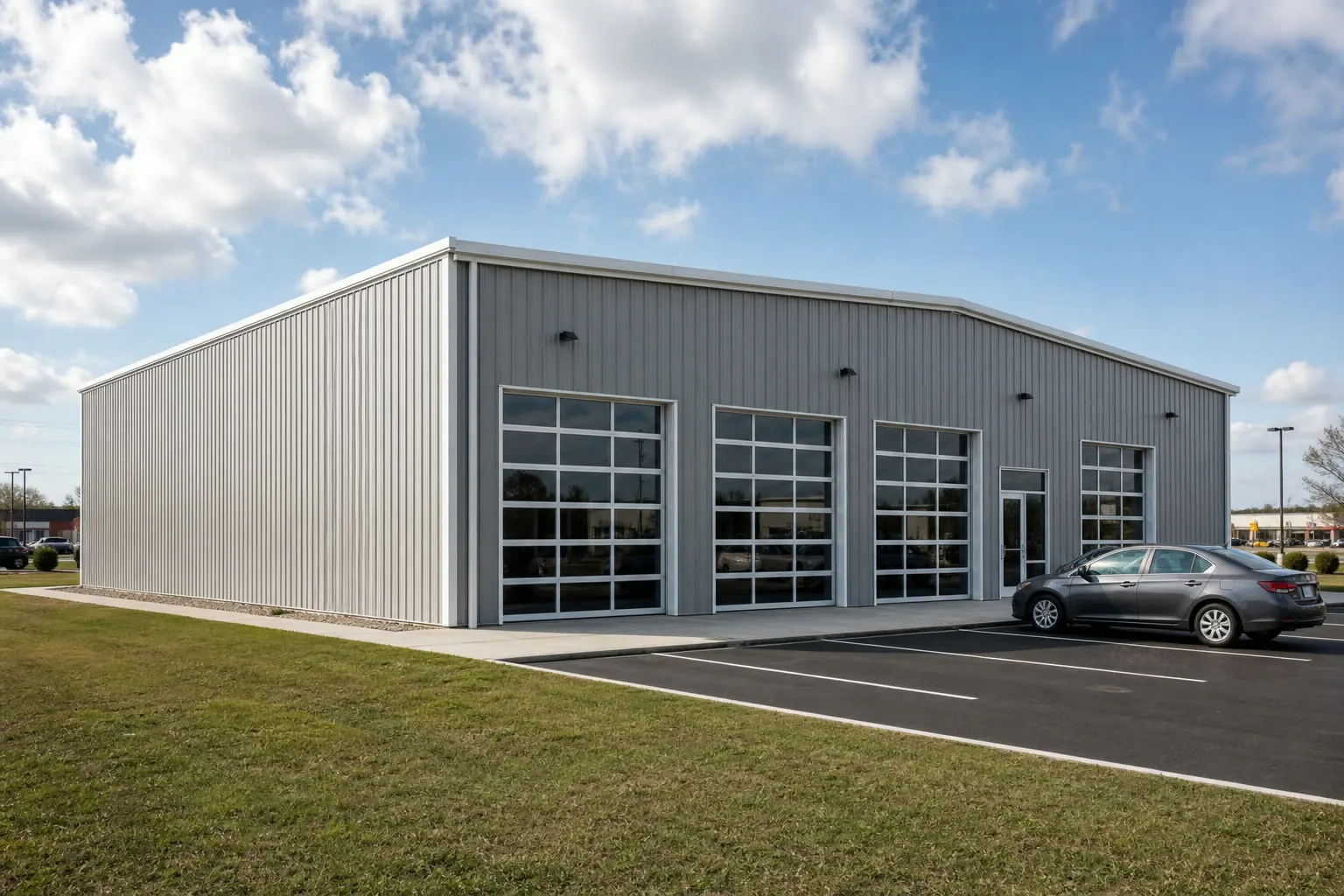
Two Facts That Shape a California Repair Shop
Ask what changes for a repair shop in California and the honest answer starts with a lookup, not a rule. CAL FIRE is required by Public Resources Code 4202 and Government Code 51178 to classify land into Fire Hazard Severity Zones based on fuel loading, slope, fire weather and wind, and that classification depends entirely on the parcel — a shop three miles apart can land in different zones. Layered under that is a single statewide code framework: the California Building Standards Commission administers Title 24 of the California Code of Regulations, so the code conversation with your local department starts from one named body rather than a state-by-state patchwork. Neither fact tells you what your specific site requires; both tell you where to start asking.
Site Selection
Fire Hazard Severity Zones Change the Site Plan, Not Just the Address
A California shop's exterior materials, vegetation clearance and access width can all depend on whether the parcel sits in a mapped Fire Hazard Severity Zone.
CAL FIRE's statutory mapping program exists because fuel loading, slope, fire weather and wind vary sharply across California's terrain — the state's own geological survey recognizes 11 distinct geomorphic provinces, from Coast Ranges to the Mojave Desert, and a repair shop's exposure changes with which of those it sits in. A shop backing onto wildland-urban interface vegetation faces a different clearance and access conversation than one on a paved commercial corridor, even within the same county.
None of that is a reason to guess. The correct first step for any California repair shop site is confirming the parcel's mapped zone status with the local authority and CAL FIRE before the site plan is finalized, because exterior material specification, defensible-space clearance and even driveway width can all follow from that answer.
Buyers sometimes assume a shop away from obvious brush is automatically clear. That is not something this page can confirm for any given address — the zone maps exist precisely because visual inspection is not a substitute for the mapped classification.
Layout
California Layout Decisions Worth Making Early
These are the layout choices where a California shop diverges from the same shop in a colder or wetter state.
- Open-bay ventilation for most of the yearWith dry conditions typical from May through September per the State Climatologist, many California shops can run open bay doors and natural cross-ventilation for a large part of the year, changing the exhaust-extraction sizing conversation compared with a shop that stays sealed up most months.
- A compressed wet-season drainage planPrecipitation concentrates October through April, so the floor and site drainage need to handle a shorter, more intense wet season rather than steady year-round runoff — confirm site grading and stormwater requirements with the local authority before the pad is set.
- Defensible space if the parcel is near wildland vegetationIf the mapped Fire Hazard Severity Zone status calls for it, vegetation clearance around the structure becomes a site-plan item, not a landscaping afterthought, and should be checked before the building footprint is finalized.
- Exterior material specification tied to zone statusEmber-resistant detailing at vents, eaves and openings may be relevant depending on the mapped zone; confirm with the local building department and CAL FIRE rather than defaulting to a standard-state specification.
- Cooling load planning for a warming trendNOAA's state summary records roughly 3°F of warming since the early 1900s with six of the state's warmest years since 2014, a reasonable planning signal for shops sizing cooling and ventilation without asserting a specific design temperature.
- One code framework, local enforcementTitle 24 gives California a single statewide code body, but enforcement, plan review and specific requirements are still local — confirm the applicable edition and any local amendments with the permit office for your jurisdiction.
Get repair shop quotes for your California site
Give suppliers the bay count, your parcel's confirmed Fire Hazard Severity Zone status, and your local department's design values. Shell quotes without those are not comparable.
Site Context
California's Provinces Change the Shop Brief
The California Geological Survey's 11 geomorphic provinces mean a repair shop's site conditions differ sharply depending on where in the state it sits.
Coastal and metro corridors
Higher land competition, denser zoning review, and generally lower wildfire exposure than inland terrain, though local approvals still govern parking counts, signage and site coverage for a commercial occupancy.
Inland valleys and foothill terrain
This is where the Fire Hazard Severity Zone question becomes most relevant to siting, and where dry-season temperatures per NOAA's warming trend can push ventilation and cooling higher up the design priority list.
Desert and Basin and Range areas
The State Climatologist's narrative places southeastern deserts under 5 inches of annual precipitation, a very different drainage and floor-planning problem than the north coast's over-100-inch totals — confirm with local data for the specific site rather than a statewide average.
Footprints
Bay Counts That Work Across California Site Types
California shops commonly plan for flexible open-bay ventilation and a site-plan step most other states skip: the wildfire-zone lookup.
40′ × 60′
2,400 sq ft
A two- to three-bay shop; the compact footprint keeps defensible-space clearance manageable if the parcel is near mapped wildland vegetation.
50′ × 80′
4,000 sq ft
Four bays plus customer space, sized for the open-bay ventilation strategy many California sites can use through the dry season.
60′ × 80′
4,800 sq ft
Adds an extra bay or interior storage where a parcel's zone status or wet-season drainage plan calls for keeping more work indoors.
Example Configuration — for planning purposes only.
Bay dimensions and lift clearances belong to the type page; wildfire-zone and occupancy requirements come from CAL FIRE and your local department.
Evidence Position
What We Do Not Assert
No specific Fire Hazard Severity Zone assignment, seismic design category, code edition, permit threshold or price appears on this page.
The sourced California material used here is limited to the State Climatologist's Mediterranean climate narrative, NOAA's state climate summary warming figures, FEMA's 18-hazard National Risk Index category list, CAL FIRE's statutory Fire Hazard Severity Zone program description, the CBSC's administration of Title 24, and the California Geological Survey's 11 geomorphic provinces.
We hold no sourced figure for any specific parcel's fire hazard zone, seismic design category, adopted code edition or local permit threshold, and inventing one would be worse than useless. Every one of those is answered by CAL FIRE and your local building department for your specific site, and a supplier quoting a shell has not answered any of them.
Questions
California Auto Repair Shop Questions
What California shop owners ask that a general repair-shop page cannot answer.
Check the CAL FIRE Fire Hazard Severity Zone maps for the exact parcel and confirm with the local building department; this is a required statutory classification under Public Resources Code 4202 and Government Code 51178, and it is parcel-specific, not a statewide fact.
It can change the strategy rather than eliminate the need. Many California shops rely on open bay doors and cross-ventilation through the dry months described by the State Climatologist, but exhaust extraction for fumes is still a code and safety question your local department will confirm.
The framework is: the California Building Standards Commission administers Title 24 statewide. Enforcement, plan review and any local amendments are still handled by your city or county building department, so confirm specifics locally.
That depends on your parcel's mapped Fire Hazard Severity Zone status, which we cannot determine for any given address. Confirm with CAL FIRE and your local department before finalizing exterior material specification.
Precipitation concentrates October through April per the State Climatologist, so site grading and floor drainage need to handle a compressed wet season. Confirm stormwater and drainage requirements with your local authority.
Pricing is delegated to the cost silo. The California-variable drivers are the wildfire-zone site work (if applicable), the ventilation strategy, and local plan-review requirements under Title 24.
Sources for the California facts on this page
This page states no code requirement, wind speed, snow load, permit rule, price or supplier claim. The state-specific facts it does use are listed with their publisher below.
The California State Climatologist describes California as having a Mediterranean climate overall, with precipitation concentrated October through April and dry conditions May through September, strongly modulated by mountains and the Pacific Ocean, with north coast areas averaging over 100 inches of annual precipitation and southeastern deserts under 5 inches.
California Department of Water Resources / Office of the State Climatologist (republished via CoCoRaHS) · n/a (narrative climatology) · Tier 2
https://media.cocorahs.org/docs/ClimateSum_CA.pdfNOAA's NCEI State Climate Summary reports temperatures in California have risen almost 3°F since the beginning of the 20th century, with the six warmest years on record occurring since 2014.
NOAA National Centers for Environmental Information · 2022 report · Tier 1
https://statesummaries.ncics.org/downloads/California-StateClimateSummary2022.pdfFEMA's National Risk Index scores U.S. communities, including California counties, across 18 defined natural hazard types.
FEMA · current dataset · Tier 1
https://www.fema.gov/about/openfema/data-sets/national-risk-index-dataCAL FIRE, under the state Office of the State Fire Marshal, is required by law (Public Resources Code 4202 / Government Code 51178) to classify lands into Fire Hazard Severity Zones based on fuel loading, slope, fire weather, and wind, without this evidence assigning any specific zone.
California Department of Forestry and Fire Protection (CAL FIRE) / Office of the State Fire Marshal · current program; 2024 FHSZ maps referenced · Tier 2
https://osfm.fire.ca.gov/what-we-do/community-wildfire-preparedness-and-mitigation/fire-hazard-severity-zonesThe California Building Standards Commission (CBSC) administers the California Building Standards Code, Title 24 of the California Code of Regulations, as the state's building standards framework.
California Department of General Services, Building Standards Commission (CBSC) · 2025 Triennial Edition, effective Jan 1, 2026 · Tier 2
https://www.dgs.ca.gov/bsc/The California Geological Survey (state geological survey) divides the state into 11 recognized geomorphic provinces, including the Coast Ranges, Central Valley, Sierra Nevada, Basin and Range, Mojave Desert, Colorado Desert, Transverse Ranges, Peninsular Ranges, Klamath Mountains, Cascade Range, and Modoc Plateau.
California Department of Conservation, California Geological Survey · 2002 (revised) · Tier 2
https://www.conservation.ca.gov/cgs/documents/publications/cgs-notes/CGS-Note-36.pdf