
Office building · CA
Office Buildings in California
This is a small, specific search: buyers looking at a modular or metal office building in California are not asking a broad commercial-construction question, they are comparing a product against a statewide framework and a parcel they already have in mind. Two things genuinely change here. First, the California Building Standards Commission administers Title 24 of the California Code of Regulations as one statewide building-standards framework, so the code question starts from a single named body rather than a patchwork. Second, CAL FIRE is required by state law to classify land into Fire Hazard Severity Zones based on fuel, slope, fire weather and wind, and that classification is parcel-specific — it has to be looked up for your address, not assumed from a state average. Neither fact is a requirement this page will state; both are the reason the next step is a lookup, not a guess.
The intersection
A framework question, then a parcel question
California does not change the office building. It changes the order of two conversations you have before you site one: a statewide framework conversation, then a parcel-specific hazard lookup.
The California Building Standards Commission administers Title 24 of the California Code of Regulations as the state's building standards framework. That gives a California office-building buyer one named starting body instead of a state with no statewide authority. This page does not restate what Title 24 requires for a commercial office structure — that detail belongs to the CBSC and your local building department — but knowing the framework exists, and where it comes from, is the first honest fact this page can offer.
The second fact is parcel-specific by design. CAL FIRE is required by California Public Resources Code section 4202 and Government Code section 51178 to classify land into Fire Hazard Severity Zones, based on fuel loading, slope, fire weather and wind. Crucially, that classification is not a statewide number; it is mapped parcel by parcel and zone by zone. We will not tell you what zone your site falls in, because that would be a guess dressed up as a fact. What we will say is that looking up your own parcel on CAL FIRE's published maps is a normal, expected step before you finalize a California office-building plan, and it costs nothing to do early.
Underneath both of those procedural facts sits a genuinely varied state. The California Geological Survey recognizes 11 distinct geomorphic provinces, from the Coast Ranges to the Mojave Desert, and the State Climatologist describes a Mediterranean pattern with precipitation concentrated October through April and little rain the rest of the year. A coastal office site and a Central Valley office site are not facing the same siting conversation, even under the same statewide code.
What to actually check
Two lookups before you compare quotes
Neither of these is a number we can hand you. Both are quick to check and change how a quote should be scoped.
Step 1
Confirm Title 24 scope with your local building department
The California Building Standards Commission sets the statewide framework, but your local department applies it to your project type and parcel.
Step 2
Look up your parcel's Fire Hazard Severity Zone
CAL FIRE publishes maps built from a statutory methodology covering fuel, slope, weather and wind. Check your specific address rather than assuming a zone.
Step 3
Note your region's precipitation pattern
California's wet season runs roughly October through April statewide, but the amount varies enormously by geomorphic province, from wet north coast conditions to arid desert conditions.
Step 4
Ask about product approval and documentation
Any seller proposing a modular or metal office structure in California should be able to speak to how their product fits the statewide framework; ask before comparing price.
Demand
Why this page stays narrow on purpose
The measured search behavior for this cluster is small and specifically modular-led, and this page reflects that honestly rather than inflating it into a general commercial-buildings resource.
Search volume for California office-building queries is modest, and the dominant phrasing centers on modular construction specifically, not on office buildings broadly or on commercial construction in general. That tells us who is actually looking: a buyer who has already decided modular or metal construction is the format they want, and is now checking whether California adds anything to that decision.
It does, but only the two procedural items above — the statewide framework and the parcel-level fire hazard lookup — plus the general climatic and geologic variety of the state. There is no long list of California-specific office-building rules to enumerate here, and manufacturing one would misrepresent both the demand and the honest facts available.
What this page can add is a realistic picture of how a California office project tends to sequence. The parcel-level questions — zoning, allowed use, parking, access and the fire hazard severity zone designation — get answered before the building question, because they determine whether the project is viable at the intended size at all. Only then does the structure become the topic, and by that point most of the genuine constraints are already known.
It is also worth being clear about what an office building has to do that a storage or shop building does not. Occupied commercial space brings accessibility, egress, fire protection, mechanical and energy performance into scope, and those are handled through design and plan review rather than chosen from a product list. A steel structural system is entirely compatible with all of it; it simply is not the part of the project that carries the complexity.
So the useful posture for a California buyer is to treat the shell as one procurement inside a larger design-and-approval process, and to bring an architect or design professional into the conversation early. That is a less tidy answer than a list of state-specific rules would be, and it is the accurate one.
Get California office-building quotes
Tell us your rough program, your parcel location and whether you've already checked your Fire Hazard Severity Zone status. We route it with the California and office-building context already attached.
Site context
How California's geography changes a site visit
The California Geological Survey's 11 geomorphic provinces are a useful shorthand for how differently a California office-building site can behave.
Coastal ranges and valleys
Sites here generally see the wetter end of the state's October-through-April precipitation pattern; drainage planning around a slab-on-grade office structure is worth confirming with your site contractor.
Central Valley
Flatter ground typically simplifies pad preparation, but summer heat and the same wet-season timing still apply; check parcel-specific fire hazard status regardless of how urban the surrounding area looks.
Desert and southeastern provinces
Under five inches of annual precipitation in some southeastern areas per the State Climatologist changes site drainage assumptions considerably; confirm with a local site engineer rather than assuming statewide averages apply.
Configuration
What a California office building is usually asked to do
The modest, modular-led demand pattern suggests two common briefs rather than a wide range of configurations.
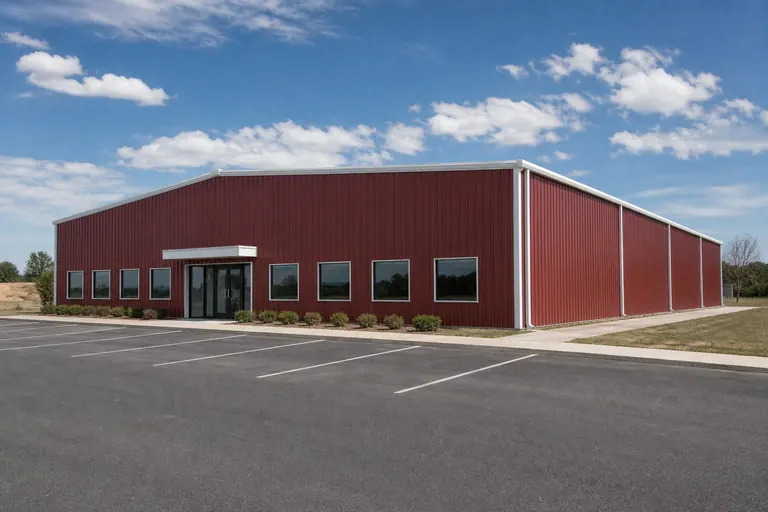 Standalone modular officeA single-purpose administrative or professional office structure, typically the clearest fit for the framework-plus-parcel-lookup process described above.Office attached to a metal building operationAn office component added to an existing commercial or industrial metal building, where the same Title 24 and fire-hazard-zone questions apply to the office portion specifically.
Example Configuration — for planning purposes only.
Questions
California office building questions
Questions we can answer honestly at the state level, with the rest routed to whoever actually owns the answer.
The California Building Standards Commission administers Title 24 of the California Code of Regulations as a single statewide framework. What Title 24 requires for your specific office building and use is a question for your local building department; we do not state code requirements on this page.
CAL FIRE is required by state law to classify land into Fire Hazard Severity Zones based on fuel, slope, fire weather and wind, and publishes maps you can search by address. We do not assign a zone here; check your specific parcel on CAL FIRE's published maps.
We do not publish prevalence statistics. What we can say is that measured search behavior for this cluster is small in volume and specifically modular-led, which is the demand pattern this page was built to answer honestly.
We cannot point you to footprint-specific pages for this building type yet; no Phase 18.1 size pages exist for office buildings. Describe your program to a builder directly and they can scope a footprint from there.
We do not publish state-level prices, because a credible number depends on your specification, site work and current material pricing. Our cost pages cover what drives the number; a quote covers your specific building.
Sources for the California facts on this page
This page states no code requirement, wind speed, snow load, permit rule, price or supplier claim. The state-specific facts it does use are listed with their publisher below.
The California Building Standards Commission (CBSC) administers the California Building Standards Code, Title 24 of the California Code of Regulations, as the state's building standards framework.
California Department of General Services, Building Standards Commission (CBSC) · 2025 Triennial Edition, effective Jan 1, 2026 · Tier 2
https://www.dgs.ca.gov/bsc/CAL FIRE, under the state Office of the State Fire Marshal, is required by law (Public Resources Code 4202 / Government Code 51178) to classify lands into Fire Hazard Severity Zones based on fuel loading, slope, fire weather, and wind, without this evidence assigning any specific zone.
California Department of Forestry and Fire Protection (CAL FIRE) / Office of the State Fire Marshal · current program; 2024 FHSZ maps referenced · Tier 2
https://osfm.fire.ca.gov/what-we-do/community-wildfire-preparedness-and-mitigation/fire-hazard-severity-zonesNOAA's NCEI State Climate Summary reports temperatures in California have risen almost 3°F since the beginning of the 20th century, with the six warmest years on record occurring since 2014.
NOAA National Centers for Environmental Information · 2022 report · Tier 1
https://statesummaries.ncics.org/downloads/California-StateClimateSummary2022.pdfThe California State Climatologist describes California as having a Mediterranean climate overall, with precipitation concentrated October through April and dry conditions May through September, strongly modulated by mountains and the Pacific Ocean, with north coast areas averaging over 100 inches of annual precipitation and southeastern deserts under 5 inches.
California Department of Water Resources / Office of the State Climatologist (republished via CoCoRaHS) · n/a (narrative climatology) · Tier 2
https://media.cocorahs.org/docs/ClimateSum_CA.pdfThe California Geological Survey (state geological survey) divides the state into 11 recognized geomorphic provinces, including the Coast Ranges, Central Valley, Sierra Nevada, Basin and Range, Mojave Desert, Colorado Desert, Transverse Ranges, Peninsular Ranges, Klamath Mountains, Cascade Range, and Modoc Plateau.
California Department of Conservation, California Geological Survey · 2002 (revised) · Tier 2
https://www.conservation.ca.gov/cgs/documents/publications/cgs-notes/CGS-Note-36.pdfCalifornia had 63,134 farms in 2022 per the USDA Census of Agriculture.
USDA National Agricultural Statistics Service (NASS) · 2022 · Tier 1
https://www.nass.usda.gov/Publications/AgCensus/2022/Full_Report/Volume_1,_Chapter_1_State_Level/California/California's total land area was 155,766 square miles per the 2008 Census Bureau state area measurements, the third-largest U.S. state by land area.
U.S. Census Bureau, Statistical Abstract of the United States: 2011 · 2008 · Tier 1
https://www2.census.gov/library/publications/2010/compendia/statab/130ed/tables/11s0355.pdf