
Storage building · MA
Storage Buildings in Massachusetts
A storage building in Massachusetts is rarely a one-purpose barn on a big spread. USDA's 2022 Census of Agriculture counted 464,451 acres in farms across 7,083 Massachusetts operations, an average of 66 acres per farm -- among the smallest average farm sizes in the country. That pattern pushes most storage-building briefs here toward compact, multi-use structures: equipment, feed, and household overflow sharing one footprint rather than a dedicated building for each. Add an older, denser housing stock and Boston-area winter exposure, and siting decisions carry more weight than they would on a large rural parcel.
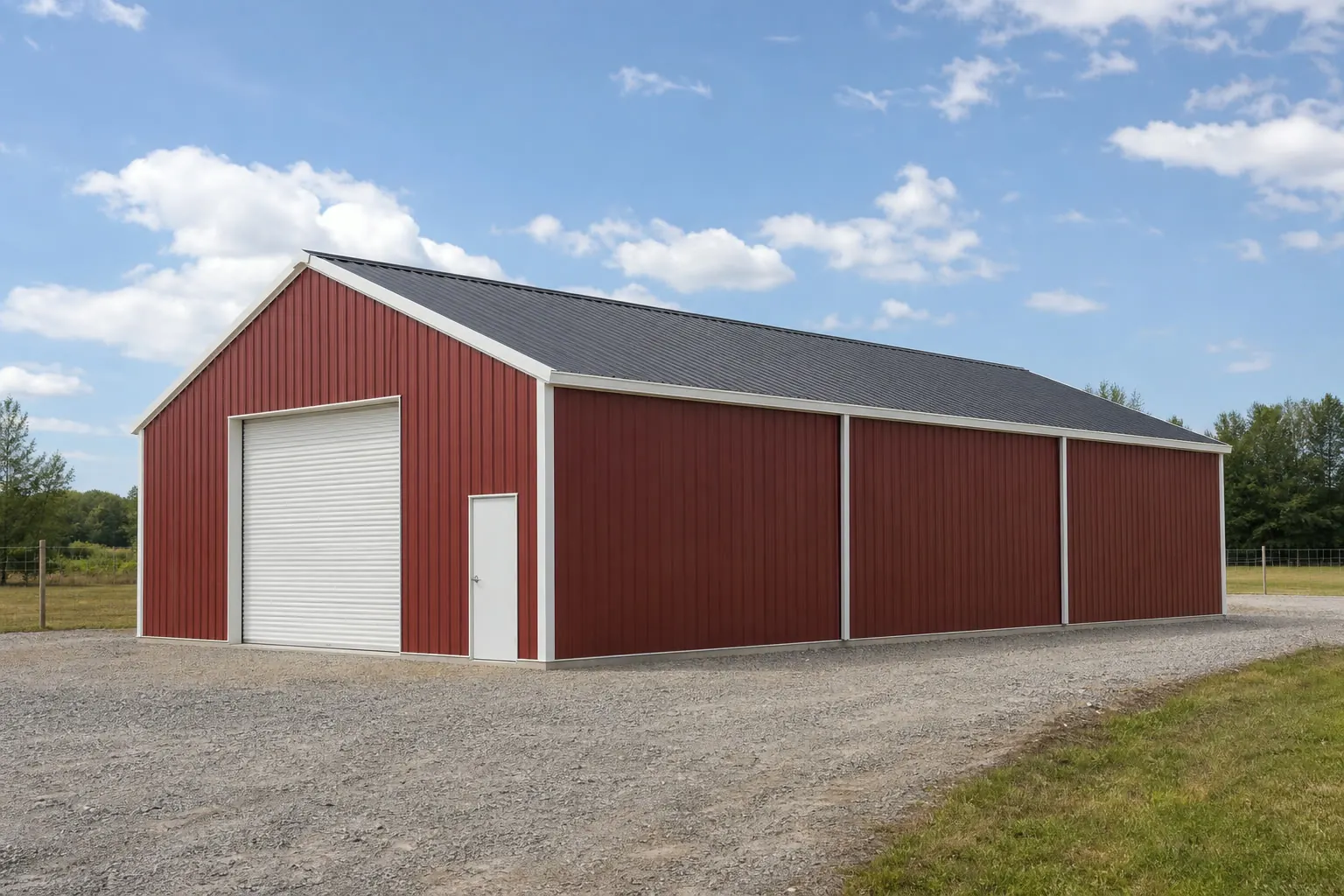
The intersection
What a Massachusetts site changes about a storage building
The building is standard steel-frame construction. What differs is scale of the brief and what the parcel does underneath it.
USDA's 2022 Census of Agriculture counted 7,083 Massachusetts farms working 464,451 acres, an average of just 66 acres per farm -- one of the smallest average farm sizes nationally, and down from 7,241 farms in 2017. That combination of small acreage and a shrinking count means most Massachusetts storage-building buyers are not equipping a large commercial operation; they're a small farm, hobby homestead, or landowner who needs one flexible building to hold equipment, feed, and seasonal goods rather than several dedicated structures.
The state's housing pattern compounds the need. Census Bureau permit data shows only 5,626 of the 14,338 new privately-owned housing units authorized in Massachusetts during 2024 were single-unit structures. A large share of the existing housing stock is older and denser still, often without the basement or attached-garage capacity that newer single-family homes elsewhere use for overflow storage. A standalone storage building fills a gap that the house itself doesn't cover.
Terrain and precipitation round out the picture. USGS documents a state split between crystalline upland terrain in the west, including the Berkshires, and Coastal Plain sediment in the southeast, which changes what a slab crew finds when they break ground. Boston Logan's NOAA normals add roughly 43.6 inches of average annual precipitation -- again, not a design load, but a reason to plan grading and drainage around the pad before it's poured rather than after standing water becomes a problem.
Site context
How terrain changes storage building siting across Massachusetts
The USGS upland/coastal split is the most useful lens for anticipating site prep before a quote.
Western uplands and Berkshires
Rolling to steep ground with shallow bedrock in places. Plan for a site visit before assuming a simple flat pour.
Central valleys
Generally moderate grading; existing farm-lane access and tree cover are the usual variables.
Southeastern Coastal Plain
Flatter, sandier ground, often easier to grade, but confirm drainage away from the slab given the region's water table.
Scale
Sizing a storage building for a small Massachusetts parcel
With average farm size around 66 acres, most Massachusetts storage briefs are compact and multi-purpose by necessity.
A 66-acre average farm doesn't need -- or usually have room for -- the sprawling equipment barns common on much larger operations elsewhere. Massachusetts storage buildings more often serve a mixed brief: a tractor or utility vehicle bay, a feed or hay section, and general dry storage for tools and seasonal goods, all under one roof.
That compactness also suits non-farm owners. A landowner storing a mower, firewood, and yard equipment on a suburban or exurban lot faces the same footprint logic as a small-farm owner, just at a smaller scale, which is why Massachusetts storage-building sizing skews toward the smaller end of the type's range.
- Zone the interior
- Split the footprint by use -- equipment, feed or bulk goods, general storage -- before fixing overall dimensions.
- Plan for access, not just area
- A wider door and turning radius often matters more on a tight parcel than a few extra square feet.
- Leave room to grow
- A shrinking-but-persistent small-farm sector suggests planning modest expansion room rather than maxing out the lot on day one.
Get Massachusetts storage building quotes
Tell us your parcel size, terrain, and what you're storing. We route it with the Massachusetts and storage-building context attached.
Configuration
What Massachusetts storage buildings are usually asked to do
Given small average acreage and an older housing stock, most Massachusetts storage briefs solve a specific capacity gap.
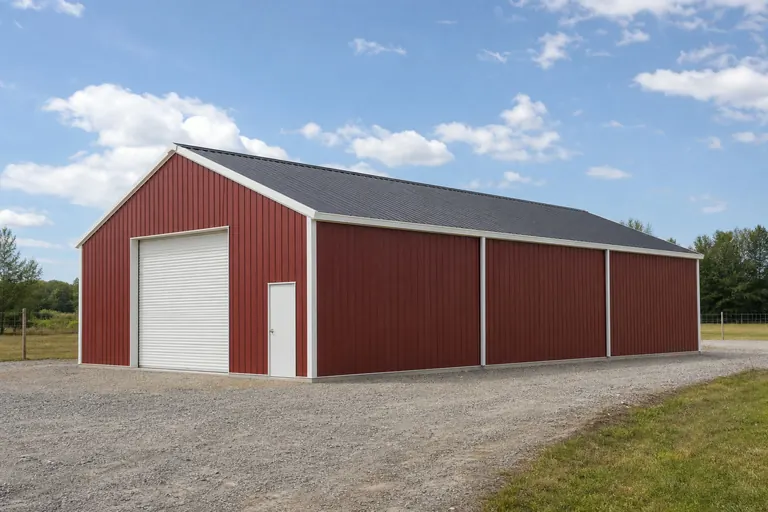 Small-farm equipment and feed storageA compact bay for a tractor, implements, and feed or hay, sized to a small-acreage operation rather than a commercial farm.Household and seasonal overflowDry storage for yard equipment, firewood, and seasonal goods on a lot without basement or attic capacity.Small business or trade storageTools, materials, and inventory storage for a home-based trade or small business on a residential lot.
Example Configuration — for planning purposes only.
Footprint
Sizes that fit a Massachusetts small-parcel brief
Given the state's small average farm size and older, denser housing stock, most storage-building footprints stay modest.
12′ × 20′
240 sq ft
Compact tool and equipment storage for a small lot.
20′ × 30′
600 sq ft
A single-tractor bay with room for feed or hay storage.
24′ × 36′
864 sq ft
Mixed equipment and household overflow storage.
30′ × 50′
1,500 sq ft
Larger multi-zone storage for a working small farm.
Example Configuration — for planning purposes only.
Footprint pages carry the door and layout detail; this page explains why the Massachusetts brief tends to stay compact.
Preparation
Before you request a Massachusetts storage building quote
These items address frequent re-quote triggers for a Massachusetts storage building.
Step 1
Check setback and accessory-structure rules with your local building department
Rules vary by town; confirm before fixing a footprint on a small or irregular parcel.
Step 2
Describe your terrain
Upland ledge and coastal drainage require different slab prep; tell your builder which you have.
Step 3
List everything you plan to store
Zoning the interior for equipment, feed, and household goods up front avoids an expensive mid-project redesign.
Step 4
Confirm access width for equipment
A tractor or utility vehicle needs a wider door and clearer approach than general household storage.
Questions
Massachusetts storage building questions
Honest state-level answers, with jurisdiction-specific items routed to the office that owns them.
Permit requirements depend on your municipality, lot, and structure size. Your local building department is the only reliable source; ask before finalizing dimensions.
There's no official typical size, but USDA data shows Massachusetts farms average around 66 acres, among the smallest in the country, which is why most storage-building briefs here stay compact and multi-use rather than large single-purpose barns.
We do not state design loads on this page. Boston Logan's climate normals -- about 43.6 inches of annual precipitation and roughly 49 inches of average annual snowfall -- are planning context only; your engineer and local building department determine the actual design requirement for your site.
USGS documents genuinely different terrain across the state -- upland ledge in the west versus Coastal Plain sediment in the southeast -- so slab prep should be based on a site visit, not assumed from your town name alone.
Many Massachusetts storage-building buyers are working with smaller parcels, whether a small farm averaging around 66 acres or a suburban lot without basement or garage capacity; a compact, zoned footprint usually fits better than a single large building sized for a bigger operation.
Sources for the Massachusetts facts on this page
This page states no code requirement, wind speed, snow load, permit rule, price or supplier claim. The state-specific facts it does use are listed with their publisher below.
Massachusetts had 464,451 acres of land in farms in 2022, an average farm size of 66 acres -- among the smallest average farm sizes in the country.
USDA NASS · 2022 · Tier 1
https://www.nass.usda.gov/Publications/AgCensus/2022/Full_Report/Volume_1,_Chapter_1_State_Level/Massachusetts/st25_1_001_001.pdfMassachusetts had 7,083 farms in 2022, down from 7,241 in 2017.
USDA National Agricultural Statistics Service (NASS) · 2022 (with 2017 comparison) · Tier 1
https://www.nass.usda.gov/Publications/AgCensus/2022/Full_Report/Volume_1,_Chapter_1_State_Level/Massachusetts/st25_1_001_001.pdfBoston Logan Airport's NOAA 1991-2020 climate normals show total annual precipitation of about 43.6 inches and average annual snowfall of about 49 inches.
NOAA National Centers for Environmental Information (NCEI) · 1991-2020 · Tier 1
https://www.ncei.noaa.gov/access/services/data/v1?dataset=normals-monthly-1991-2020&format=pdf&stations=USW00014739USGS Geomorphology of New England (Professional Paper 1208) describes Massachusetts as spanning crystalline upland terrain (including the Berkshires in the west) and Coastal Plain sediments along the southeast, reflecting a mix of glacially shaped hill country and low coastal terrain.
U.S. Geological Survey · 1982 · Tier 1
https://pubs.usgs.gov/pp/1208/report.pdfBuilders in Massachusetts were authorized to construct 14,338 new privately-owned housing units in 2024, of which 5,626 were single-unit structures.
U.S. Census Bureau · 2024 (final annual estimates) · Tier 1
https://www.census.gov/construction/bps/stateannual.html