
Shed · MI
Sheds in Michigan
A shed is the building where Michigan's winter does the most damage relative to its cost, because it is usually unheated, usually on the cheapest foundation the buyer can justify, and usually sited by eye rather than by plan. The state's benchmark normals at Detroit Metro Airport run near 34-35 inches of annual precipitation with mean January and February snowfall around 12-14 inches each, and the northern half of the state is harsher. Combine that with FEMA's National Risk Index scoring winter weather, ice storm and severe/strong wind among the hazards across Michigan's 83 counties, and the shed brief here becomes: get the ground right, get the clearances right, and confirm the local accessory-structure rules before you order.
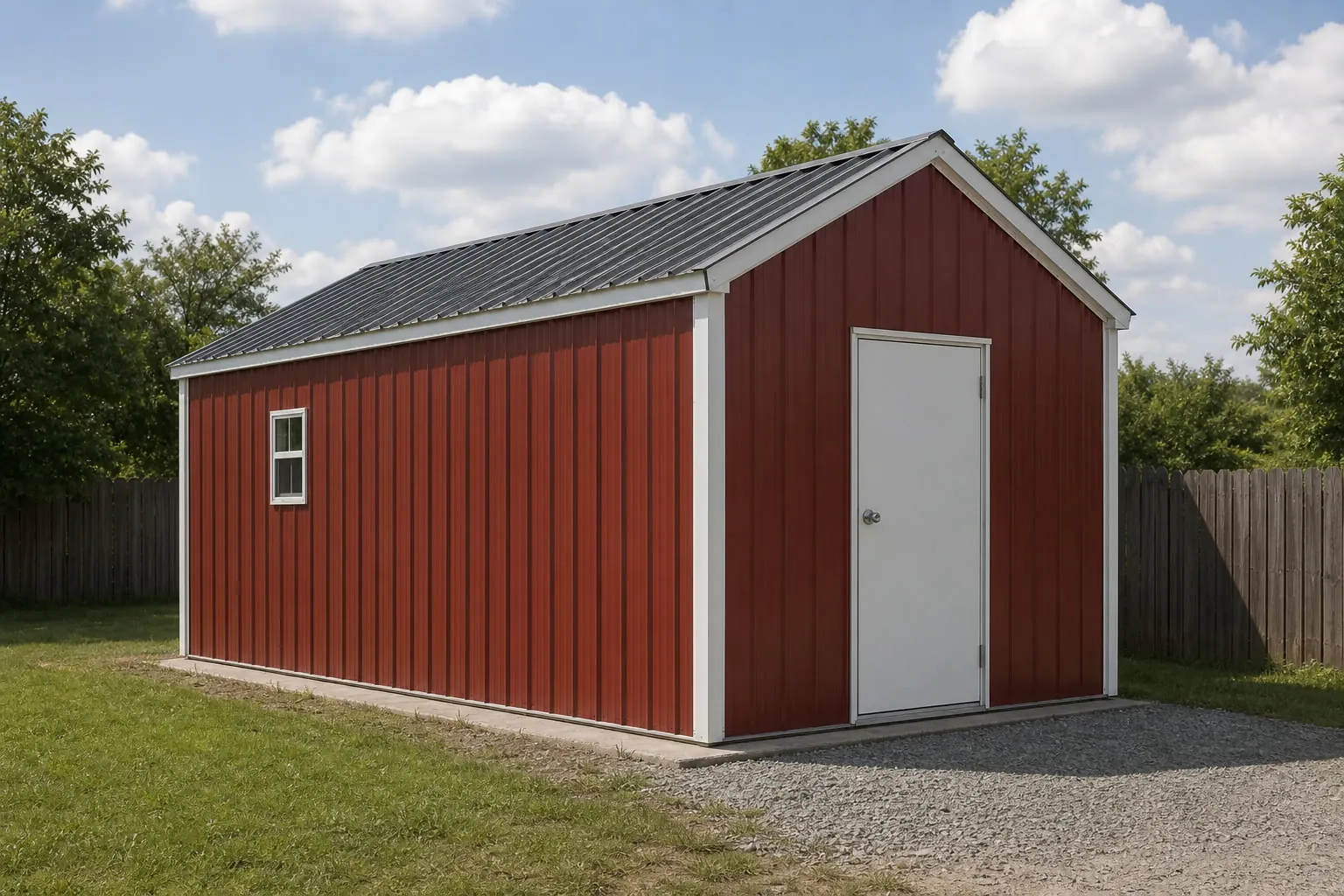
Small Building, Michigan-Sized Ground Problem
Sheds are bought casually and regretted specifically. In Michigan the regret is almost always about the ground: an unheated building sitting on a pad that freezes, lifts and settles through a winter that the state's own benchmark station describes with mean January and February snowfall near 12-14 inches each. USGS, working with the Michigan DNR, mapped distinct hydrologic provinces across both peninsulas, and that variability is precisely why a pad detail copied from a neighbour two counties away is not a safe default. Get the ground and the clearances right and a steel shed in Michigan is a thirty-year building; get them wrong and it is a door that stops closing in year two.
Foundation
Why the Pad Decides a Michigan Shed's Lifespan
Unheated buildings follow ground temperature, so a Michigan shed's foundation has to tolerate freeze-thaw movement rather than resist it by mass alone.
A heated building keeps some warmth in the soil beneath it. A shed does not, which means the ground under a Michigan shed freezes as deeply as the ground beside it and moves accordingly. The visible symptoms are mundane and annoying: a door that binds each spring, a frame that racks slightly out of square, panel screws that back out over successive seasons. None of this is a structural collapse, and all of it makes the building worse to own.
The three common approaches — gravel pad, pier or footing set below the local frost line, and a monolithic slab with frost-protected edges — are all defensible depending on the site and what is stored. The Michigan-specific point is that you cannot choose between them from a catalogue, because soil and groundwater behaviour vary across the mapped hydrologic provinces USGS documented with the state DNR. Ask the local building department for the frost depth used on your parcel, and be honest about drainage: a pad that sits in the low corner of a yard will hold meltwater every March.
Anchoring is the companion decision. FEMA's National Risk Index scores severe/strong wind among the 18 hazard types across Michigan's 83 counties, and a light, empty steel shed is the most wind-sensitive thing on a rural property. Whatever foundation you choose should give the anchors something real to hold, which is a different requirement from simply giving the building something flat to sit on.
Before You Order
Six Michigan Shed Confirmations
Every one of these is a local answer. None of them is a number this page will guess at on your behalf.
- Ask your township what it allows without a permitMichigan regulates locally, and accessory-structure allowances differ by township as well as by county. The question to ask is specific: at what footprint, height and setback does my shed need a permit on this parcel?
- Get the frost depth used on your parcelThis single number decides whether a gravel pad is adequate or whether you need footings below frost. It is the cheapest thing to obtain and the most expensive to guess.
- Choose the snow shed line before the door faceRoof snow lands somewhere. If it lands on your door approach, the shed is inaccessible in the months you most want the snow blower that is inside it.
- Check the drainage in a thaw, not in JulySite selection made in summer routinely ignores where meltwater collects. Walk the parcel in a thaw or look for the low ground before the pad goes in.
- Plan delivery access on a rural parcelWith 45,581 Michigan farms across 9.47 million acres, plenty of shed sites sit well back from the road. Confirm that a delivery vehicle can reach the pad in the season you are ordering for.
- Decide now whether power will ever run to itTrenching in frozen ground is not an option for several months of the year. If the shed may ever be powered, put the conduit in when the pad goes in.
Get shed quotes for your Michigan parcel
Tell suppliers your county, your intended foundation and what you plan to store through winter. Those three answers make Michigan shed quotes comparable.
Footprints
Shed Footprints That Work on Michigan Properties
Michigan shed buyers usually need seasonal equipment storage, which pushes the footprint slightly larger than a pure garden shed.
12′ × 20′
240 sq ft
Holds a rider mower and a snow blower with room to get past both — the minimum that stays usable when winter equipment is inside from November.
16′ × 24′
384 sq ft
Adds a workbench wall and a second seasonal machine without pushing into the footprints many townships treat differently.
20′ × 30′
600 sq ft
A rural-parcel utility shed: implement storage plus a covered space to work out of the weather during a thaw.
Example Configuration — for planning purposes only.
Confirm the local accessory-structure threshold before selecting a footprint; the size pages carry the dimensional detail.
Evidence Position
What This Page Will Not Tell You
No Michigan frost depth, snow load, permit threshold or price is asserted here. Those are local values and we hold no sourced statewide figure for any of them.
The Michigan facts on this page are limited to sourced federal material: NOAA 1991-2020 normals for the Detroit Metro Airport station, FEMA's National Risk Index as the federal hazard tool covering the state's 83 counties, USGS hydrologic province mapping done with the Michigan DNR, and USDA NASS 2022 Census of Agriculture farm counts and acreage.
A shed is a small enough purchase that buyers are tempted to skip the local questions entirely. That is a reasonable instinct in a mild state and a costly one here, because Michigan's freeze-thaw cycle punishes an unconsidered foundation on a schedule of about two winters.
Questions
Michigan Shed Questions
The Michigan-specific questions a general shed page cannot answer.
It depends on your township and county, and there is no single statewide answer we will publish. Michigan enforcement is local across 83 counties, and accessory-structure allowances differ by footprint, height and setback. Ask your local department about your specific parcel before ordering.
Often yes, for lighter storage on well-drained ground — but the decision depends on your parcel's soil, drainage and frost depth. USGS mapped distinct hydrologic provinces across the state with the Michigan DNR, so ground behaviour genuinely varies. Get the local frost depth before you decide.
Away from where roof snow sheds, and ideally not into the prevailing wind. Buyers who skip this decision at siting often find the door approach buried for weeks at a time once the snow starts sticking around.
Condensation on the underside of the roof is common in any unheated metal building in a damp, cold climate, and it is the reason many Michigan owners add a condensation-control layer or ventilation even on a storage-only shed. Whether you need it depends on what you store and how the building is used.
Michigan has 45,581 farms across 9,472,069 acres, so many sheds are rural. The building is the same; the planning differs in delivery access, distance to power, and whether your local department treats the use as agricultural. Ask before you assume an exemption.
Pricing is handled by the cost silo. The Michigan-variable elements are the foundation work, site access and whether trenching is included — all of which are seasonal here.
Sources for the Michigan facts on this page
This page states no code requirement, wind speed, snow load, permit rule, price or supplier claim. The state-specific facts it does use are listed with their publisher below.
Detroit Metro Airport's NOAA 1991-2020 climate normals show total annual precipitation of roughly 34-35 inches, with January and February mean snowfall near 12-14 inches each.
NOAA National Centers for Environmental Information (NCEI) · 1991-2020 · Tier 1
https://www.ncei.noaa.gov/access/services/data/v1?dataset=normals-monthly-1991-2020&format=pdf&stations=USW00094847FEMA's National Risk Index is the federal tool for county- and state-level natural hazard exposure data for Michigan's 83 counties, covering 18 hazard types including winter weather, ice storm, and severe/strong wind.
Federal Emergency Management Agency (FEMA) · Current NRI release · Tier 1
https://www.fema.gov/flood-maps/products-tools/national-risk-indexUSGS Water-Resources Investigations Report 91-4120 delineates named hydrologic provinces across Michigan's Upper and Lower Peninsulas, prepared in cooperation with the Michigan DNR Geological Survey Division.
U.S. Geological Survey, in cooperation with Michigan Dept. of Natural Resources · 1991 · Tier 1
https://pubs.usgs.gov/wri/1991/4120/report.pdfMichigan had 45,581 farms in 2022, down from 47,641 in 2017.
USDA National Agricultural Statistics Service (NASS) · 2022 (with 2017 comparison) · Tier 1
https://www.nass.usda.gov/Publications/AgCensus/2022/Full_Report/Volume_1,_Chapter_1_State_Level/Michigan/st26_1_001_001.pdfMichigan had 9,472,069 acres of land in farms in 2022, an average farm size of 208 acres.
USDA NASS · 2022 · Tier 1
https://www.nass.usda.gov/Publications/AgCensus/2022/Full_Report/Volume_1,_Chapter_1_State_Level/Michigan/st26_1_001_001.pdf