
Shed · CO
Steel Sheds in Colorado
A shed is usually the smallest accessory building on a Colorado property, so the question that matters most is not the structure itself but who decides whether it needs a permit at all. Colorado has no single statewide building-code agency for general construction; the Office of the State Architect's authority covers only state-owned or state-lease-purchased buildings, while the Department of Local Affairs' Division of Housing confirms other construction defaults to local adoption. Land status matters too: Congressional Research Service data lists roughly 23.8 million federal acres against Colorado's approximately 23.6 million total state acreage in the same historical table, worth a check before a rural shed site is finalized. And because Mount Elbert reaches 14,440 feet while the eastern two-fifths of the state sits flat, a shed anchored at elevation faces a different exposure than one on the plains. This page works through those Colorado-specific realities.
The intersection
The First Colorado Shed Question Is Who Decides the Permit Threshold
A shed's small footprint often sits near a permit exemption threshold, and in Colorado that threshold is a local jurisdiction's call.
Colorado has no single statewide building-code agency for general construction. The Office of the State Architect's minimum codes apply only to state-owned or state-lease-purchased buildings, per the OSA's own building-codes page, so a private shed on residential or rural land is not covered by that authority at all. Whatever square-footage exemption threshold or permit requirement applies comes from the specific city or county the shed sits in.
The Division of Housing's own resolutions, codified at 8 CCR 1302-8, apply only where local standards do not already exist — further confirmation that Colorado's default is to let the local jurisdiction lead rather than fill gaps with a statewide small-structure rule. The practical move is to call that local department with the shed's exact dimensions before ordering, not to rely on a rule of thumb from another state or a neighboring Colorado county.
Site reality
Confirm the Land, Then Plan for Elevation and Zone
Colorado's federal-land share and its elevation range are two separate, sourced reasons to think through shed siting before ordering.
Congressional Research Service data lists roughly 23.8 million federal acres against approximately 23.6 million total state acreage for Colorado in the same 2013-era table, a figure the report notes was affected by year-to-year BLM and DOD reporting adjustments in western states. Neither figure describes any single parcel, but together they explain why confirming a rural Colorado shed site is genuinely private, buildable land is worth doing before a foundation is poured. That check matters more for a shed than it sounds: a small accessory building is often the first structure added to a newly subdivided rural lot, before a survey or title search has ever been run for that specific parcel, so the federal-adjacency question can otherwise go unasked until a boundary dispute surfaces later.
Separately, Mount Elbert's verified 14,440-foot elevation and the state's 54 peaks above 14,000 feet sit in sharp contrast to an eastern plains region NETSTATE describes as flat. A shed anchored at higher elevation faces different wind and snow-load exposure than one on the eastern plains, and the Colorado Geological Survey's four physiographic zones mean even the gravel or slab pad under a small shed should be scoped to the specific zone rather than assumed from a statewide default. A mountain-zone pad sitting on shallow rock and thin soil calls for a different leveling approach than a plains-zone pad sitting on deeper alluvial soil, and that difference shows up in how much site prep a shed order actually needs before delivery, not just in the finished anchoring method.
- Confirm parcel status against federal land records
- Colorado carries a historically large federal-acreage share worth checking for rural sites.
- Ask your local department about the shed permit exemption threshold
- There is no single statewide figure; it is set city by city and county by county.
- Match anchoring and pad prep to your elevation and zone
- Colorado's elevation runs from flat plains to peaks above 14,000 feet across four distinct physiographic zones.
Configuration
What Colorado Sheds Are Commonly Asked to Do
Colorado shed briefs split between compact residential storage and larger rural or mountain-property support.
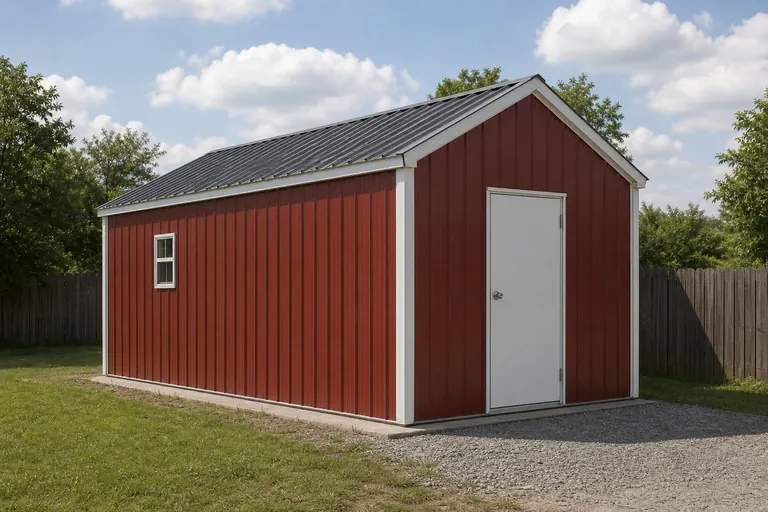 Front Range residential storageA compact single-purpose building for tools and equipment, most likely to sit near a local permit-exemption threshold.Mountain-property equipment storageA shed sited at higher elevation where anchoring and roof snow exposure deserve more attention than a plains-zone site.Rural or plains-zone accessory buildingA shed sited on a larger eastern-plains or rural parcel, where confirming land status matters more than in a dense subdivision.
Example Configuration — for planning purposes only.
Get Colorado Shed Quotes
Tell us your city or county, parcel status, and intended use. We route it with the Colorado and shed context already attached.
Footprint
Sizes That Suit Common Colorado Shed Briefs
Most enquiries stay compact, but a rural or mountain-property brief can call for more room.
10′ × 12′
120 sq ft
A small footprint for tool and equipment storage, worth checking against your local permit-exemption threshold.
12′ × 20′
240 sq ft
A common step up when equipment or feed storage is added to general storage.
16′ × 24′
384 sq ft
Enough depth for a small equipment bay on a larger rural or mountain-property parcel.
Example Configuration — for planning purposes only.
Footprint pages carry layout and door detail; this page explains only the Colorado permit and siting context.
Preparation
Before You Request a Colorado Shed Quote
Steps that address the parts of a Colorado shed project a generic quote will not cover.
- Call your local building department with exact shed dimensionsColorado sets permit-exemption thresholds locally; there is no statewide figure to assume.
- Verify your parcel's ownership status on rural sitesColorado carries a historically large federal-acreage share worth checking against your specific site.
- Confirm anchoring and pad prep for your elevation and zoneColorado's range runs from flat eastern plains to peaks above 14,000 feet across four mapped physiographic zones.
- State the shed's full intended use up frontA shed quoted as basic storage but used for equipment or feed is a common source of a second round of quoting.
Questions
Colorado Shed Questions
Honest state-level answers, with jurisdiction-specific and land-status questions routed to the office that actually decides them.
It depends on your specific city or county, since Colorado has no single statewide building-code agency for private construction and permit-exemption thresholds are set locally. Call your building department with your shed's exact dimensions to confirm.
It can. Colorado's elevation runs from flat eastern plains to Mount Elbert's 14,440-foot summit and 54 peaks above 14,000 feet, and exposure differs by site. A local installer can recommend anchoring appropriate to your exact elevation and zone.
Possibly, but confirm boundaries first. CRS data shows a historically large federal-acreage share for Colorado, so verifying your parcel is genuinely private, buildable land is a worthwhile step before ordering.
There is no official typical size. Compact 10x12 to 12x20 footprints are common for residential storage, while rural or mountain-property parcels sometimes call for more room.
We do not publish state-level prices, because a credible number depends on specification, site work, and current material pricing. Our cost pages cover what drives the number.
It can. The Colorado Geological Survey maps four physiographic zones — Southern Rocky Mountains, Great Plains, Wyoming Basin, and Colorado Plateau — with different pad-prep needs. Confirm specifics for your zone with a local installer.
Sources for the Colorado facts on this page
This page states no code requirement, wind speed, snow load, permit rule, price or supplier claim. The state-specific facts it does use are listed with their publisher below.
Colorado has no single statewide building code agency for general construction; the state's Office of the State Architect only sets minimum codes for state-owned/state-lease-purchased buildings, while other construction is subject to local adoption per the Division of Housing and Colorado's Planning for Hazards program.
Colorado Office of the State Architect; Colorado Department of Local Affairs, Division of Housing · current, accessed 2024/2025 · Tier 2
https://osa.colorado.gov/building-codesColorado's Division of Housing (Department of Local Affairs) issues state housing board resolutions (e.g., on-site construction/safety codes for manufactured and multi-family housing) that apply only where local standards do not otherwise exist, illustrating the state's default-to-local code structure.
Colorado Secretary of State / Department of Local Affairs, Division of Housing · current codified rule · Tier 2
https://www.sos.state.co.us/CCR/GenerateRulePdf.do?fileName=8+CCR+1302-8&ruleVersionId=7589CRS's federal land ownership dataset lists Colorado federal acreage at roughly 23.8 million acres (2013 data) against total state acreage of approximately 23.6 million acres reported in the same table (figures should be read alongside the report's narrative, as western-state totals were affected by year-to-year BLM/DOD adjustments).
Congressional Research Service · data as of FY2013, report dated March 3, 2017 · Tier 1
https://www.everycrsreport.com/files/20170303_R42346_95ce191e74ed8e08054bb5476971544bc55823f2.htmlColorado's highest point, Mount Elbert, reaches 14,440 feet elevation (NAVD 88), reflecting the extreme high-mountain-to-plains elevation range relevant to mountain snow load versus valley/plains conditions.
Wikipedia (cross-referencing USGS elevation data) · current · Tier 1
https://en.wikipedia.org/wiki/Mount_ElbertThe Colorado Geological Survey's physiographic map divides the state into the Southern Rocky Mountains, the Great Plains (with High Plains, Colorado Piedmont, and Raton Basin subprovinces), the Wyoming Basin, and the Colorado Plateau.
Colorado Geological Survey · current reference map · Tier 2
https://coloradogeologicalsurvey.org/wp-content/uploads/ON-010-09-04.pdf