
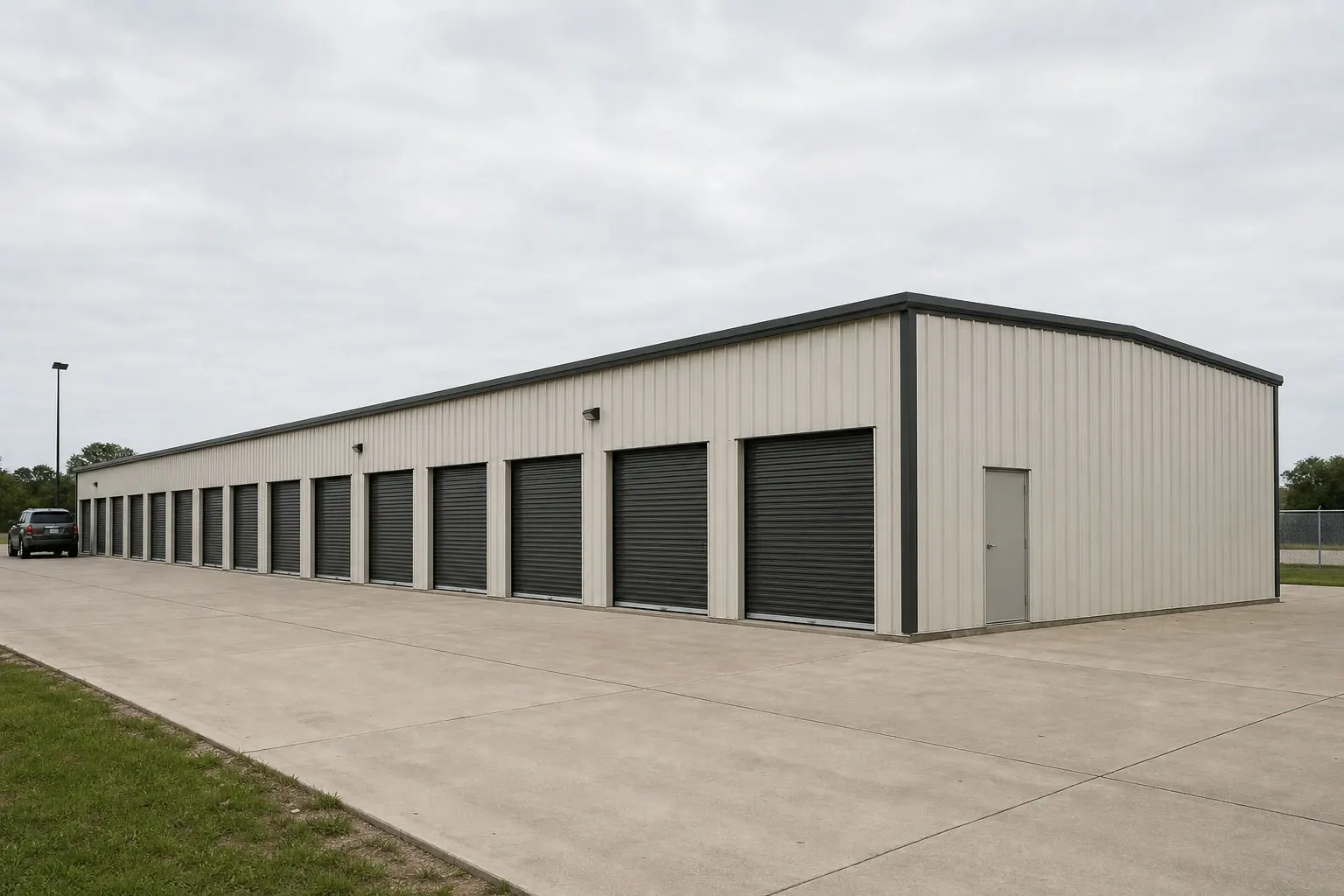
Mini storage building · MI
Mini-Storage Buildings in Michigan
Developing a mini-storage facility in Michigan requires navigating regional hydrologic differences and diverse municipal zoning landscapes. Whether you are developing in the urban Lower Peninsula or rural northern areas, Michigan's varied site conditions require a site-specific geotechnical approach. Our evidence focuses on the statewide context; local zoning must confirm project viability.
Geotechnical
Geotechnical and regional planning
Commercial mini-storage developers have extra considerations in Michigan's two-peninsula landscape.
In Michigan, mini-storage facility development relies on understanding how your specific parcel's hydrologic province impacts storm-water retention and pavement durability. The state's unique geography, consisting of two peninsulas, means that a developer in the Upper Peninsula faces a different set of subsurface challenges than one in the Lower Peninsula. In many Michigan provinces, the soil is composed of glacial till or heavy clay, which can trap water and cause significant frost heave. For a large mini-storage facility, this heave can lead to cracked pavement and misaligned unit doors, which are costly to repair and frustrating for tenants. A comprehensive geotechnical report that identifies the hydrologic characteristics of your specific site is the first and most important investment for a Michigan developer.
Storm-water management is another critical component of Michigan planning. Because a mini-storage facility creates a large amount of impervious surface (roofs and pavement), Michigan law requires that the resulting runoff be managed effectively to prevent flooding and protect the state's vast freshwater resources. This often means dedicating a significant portion of your site to retention ponds or underground detention systems. The design of these systems must account for Michigan's precipitation patterns, which average roughly 35 inches annually but can be concentrated in heavy spring rain or winter melt events. Working with an engineer who understands local Michigan DNR and county drain commission requirements is essential for a successful project.
The decentralized nature of Michigan's municipal government means that zoning for mini-storage can vary wildly between adjacent townships. Some Michigan communities view mini-storage as a light industrial use, while others classify it as commercial. This affects not only where you can build but also the specific design standards you must meet, such as landscaping buffers, lighting restrictions, and architectural requirements. With 21,750 new housing units authorized in the state in 2024, many growing Michigan corridors are seeing increased demand for storage, but developers must navigate a complex patchwork of local land-use policies to tap into this market.
Operations
Building for Michigan's climate cycles
The Michigan environment impacts both the construction and the long-term maintenance of a storage facility.
The climate data for Michigan highlights the importance of moisture management. With high humidity levels influenced by the surrounding Great Lakes, climate-controlled units are becoming increasingly popular in the Michigan market. A non-controlled unit in Michigan is susceptible to interior condensation during the rapid temperature shifts of the spring and fall. For developers, this means investing in high-quality vapor barriers and robust insulation systems for at least a portion of their units. This allows you to charge a premium for 'deluxe' storage that protects sensitive items from Michigan's humidity and temperature swings.
Snow and ice management are major operational costs for Michigan storage facilities. FEMA's hazard data notes that all Michigan counties are at risk for severe winter weather and ice storms. When designing your facility, the layout must include ample space for snow storage—where the plows will push the snow during a heavy Michigan winter. If you don't plan for this, you may find yourself losing rentable units or parking spaces to massive snow banks. Furthermore, the roof design of the units should be simple, avoiding complex valleys where ice dams can form. Ice damming is a common cause of roof leaks in Michigan and can lead to significant damage to tenant property.
Lastly, consider the impact of the Great Lakes on your building's exterior. Coastal Michigan counties experience higher salt concentrations in the air (though freshwater, the environment is still more corrosive than inland areas) and higher humidity. Using high-grade steel with superior protective coatings (like Galvalume or specialized paint systems) is a smart long-term investment. While these materials may have a higher upfront cost, they will resist the rust and fading that can plague cheaper buildings in the Michigan climate, maintaining the facility's curb appeal and resale value.
- Snow Storage Planning
- Allocate at least 10-15% of your site's open area for snow accumulation to ensure aisles remain clear.
- Condensation Control
- Use Drip-Stop or similar roof coatings on non-insulated units to manage Michigan's high seasonal humidity.
- Pavement Durability
- Specify a thicker-than-average sub-base for asphalt areas to withstand Michigan's aggressive freeze-thaw cycles.
Strategic
Market trends in Michigan storage
Demand is shifting toward high-end, secure, and climate-resilient storage options.
The Michigan storage market is maturing, with a shift away from simple 'cold' storage toward more specialized facilities. As the state's housing market continues to grow—reflected in the high number of units authorized—more Michiganders are looking for storage that feels as safe and clean as their own homes. This means that features like high-end security systems, bright LED lighting, and individual unit alarms are no longer 'extra'—they are expected. For a developer, this requires a more robust electrical plan and a commitment to ongoing technology maintenance.
Another trend in Michigan is the growth of 'toy storage' for boats, RVs, and classic cars. Given Michigan's 208-acre average farm size and its recreational culture, there is a massive amount of high-value equipment that needs a home during the winter. A storage building that offers oversized units with large power-operated doors can tap into this lucrative market. Many Michigan owners are willing to pay a premium for a unit that allows them to store their boat or RV indoors, protected from the ice and snow that FEMA warns about.
Finally, sustainability is becoming a factor in Michigan commercial development. With the state's focus on protecting its water resources, many developers are looking at ways to reduce the environmental footprint of their facilities. This can include using permeable pavers for parking areas, installing solar arrays on the expansive roof surfaces, or using energy-efficient HVAC systems for climate-controlled units. Not only do these features appeal to environmentally conscious Michigan tenants, but they can also lead to significant long-term savings on utility and maintenance costs.
Mini-Storage Quotes
Get Michigan-specific quotes for your storage development.
Before You Break Ground
Michigan Mini-Storage Pre-Development Checklist
Resolve these before the site plan is drawn, not after the geotechnical report comes back.
Step 1
Identify your parcel's hydrologic province
USGS-mapped provinces determine whether your pavement sub-base and detention design need to handle rapid sandy drainage or slow-draining clay till.
Step 2
Confirm your township's classification of mini-storage
Some Michigan municipalities treat the use as light industrial, others as commercial; the classification changes required buffers, lighting limits and architectural standards.
Step 3
Size your snow-storage area before finalizing the site plan
Aisles and parking that look adequate in a site rendering routinely fail once a Michigan winter's plowed snow needs somewhere to go.
Step 4
Coordinate storm-water design with the county drain commission
Michigan's drain commission structure means storm-water rules are administered locally; confirm detention requirements before committing to an impervious-surface layout.
Footprints
Mini-Storage Building Footprints for Michigan Sites
Michigan's freeze-thaw cycle and township drainage review favour phased, drive-aisle-friendly building runs over one oversized structure.
30′ × 100′
3,000 sq ft
A single-run starter building for a small-town Michigan site, narrow enough to keep drive aisles clear of snow-storage banks along the property edge.
40′ × 150′
6,000 sq ft
A mid-phase run with a central corridor, sized so plow routes and snow-melt drainage can be planned around the building rather than through it.
50′ × 200′
10,000 sq ft
A larger run for a metro-edge Michigan parcel, where impervious-surface area and detention capacity usually drive the layout more than the building itself.
Example Configuration — for planning purposes only.
Storm-water detention and impervious-surface limits are administered locally in Michigan; confirm them with your county drain commission before fixing a building count.
FAQ
Michigan Mini-Storage FAQ
Practical advice for commercial storage developers.
Many townships are concerned about the traffic and aesthetic impact of mini-storage. Presenting a professional site plan with extensive landscaping can help overcome these hurdles.
Your foundation and any underground utilities must be placed below the local frost line to prevent damage from seasonal ground movement.
While not strictly required, it is highly recommended for a portion of your units to address the state's high humidity and temperature fluctuations.
There is no statewide figure, but experienced Michigan developers typically hold back a meaningful share of open site area — well beyond what a snow-free state would need — specifically as a plowing destination, separate from drive aisles and parking. Confirm expectations with your site engineer based on your specific county's typical snowfall.
Often yes. Michigan's decentralized storm-water administration means the county drain commission, not just the township, can set requirements for how roof and pavement runoff from a large storage facility is detained and released.
Sources for the Michigan facts on this page
This page states no code requirement, wind speed, snow load, permit rule, price or supplier claim. The state-specific facts it does use are listed with their publisher below.
USGS Water-Resources Investigations Report 91-4120 delineates named hydrologic provinces across Michigan's Upper and Lower Peninsulas, prepared in cooperation with the Michigan DNR Geological Survey Division.
U.S. Geological Survey, in cooperation with Michigan Dept. of Natural Resources · 1991 · Tier 1
https://pubs.usgs.gov/wri/1991/4120/report.pdfUSGS describes Michigan as consisting of two peninsulas -- the Upper Peninsula and Lower Peninsula, separated by the Straits of Mackinac -- and notes it is the only U.S. state touching four of the five Great Lakes, giving it the longest freshwater coastline in the country.
U.S. Geological Survey · 2021 · Tier 1
https://pubs.usgs.gov/publication/fs20213047Builders in Michigan were authorized to construct 21,750 new privately-owned housing units in 2024, of which 15,045 were single-unit structures.
U.S. Census Bureau · 2024 (final annual estimates) · Tier 1
https://www.census.gov/construction/bps/stateannual.htmlMichigan had 9,472,069 acres of land in farms in 2022, an average farm size of 208 acres.
USDA NASS · 2022 · Tier 1
https://www.nass.usda.gov/Publications/AgCensus/2022/Full_Report/Volume_1,_Chapter_1_State_Level/Michigan/st26_1_001_001.pdfFEMA's National Risk Index is the federal tool for county- and state-level natural hazard exposure data for Michigan's 83 counties, covering 18 hazard types including winter weather, ice storm, and severe/strong wind.
Federal Emergency Management Agency (FEMA) · Current NRI release · Tier 1
https://www.fema.gov/flood-maps/products-tools/national-risk-indexDetroit Metro Airport's NOAA 1991-2020 climate normals show total annual precipitation of roughly 34-35 inches, with January and February mean snowfall near 12-14 inches each.
NOAA National Centers for Environmental Information (NCEI) · 1991-2020 · Tier 1
https://www.ncei.noaa.gov/access/services/data/v1?dataset=normals-monthly-1991-2020&format=pdf&stations=USW00094847