Shed · CA
Steel Sheds in California
A backyard or ranch-yard shed in California sits under a single statewide Title 24 framework administered by the California Building Standards Commission, which is a different starting point than a state with no statewide code authority. What that framework does not tell you is whether your parcel carries added exposure: CAL FIRE is required by state law to classify land into Fire Hazard Severity Zones based on fuel loading, slope, fire weather and wind, and that classification applies parcel by parcel, not by county or region. With 63,134 farms recorded across 24.19 million acres of farmland in the 2022 Census of Agriculture, a meaningful share of California shed demand comes from working land rather than a suburban backyard, and the California Geological Survey's 11 recognized geomorphic provinces mean the ground a shed pad sits on can look nothing alike from the north coast to the Mojave. This page addresses those California-specific realities instead of repeating generic shed advice.
The intersection
What a California site actually changes about a shed
A shed is a simple building, but in California a statewide code framework and a parcel-level fire hazard lookup both reach it before the ground even gets prepared.
The California Building Standards Commission administers Title 24 of the California Code of Regulations as the state's building standards framework. That gives a shed project a single named starting authority, which is a real contrast with a state that leaves code adoption entirely to individual cities and counties. This page does not state what Title 24 requires for a shed of any particular size — that answer belongs to your local building department — but knowing the framework's source is worth having before you specify anything.
The fire question is separate and parcel-specific. CAL FIRE is required by Public Resources Code section 4202 and Government Code section 51178 to classify land into Fire Hazard Severity Zones based on fuel loading, slope, fire weather and wind. A shed on a parcel in a higher-classified zone may face different siting distance or vegetation clearance expectations than the same shed on a lower-risk parcel a few miles away, and the only reliable way to know is to look up your specific address on CAL FIRE's published maps before you order.
Terrain is the third variable. The California Geological Survey divides the state into 11 recognized geomorphic provinces, from the Coast Ranges and Central Valley to the Sierra Nevada, the Mojave Desert and the Modoc Plateau. A shed pad on Central Valley flatland behaves differently during grading than one on Sierra Nevada foothill slopes or Mojave Desert ground, which is a site-work conversation worth having with whoever pours your pad, not a detail to discover after delivery.
Site context
How the build site differs across California
The California Geological Survey's geomorphic provinces are a practical lens for anticipating shed site work before you request a quote.
North coast and Coast Ranges
The wettest part of the state; drainage away from the pad and, for wildland-adjacent parcels, the fire hazard zone question are worth resolving early.
Central Valley
Generally flat ground that simplifies pad preparation, but summer heat and irrigation-adjacent moisture near farmland are still worth accounting for.
Sierra Nevada and mountain provinces
Sloped terrain and elevated fire exposure make grading and vegetation clearance a bigger part of the siting conversation.
Mojave and Colorado deserts
Arid, wind-exposed ground where dust and heat matter more than moisture, and access for delivery over unpaved terrain is worth confirming in advance.
Use case
California sheds are frequently a working-acreage building
With 63,134 farms recorded in the 2022 Census of Agriculture across 24.19 million acres of land in farms, a real share of shed demand in California comes from working land rather than a suburban lot.
That statewide farm count does not describe your parcel and is not a claim about what any one buyer needs; it explains why a California shed brief so often includes feed, tack, small equipment or fencing supplies rather than only lawn tools. An average farm size of 383 acres statewide means many operations have room for a dedicated small building rather than repurposing space in an existing structure.
That context also matters for the fire hazard conversation above: a shed on working acreage at the edge of wildland is more likely to sit in a higher Fire Hazard Severity Zone than a shed in a dense suburban tract, which is a real reason the CAL FIRE lookup matters more for rural-acreage buyers than for a purely urban backyard project.
Get California shed quotes
Tell us your region, your parcel's fire hazard zone status if known, and your intended use. We route it with the California and shed context already attached.
Configuration
What California sheds are usually asked to do
California shed briefs split fairly cleanly between suburban storage and working-acreage support, and the siting priorities differ accordingly.
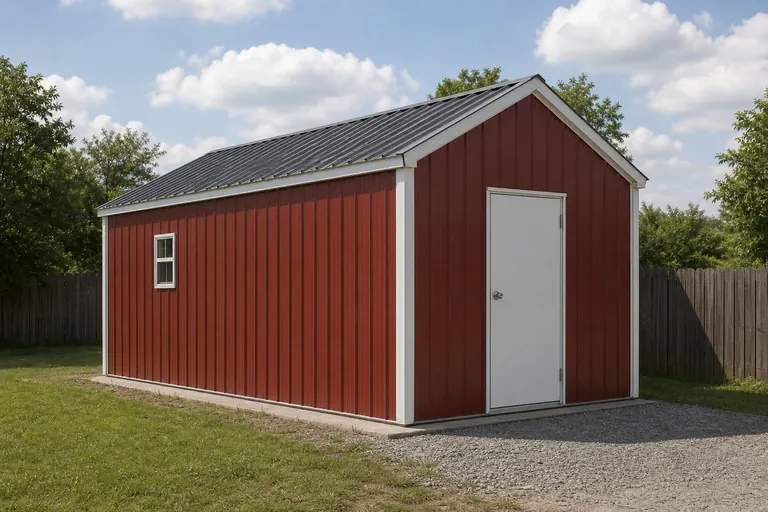 Backyard storageA compact, single-purpose building for tools, mowers and seasonal items, typically the simplest Title 24 conversation.
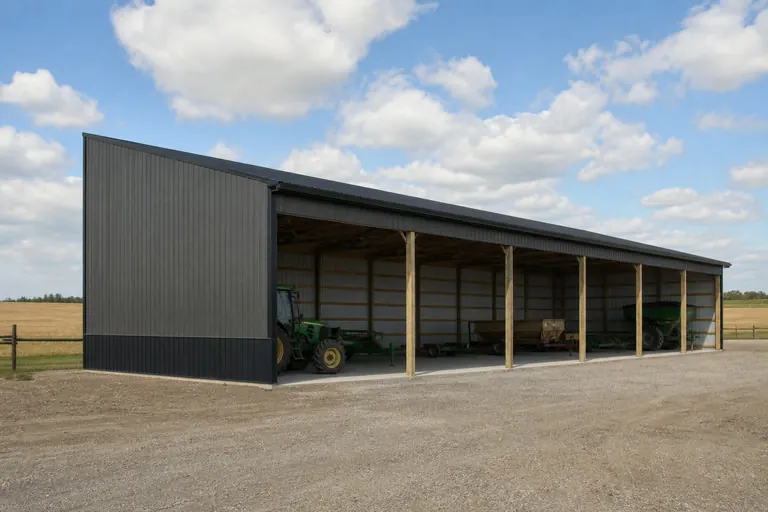 Ranch and feed storageA working building for feed, tack and small equipment, where the Fire Hazard Severity Zone lookup carries more weight due to wildland proximity.Wildland-adjacent accessory buildingA shed on a parcel in a higher fire hazard zone, where vegetation clearance and siting distance are worth confirming before ordering.
Example Configuration — for planning purposes only.
Footprint
Sizes that suit common California shed briefs
Most California shed enquiries stay compact because the building supplements an existing structure rather than replacing one, even on large acreage.
10′ × 12′
120 sq ft
The smallest practical footprint for tool and mower storage.
12′ × 20′
240 sq ft
A common step up when feed or tack storage is added to general storage.
16′ × 24′
384 sq ft
Enough depth for a small equipment bay alongside storage.
20′ × 30′
600 sq ft
Where the building starts to double as a small workshop.
Example Configuration — for planning purposes only.
Footprint pages carry layout and door detail; this page explains why California briefs land in this range.
Questions
California shed questions
Questions we can answer honestly at state level, with the rest routed to whoever actually owns them.
Title 24, administered by the California Building Standards Commission, is the statewide framework, but application to a specific shed size and use is decided by your local building department. Confirm before you order.
If your parcel is near wildland, yes. CAL FIRE is required by state law to classify land into Fire Hazard Severity Zones, and the classification is parcel-specific. Look up your address on CAL FIRE's published maps before finalizing a site plan.
There is no official typical size. Most enquiries stay in the 10x12 to 20x30 range because the building usually supplements an existing structure rather than replacing one.
We do not publish state-level prices, because a credible number depends on specification, site work and current material pricing. Our cost pages cover what drives the number.
Site conditions vary widely across the state's 11 geomorphic provinces — Central Valley flatland, Sierra Nevada slopes and desert ground behave differently — but the right foundation for your parcel is a site-specific decision for your builder, not a statewide rule.
Sources for the California facts on this page
This page states no code requirement, wind speed, snow load, permit rule, price or supplier claim. The state-specific facts it does use are listed with their publisher below.
The California Building Standards Commission (CBSC) administers the California Building Standards Code, Title 24 of the California Code of Regulations, as the state's building standards framework.
California Department of General Services, Building Standards Commission (CBSC) · 2025 Triennial Edition, effective Jan 1, 2026 · Tier 2
https://www.dgs.ca.gov/bsc/CAL FIRE, under the state Office of the State Fire Marshal, is required by law (Public Resources Code 4202 / Government Code 51178) to classify lands into Fire Hazard Severity Zones based on fuel loading, slope, fire weather, and wind, without this evidence assigning any specific zone.
California Department of Forestry and Fire Protection (CAL FIRE) / Office of the State Fire Marshal · current program; 2024 FHSZ maps referenced · Tier 2
https://osfm.fire.ca.gov/what-we-do/community-wildfire-preparedness-and-mitigation/fire-hazard-severity-zonesCalifornia had 63,134 farms in 2022 per the USDA Census of Agriculture.
USDA National Agricultural Statistics Service (NASS) · 2022 · Tier 1
https://www.nass.usda.gov/Publications/AgCensus/2022/Full_Report/Volume_1,_Chapter_1_State_Level/California/Land in farms in California totaled 24,190,604 acres in 2022.
USDA NASS · 2022 · Tier 1
https://www.nass.usda.gov/Publications/AgCensus/2022/Full_Report/Volume_1,_Chapter_1_State_Level/California/The California Geological Survey (state geological survey) divides the state into 11 recognized geomorphic provinces, including the Coast Ranges, Central Valley, Sierra Nevada, Basin and Range, Mojave Desert, Colorado Desert, Transverse Ranges, Peninsular Ranges, Klamath Mountains, Cascade Range, and Modoc Plateau.
California Department of Conservation, California Geological Survey · 2002 (revised) · Tier 2
https://www.conservation.ca.gov/cgs/documents/publications/cgs-notes/CGS-Note-36.pdfFEMA's National Risk Index scores U.S. communities, including California counties, across 18 defined natural hazard types.
FEMA · current dataset · Tier 1
https://www.fema.gov/about/openfema/data-sets/national-risk-index-data