Garden shed · CA
Garden Sheds in California
A garden shed in California is shaped by a gardening calendar most other states do not have. The State Climatologist describes California's overall pattern as Mediterranean, with precipitation concentrated October through April and dry conditions May through September, which means irrigation equipment, hose storage and drought-tolerant supplies matter more here than seasonal snow-clearing gear. NOAA's state climate summary also records almost 3°F of warming since the beginning of the 20th century, with the six warmest years on record occurring since 2014, which is part of why defensible space and vegetation management around any structure, including a small garden shed, are live topics for California property owners. The California Building Standards Commission administers Title 24 as the statewide code framework, and CAL FIRE's parcel-level Fire Hazard Severity Zone classification is the other lookup worth doing before you site a garden shed near planted beds or wildland edges.
The intersection
A dry-season shed for a dry-season garden
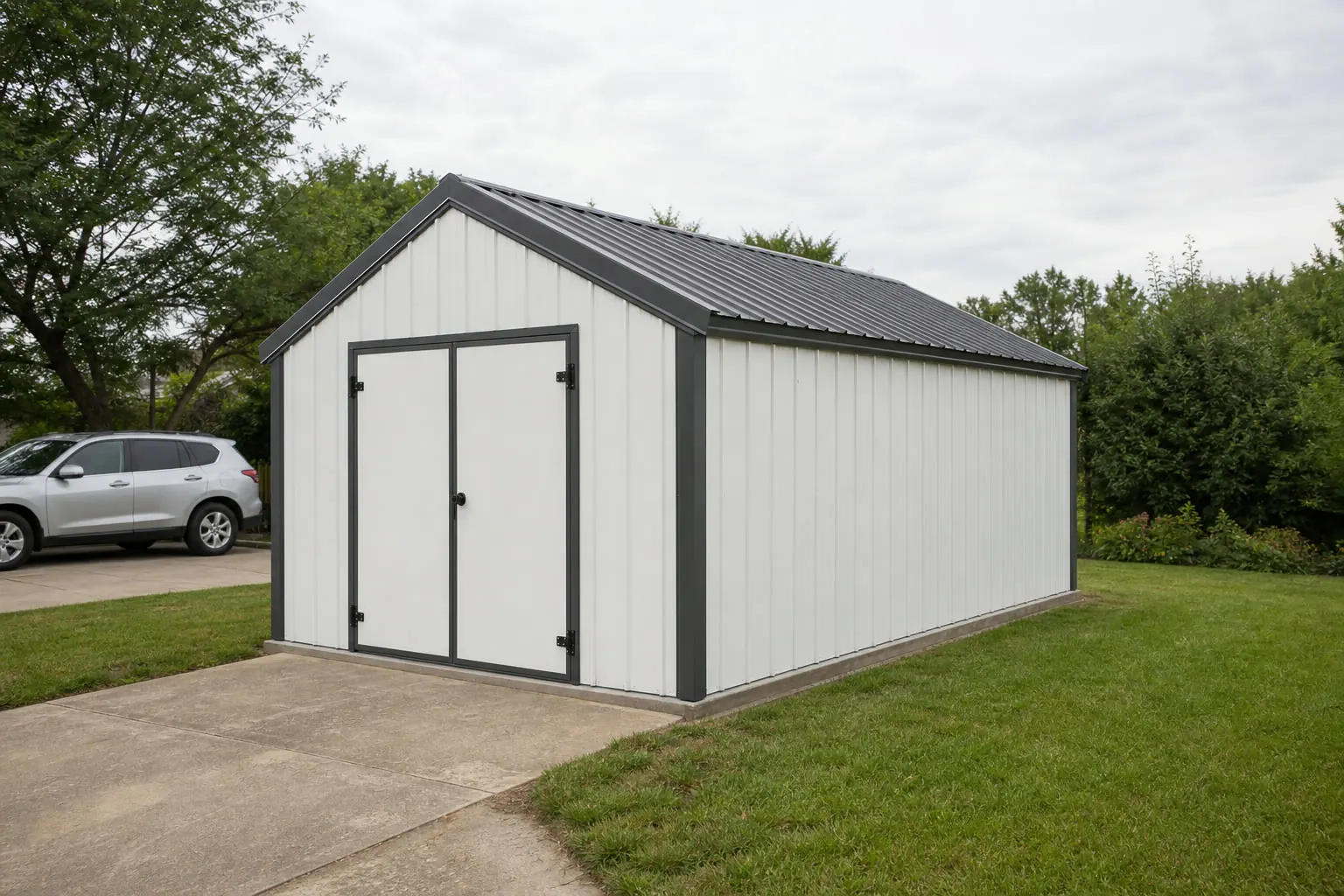
California's Mediterranean climate pattern reorganizes what a garden shed needs to hold and how it should be sited relative to fire risk.
The California State Climatologist describes the state's overall pattern as Mediterranean, with precipitation concentrated October through April and dry conditions May through September, and that split shapes a garden shed's contents more than almost any other single fact. Instead of snow shovels and salt, a California garden shed typically organizes around hose reels, drip-irrigation fittings, shade cloth and drought-tolerant plant supplies, because the growing season runs through a long dry stretch that needs active water management rather than passive winter storage.
NOAA's State Climate Summary reports temperatures in California have risen almost 3°F since the beginning of the 20th century, with the six warmest years on record occurring since 2014. That trend is background, not a design requirement this page sets, but it is part of why vegetation management and defensible space around structures — including a small garden shed — are actively discussed by California property owners and local fire authorities rather than an afterthought.
That is where the fire-hazard lookup becomes relevant even for a gardening-focused building. CAL FIRE is required by state law to classify land into Fire Hazard Severity Zones based on fuel loading, slope, fire weather and wind, and the classification is parcel-specific. A garden shed sited near dense plantings or a wildland edge is worth checking against your own address on CAL FIRE's published maps, since a garden setting does not exempt a parcel from the classification.
The Mediterranean label also hides real regional range within one state. The same State Climatologist narrative that sets the wet-October-to-April, dry-May-to-September pattern also records north coast areas averaging over 100 inches of annual precipitation against southeastern deserts under 5 inches, a spread of more than 20 to 1 across California. A garden shed on the fog-prone north coast is more likely to need ventilated shelving to keep seed packets and fertilizer from clumping in persistent humidity, while a desert-adjacent shed is more likely to need shade siting and heat-tolerant storage for anything that softens or degrades above typical summer temperatures. Fire Hazard Severity Zone status is worth checking on top of that regional read, not instead of it: FEMA's National Risk Index separately scores every California county across 18 defined natural hazard types, including drought, extreme heat and inland flooding, so a county that scores low for wildfire can still carry other exposures worth a quick look before finalizing a garden shed's siting and construction details.
Framework
The statewide code, then the local siting question
Title 24 gives a California garden shed one statewide starting framework; the siting details are still local.
The California Building Standards Commission administers Title 24 of the California Code of Regulations as the state's building standards framework. This page does not state what Title 24 requires for a garden shed of a particular size — that is a question for your local building department — but the framework's existence as a single statewide body is worth knowing before you specify a structure.
Local zoning and setback rules still apply on top of that framework, and for a garden shed specifically, placement relative to planted beds, irrigation lines and any defensible-space clearance your parcel's fire hazard zone calls for are all worth resolving with your local department and, where relevant, your local fire authority before the pad is set.
Configuration
What a California garden shed is usually asked to do
The dry-season calendar and the state's gardening culture shape a few recurring garden shed briefs.
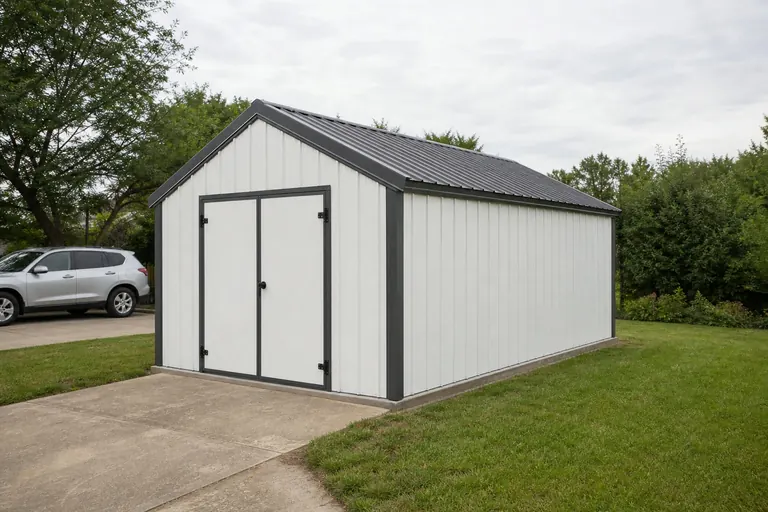 Irrigation and tool storageHose reels, drip fittings, hand tools and fertilizer, organized around the long dry season rather than winter storage.Seed-starting and potting stationA workbench and shelving for potting soil and starts, often positioned to capture available light during the wet-season growing window.Working-acreage garden supportA larger garden shed on agricultural land supporting a broader growing operation, distinct from a purely ornamental backyard garden.
Example Configuration — for planning purposes only.
Get California garden shed quotes
Tell us your gardening setup and your parcel's fire hazard zone status if known, and we route it with the California context already attached.
Preparation
Before you order a California garden shed
A few California-specific checks keep a garden shed project simple.
Step 1
Check your parcel's Fire Hazard Severity Zone
CAL FIRE's classification is parcel-specific; check your address before finalizing placement near plantings or wildland edges.
Step 2
Confirm Title 24 scope with your local building department
The CBSC sets the statewide framework, but your local department applies it to your specific structure.
Step 3
Plan for the dry-season storage load
Irrigation equipment and drought-tolerant supplies typically dominate a California garden shed's contents; size shelving accordingly.
Step 4
Ask about defensible-space clearance if relevant
If your parcel carries a higher fire hazard classification, vegetation clearance around structures may factor into siting.
Step 5
Pull your county's FEMA hazard profile
The National Risk Index scores 18 hazard types by county, so it is worth a look even where the fire-hazard picture is clear, since drought and extreme-heat exposure vary independently by county.
Footprint
Common California garden shed sizes
California garden sheds tend to stay compact, sized around tools and irrigation equipment rather than large machinery.
8′ × 10′
80 sq ft
A compact footprint for hand tools and irrigation supplies.
10′ × 16′
160 sq ft
Room for a potting bench alongside general garden storage.
12′ × 20′
240 sq ft
Suited to working-acreage gardening support with more equipment and supply storage.
Example Configuration — for planning purposes only.
Confirm your local setback rules and any fire hazard clearance requirements before finalizing a footprint.
Questions
California garden shed questions
Honest answers at the state level, with parcel-specific and pricing questions routed to whoever actually owns them.
It affects contents more than construction. The Mediterranean pattern of wet October-through-April and dry May-through-September months shapes toward irrigation and drought-tolerant supply storage rather than any specific structural requirement.
If your parcel is near wildland or dense vegetation, yes. CAL FIRE's Fire Hazard Severity Zone classification is parcel-specific; look up your address before finalizing siting.
Title 24, administered by the California Building Standards Commission, is the statewide framework, but how it applies to a specific garden shed size is a question for your local building department.
There is no official typical size. Most California garden sheds run from about 8x10 to 12x20 depending on tool and irrigation-equipment storage needs.
We do not publish state-level prices, since cost depends on size, specification and site work. Our cost pages explain what drives the number.
It can change ventilation and shelving choices more than the structure itself. The State Climatologist's data shows north coast areas averaging over 100 inches of yearly precipitation against under 5 inches in southeastern deserts, so a humid coastal shed and an arid desert-adjacent shed reasonably prioritize different interior storage details.
Sources for the California facts on this page
This page states no code requirement, wind speed, snow load, permit rule, price or supplier claim. The state-specific facts it does use are listed with their publisher below.
The California State Climatologist describes California as having a Mediterranean climate overall, with precipitation concentrated October through April and dry conditions May through September, strongly modulated by mountains and the Pacific Ocean, with north coast areas averaging over 100 inches of annual precipitation and southeastern deserts under 5 inches.
California Department of Water Resources / Office of the State Climatologist (republished via CoCoRaHS) · n/a (narrative climatology) · Tier 2
https://media.cocorahs.org/docs/ClimateSum_CA.pdfNOAA's NCEI State Climate Summary reports temperatures in California have risen almost 3°F since the beginning of the 20th century, with the six warmest years on record occurring since 2014.
NOAA National Centers for Environmental Information · 2022 report · Tier 1
https://statesummaries.ncics.org/downloads/California-StateClimateSummary2022.pdfCAL FIRE, under the state Office of the State Fire Marshal, is required by law (Public Resources Code 4202 / Government Code 51178) to classify lands into Fire Hazard Severity Zones based on fuel loading, slope, fire weather, and wind, without this evidence assigning any specific zone.
California Department of Forestry and Fire Protection (CAL FIRE) / Office of the State Fire Marshal · current program; 2024 FHSZ maps referenced · Tier 2
https://osfm.fire.ca.gov/what-we-do/community-wildfire-preparedness-and-mitigation/fire-hazard-severity-zonesThe California Building Standards Commission (CBSC) administers the California Building Standards Code, Title 24 of the California Code of Regulations, as the state's building standards framework.
California Department of General Services, Building Standards Commission (CBSC) · 2025 Triennial Edition, effective Jan 1, 2026 · Tier 2
https://www.dgs.ca.gov/bsc/California had 63,134 farms in 2022 per the USDA Census of Agriculture.
USDA National Agricultural Statistics Service (NASS) · 2022 · Tier 1
https://www.nass.usda.gov/Publications/AgCensus/2022/Full_Report/Volume_1,_Chapter_1_State_Level/California/FEMA's National Risk Index scores U.S. communities, including California counties, across 18 defined natural hazard types.
FEMA · current dataset · Tier 1
https://www.fema.gov/about/openfema/data-sets/national-risk-index-dataCalifornia's total land area was 155,766 square miles per the 2008 Census Bureau state area measurements, the third-largest U.S. state by land area.
U.S. Census Bureau, Statistical Abstract of the United States: 2011 · 2008 · Tier 1
https://www2.census.gov/library/publications/2010/compendia/statab/130ed/tables/11s0355.pdf