
RV carport · UT
RV Carports in Utah
An RV carport is an open, taller-clearance structure than a standard vehicle carport, and where you place one inside Utah changes the exposure conversation more than it would in a state with one dominant landscape. Utah Agriculture in the Classroom's reference material splits the state into three climate zones — desert covering about a third of Utah, steppe covering roughly two-fifths, and highland or mountain terrain making up about a quarter — with an elevation range running from 2,350 feet at Beaver Dam Wash up to 13,528 feet at Kings Peak. A carport roof in a mountain valley community sits in genuinely different conditions than one in a low desert basin, which is exactly the kind of site-specific variation a builder and local jurisdiction need to talk through directly. What is comparatively unusual about Utah, though, is that code administration itself pushes toward statewide consistency: the Division of Professional Licensing (DOPL), inside the Department of Commerce, administers the Uniform Building Standards Act and works with the Uniform Building Code Commission specifically to promote uniform code enforcement across Utah, a structure that is worth understanding before assuming an RV carport permit path will vary as widely by county as the terrain does.
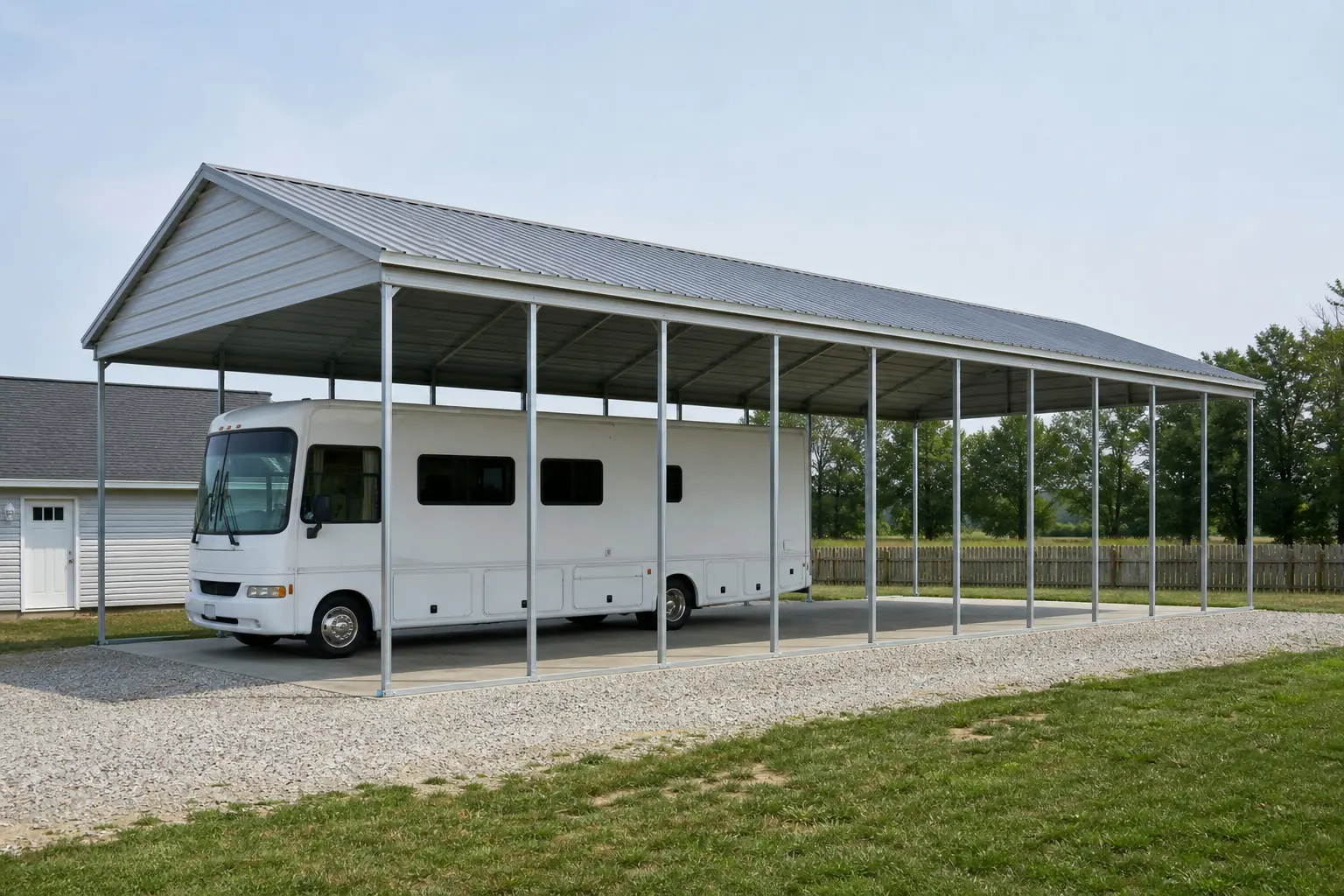
The intersection
Utah's elevation spread makes 'where' the first RV carport question
An RV carport's exposure depends heavily on which of Utah's three climate zones the site sits in, more than a state with one dominant landscape.
Utah Agriculture in the Classroom's elevation and precipitation reference splits the state into three climate zones: desert covers about a third of Utah, steppe covers roughly two-fifths, and highland or mountain terrain makes up about a quarter. The same reference documents an elevation range from Beaver Dam Wash at 2,350 feet up to Kings Peak at 13,528 feet — nearly 11,200 feet of vertical difference across the state. For a large open-roof structure like an RV carport, that spread is not academic: a highland-zone site and a low desert-basin site are functionally different planning contexts before wind or snow figures ever enter the conversation.
This page does not assign a wind speed or snow load to either zone; those numbers depend on the exact parcel and come from the local building department and the project's engineer of record. What is fair to say is that an RV carport brief in Utah should start by naming which of the three zones the site falls in, because that framing changes what questions to ask a builder next.
Jurisdiction
Utah pushes toward statewide code uniformity, unlike states with fully local systems
Utah's Division of Professional Licensing and the Uniform Building Code Commission work specifically to keep code enforcement consistent across the state, which is worth knowing before assuming a fully county-by-county permit path.
Utah's Division of Professional Licensing (DOPL), within the Department of Commerce, administers the Uniform Building Standards Act and works with the Uniform Building Code Commission to promote statewide uniformity in code enforcement. The State Construction and Fire Codes Act, Title 15A, is the statutory basis for that administration. That is a structurally different setup from a state where each city or county writes and enforces its own separate construction code framework from scratch — Utah's system is built around a shared statewide standard, administered with local enforcement.
That still does not mean every RV carport permit question is answered at the state level. Site-specific items — the exact permit threshold for an accessory structure of this size, required setbacks, and inspection sequencing — are locally administered even inside a statewide-uniformity framework, so confirming with the specific city or county building department remains the right first step.
- Name your climate zone first
- Desert, steppe or highland/mountain — the zone frames the exposure conversation with your builder.
- Ask DOPL's framework, then your local office
- Utah's uniform code structure still runs through local permit administration for the specifics.
- Check trust-land boundaries near your site
- SITLA-managed land follows a different framework than private parcels; confirm status before finalizing plans.
Site context
Utah's terrain provinces change the RV carport site checklist
Utah spans three physiographic provinces, and where a site falls among them shapes foundation and grading questions.
Rocky Mountain province (Uinta and Wasatch, northeast)
Mountain terrain here overlaps with the highland/mountain climate zone; confirm site grading and access with a local contractor before sizing an RV carport.
Colorado Plateau (east and southeast)
Plateau terrain calls for its own site-specific geotechnical read rather than assuming basin conditions found elsewhere in the state.
Basin and Range (west)
Broad valley floors here often align with the desert or steppe climate zones; confirm local drainage patterns before finalizing a foundation plan.
Parcels near SITLA trust land
Utah's Trust Lands Administration manages state trust land for school and institutional beneficiaries; confirm the governing authority for any RV storage parcel bordering that boundary.
Get Utah RV carport quotes
Tell us your climate zone, RV's dimensions and rough footprint. We route it with the Utah context already attached.
Configuration
What Utah RV carport enquiries are usually built to do
Zone-appropriate exposure protection for a motorhome, travel trailer or boat is the recurring brief, scaled larger than an everyday vehicle carport.
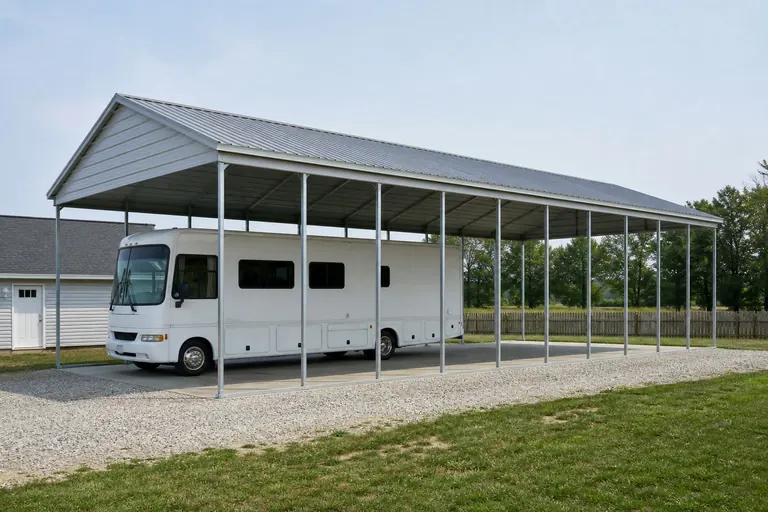 Motorhome or Class A storageTall clearance suited to year-round parking, with exposure needs that vary by which of Utah's three climate zones the site sits in.Travel trailer and toy hauler coverA long, open structure for trailers stored between trips through highland or desert conditions depending on location.
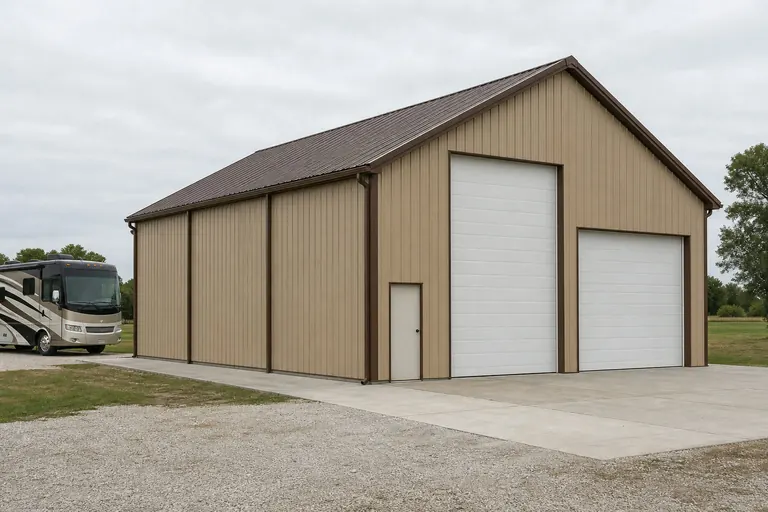 Enclosed upgrade pathWhere full weather protection matters more than open access, an RV garage is the enclosed alternative worth comparing.
Example Configuration — for planning purposes only.
Preparation
Before you request a Utah RV carport quote
Resolving these first makes the difference between a comparable quote and a re-quote on a Utah RV storage site.
- Identify your climate zoneDesert, steppe or highland/mountain — Utah Agriculture in the Classroom's reference splits the state into all three.
- Confirm your RV's exact height and lengthClearance and span are sized to the specific vehicle, not a generic carport footprint.
- Contact your local building departmentUtah runs a statewide code-uniformity framework through DOPL, but permit specifics are still confirmed locally.
- Check trust-land or public-land adjacencyConfirm the governing authority for any site bordering SITLA trust land before finalizing plans.
Questions
Utah RV carport questions
Questions we can answer honestly at state level, with the rest routed to whoever actually owns them.
The site context differs: Utah Agriculture in the Classroom documents desert, steppe and highland/mountain zones covering different shares of the state, with elevation running from 2,350 to 13,528 feet. Exact wind and snow values still come from your local building department and engineer of record.
Utah's Division of Professional Licensing and the Uniform Building Code Commission work to promote statewide code uniformity under the State Construction and Fire Codes Act, but permit-specific administration still runs through your local building department.
Confirm the governing authority first. SITLA manages Utah trust land for school and institutional beneficiaries under a framework distinct from private-parcel permitting.
It can. Utah spans the Rocky Mountain, Colorado Plateau and Basin and Range provinces, and foundation or grading conditions differ enough between them that a site-specific check is worth doing before finalizing placement.
Yes, an accessory structure like this typically needs local permit review; confirm exact thresholds and documentation with your city or county building department.
We do not publish state-level prices, since specification, site work and current material pricing all affect the number. Our cost pages cover the drivers; a quote covers your building.
Sources for the Utah facts on this page
This page states no code requirement, wind speed, snow load, permit rule, price or supplier claim. The state-specific facts it does use are listed with their publisher below.
Utah's highest point is Kings Peak at 13,528 feet and its lowest point is Beaver Dam Wash at 2,350 feet, illustrating the mountain-versus-valley elevation and climate contrast used in state education materials.
Utah Agriculture in the Classroom (agclassroom.org, hosted via Utah State University Extension network) · current reference sheet · Tier 3
https://cdn.agclassroom.org/ut/lessons/cc/ut_elevation_precip_maps.pdfUtah has three distinct climate zones: desert (33% of the state), steppe (43%), and highland/mountain (24%), reflecting the valley-to-mountain precipitation and snowfall contrast.
Utah Agriculture in the Classroom · current reference sheet · Tier 3
https://cdn.agclassroom.org/ut/lessons/cc/ut_elevation_precip_maps.pdfUtah's Division of Professional Licensing (DOPL), within the Department of Commerce, administers the Uniform Building Standards Act and works with the Uniform Building Code Commission to promote statewide uniformity in code enforcement.
Utah Department of Commerce, Division of Professional Licensing · current, accessed 2024/2025 · Tier 2
https://commerce.utah.gov/dopl/uniform-building-codes/Utah's School and Institutional Trust Lands Administration (SITLA/Trust Lands Administration) manages state trust land granted by Congress to benefit Utah schools and institutions.
Utah Trust Lands Administration (SITLA) · current, accessed 2024 · Tier 2
https://trustlands.utah.gov/Utah lies at the convergence of three physiographic provinces: the Rocky Mountain Province (Uinta and Wasatch mountains) in the northeast, the Colorado Plateau in the east/southeast, and the Basin and Range in the west.
Utah Division of State History (History to Go) · current reference page · Tier 2
https://historytogo.utah.gov/unique-setting/