
Steel home · UT
Steel Homes in Utah
A residential steel build in Utah starts with a land-status question that is unusually load-bearing for this state. The Congressional Research Service's federal land ownership dataset lists roughly 33.3 million acres of Utah as federally owned against a reported total of approximately 33.6 million acres in that same dataset — a figure worth treating as CRS's own reporting scope rather than the state's full land area, but still a strong signal that private, open-market residential ground is a smaller slice of Utah than the map suggests. Layered on top of that is Utah's own state trust land system: the Utah Trust Lands Administration, known as SITLA, manages land granted by Congress specifically to benefit Utah schools and institutions, under a framework distinct from private ownership. For a steel home buyer, that means confirming deeded private status is a genuinely earlier and more consequential step in Utah than in a state with more straightforward private land availability. Once land status is settled, Utah's Division of Professional Licensing and its Uniform Building Code Commission apply a statewide push toward consistent code enforcement, under the State Construction and Fire Codes Act, which is worth understanding before assuming every jurisdiction in Utah works from an entirely separate rulebook.
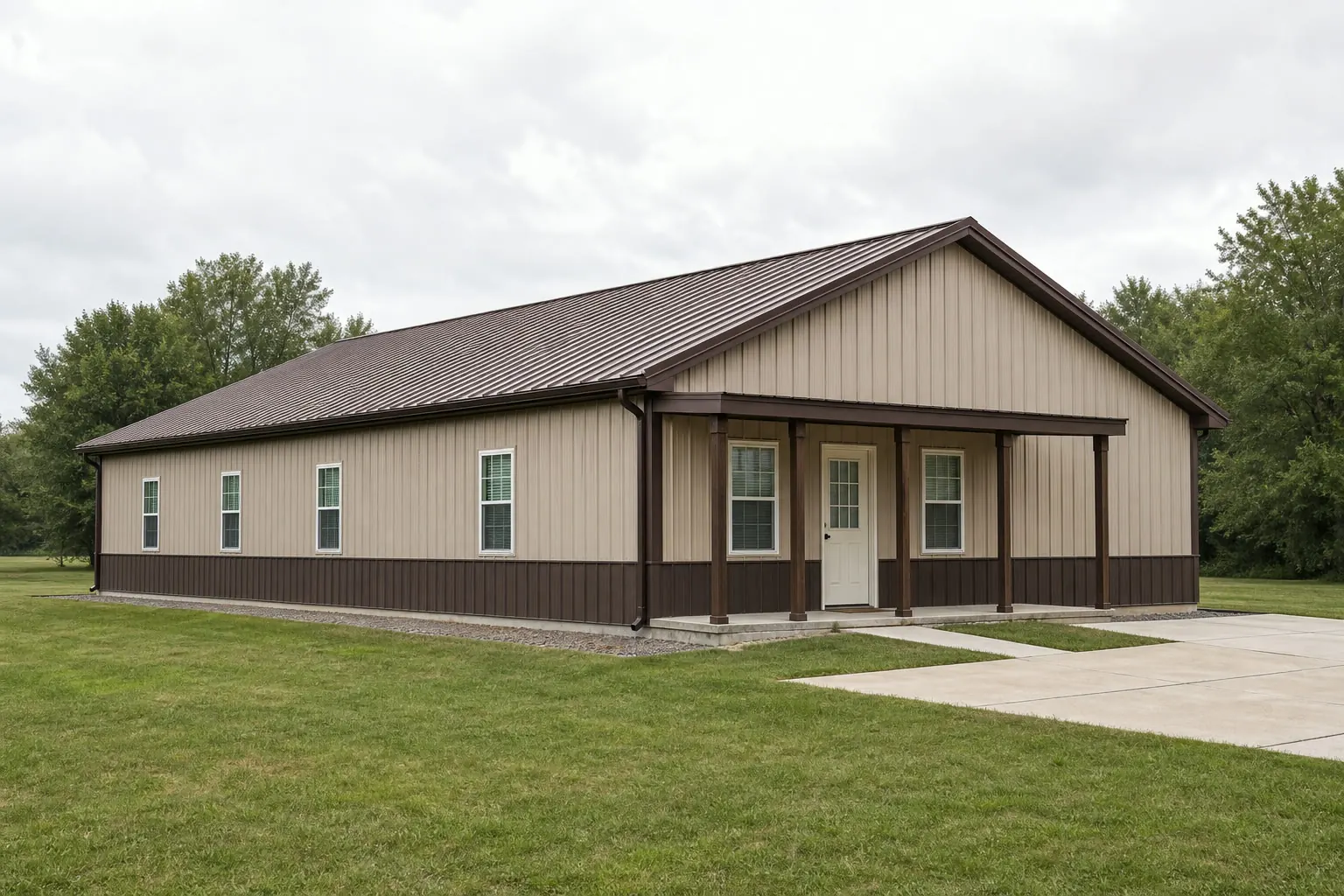
The dividing line
Confirming private land status comes before design in Utah
A large share of Utah's reported acreage is federal or state trust land, so confirming deeded private status is an earlier step here than in many states.
CRS's federal land ownership dataset lists roughly 33.3 million acres of Utah as federally owned against approximately 33.6 million total acres reported in that same dataset. That combined figure is CRS's own reporting scope, not necessarily the state's complete land area, but the scale of the number is itself the point: a large share of Utah's land base sits outside the straightforward private, open-market category.
Separately, the Utah Trust Lands Administration (SITLA) manages state trust land granted by Congress specifically to benefit Utah schools and institutions. Trust land operates under its own leasing and management framework, distinct from private-parcel ownership, so a residential site near a trust-land boundary needs that status confirmed before a steel home design proceeds — not after a builder is already engaged.
None of this substitutes for a title search or a direct conversation with the county recorder for a specific parcel. It is a reason to do that confirmation earlier in the Utah planning sequence than a buyer might in a state with a larger straightforward private-land share.
Process
How Utah's code structure differs from a fully local system
Utah pushes toward statewide code uniformity while still administering permits locally, a distinct middle structure worth understanding.
| Layer | What it does | What it does not decide |
|---|---|---|
| DOPL / Uniform Building Code Commission | Administers the Uniform Building Standards Act and works to keep code enforcement consistent statewide under Title 15A. | Site-specific permit thresholds, setbacks and inspection scheduling. |
| Local building department | Handles plan review, inspection sequencing and site-specific permit administration for your parcel. | Statewide code edition consistency, which DOPL's structure is built to promote. |
| SITLA (where relevant) | Governs trust land leasing and use where a parcel borders or sits on state trust land. | Private-parcel permitting once land status is confirmed as deeded private. |
DOPL / Uniform Building Code Commission
- What it does
- Administers the Uniform Building Standards Act and works to keep code enforcement consistent statewide under Title 15A.
- What it does not decide
- Site-specific permit thresholds, setbacks and inspection scheduling.
Local building department
- What it does
- Handles plan review, inspection sequencing and site-specific permit administration for your parcel.
- What it does not decide
- Statewide code edition consistency, which DOPL's structure is built to promote.
SITLA (where relevant)
- What it does
- Governs trust land leasing and use where a parcel borders or sits on state trust land.
- What it does not decide
- Private-parcel permitting once land status is confirmed as deeded private.
Site selection
Utah's three physiographic provinces call for province-specific siting
A steel home foundation and grading plan should reflect which of Utah's three provinces the site sits in.
Rocky Mountain province (Uinta and Wasatch)
Mountain terrain in the northeast; site grading and access planning should be scoped to this terrain rather than assumed from a flatter site.
Colorado Plateau (east and southeast)
A distinct plateau region; get a site-specific geotechnical read rather than assuming conditions found in Utah's mountain or basin regions apply.
Basin and Range (west)
Broad valley terrain, often the setting for larger rural residential parcels and agricultural operations.
Large rural agricultural holdings
The 2022 Census of Agriculture recorded an average Utah farm size of 604 acres; a residential steel build on this scale typically needs its own well, septic and service-run plan.
Get Utah steel home quotes
Tell us your parcel's land status, which region of Utah it's in, and the living area you have in mind. We pass the Utah context through with the enquiry.
Sequence
A workable order for planning a Utah steel home
Land status and jurisdiction confirmation come before design decisions in Utah's specific land and code environment.
Step 1
Confirm deeded private status for the parcel
Given the scale of federal and trust land in Utah, this is worth doing before design work, not after.
Step 2
Check SITLA trust-land boundaries if the site is nearby
Trust land follows a leasing and management framework distinct from private ownership.
Step 3
Ask your local building department how DOPL's statewide framework applies
Utah pushes for uniform code enforcement, but permit specifics remain locally administered.
Step 4
Scope the foundation plan to your specific physiographic province
Rocky Mountain, Colorado Plateau and Basin and Range terrain differ enough to matter for grading.
Step 5
Plan utilities alongside the building on rural acreage
Utah's average farm size of 604 acres suggests well, septic and service-run planning is common, not rare, on larger parcels.
Footprint
Footprints that suit a Utah residential brief
Single-level living with an efficient footprint is a common starting point once land status and site terrain are confirmed.
30′ × 60′
1,800 sq ft
A common single-level layout with room for three defined zones along the length.
40′ × 60′
2,400 sq ft
Adds width for a genuinely open central living area rather than a corridor plan.
30′ × 70′
2,100 sq ft
Length instead of width where the site favors a long, narrow building footprint.
40′ × 80′
3,200 sq ft
Where the brief includes an attached shop or garage bay under the same roofline.
Example Configuration — for planning purposes only.
Each footprint page carries layout detail; this page explains why a Utah brief starts with land status and terrain rather than a generic spec.
Questions
Utah steel home questions
What we can answer at state level, with the rest routed to who owns it.
CRS lists roughly 33.3 million of Utah's reported 33.6 million acres as federal in that dataset, and Utah's SITLA separately manages state trust land. Confirming deeded private status early avoids planning around land that isn't a straightforward private purchase.
Utah's DOPL and Uniform Building Code Commission work to promote statewide uniformity in code enforcement under Title 15A, but plan review, inspections and site-specific permit thresholds are still administered by your local building department.
Confirm the governing authority first. Trust land is managed under a leasing and disposition framework for the benefit of Utah schools and institutions, separate from private-parcel permitting.
It can. Utah spans the Rocky Mountain, Colorado Plateau and Basin and Range provinces, and a site-specific geotechnical read is worth getting rather than assuming one province's conditions apply statewide.
It can be: the 2022 Census of Agriculture recorded an average Utah farm size of 604 acres. On that scale, well, septic and service-run planning typically shape the schedule as much as the building itself.
Not quite. A barndominium brief usually combines living space with a working shop or storage area under one roof. If that describes your project, the barndominium pages are the better starting point.
Sources for the Utah facts on this page
This page states no code requirement, wind speed, snow load, permit rule, price or supplier claim. The state-specific facts it does use are listed with their publisher below.
CRS's federal land ownership dataset lists Utah federal acreage at roughly 33.3 million acres (2013 data) against total state acreage of approximately 33.6 million acres.
Congressional Research Service · data as of FY2013, report dated March 3, 2017 · Tier 1
https://www.everycrsreport.com/files/20170303_R42346_95ce191e74ed8e08054bb5476971544bc55823f2.htmlUtah's School and Institutional Trust Lands Administration (SITLA/Trust Lands Administration) manages state trust land granted by Congress to benefit Utah schools and institutions.
Utah Trust Lands Administration (SITLA) · current, accessed 2024 · Tier 2
https://trustlands.utah.gov/Utah's Division of Professional Licensing (DOPL), within the Department of Commerce, administers the Uniform Building Standards Act and works with the Uniform Building Code Commission to promote statewide uniformity in code enforcement.
Utah Department of Commerce, Division of Professional Licensing · current, accessed 2024/2025 · Tier 2
https://commerce.utah.gov/dopl/uniform-building-codes/Utah's State Construction and Fire Codes Act (Title 15A) is the statutory basis for state construction code administration, referencing the Division of Professional Licensing.
Utah State Legislature / Utah State Fire Marshal (hosted copy) · current codified statute · Tier 2
https://firemarshal.utah.gov/wp-content/uploads/2024-State-Fire-Code.pdfAverage Utah farm size in the 2022 Census was 604 acres, up about 3% from 2017.
USDA NASS · 2022 · Tier 1
https://www.nass.usda.gov/Publications/AgCensus/2022/Online_Resources/County_Profiles/Utah/cp99049.pdfUtah lies at the convergence of three physiographic provinces: the Rocky Mountain Province (Uinta and Wasatch mountains) in the northeast, the Colorado Plateau in the east/southeast, and the Basin and Range in the west.
Utah Division of State History (History to Go) · current reference page · Tier 2
https://historytogo.utah.gov/unique-setting/